
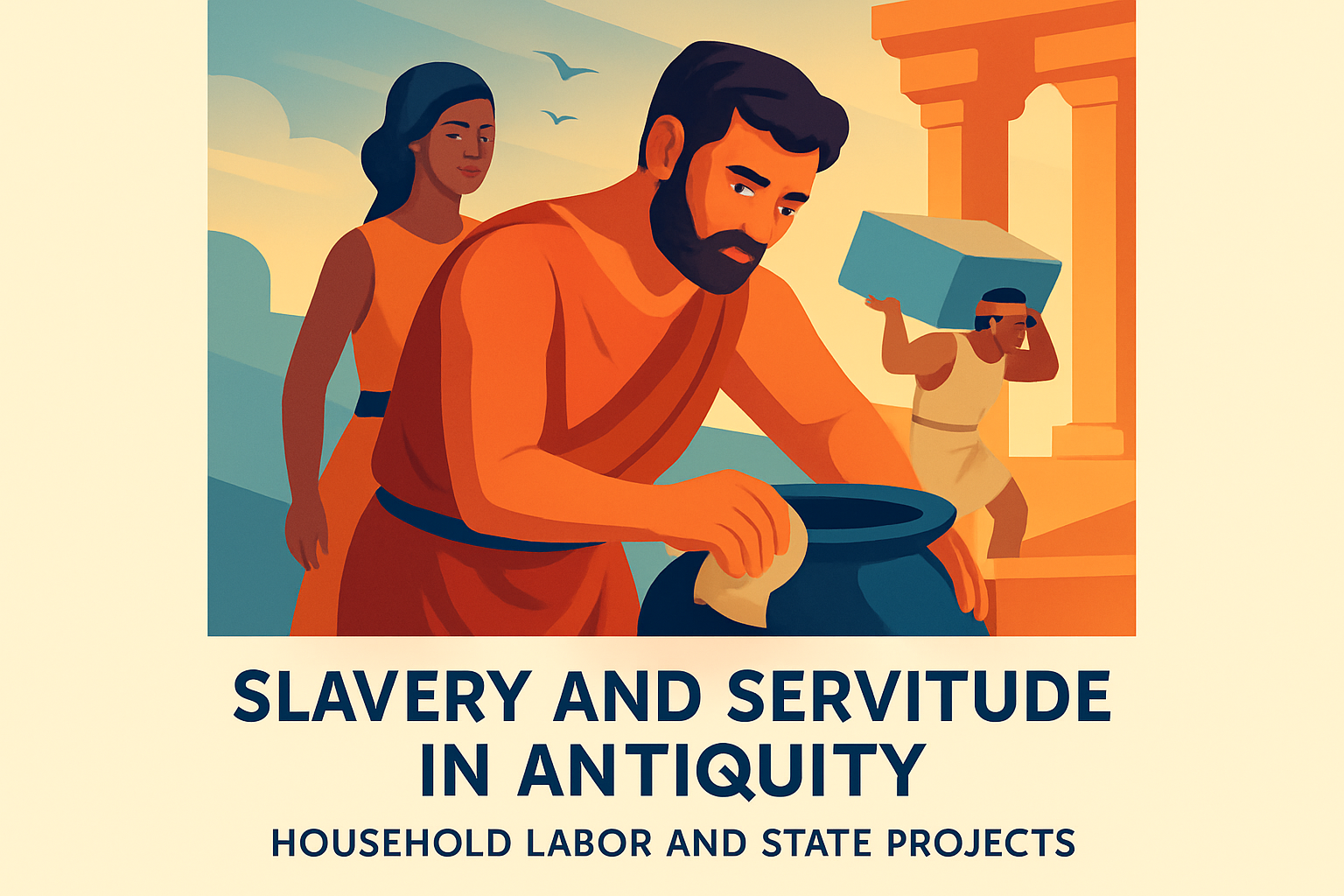
Slavery and servitude have been a part of human civilization for millennia, deeply intertwined with the social, economic, and political fabric of antiquity. Undoubtedly, this complex dynamic provided the backbone to numerous ancient societies, acting as a driving force behind monumental state projects and routine household tasks. Understanding this age-old practice sheds light on how past societies were structured and operated, alongside providing valuable insights into the development of labor systems over time.
In ancient times, slavery was characterized by the complete ownership of one human being by another. Under these conditions, enslaved individuals were stripped of their rights and rendered as property. This status differed slightly from servitude, where individuals might work without ownership rights but were still subject to harsh conditions and restrictions. Both played pivotal roles in shaping the infrastructure and societal hierarchies of civilizations like Egypt, Rome, and Greece. Exploring these roles provides a foundation to understand legacies influencing today’s labor practices and socio-economic structures.
Addressing slavery and servitude today matters, as it provides context for current discussions about human rights and economic disparity. It allows us to critically reflect on contemporary labor inequities, offering lessons from the past on the treatment of workers and ethical implications of forced labor. By closely examining these ancient practices, society can arm itself with historical perspectives to identify and combat remnants of such systems persisting in modern times.
Slavery in Ancient Households
Household slavery was a widespread phenomenon in ancient civilizations and served critical functions within both urban and rural settings. In Rome, for example, enslaved individuals commonly performed a myriad of tasks essential to maintaining daily life within homes. Slaves cooked, cleaned, cared for children, and managed household finances, allowing their masters to devote time to other pursuits, such as politics or leisure. The ubiquitous nature of household slaves was such that even families with modest means retained at least one slave, signifying their social standing.
In the context of ancient Greece, the daily operations of households depended heavily on a system supported by slave labor. Greek oikoi (households) often utilized slaves for domestic duties, such as food preparation and textile production. One notable example is the Athenian statesman and general, Cimon, who reportedly used household slaves to tend to his estates. This reveals how deeply ingrained slavery was in Greek domestic life, extending beyond mere labor dependency to a status symbol ingrained within the social hierarchy.
The experiences and living conditions of household slaves varied greatly. In some instances, these individuals were integrated into the family unit, living alongside free members of the household. However, their lack of autonomy and susceptibility to harsh treatment and punishment underscored the precarious nature of their existence. This dichotomy between dependency and vulnerability highlights the complex reality of slavery in domestic settings during antiquity.
State Projects and Monumental Constructions
Slaves were indispensable to the realization of grand state projects in ancient times, particularly known for their contributions to monumental architectural achievements. Ancient Egypt is an exemplar of enslaved labor leveraged for state purposes, famously illustrated by the construction of the pyramids. While the specifics of labor organization remain a topic of scholarly debate, it is widely acknowledged that both slaves and conscripted laborers played critical roles in these projects. The formidable task of erecting such grand structures relied heavily on forced labor, evidencing the scale at which state powers utilized human resources.
The Roman Empire, too, employed an extensive system of slavery to facilitate ambitious infrastructure projects, including roads, aqueducts, and public buildings. The labor of enslaved individuals was pivotal in constructing the Roman Colosseum, an architectural marvel of its time. Engaging slaves in these endeavors demonstrated the reliance of state mechanisms on such labor to bolster economic and cultural prominence. The adage, “All roads lead to Rome,” underscores the sprawling network built upon the toil of countless enslaved workers.
These projects not only demanded immense human resources but also showcased the ingenuity and might of the ruling entities. Despite being driven by forced labor, the fruits of these projects often bore significant cultural symbolism and served as mechanisms for leaders to imprint their legacy upon history.
The Legal and Economic Structures Surrounding Slavery
The legal frameworks governing slavery were elaborate and meticulously structured to ensure control over enslaved populations. Roman laws, for instance, provided specific definitions and rights concerning ownership, transfer, and treatment of slaves. Legal codes, such as the Twelve Tables, dictated clear parameters regarding the sale and manumission (freeing) of slaves, thereby enshrining the institution within the legal psyche of Roman citizenship.
Economically, the slavery system was inextricable from ancient economies, functioning as a cornerstone of economic activity across civilizations. It allowed wealthier citizens to amass greater wealth by minimizing labor costs while maximizing productivity and outputs. The abundance and steady flow of enslaved labor also facilitated significant agricultural and industrial undertakings, contributing to the economic stability and growth of empires.
The complex trade networks of the era further entrenched slavery in the economic systems of antiquity. Notably, slaves were commodities, traded as part of a larger marketplace that spanned across regions such as Africa, Europe, and Asia. This robust network underpinned not only the dispersal of laborers but also the spread of cultural and technological innovations across borders.
- Legal frameworks: Ensured control and regulation of slavery.
- Economic impact: Allowed economic expansion and wealth accumulation.
- Trade networks: Facilitated the movement of slaves and cultural exchange.
Slavery’s Social and Cultural Implications
Beyond economic and labor roles, slavery had profound social and cultural implications. As a pervasive institution, it both reflected and influenced the social hierarchies within ancient civilizations. The presence of slaves acted as a distinguishing feature among social classes, whereby ownership signified status and power. The societal fabric was thus deeply embedded with divisive lines distinguishing free citizens from enslaved populations, further dictating social interaction and cultural norms.
Culturally, slavery influenced art, literature, and philosophical musings of the time. Many narratives featured in ancient texts and plays drew upon themes of slavery, freedom, and human autonomy. Notably, the works of Greek philosophers, such as Aristotle, grappled with concepts of natural slavery, presenting dichotomies of superior and inferior beings and rationalizations for the existence of hierarchical structures.
However, cultural complexity did not always translate to ethical considerations regarding slavery, as exploitative dynamics persisted. The normalization and acceptance of slavery were perpetuated across generations, revealing deep-rooted cultural attitudes that, once established, proved difficult to dismantle over time.
Protocol for Manumission and Freeing of Slaves
While the life of a slave was often devoid of hope for freedom, avenues for manumission, or the formal release from slavery, did exist. Across different societies, manumission acted as a testament to the complex human relationships between slaves and their masters, punctuated by acts of goodwill, loyalty, and occasionally economic considerations.
In many cases, slaves could obtain freedom through acts of valor or exceptional service, sometimes earning the trust and benevolence of their masters. The diverse pathways to manumission included governmental policies, master’s discretion, or purchases facilitated by the slaves’ savings, a method prevalent in Roman society. Despite offering a glimpse of hope, the act of manumission underscored utilitarian incentives, as freed slaves could still remain dependent on former masters in a limited capacity, thus maintaining socio-economic ties.
The nuanced relationship between manumission and socio-economic mobility reveals that although freedom was obtainable, its attainment often entailed complex negotiations regarding continued association and societal adaptation for the freed individuals.
| Avenue | Mechanism |
|---|---|
| Acts of Service | Reputation-based manumission |
| Economic Purchase | Saved funds leading to freedom |
| Legal Decree | Government-mandated freedom |
| Master’s Will | Personal decision of the owner |
Conclusion: Lessons for Modern Society
The examination of slavery and servitude in antiquity reveals the enduring complexities behind the subjugation of individuals for labor purposes. From household roles to monumental state projects, the pervasive nature of slavery served as a vital component of ancient societies, often perpetuating economic growth and cultural developments at the cost of human freedom and dignity.
Understanding these ancient practices offers modern readers valuable perspectives, underscoring the moral implications of forced labor and the critical need for fair and equitable labor systems today. In recognizing the painful past of slavery, we bolster our resolve to combat forms of modern-day servitude, ensuring commitment to principles of human rights and dignity.
Let this understanding motivate us to explore historical narratives further, deepening our education about past injustices and championing contemporary efforts towards just and humane labor practices worldwide.
Frequently Asked Questions
1. How was slavery integrated into the household structure in ancient societies?
Slavery in ancient societies wasn’t just about labor in large state projects or fields; it was also deeply embedded within the household. In many ancient cultures, households relied heavily on enslaved people to perform a wide array of tasks. This included cooking, cleaning, child-rearing, and even serving as tutors for children. Enslaved people often lived in close quarters with their owners, forming an integral part of the domestic setting. For instance, in ancient Rome, a wealthy family might own dozens of enslaved individuals who managed household affairs meticulously, allowing the owner to focus on public and political life. These enslaved individuals could sometimes develop close bonds with the family, albeit within the confines of a rigid hierarchy that dictated their status as property rather than people.
2. What were some monumental state projects that utilized servitude in antiquity, and how was labor organized?
Monumental state projects such as the construction of pyramids in ancient Egypt, the great wall building endeavors in China, and the massive public works of the Roman Empire heavily relied on forced labor. Enslaved individuals and conscripted workers were a fundamental labor force for these immense tasks. These projects required extensive planning, resource allocation, and labor management. In Egypt, for example, it is believed that a combination of free laborers, corvée labor (a form of unpaid, forced labor as a tax), and possibly enslaved individuals were organized into seasonal crews to work on the pyramids. Roman engineering feats like roads, aqueducts, and amphitheaters similarly depended on the servitude of conquered peoples and state-owned slaves, who were often overseen by skilled engineers and architects. This labor not only reflected the grandeur and ambition of these civilizations but also their reliance on exploiting human resources to achieve their grand designs.
3. Were there any legal systems or traditions that governed slavery and servitude in ancient societies?
Indeed, many ancient societies had complex legal systems and social traditions that governed slavery and servitude. For example, the Code of Hammurabi in Babylon included numerous laws concerning the treatment and status of slaves, offering insight into their social and economic roles. In Rome, there were well-defined legal frameworks governing the buying, selling, and manumission (the act of freeing a slave) of enslaved individuals. The Roman legal system recognized slaves as property, yet some legal protections existed to prevent extreme maltreatment. Additionally, certain religious and cultural practices also codified the status and treatment of enslaved individuals. For instance, in ancient Greece, both public sentiment and tradition allowed for a degree of autonomy in personal matters that could lead to eventual freedom. These legal and social norms varied considerably across regions and epochs, reflecting the diversity of experiences and the complexity of the institution itself in antiquity.
4. What were the long-term impacts of slavery and servitude on ancient economies and societies?
Slavery and servitude had profound and lasting impacts on ancient economies and societies. Economically, they provided a labor force that enabled the large-scale agriculture and infrastructural projects that underpinned the wealth and expansion of great empires like Rome and Egypt. This reliance on unfree labor influenced economic structures, reducing the incentive for technological innovations that could replace human labor. Socially, slavery created a stratified society, with a priviliged few enjoying the benefits of enslaved labor, leading to vast inequalities and underlying social tensions. This stratification became ingrained in the cultural and philosophical constructs of ancient civilizations, influencing notions of citizenship, freedom, and human rights that continue to echo through history. Moreover, the institution of slavery also fueled economic and territorial expansion, as empires sought new sources of labor through conquest and trade. Understanding these impacts provides crucial insights into the foundational elements of modern social and economic systems.
5. How do historians and archaeologists study slavery and servitude in ancient times, and what are some of the challenges they face?
Historians and archaeologists employ a multitude of methods to study the institution of slavery and servitude in ancient times. They analyze archaeological remnants such as tools, artifacts, dwelling sites, and the monumental structures built by enslaved labor to gain insights into their daily lives and contributions. Ancient texts, including legal documents, personal letters, and historical accounts, serve as invaluable resources for understanding the legal framework, social attitudes, and economic importance of slavery. However, studying slavery in antiquity presents significant challenges. Primary sources are often written from the perspective of the elite, providing a biased or incomplete picture of enslaved life. Enslaved individuals, having left few records of their own, are voiceless in the historical record, requiring researchers to extrapolate their experiences from limited evidence. Additionally, interpreting these sources necessitates careful consideration of cultural context, as concepts of freedom and servitude have evolved significantly over time. Despite these challenges, ongoing research continues to illuminate the complex reality of slavery and servitude in antiquity, enhancing our understanding of ancient societies and their legacies.