
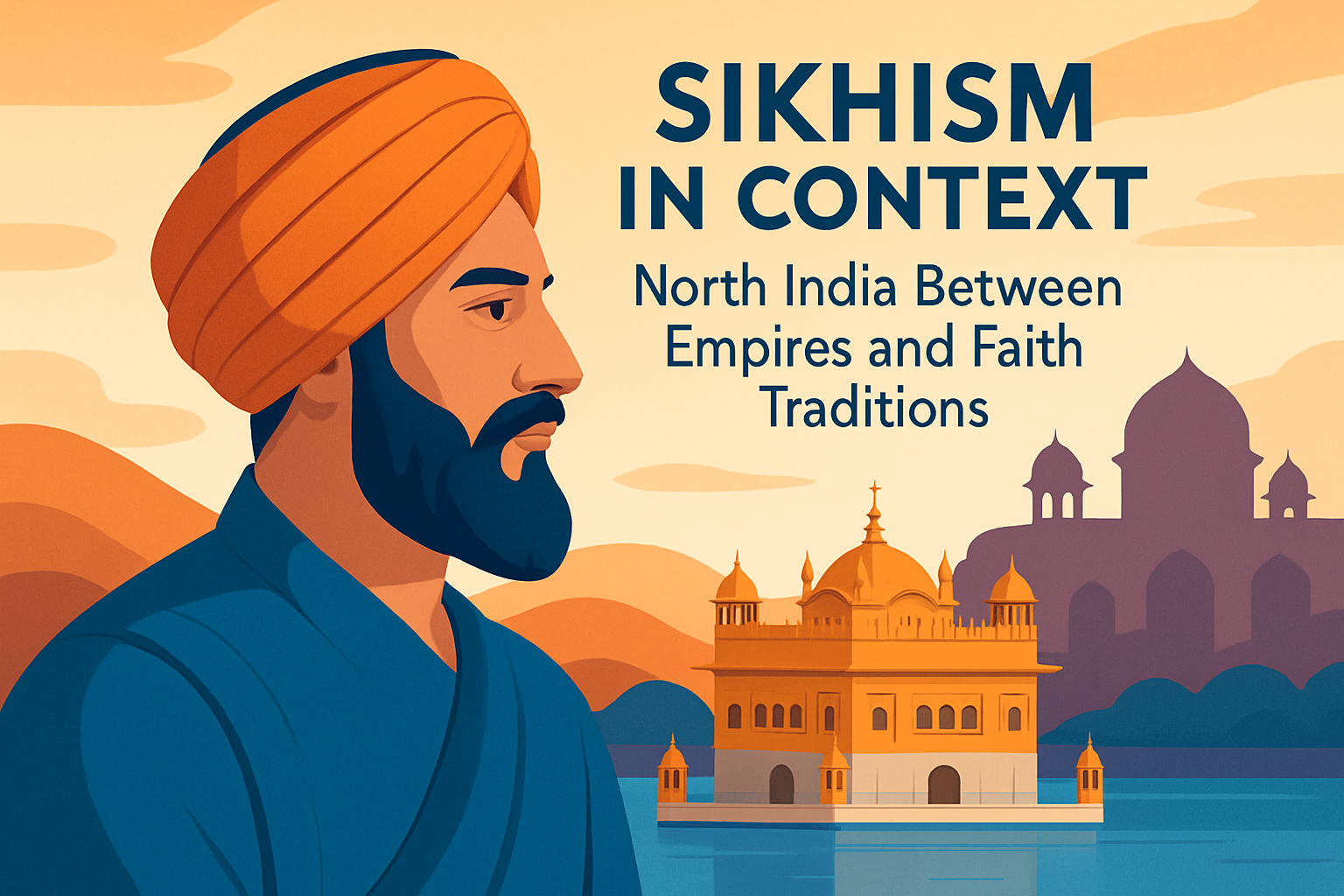
Sikhism emerged in the Punjab during a period of profound political change, commercial growth, and religious debate, making it impossible to understand the tradition without seeing the wider North Indian world that shaped it. In historical terms, “context” means the social, political, linguistic, and devotional environment in which a faith develops, while “North India” in this discussion refers primarily to the Punjab and its neighboring regions under late Delhi Sultanate, Mughal, and successor-state influence. Sikhism is a monotheistic tradition founded on the teachings of Guru Nanak and the line of Sikh Gurus, but it is also a lived historical community formed amid imperial administration, agrarian transformation, interreligious encounters, and recurring episodes of persecution and negotiation. When I have taught this subject, the most common mistake readers make is to isolate Sikh history from the worlds of Islam, Hindu bhakti, Sufi networks, and Mughal statecraft; in reality, Sikhism took shape in active conversation with all of them. That is precisely why the topic matters. Understanding Sikhism in context clarifies how a spiritual movement became a durable religious community with institutions, scripture, sacred space, and eventually political sovereignty. It also helps correct simplistic narratives that portray Sikhism either as merely a blend of older traditions or as a community formed only through conflict with empire. Neither claim is adequate.
The Punjab of the fifteenth to eighteenth centuries was a crossroads. Trade routes linked Lahore and Multan to Central Asia, agrarian settlements expanded, Persian operated as an administrative language, and vernaculars such as Punjabi carried devotional poetry to ordinary listeners. In this setting, questions about divine unity, ritual authority, caste hierarchy, and the moral limits of political power were not abstract. They were debated in shrines, markets, villages, and courts. Sikhism answered these questions through core ideas that remain central today: ik onkar, the oneness of God; nam simran, remembrance of the divine Name; kirat karo, honest labor; vand chhako, sharing with others; and the rejection of empty ritual and inherited status as measures of spiritual worth. Those commitments gave the Sikh tradition both theological coherence and social force. To place Sikhism in context, then, is not to reduce it to its environment. It is to show how the Sikh Gurus articulated a distinct path within a diverse and contested North Indian landscape.
Punjab as a Frontier of Empire, Language, and Exchange
Before Sikhism became a globally recognized religion, Punjab was already one of South Asia’s most strategically important regions. The very name, from the Persian panj-ab or “five waters,” signals a riverine land shaped by mobility and settlement. Successive regimes valued the region because it connected the Indo-Gangetic plain with Kabul and beyond. Under the Delhi Sultanate and then the Mughals, Punjab mattered for military logistics, revenue extraction, and trade. Cities such as Lahore served as administrative hubs, while rural society was organized around cultivation, kinship groups, and local religious institutions. From my own work with historical sources, one pattern always stands out: Punjab was never sealed within a single culture. Persianate court norms, Indic devotional idioms, and local agrarian realities overlapped constantly.
This mixed environment influenced how new religious voices were heard. A teacher speaking in the language of the people rather than in elite Sanskrit or formal Persian could cross boundaries more effectively. Guru Nanak’s hymns circulated in Punjabi and related vernacular forms, but they also used vocabulary intelligible across religious communities, including terms familiar to Hindus and Muslims. That multilingual flexibility was not accidental. It reflected the social world of North India, where merchants, peasants, faqirs, mendicants, and officials lived within layered identities. The result was a setting unusually favorable to a message that emphasized divine unity over sectarian division.
At the same time, imperial conditions mattered because they structured daily life. Revenue demands affected peasant communities; military campaigns disrupted local stability; and official tolerance could vary dramatically depending on rulers, governors, and political crises. Sikh institutions therefore developed in a world where spiritual authority could not ignore state power. The later evolution of the Sikh Panth into a community capable of self-defense and governance makes far more sense when seen against these pressures. Punjab was not simply a backdrop to Sikh history. It was the terrain that made questions of devotion, justice, and collective organization inseparable.
Guru Nanak and the Religious Ferment of North India
Guru Nanak, born in 1469 at Talwandi, articulated a vision that was rooted in this regional ferment yet clearly distinctive. He is often introduced as a reformer, but that word can be too narrow if it suggests he merely corrected existing practices. His hymns present a comprehensive theological and ethical orientation centered on the one, formless, timeless God, accessible through remembrance, humility, and truthful living. He criticized hollow ritual, caste pride, formalism, and hypocrisy among both Hindus and Muslims, not to erase difference through vague universalism, but to insist that authentic devotion requires inner transformation and ethical responsibility.
North India in Guru Nanak’s era had already witnessed major currents of bhakti and Sufi thought. Bhakti poets challenged priestly mediation and emphasized direct devotion, while Sufi lineages cultivated mystical piety, music, and vernacular outreach. Sikhism shares certain historical proximities with these currents, especially in poetic form, concern for inward sincerity, and criticism of ego. Yet Sikh teaching cannot be collapsed into either framework. The Guru was not a Sufi pir in another guise, nor a bhakti saint without institutional legacy. The Sikh path centered on the authority of the Guru, the primacy of shabad or divine Word, and the formation of a disciplined sangat, a congregation bound by shared practice.
Janamsakhi traditions, though composed in layered forms and requiring careful historical reading, preserve an important memory: Guru Nanak traveled widely and engaged diverse communities. Whether every detail is literal history is less important than the broader truth those narratives express. The founding figure of Sikhism was remembered as someone who tested claims to religious exclusivity against the reality of a universal Creator. That memory matters because it shaped Sikh self-understanding from the beginning. In practical terms, Guru Nanak’s message offered a way of life: meditate on the Name, earn honestly, share food and resources, and reject social hierarchies that deny divine equality. Those teachings gave ordinary people a framework for devotion that was spiritually serious and socially concrete.
From Spiritual Fellowship to Organized Community
The development of Sikhism after Guru Nanak shows why historical context matters as much as theology. The subsequent Gurus did not merely preserve a founder’s sayings; they built institutions that transformed a devotional fellowship into a durable community. Guru Angad standardized the Gurmukhi script, a crucial step because script is never neutral in religious history. By supporting a script associated with the Sikh community, the Gurus strengthened transmission, literacy, and identity. Guru Amar Das expanded the manji system of local preaching and reinforced practices such as langar, the communal kitchen, where all sat together regardless of caste. In a society structured by rank and commensal restrictions, this was a radical social practice, not a symbolic gesture.
Guru Ram Das founded Amritsar, and Guru Arjan consolidated Sikh institutions further by overseeing the Harmandir Sahib and compiling the Adi Granth in 1604. That compilation is one of the decisive moments in South Asian religious history. By collecting the hymns of the Sikh Gurus alongside selected compositions of bhagats and other devotional figures, Guru Arjan defined a canon centered on theological coherence rather than birth community. The scripture affirmed divine unity, condemned ego and ritualism, and provided the Panth with a stable source of authority. As someone who has worked through translated portions with students, I can say this point often surprises them: Sikh scripture was not an afterthought to institution building. It was the institution’s anchor.
The Sikh community by this stage had congregations, pilgrimage focus, scriptural authority, revenue support through offerings, and a growing sense of collective distinctiveness. These developments also made the Panth more visible to Mughal authorities. Visibility brought strength, but it also increased political risk. A community with land, followers, and recognized leadership could no longer be treated as just another local devotional circle. This transition from fellowship to organized community helps explain the conflicts that followed.
Mughal Power, Martyrdom, and the Militarization of the Panth
The relationship between the Sikh Gurus and the Mughal state was never uniformly hostile, but neither was it politically irrelevant. Under Akbar, there appears to have been space for accommodation; Mughal governance at its best could be pragmatic and inclusive. Yet under Jahangir, Guru Arjan was arrested and executed in 1606, an event remembered in Sikh tradition as the first major martyrdom. Historians debate the precise balance of political and religious causes, including issues involving Prince Khusrau and imperial suspicion, but the larger conclusion is clear. Mughal sovereignty had come to see the Sikh community as significant enough to discipline.
After Guru Arjan’s death, Guru Hargobind adopted a more assertive posture, symbolized by the doctrine of miri-piri, the integration of temporal and spiritual authority. This concept is central to understanding Sikh history in context. It did not mean abandoning spirituality for warfare. It meant that religious life and worldly responsibility could not be separated when justice, community survival, and moral order were at stake. The wearing of two swords and the establishment of the Akal Takht expressed that synthesis in public form.
The pattern intensified in the later seventeenth century. Guru Tegh Bahadur’s execution in 1675 under Aurangzeb became another foundational martyrdom, remembered especially in relation to defending freedom of conscience. In 1699, Guru Gobind Singh founded the Khalsa, giving the Sikh community a new level of discipline, solidarity, and visible identity. The initiation ceremony, shared surnames Singh and Kaur, and the article markers later known as the Five Ks reconfigured community boundaries. The Khalsa was not created in a vacuum. It emerged from decades of institution building, imperial pressure, and the need for internal cohesion.
| Historical force | Sikh response | Why it mattered |
|---|---|---|
| Caste hierarchy | Langar and shared initiation | Created embodied equality |
| Imperial pressure | Miri-piri and armed defense | Linked devotion with responsibility |
| Doctrinal fragmentation | Scriptural canon and Guru authority | Protected theological coherence |
| Regional instability | Khalsa discipline and collective identity | Enabled survival and expansion |
This process of militarization is often misunderstood. Sikhism did not cease to be a spiritual tradition when it embraced the right and duty of self-defense. Rather, the community concluded through historical experience that piety without protection could leave justice defenseless. That lesson was shaped directly by the North Indian imperial environment.
Sikhism and Neighboring Faith Traditions
One of the most important questions readers ask is whether Sikhism is closer to Hinduism or Islam. The best answer is that Sikhism emerged in a world deeply shaped by both, shares historical interactions with both, and remains a distinct religion with its own scripture, institutions, initiation, and theological grammar. The insistence on one God, rejection of idols as necessary mediators, and critique of ritual formalism resonated with Islamic and especially Sufi sensibilities in some respects. Meanwhile, karma, rebirth, liberation, and devotional poetry existed within a broader Indic religious vocabulary familiar across North India. Shared vocabulary, however, does not equal sameness.
In practice, Sikh distinctiveness became clearer over time. The Guru Granth Sahib is not the Vedas, the Quran, or a derivative anthology; it is the revealed and authoritative scripture of the Sikh tradition. The sangat and langar formed patterns of collective life that challenged both caste exclusion and narrow communal boundaries. The Khalsa created an initiated order unlike Hindu caste society and unlike Muslim communal organization. At the same time, Sikh history cannot be told honestly without acknowledging porous boundaries in the early modern period. Shrines were visited across communities, devotional songs traveled widely, and identities could be locally layered. That complexity is exactly why context matters.
Scholars today generally reject older colonial efforts to force neat civilizational boxes onto premodern North India. Better analysis asks how communities defined themselves through practice, authority, memory, and conflict. By those measures, Sikhism was neither an accidental hybrid nor a late political invention. It was a distinct path that matured through engagement with neighboring traditions and through the discipline of historical testing. That is a more accurate and more useful understanding.
From Misls to Empire and Modern Memory
After the death of Guru Gobind Singh and the closing of the line of personal Gurus, authority was vested in the Guru Granth Sahib and the Guru Panth, the collective body of the Khalsa. The eighteenth century brought severe persecution under Mughal and Afghan forces, but it also saw the rise of Sikh warrior confederacies known as misls. These were not merely armed bands; they were political formations rooted in shared memory, mobile power, and regional control. Their eventual consolidation under Maharaja Ranjit Singh in the early nineteenth century created the Sikh Empire, centered in Lahore.
Ranjit Singh’s kingdom is essential for understanding Sikhism in context because it demonstrates that the community’s evolution did not end with survival. It reached sovereignty. His state employed Sikhs, Hindus, and Muslims, supported key shrines, maintained a formidable army, and served as one of the last major powers to resist British expansion. Yet the empire was not a simple theocracy. It was a multilingual, multiethnic kingdom shaped by Sikh legitimacy and practical statecraft. That balance reflected the long history of the Panth itself: spiritually grounded, politically alert, and regionally embedded.
Modern Sikh identity was further sharpened under colonial rule, Singh Sabha reform, gurdwara movements, and the traumas of Partition in 1947, when Punjab was divided and communities experienced massive violence and displacement. Those later developments lie beyond the early modern frame, but they reinforce the central point of this article. Sikhism has always developed in dialogue with changing political orders and neighboring traditions. Its continuity lies not in isolation, but in a powerful capacity to preserve core principles while adapting institutions to new historical realities.
Sikhism in context is the story of a distinct faith emerging in a North Indian region shaped by empire, trade, agrarian life, and intense religious exchange. The Sikh Gurus did not simply react to their environment; they interpreted it, challenged it, and built institutions strong enough to outlast it. From Guru Nanak’s proclamation of divine unity to the compilation of the Adi Granth, from langar and sangat to miri-piri and the Khalsa, Sikh history shows how theology becomes community and how community responds to power. The key takeaway is clear: Sikhism is best understood neither as a derivative mix of surrounding religions nor as a tradition defined only by conflict. It is a coherent, original path forged in conversation with bhakti, Sufism, and Mughal India while maintaining its own scripture, discipline, ethics, and sacred authority.
For anyone studying South Asian history, religious studies, or Punjab’s past, this perspective offers a more accurate foundation. It explains why Sikh institutions look the way they do, why martyrdom and service are both central, and why political responsibility became part of spiritual life. It also provides a better framework for reading modern Sikh identity, which still carries the imprint of these formative centuries. If you want to deepen your understanding, the next step is simple: read selections from the Guru Granth Sahib alongside reliable histories of the Sikh Gurus and early modern Punjab, and study the tradition as both a spiritual vision and a historical community.
Frequently Asked Questions
Why is historical context so important for understanding the emergence of Sikhism?
Historical context matters because Sikhism did not emerge in isolation. It developed in the Punjab within a larger North Indian world shaped by shifting empires, expanding trade networks, agrarian change, multilingual exchange, and intense religious discussion. To understand the teachings of Guru Nanak and the later Sikh Gurus, it helps to see the conditions in which people lived: political authority was changing, commercial towns were growing, and communities interacted across lines of language, caste, occupation, and religious identity. In that environment, questions about devotion, justice, authority, social hierarchy, and the proper path to God were not abstract ideas; they were part of everyday life.
Seeing Sikhism in context also clarifies what was distinctive about it. The Sikh tradition spoke into a world already filled with Hindu devotional movements, Sufi networks, yogic practices, and established Islamic political institutions. Its message engaged themes that many people in North India recognized, such as remembrance of the divine name, critique of empty ritual, and the importance of ethical living, but it organized those themes in a specific and increasingly institutional form through the line of Gurus, the sangat, and later the Khalsa. Context does not reduce Sikhism to a product of its surroundings. Rather, it shows how the tradition responded creatively and powerfully to the world around it while building a path with its own theology, discipline, scripture, and communal identity.
What does “North India” mean in the context of Sikh history?
In the context of Sikh history, “North India” refers primarily to the Punjab and the neighboring regions that were politically, economically, and culturally connected to it. This includes territories influenced by the late Delhi Sultanate, the Mughal Empire, and regional powers that shaped everyday life in the fifteenth through eighteenth centuries. Punjab was not a closed zone. It sat at a crossroads of overland trade, migration, military movement, and cultural exchange, linking Central Asia, the Indo-Gangetic plain, and western India. That strategic position made it especially important as a frontier, a farming region, and a zone of urban and commercial growth.
This broader regional frame is important because Sikhism emerged in a world where people moved between villages, market towns, courts, shrines, and pilgrimage centers. Languages such as Punjabi, Persian, and various regional vernaculars circulated together. Administrative systems, taxation, landholding patterns, and imperial politics shaped social life, while religious ideas moved through poets, saints, Sufis, mendicants, and scholars. So when historians place Sikhism in “North India,” they are not just pointing to a map. They are identifying a dense historical landscape in which power, economy, language, and devotional practice intersected, and in which the Sikh tradition took shape through both local rootedness and wider regional connections.
How did political change under the Delhi Sultanate and Mughals affect the world in which Sikhism developed?
The political transformations of late Sultanate and Mughal North India created the larger framework in which Sikhism developed. These states expanded systems of taxation, administration, military organization, and long-distance governance. Their rule affected land use, agrarian production, urbanization, and patterns of patronage. For people in Punjab, imperial power was not only something distant at the court; it could influence village life, commercial opportunities, social mobility, and the relationship between local communities and broader political authority. This made questions of justice, ethical leadership, and the moral use of power especially meaningful.
For the Sikh tradition, this changing political environment mattered in several ways. Early Sikh teachings emerged at a time when imperial authority was real but not all-powerful, and when social and religious life remained highly plural. As the Sikh community grew under successive Gurus, its institutions became more visible and more organized. Over time, relations with Mughal authority ranged from coexistence to tension and persecution, particularly in moments when Sikh leadership and imperial priorities came into conflict. These developments helped shape the Sikh community’s evolving sense of collective responsibility, discipline, and resistance to oppression. The result was not simply a reaction to empire, but a tradition that articulated a strong moral vision while also forming institutions capable of enduring within, alongside, and at times against major political powers.
How did religious diversity in Punjab influence the formation of Sikhism?
Punjab was religiously diverse, and that diversity deeply influenced the environment in which Sikhism took shape. The region included a wide range of Hindu practices, Islamic traditions, Sufi devotional cultures, ascetic lineages, local cults, and broader bhakti currents that emphasized direct devotion to the divine. People often encountered multiple forms of religious expression in daily life through shrines, festivals, songs, sermons, merchants, travelers, and holy figures. This meant that spiritual debate was not confined to formal institutions; it was woven into the public and social life of the region.
Sikhism emerged within this plural landscape, engaging ideas that many communities would have recognized while also redirecting them in important ways. The Sikh Gurus emphasized devotion to one God, the remembrance of the divine name, the rejection of hollow ritualism, the centrality of ethical living, and the critique of social pride and caste hierarchy. At the same time, the Sikh path did not simply blend preexisting traditions. It established a distinct line of authority through the Gurus, cultivated communal practices such as the sangat and langar, and eventually centered scriptural and institutional forms that marked Sikh identity in durable ways. In other words, religious diversity provided the setting for conversation, contrast, and exchange, but Sikhism developed its own coherent vision rather than functioning as a vague middle ground between other traditions.
Why are language, commerce, and social life essential to understanding Sikhism in context?
Language, commerce, and social life are essential because religions spread and take shape through lived communities, not only through doctrines. Punjab’s linguistic environment was especially important. Punjabi and related vernaculars connected the Gurus’ message to ordinary people, while Persian served as a major language of administration and high culture across much of North India. This multilingual setting helped make Sikh teachings both locally grounded and regionally legible. The use of accessible poetic forms and devotional compositions allowed Sikh ideas to circulate across social boundaries, while scriptural formation gave those teachings permanence and authority within the community.
Commerce and social life also played a major role. The growth of market towns, artisan networks, agrarian production, and trade routes created spaces where people from different backgrounds met and exchanged ideas. Communities were structured by caste, kinship, occupation, and locality, yet these structures were also being tested by mobility and economic change. Sikh institutions responded to this world in practical ways. The sangat created a shared devotional community, and the langar embodied equality, service, and collective participation in ways that challenged status divisions. Understanding these social and economic dimensions helps explain why Sikhism resonated so strongly: it offered not just spiritual teaching, but a concrete model of disciplined, ethical, communal life within a changing North Indian society.