
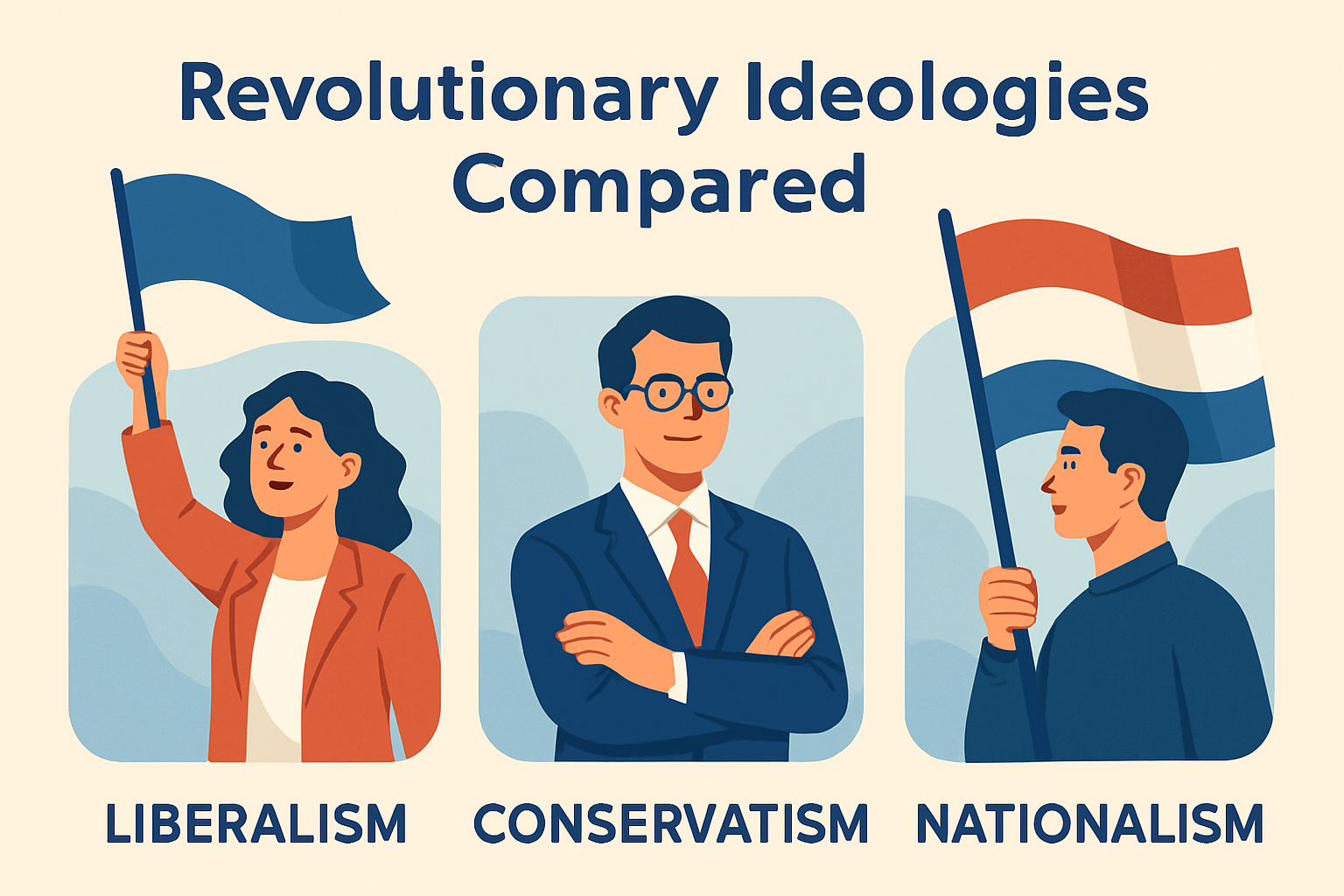
Revolutionary ideologies reshaped the modern world by redefining power, rights, and political belonging. Liberalism, conservatism, and nationalism emerged most forcefully during the age of Atlantic revolutions and the political upheavals that followed the French Revolution. Each offered a distinct answer to urgent questions that I repeatedly encounter when teaching modern history: Who should govern, what should be preserved, and why do people owe loyalty to a state? Understanding these ideologies matters because they still influence elections, constitutions, foreign policy, civic identity, and public debate across democracies and authoritarian systems alike. Liberalism prioritizes individual liberty, constitutional government, and legal equality. Conservatism emphasizes order, continuity, religion or inherited institutions, and gradual reform. Nationalism argues that people sharing a common identity, history, language, or culture should have political self-determination. These traditions often overlap in practice, but their assumptions differ in ways that explain centuries of conflict and cooperation.
In historical terms, these ideologies were revolutionary not simply because they appeared during revolutions, but because they changed the vocabulary of politics. Before the late eighteenth century, legitimacy often rested on dynasty, religion, and custom. After 1789, political actors increasingly justified authority through rights, representation, tradition, or the nation. In archives, speeches, and constitutional texts, I see the same shift again and again: rulers had to explain themselves in ideological language. Liberalism challenged absolute monarchy and mercantilist restrictions. Conservatism responded to revolutionary excess and defended social cohesion against abstract theories. Nationalism mobilized populations in ways older empires struggled to control. For students, policymakers, and curious readers, comparing these ideologies clarifies why modern states protect civil liberties, preserve institutions, and inspire patriotic loyalty at the same time. The comparison also reveals where tensions begin, especially when freedom, order, and national identity pull in different directions.
What liberalism stands for in theory and practice
Liberalism is the ideology most closely associated with individual rights, limited government, consent of the governed, private property, and equality before the law. Its intellectual roots lie in thinkers such as John Locke, Adam Smith, Montesquieu, and later John Stuart Mill. Locke’s argument that governments exist to protect life, liberty, and property became foundational for constitutional politics in Britain, the United States, and beyond. In practical governance, liberalism supports written constitutions, representative institutions, free expression, independent courts, and market exchange. When I explain liberalism in plain terms, I describe it as the belief that people are citizens with rights first, and subjects of rulers second. That simple inversion transformed politics.
The American Revolution offers a classic liberal example. Colonial leaders justified resistance by invoking natural rights and taxation with representation. The United States Constitution, despite its original exclusions and contradictions, institutionalized liberal mechanisms such as separated powers, checks and balances, and later a Bill of Rights. Nineteenth-century liberal reformers in Britain pushed for freer trade, religious toleration, and parliamentary reform. Across Europe, liberals demanded constitutions and curbs on arbitrary rule during the revolutions of 1830 and 1848. Liberalism was never perfectly inclusive; many early liberals limited voting rights by gender, race, or property. Still, the ideology established the durable principle that legitimate states must recognize individual legal rights and justify coercion through law rather than inherited privilege.
How conservatism emerged as a response to revolutionary disruption
Conservatism arose not as simple resistance to all change, but as a critique of radical, abstract, and destabilizing change. Edmund Burke remains its defining early voice. Writing in response to the French Revolution, Burke argued that society is an organic partnership linking the living, the dead, and those yet unborn. In my experience comparing political texts, this conservative insight is crucial: institutions often contain practical wisdom that theory alone cannot replace. Conservatives defend continuity, hierarchy tempered by duty, religion as a moral foundation, and reform pursued carefully rather than through ideological rupture. Their core fear is not liberty itself, but social breakdown caused by dismantling institutions faster than human beings can rebuild trust and order.
The post-Napoleonic settlement designed by Klemens von Metternich illustrates conservative statecraft. After decades of war and revolution, European leaders at the Congress of Vienna in 1814 to 1815 prioritized balance of power, dynastic legitimacy, and political stability. They restored monarchies, contained France, and cooperated to suppress revolutionary uprisings. Critics call this reactionary, and often rightly so, yet it also reflected a sober assessment of how violent ideological upheaval had devastated Europe. Conservative politics later adapted to mass society. In Britain, Benjamin Disraeli supported cautious reform to preserve the social order. This is a pattern I have seen repeatedly: successful conservatism survives not by freezing history, but by conceding limited change to prevent systemic collapse.
Why nationalism became such a powerful modern force
Nationalism is the belief that a people sharing a common identity should form, govern, or prioritize their own political community. That identity may be civic, based on laws and citizenship, or ethnic, based on ancestry, language, and culture. Nationalism became powerful because it translated abstract politics into emotional belonging. Citizens would fight, pay taxes, and accept sacrifice for a nation more readily than for a distant dynasty. The French Revolution helped unleash mass nationalism by mobilizing citizens in the name of the nation. Later, nationalist movements challenged multinational empires such as the Austrian, Ottoman, and Russian empires. Once populations began to think of themselves as Italians, Germans, Greeks, Serbs, or Poles, imperial borders looked increasingly illegitimate.
Italy and Germany provide the clearest nineteenth-century examples. Italian unification involved figures with different ideological commitments, including Giuseppe Mazzini’s republican nationalism and Count Cavour’s pragmatic statecraft under Piedmont-Sardinia. German unification under Otto von Bismarck was less liberal and more strategic, combining war, diplomacy, and state power. In both cases, nationalism did what liberal constitutionalism alone had struggled to do: mobilize broad publics around a shared identity and concrete state-building project. Yet nationalism has two faces. It can support self-determination against empire, as in Greek independence, but it can also encourage exclusion, chauvinism, and expansionist politics. That dual character is essential to any serious comparison.
Where these ideologies overlap and where they collide
Liberalism, conservatism, and nationalism are often presented as neat opposites, but historically they have mixed in unstable combinations. Liberal nationalism was one of the most important nineteenth-century syntheses. Many reformers wanted constitutional government and national self-rule at the same time. The revolutions of 1848 showed this clearly, with activists demanding constitutions, civil rights, and national unification. At the same time, conservatives sometimes used nationalism to strengthen monarchies and military states. Bismarck did not become a liberal simply because he unified Germany. Likewise, liberals have sometimes defended empire or markets in ways that undercut the self-determination they endorsed elsewhere. Real politics rarely fits textbook categories.
| Ideology | Core principle | Main political goal | Historic strength | Key limitation |
|---|---|---|---|---|
| Liberalism | Individual rights and consent | Constitutional, limited government | Protects liberty and rule of law | Can ignore social inequality or shared identity |
| Conservatism | Order, continuity, tradition | Stable institutions and gradual reform | Preserves cohesion during upheaval | Can defend unjust hierarchies too long |
| Nationalism | Collective identity and self-determination | Political unity of the nation | Mobilizes solidarity and state formation | Can become exclusionary or aggressive |
The central conflict between liberalism and conservatism concerns the source of legitimacy. Liberals trust rights, consent, and legal equality; conservatives trust inherited institutions, tested customs, and social obligations. The tension between liberalism and nationalism appears when universal rights confront majority identity. A liberal state should protect minorities even when the nation’s dominant culture resists doing so. The tension between conservatism and nationalism appears when nationalist movements threaten established empires or longstanding local traditions. In the classroom and in current affairs, these clashes remain vivid. Debates over immigration, federalism, constitutional courts, free speech, and national history all replay older ideological arguments in modern language.
How liberalism conservatism and nationalism shaped modern states
Modern political systems are best understood not as pure expressions of one ideology, but as layered settlements shaped by all three. Most constitutional democracies are liberal in their legal architecture, conservative in their institutional continuity, and nationalist in their civic symbolism. Consider France. The republic is grounded in liberal principles such as citizenship and legal equality, but it also relies on conservative institutions including a professional civil service and centralized administration. At the same time, French politics is deeply nationalist, expressed through laicite, republican schooling, national memory, and debates about belonging. The United Kingdom offers another hybrid. It has liberal traditions of parliamentary accountability and civil liberties, conservative respect for precedent and monarchy, and persistent nationalist tensions among British, English, Scottish, and Welsh identities.
These ideological layers also shaped the expansion of suffrage, welfare policy, and foreign policy. Liberal arguments drove civil equality and representative reform. Conservative leaders often accepted social legislation to preserve order, as seen in Bismarck’s pioneering welfare measures in the 1880s. Nationalism justified mass conscription, public education, and commemorative culture, helping states integrate diverse populations. The same forces, however, intensified conflict. Nationalist competition contributed directly to the outbreak of World War I, while weak liberal institutions and conservative elites enabled authoritarian takeovers in several interwar states. The historical record shows a clear lesson: states are most resilient when rights, institutions, and national identity are balanced, and most dangerous when one principle expands without restraint from the others.
What this comparison means for politics today
The comparison remains relevant because contemporary politics still turns on liberty, order, and identity. In democratic societies, liberalism underpins judicial review, due process, free media, and protections for conscience. Conservatism influences debates about family, local institutions, constitutional restraint, and the limits of rapid cultural change. Nationalism shapes arguments over borders, sovereignty, military service, language policy, and historical memory. When I assess present-day party platforms or constitutional disputes, I rarely see entirely new ideas. I see revised versions of older ideological commitments. Populist movements often blend nationalism with anti-liberal attacks on courts or media. Centrist reformers often combine liberal rights with conservative institutionalism. Even global issues like migration and trade are argued through these inherited frameworks.
For readers trying to compare revolutionary ideologies clearly, the most useful test is to ask three questions. First, what is the individual owed by the state? That reveals liberal assumptions. Second, what must be preserved for society to remain stable and meaningful? That reveals conservative assumptions. Third, who counts as the political community entitled to rule itself? That reveals nationalist assumptions. These questions do not solve every political problem, but they expose the logic behind competing claims. Liberalism, conservatism, and nationalism endure because each addresses a permanent human need: freedom, order, and belonging. The challenge for any modern society is not choosing one forever, but preventing any one from hardening into dogma. Use this comparison as a framework, and today’s political arguments become much easier to understand.
Frequently Asked Questions
What is the main difference between liberalism, conservatism, and nationalism?
The clearest way to compare these three ideologies is to focus on the central question each one tries to answer. Liberalism is primarily concerned with individual liberty, legal equality, constitutional government, and the protection of rights. It emerged strongly in the age of revolution as a challenge to absolute monarchy, inherited privilege, and arbitrary rule. Liberals typically argued that governments should derive their legitimacy from the consent of the governed, that citizens should enjoy civil freedoms such as speech, property rights, and representation, and that political authority should be limited by law.
Conservatism, by contrast, developed in large part as a response to the disruption and violence of revolutionary change, especially after the French Revolution. Conservatives did not necessarily reject all reform, but they were deeply skeptical of rapid attempts to remake society according to abstract principles. They tended to emphasize order, continuity, religion, tradition, and established institutions such as monarchy, family, and church. In this view, societies are not simply designed from scratch; they evolve over time, and stability matters as much as freedom.
Nationalism centers on the idea that a people who share a common identity, history, culture, language, or historical memory should form a political community and, ideally, govern themselves. Nationalists argue that loyalty to the nation can provide a powerful basis for state legitimacy. Unlike liberalism and conservatism, nationalism is less about one fixed set of institutions and more about the principle of collective belonging. That is why nationalism could align with liberal movements seeking self-determination, but it could also support conservative efforts to unify populations around monarchy, heritage, or state power.
How did the French Revolution shape liberalism, conservatism, and nationalism?
The French Revolution was one of the most important turning points in the development of all three ideologies because it transformed abstract political ideas into urgent historical realities. For liberals, the Revolution seemed to confirm that old regimes based on privilege and absolute monarchy could be challenged in the name of liberty, citizenship, and equal rights. Revolutionary declarations, written constitutions, and calls for representative government gave liberal principles a dramatic public platform. Even when revolutionary governments became unstable or repressive, the broader liberal language of rights and constitutionalism survived and spread across Europe and the Atlantic world.
For conservatives, the Revolution served as a warning about the dangers of radical political upheaval. The collapse of traditional authority, the execution of the king, the Reign of Terror, and the social turmoil that followed convinced many conservative thinkers that sudden change could destroy the moral and institutional foundations of society. This is why conservatism after 1789 often stressed prudence, gradual reform, and respect for inherited institutions. Conservative statesmen and writers argued that order and continuity were not obstacles to political life but necessary conditions for it.
The Revolution also energized nationalism by redefining sovereignty in collective terms. Once political legitimacy was no longer tied only to dynastic rulers, the idea that “the people” formed the basis of the state became increasingly powerful. Revolutionary France mobilized citizens in the name of the nation, and resistance to Napoleonic conquest in other parts of Europe often encouraged local and regional national consciousness. In that sense, the French Revolution did not just inspire nationalism inside France; it helped awaken nationalist feeling elsewhere by linking politics, identity, and mass participation in new ways.
Can liberalism, conservatism, and nationalism overlap with one another?
Yes, and this is one of the most important points to understand when comparing these ideologies historically. Although they are often introduced as separate traditions, in practice they frequently overlap, compete, and combine. Liberal nationalism is a classic example. In the nineteenth century, many reformers believed that nations had the right to self-government and that constitutional liberty could flourish best when a people governed itself rather than being ruled by an empire or foreign dynasty. In this version, nationalism supported liberal goals such as representative institutions, civic equality, and national sovereignty.
Conservative nationalism also emerged as a powerful force. Some rulers and political elites recognized that national identity could strengthen loyalty to the state and reinforce social unity. Rather than promoting popular democracy, conservative nationalists often used symbols of shared history, language, monarchy, military pride, or religion to bind populations together. This approach shows that nationalism is not automatically liberal. It can be used to support hierarchy and authority just as easily as it can be used to demand political reform.
Even liberalism and conservatism, despite their tensions, can intersect. Many nineteenth-century politicians accepted constitutional rule while still valuing social order, religion, and gradual reform. Over time, some conservatives came to support limited representative institutions, while some liberals moderated their revolutionary impulses in favor of stability and legal process. The key lesson is that these ideologies are best understood not as rigid boxes but as evolving traditions that respond to historical pressures. Their relationships are dynamic, and much of modern political history comes from the ways they blend as well as the ways they clash.
Why was nationalism such a powerful force in the modern world?
Nationalism became so influential because it offered an emotionally compelling answer to the question of political loyalty. Earlier political systems often relied on dynastic legitimacy, imperial rule, local allegiance, or religious authority. Nationalism proposed something different: that people belonged to a larger community defined by shared identity and that this community should be the basis of political sovereignty. This idea was especially powerful in an age of revolutions, wars, state-building, and expanding mass politics because it connected government to collective identity in a way that many people found immediate and meaningful.
It also gained strength because it could operate across very different political contexts. In fragmented regions, nationalism inspired movements for unity. In multiethnic empires, it encouraged subject peoples to demand self-determination. In established states, it could be used to deepen loyalty, mobilize armies, expand education, standardize language, and create national symbols. Flags, anthems, public ceremonies, national histories, and mass schooling all helped turn the nation from an abstract ideal into an everyday social reality. Nationalism was therefore not just a theory; it became embedded in institutions and public culture.
At the same time, nationalism’s power came with risks. Because it draws strong boundaries around who belongs, it can promote exclusion as well as solidarity. It has inspired liberation movements and democratic citizenship, but it has also fueled ethnic conflict, chauvinism, and imperial ambition. That dual capacity is exactly why nationalism deserves careful comparison with liberalism and conservatism. It can support freedom, order, or domination depending on the historical setting and the political aims of those invoking it.
Why is it important to compare these ideologies in modern history?
Comparing liberalism, conservatism, and nationalism is essential because they provide three of the most influential frameworks for understanding modern politics. Each emerged in response to the crises of the late eighteenth and nineteenth centuries, yet each posed a different solution to the problems of legitimacy, authority, rights, and belonging. Liberalism asks how government can protect freedom and consent. Conservatism asks how societies can preserve order, continuity, and moral stability. Nationalism asks why people should identify with a political community and what gives that community the right to govern itself. Modern history makes much more sense when these questions are examined together rather than in isolation.
This comparison also helps explain why political movements that seem similar on the surface may actually pursue very different goals. Two groups may both oppose an empire, but one may seek constitutional liberty while the other seeks ethnic unity above all else. Two governments may both claim to represent the nation, yet one may promote broad civil rights while the other restricts dissent in the name of order. Without comparing these ideologies carefully, it becomes easy to flatten historical complexity and miss the real sources of political conflict.
Most importantly, these ideological debates did not end in the nineteenth century. Contemporary arguments about democracy, tradition, citizenship, identity, borders, state authority, and political reform still reflect the legacy of liberalism, conservatism, and nationalism. Studying how these ideologies developed during the age of revolutions helps readers understand not only the modern past but also the language and tensions of politics today. That is why this comparison remains one of the most valuable foundations for learning modern history well.