
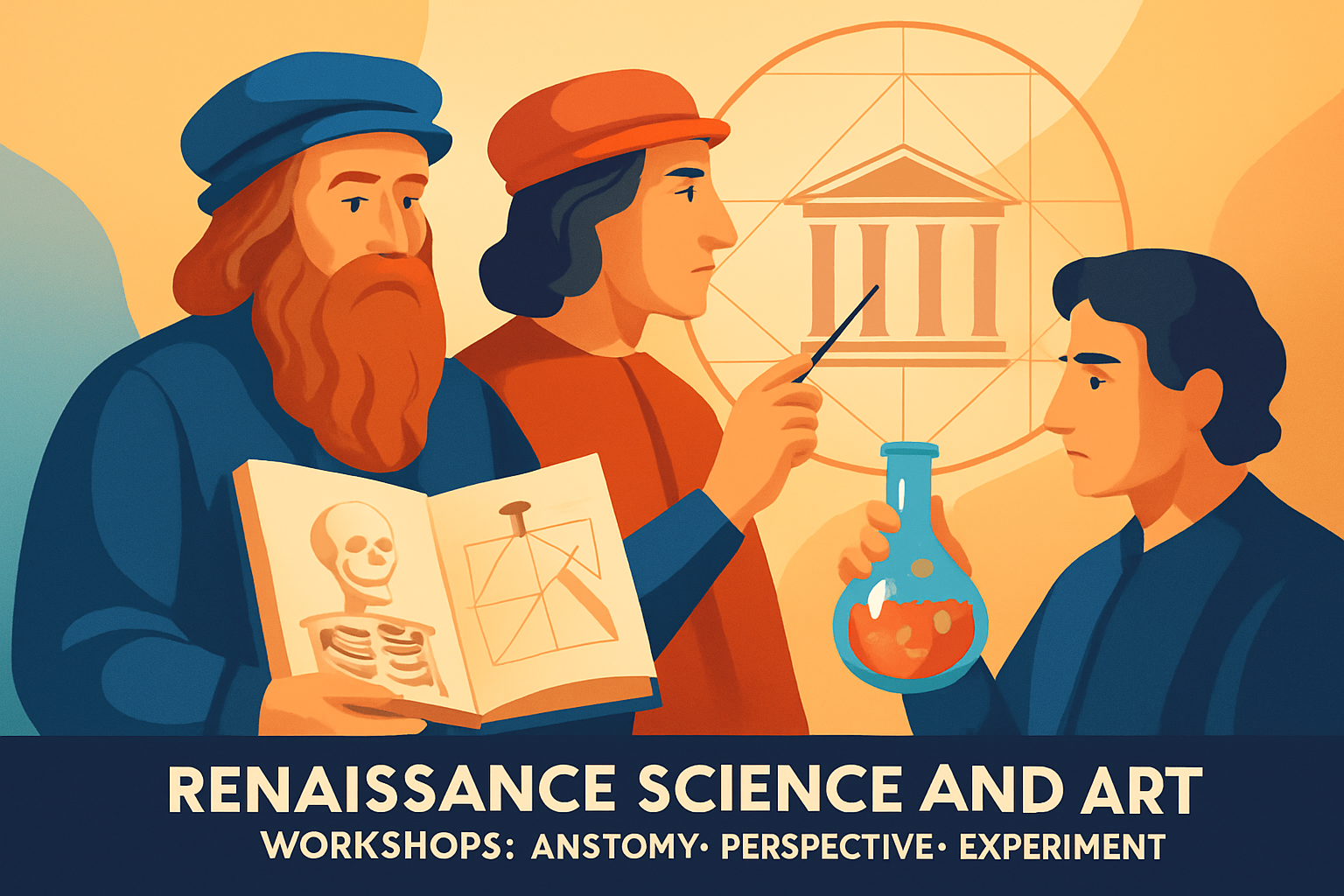
Renaissance science and art workshops changed European culture by treating observation, measurement, and skilled making as parts of the same intellectual practice. In Florence, Venice, Milan, Padua, and Nuremberg, painters, sculptors, architects, anatomists, instrument makers, and natural philosophers worked in spaces where drawing a body, dissecting a corpse, grinding pigments, and testing a lens could belong to one continuous process. The title phrase anatomy, perspective, and experiment captures that fusion precisely. Anatomy meant the close study of bodily structure through dissection, diagrams, and comparative observation. Perspective meant the mathematical construction of space, allowing artists to represent depth convincingly and architects to plan buildings rationally. Experiment meant deliberate trials with materials, optics, mechanics, and natural phenomena, often repeated to verify what the eye and hand discovered.
I have worked through workshop notebooks, museum technical reports, and reconstruction projects, and the pattern is unmistakable: Renaissance innovation rarely emerged from isolated genius alone. It grew from collaborative workshops where masters trained apprentices, exchanged methods with physicians and engineers, and solved practical problems with systematic attention. This matters because modern readers often separate art from science too sharply. The Renaissance shows a different model, one in which accurate seeing became a route to knowledge. When Leonardo da Vinci mapped muscles, when Filippo Brunelleschi demonstrated linear perspective, or when Albrecht Dürer published measurement systems, they were not switching between artistic and scientific identities. They were using shared tools of inquiry.
Understanding these workshops helps explain why Renaissance images look more convincing, why anatomical illustration became more reliable, and why experimental habits spread before modern laboratories existed. It also clarifies how skills moved across disciplines. A painter needed geometry, a surgeon needed drawing, an architect needed optics, and an engineer needed practical craft. The workshop was the institution that joined those needs. If you want to understand the Renaissance as more than a parade of masterpieces, study the working methods behind them. That is where the period’s real transformation took place, in studios and botteghe where ideas were tested by hand, eye, and instrument every day.
The Workshop as a Knowledge Engine
The Renaissance workshop, or bottega, was not merely a place of production; it was a structured environment for learning, testing, and transmitting knowledge. Apprentices began with routine tasks such as preparing panels, mixing gesso, stretching canvases, sharpening metalpoint styluses, and grinding pigments like azurite, vermilion, and malachite. Those jobs sound menial, but they trained the senses. A young assistant learned viscosity, drying time, opacity, absorbency, and the behavior of binders such as egg tempera or walnut oil. That material literacy directly supported broader inquiry. Once you know how a translucent glaze alters perceived depth, you begin asking optical questions. Once you know how plaster sets, you understand timing, humidity, and controlled procedure.
Major workshops functioned as interdisciplinary enterprises. Verrocchio’s shop in Florence, for example, linked painting, sculpture, metalwork, and engineering. Leonardo trained there, and the environment exposed him to casting, drafting, anatomy, and hydraulics alongside picture making. In Venice, Bellini’s workshop adapted technique to local light and the city’s preference for oil painting, while in Nuremberg, Dürer combined artistic practice with print technology, geometry, and publishing. Workshops also relied on networks beyond the studio. Artists consulted physicians for anatomical access, mathematicians for proportion systems, merchants for imported materials, and patrons for specialized commissions requiring technical invention.
This workshop model promoted what we would now call iterative experimentation. A master did not simply issue ideas from inspiration. He prepared cartoons, made compositional studies, adjusted foreshortening, changed pigment recipes, and tested surface effects. Surviving underdrawings visible through infrared reflectography show repeated revisions. That evidence matters because it proves that Renaissance making was investigative. Knowledge was embodied in process, not only in finished works. The studio became a knowledge engine because it combined labor, demonstration, correction, and replication. Apprentices copied the master, but copying itself was analytical. To reproduce a hand, drapery fold, or architectural interior, one had to understand the governing structure. That practical analysis is one of the strongest links between Renaissance art and science.
Anatomy: Dissection, Drawing, and the Truth of the Body
Anatomy became central to Renaissance workshops because artists wanted bodies that moved believably and physicians needed images that clarified structure. Medieval art had already developed expressive figure traditions, but Renaissance artists pursued a new degree of anatomical specificity. They studied bones, muscle groups, tendons, fat distribution, and surface landmarks such as the clavicle, patella, and iliac crest. The goal was not clinical objectivity alone. It was persuasive representation rooted in observed structure. Masaccio’s figures in the Brancacci Chapel feel weighty because their bodies are organized as volumes. Michelangelo’s sculptures display muscular exaggeration, yet their force depends on disciplined anatomical knowledge.
Leonardo da Vinci remains the most famous example because he treated anatomy as both artistic necessity and scientific investigation. Working in hospitals in Florence, Milan, and likely Rome, he dissected human cadavers and compared his findings with animal anatomy. His sheets on the shoulder, spine, heart valves, fetus in utero, and facial muscles combine text, sectional drawing, exploded views, and mechanical analogy. I have studied reproductions of these pages in detail, and their method is strikingly modern. Leonardo rotates structures, labels parts, isolates systems, and cross-checks what he sees. He does not only record appearance; he asks function. How does a valve close? Which muscle lifts the arm? What arrangement permits torsion of the neck? That functional reasoning is experimental thought applied through drawing.
The wider anatomical culture of the Renaissance extended beyond Leonardo. Andreas Vesalius, whose 1543 De humani corporis fabrica transformed anatomy, relied on a visual program shaped by artists trained in representational accuracy. Vesalius insisted on direct observation and corrected inherited errors from Galen, who had based parts of his anatomical knowledge on animals rather than humans. That shift toward dissection-based evidence parallels developments in art workshops. Both domains increasingly privileged what could be verified by seeing and handling. For artists, anatomy also improved narrative clarity. A martyr’s strained torso, a saint’s kneeling posture, or a soldier’s twisting recoil became more legible when the underlying mechanics were understood. Anatomy was therefore not a decorative add-on to Renaissance art. It was a core workshop discipline that connected beauty, truth, and empirical method.
Perspective: Geometry Made Visible
Perspective answered a practical question that mattered to painters, architects, and patrons alike: how can a flat surface represent three-dimensional space with convincing order? The Renaissance solution emerged through geometry. Filippo Brunelleschi is traditionally credited with demonstrating linear perspective in early fifteenth-century Florence, using a painted panel and mirror experiment to show how orthogonals converge toward a vanishing point. Leon Battista Alberti then codified the method in De pictura in 1435, describing painting as an intersection of a visual pyramid on a plane. That definition sounds abstract, but in workshop terms it gave artists a repeatable system. Establish a horizon line, locate the viewer, set the vanishing point, and organize receding forms accordingly.
Masaccio’s Holy Trinity is one of the clearest early demonstrations of perspective’s intellectual and devotional power. The vaulted chapel illusion depends on coherent geometry, yet the effect is not mathematical display for its own sake. It organizes sacred space so the viewer experiences structured depth and presence. Piero della Francesca pushed these ideas further, uniting painting and mathematics with unusual rigor. His treatises on perspective and solid geometry show how deeply numerical reasoning entered artistic practice. In workshops influenced by such methods, apprentices learned not just to imitate appearances but to construct them.
Perspective had several forms, and Renaissance practitioners knew the distinctions. Linear perspective governed architectural recession. Foreshortening handled figures seen at sharp angles, such as Andrea Mantegna’s dead Christ. Atmospheric perspective, used brilliantly by Leonardo, softened distant forms through color and contrast changes based on the behavior of light in air. These systems were not identical, yet all depended on disciplined observation linked to rule-based representation. Perspective also affected engineering and stage design. Designers of court spectacles used perspectival scenery to create dramatic illusion, while architects used measured drawing to communicate plans across distances. The workshop thus translated geometry into visual authority. When viewers trusted a painted space, they were responding to a system that fused mathematics, craft training, and repeated practical tests.
Experiment: Materials, Optics, and Mechanical Curiosity
Experiment in Renaissance workshops did not look exactly like a modern laboratory protocol, but it shared essential features: controlled trials, comparison, repeated observation, and revision based on results. Artists tested pigments for permanence, oils for drying behavior, varnishes for gloss, grounds for absorbency, and supports for stability. Cennino Cennini’s Il Libro dell’Arte, although rooted in late medieval practice, preserves this procedural mindset. He specifies materials, sequences, and cautions because outcomes depend on method. A workshop master knew that bad gesso could crack, excessive oil could wrinkle paint, and incompatible layers could fail over time. Material experiment was therefore inseparable from artistic success.
Optics formed another major area of inquiry. Renaissance artists paid close attention to reflection, refraction, shadow edge, and the directional behavior of light. Jan van Eyck, in the Northern tradition closely parallel to Italian developments, achieved extraordinary surface effects through oil layering that implied sophisticated visual analysis. In Italy, Leonardo’s notes on light, shadow, and color perspective show an investigator thinking across art and natural philosophy. He studied how light scatters, how shadows vary with distance, and how the eye perceives gradation. These questions matter today in computer graphics, but in the Renaissance they were pursued with chalk, brush, mirror, and direct looking.
| Workshop focus | Main question | Typical method | Practical result |
|---|---|---|---|
| Anatomy | How is the body built and how does it move? | Dissection, life drawing, comparative sketches | More convincing figures and better medical images |
| Perspective | How can depth be represented accurately on a flat surface? | Geometric construction, grids, measured drawings | Coherent interiors, architecture, and spatial illusion |
| Materials | Which substances produce durable and luminous surfaces? | Pigment grinding, binder tests, layering trials | Improved color, finish, and preservation |
| Optics and mechanics | How do light and motion behave in observable systems? | Mirror studies, lens use, sketches of machines | Better modeling, inventions, and visual analysis |
Mechanical curiosity linked workshops to broader Renaissance engineering. Leonardo designed gears, pumps, flying machines, and military devices, but he was not alone in joining drawing to invention. Mariano Taccola and Francesco di Giorgio Martini also developed image-rich technical manuscripts. Their drawings were exploratory tools, not mere illustrations after the fact. In my experience reviewing these materials, the key point is simple: the Renaissance workshop normalized experimental habits because making itself demanded them. Every failed casting, cloudy varnish, awkward foreshortening, or unstable scaffold taught a lesson. Experiment was built into production.
How Knowledge Moved Between Artists, Physicians, and Mathematicians
One reason Renaissance workshops mattered so much is that they sat inside larger urban knowledge networks. Universities, hospitals, courts, monasteries, print shops, and merchant houses all contributed to circulation. Padua is an especially important case because its university became a major center for anatomy, while nearby Venice connected scholars and craftsmen through commerce and publishing. Anatomical theaters, though later in formalized form, reflect a culture in which seeing became pedagogically central. Artists benefited from access to dissected bodies and scholarly texts; physicians benefited from artists’ representational precision. This was a two-way exchange, not a one-sided borrowing.
Print transformed that exchange by making workshop knowledge portable. Dürer’s treatises on measurement and human proportion spread geometrical and anatomical ideas far beyond his own studio. Engraving and woodcut allowed complex diagrams to circulate with consistency, something manuscript copying could not guarantee at scale. Vesalius’s anatomical plates are a landmark example because they turned direct observation into reproducible visual evidence. Once images could travel, workshop practices influenced readers who never entered the original studio. In SEO terms, if we were mapping internal linking signals across Renaissance culture, print was the high-authority node connecting disciplines, cities, and generations.
Patronage also shaped transmission. Courts wanted engineers who could design fortifications, painters who could stage dynastic power, and architects who understood proportion. Wealthy families funded chapels, altarpieces, pageants, and scientific instruments. This demand rewarded versatile practitioners. A master who understood anatomy, perspective, and mechanics had competitive advantage. Yet there were limits. Access to dissection could be restricted, mathematical literacy varied, and some workshop secrets remained guarded for economic reasons. Those tradeoffs are important because they prevent a romanticized picture. Renaissance openness existed, but it was uneven, negotiated, and often tied to status. Even so, the period established a durable model: breakthroughs happen faster when observation, craft, and theory circulate together across professional boundaries.
Lasting Impact on Modern Art, Science, and Education
The legacy of Renaissance science and art workshops is visible in modern academies, medical illustration, industrial design, architecture, and scientific visualization. Contemporary figure drawing classes still begin with skeletal landmarks and massing, a direct descendant of anatomical workshop practice. Architectural rendering still relies on perspective systems first formalized in the Renaissance, even when software now automates the geometry. Medical textbooks still depend on the principle that accurate images clarify structure and function better than text alone. Designers prototype, test materials, and revise forms in ways that would be familiar to a fifteenth-century master. The tools changed; the logic did not.
There is also a lesson here for education. When schools separate art, science, technology, and craftsmanship into isolated silos, students lose the integrative power the Renaissance workshop cultivated. Observation improves when drawing is taught seriously. Scientific reasoning strengthens when students build models and test physical outcomes. Creativity becomes more disciplined when geometry, anatomy, and material behavior are treated as connected domains. I have seen this firsthand in museum-based teaching sessions: once students sketch a cast, measure proportion, and discuss how muscles drive pose, abstract concepts become concrete quickly.
The central takeaway is clear. Renaissance workshops made anatomy, perspective, and experiment mutually reinforcing practices. They produced better images because they pursued better knowledge, and they produced better knowledge because they trusted trained observation guided by method. If you want to understand how innovation actually works, look past isolated masterpieces and study the workshop habits behind them. Read Alberti, Cennini, Leonardo, Dürer, and Vesalius together. Visit museums with conservation departments that reveal underdrawings and material analysis. The Renaissance still offers a practical model for modern creators and researchers: learn by making, verify by observing, and improve by testing your assumptions against the world.
Frequently Asked Questions
What were Renaissance science and art workshops, and why were they so important?
Renaissance science and art workshops were collaborative spaces where making, observing, measuring, and theorizing came together in practical ways. Rather than separating art from science, these workshops treated both as connected forms of inquiry. A painter studying the muscles of the arm, an anatomist dissecting a body, an architect calculating proportion, and an instrument maker refining a lens could all be engaged in closely related work. In cities such as Florence, Venice, Milan, Padua, and Nuremberg, workshops became centers of intellectual exchange where skilled hands and trained eyes produced new knowledge about the world.
Their importance lies in how they changed European culture. They helped establish the idea that careful observation could challenge inherited authority, that measurement could improve representation, and that repeated practice could lead to reliable understanding. In these environments, drawing was not merely decorative, and craft was not considered intellectually secondary. Sketching a skeleton, testing the geometry of perspective, preparing pigments, or building optical tools all contributed to a shared pursuit of truth through disciplined making. This workshop culture helped shape developments in anatomy, engineering, natural philosophy, architecture, and visual art, making it one of the most influential features of the Renaissance.
How did anatomy influence Renaissance artists and scientists?
Anatomy played a central role because it offered a way to understand the human body through direct study rather than through inherited texts alone. Artists wanted to represent the body with greater accuracy, movement, and emotional power, while physicians and anatomists sought better knowledge of structure and function. These goals often overlapped. By studying bones, muscles, tendons, and proportions, artists could create figures that appeared more convincing in motion and more believable in space. At the same time, anatomical observation encouraged habits of precision, comparison, and visual recording that were essential to scientific investigation.
Workshops and studios often became places where anatomical knowledge circulated through drawings, models, notes, and demonstrations. Dissection, though shaped by legal, religious, and social limits, became an important method for studying the body firsthand. Artists who observed dissections or made anatomical sketches learned how form changed beneath the skin, while scholars benefited from increasingly refined visual representations. This exchange mattered because it joined visual skill with empirical investigation. Anatomy in the Renaissance was not simply a medical subject or an artistic aid; it was a powerful example of how seeing, recording, and analyzing could work together to generate new understanding.
Why was perspective considered such a major breakthrough in Renaissance workshop culture?
Perspective was revolutionary because it provided a systematic method for representing three-dimensional space on a flat surface. It turned visual appearance into something that could be analyzed, constructed, and taught through geometry. For painters and architects, this meant that space could be organized according to measurable principles rather than intuition alone. For scholars interested in optics and mathematics, perspective offered a practical demonstration of how vision might be studied and translated into rules. In workshop culture, this made perspective both an artistic technique and an intellectual tool.
Its significance extended far beyond realistic backgrounds. Perspective encouraged a new confidence in the power of calculation and visual order. Artists used vanishing points, horizon lines, and proportional relationships to create convincing interiors, cityscapes, and sacred scenes, but the larger cultural shift was even more important. It suggested that the visible world had structure that could be discovered through disciplined observation and mathematical reasoning. In that sense, perspective became part of the broader Renaissance commitment to linking eye, hand, and mind. It trained artists to think analytically, and it helped establish visual representation as a serious form of knowledge.
What does the phrase “anatomy, perspective, and experiment” reveal about Renaissance thinking?
The phrase captures three deeply connected practices that defined Renaissance workshop culture. Anatomy represents the close study of the body, perspective represents the mathematical ordering of sight and space, and experiment represents the testing of materials, tools, and ideas through repeated practice. Together, these terms show that Renaissance thinkers often pursued knowledge by combining observation with making. They did not see manual labor and intellectual inquiry as opposites. Instead, they treated workshop activity as a place where theories could be tested through action and where practical problems could inspire larger conceptual advances.
This combination reveals a culture increasingly interested in evidence, process, and verification. An artist might test how light behaves on a surface, compare different pigments, or revise a drawing after studying a dissected limb. An instrument maker might refine a lens through repeated trials, while an architect might adjust proportions based on geometry and visual effect. In each case, knowledge emerged from interaction between the material world and skilled practice. The phrase therefore points to a broader Renaissance habit of mind: understanding the world by examining it closely, measuring it carefully, and reshaping it through experiment.
Which cities and professional communities were most associated with these workshops?
Several major urban centers became especially important because they brought together wealth, patronage, trade, universities, and strong craft traditions. Florence is often associated with the close relationship between artistic innovation, mathematical inquiry, and civic ambition. Venice contributed through its commercial networks, technical expertise, and distinctive culture of materials, print, and exchange. Milan offered courtly patronage and engineering interests, while Padua stood out for its medical and anatomical scholarship, especially because of its university environment. Nuremberg played a major role in linking artistic practice with measurement, print culture, and instrument making in the German-speaking world.
These cities were shaped by overlapping professional communities rather than isolated disciplines. Painters, sculptors, architects, goldsmiths, engravers, anatomists, physicians, mathematicians, natural philosophers, printers, and instrument makers all contributed to the same broader culture of inquiry. Their collaboration did not always take the form of formal institutions; often it happened through workshops, courts, universities, guilds, and personal networks. What made these communities distinctive was their willingness to treat drawing, calculation, material testing, and bodily observation as mutually reinforcing activities. That cross-disciplinary exchange helped drive some of the most important transformations in Renaissance art and science.