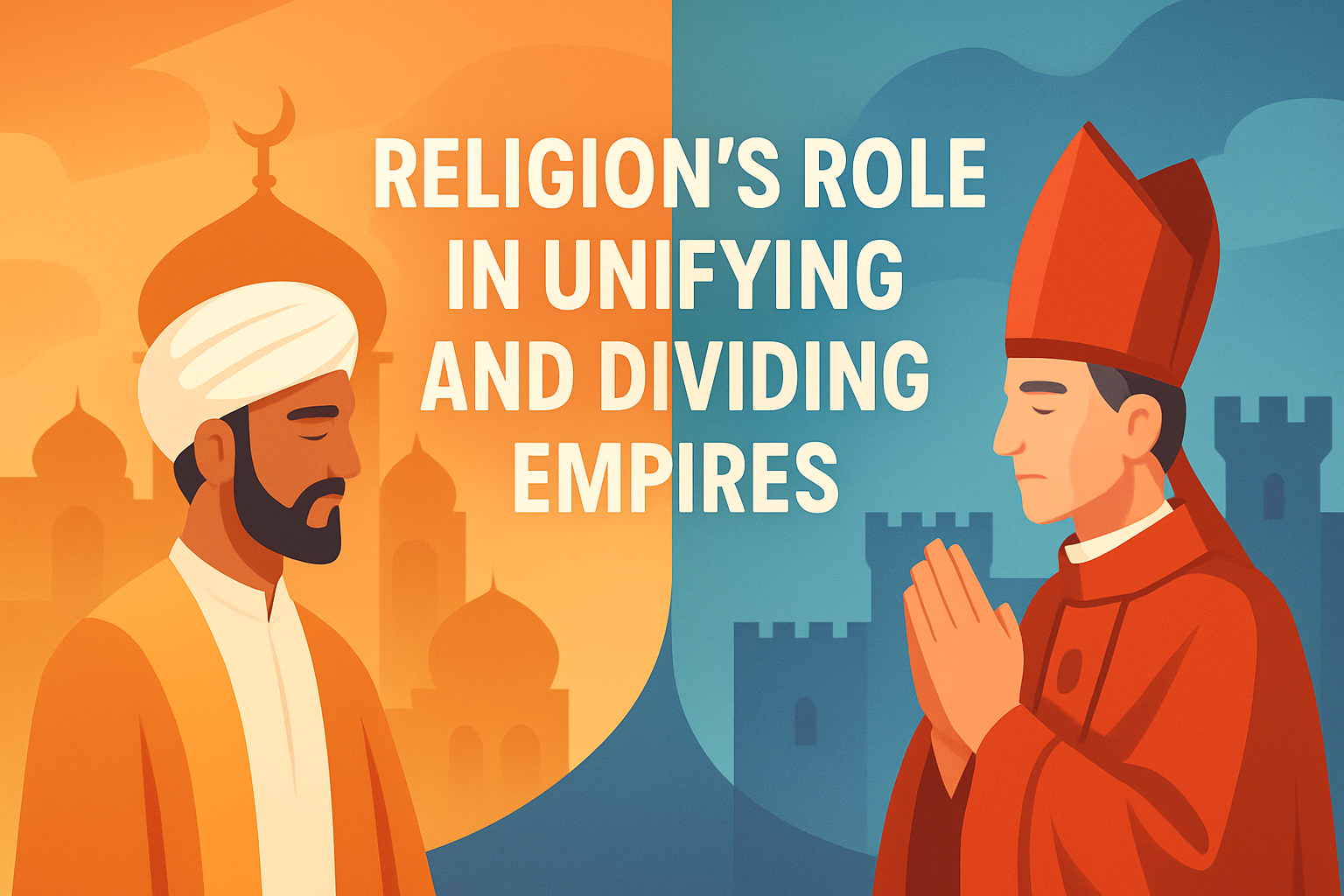
Religion has played a significant role in shaping human societies throughout history. Its impact on empires is particularly profound, as it has served both as a unifying bond and a dividing force. Understanding the dual aspects of religion’s influence is crucial not only for historical analysis but also for grasping current geopolitical trends. This topic matters because religion continues to be a compelling force in politics, society, and culture worldwide. By examining historical examples, we can learn valuable lessons about how to navigate the complex interplay between faith and power today.
The term ’empire’ typically refers to a large state or group of states under a single supreme authority, which often contains diverse regions and cultures. Within such vast entities, religion can act as a powerful tool for cohesion, fostering a sense of shared identity and purpose. Conversely, religious differences can also lead to fragmentation and conflict, testing the limits of an empire’s unity. This duality makes religion a fascinating subject of study, highlighting its roles in building and sometimes dismantling empires. The discussion moves beyond dry historical facts to explore the living, breathing impact of religion on political entities across time and continents.
The Unifying Force of Religion in Empires
Religion has historically served as a uniting force within empires by providing a shared sense of identity and common goals among diverse populations. One notable example is the use of Buddhism in the Mauryan Empire under Emperor Ashoka in ancient India. After witnessing the destruction caused by his conquests, Ashoka adopted Buddhism and promoted it as a state religion. This strategic move helped him unify the vast and culturally diverse empire. Buddhism’s emphasis on compassion and non-violence served as a moral compass, fostering a sense of community and shared values among the populace.
Similar examples can be found throughout history. In the Byzantine Empire, Christianity acted as both the state religion and a crucial factor in cultural cohesion. The shared religion helped to bind various ethnic and cultural groups together under the Byzantine banner, while also distinguishing the empire from its Muslim neighbors. This unity under a common faith facilitated communication and governance, making it easier for rulers to project power and maintain control over extensive territories.
- Mauryan Empire: Buddhism as a unifying force
- Byzantine Empire: Christianity’s role in cohesion
Religion as a Divisive Element in Empires
While religion can be a source of unity, it has also been a source of division, contributing to the decline of empires when competing beliefs come into conflict. The Roman Empire serves as a prominent example of this divisive potential. The initial spread of Christianity was seen as a threat to the old pagan religion and the traditional social order. As Christian communities grew, tensions rose, resulting in periodic persecutions and internal strife. Even after Christianity was made the official religion, theological disagreements led to further divisions, such as the split between Arianism and Nicene Christianity.
The fragmentation of the Roman Empire into Eastern and Western entities can be partially attributed to these religious disagreements. Moreover, the Eastern Roman Empire, or the Byzantine Empire, itself was marked by significant religious controversies, including the Iconoclast Controversy over the veneration of icons. This schism not only weakened internal cohesion but also complicated relations with neighboring states, highlighting how religion can fracture internal structures when manipulated by political agendas.
Religion’s Role in Social Hierarchies within Empires
Religion has also played an integral role in establishing and legitimizing social hierarchies within empires. In the ancient Egyptian empire, the Pharaoh was considered a god-king, a divine ruler imbued with celestial authority. This religious ideology was central to maintaining social order, reinforcing the Pharaoh’s supreme status and ensuring loyalty from the populace. The divine right of kings was similarly adopted in various other empires, such as in medieval Europe, where monarchs claimed their authority was sanctioned by God.
In these contexts, religion was intertwined with governance, providing a spiritual rationale for political hierarchy and obedience. This divine endorsement of authority helped legitimize the ruling class, making rebellion not just a political act but a religious transgression. In this way, religion has been used as a political tool to maintain existing power structures and suppress dissent within empires.
| Empire | Religious Influence | Example |
|---|---|---|
| Ancient Egypt | Divine Kingship | Pharaoh as god-king |
| Medieval Europe | Divine Right of Kings | Monarchs’ divine authority |
The Impact of Religious Conversion in Empires
Religious conversion is another phenomenon that has impacted the unity and division within empires. The spread of Islam, for example, brought about significant cultural and political changes in regions from the Arabian Peninsula to the Iberian Peninsula. Early Islamic empires, such as the Umayyad and Abbasid Caliphates, leveraged religious conversion strategically, offering social advancements and tax incentives to those who converted. This approach facilitated the rapid spread of Islam, unifying vast territories under a single religious and legal framework known as Sharia law.
However, conversions were not always smooth and often led to tensions with established religious communities. In the Persian Empire, the spread of Islam initially faced resistance from the entrenched Zoroastrian faith. Over time, however, Islam became dominant, transforming the cultural landscape of the region. This example underscores the dual capacity of religious conversion to unite disparate groups under a shared belief system, while also highlighting potential conflicts with established traditions.
Modern Implications of Religion’s Role in Empires
The historical impact of religion on empires offers valuable insights into contemporary geopolitics. In our increasingly globalized world, religion continues to influence political entities, sometimes acting as a unifying force, while at other times fueling division. For instance, the European Union faces challenges in integrating countries with differing religious traditions and levels of secularism. The inclusion of predominantly Muslim countries into the EU is often met with both enthusiasm and skepticism, reflecting underlying tensions between cultural identities and unity.
In contrast, modern nation-states like India have embraced religious pluralism, enshrining the principle of secularism in their constitutions to maintain unity in diversity. However, religious tensions still occasionally flare up, revealing the ongoing challenge of balancing religious freedom with national cohesion. Such examples demonstrate the complex and evolving role of religion in modern political landscapes, where it can both heal and divide.
Summary and Conclusion
The exploration of religion’s role in unifying and dividing empires provides key insights into both historical and contemporary political dynamics. Religion has served as a powerful tool for uniting diverse populations within empires, offering a shared identity and sense of purpose. At the same time, religious differences and conversions have acted as sources of division, fueling conflicts and contributing to the fragmentation of these political entities.
Modern parallels can be drawn, highlighting the continued importance of understanding religion’s influence on geopolitics. As global societies become more interconnected, the need to navigate religious diversity with sensitivity and insight is paramount. Encouraging dialogue and promoting religious tolerance can help mitigate potential conflicts, fostering more harmonious coexistence within diverse communities. One practical next step is for policymakers and community leaders to place a greater emphasis on interfaith education and cooperation, ensuring that religion acts as a bridge rather than a barrier in our globalized world.
Frequently Asked Questions
1. How has religion served as a unifying force in historical empires?
Religion has historically acted as a unifying force in several ways. One of the most striking examples is the Roman Empire’s adoption of Christianity. Before Christianity became the state religion under Emperor Constantine, the empire was a melting pot of different cultures and beliefs. Christianity provided a common faith and set of morals which helped bind disparate peoples together under one cultural and spiritual banner. Even after the fall of the Roman Empire, the Christian Church maintained influence, binding European societies together through a shared religious identity for centuries. Similarly, in the Islamic Caliphates, Islam served as a unifying bond across vast and diverse territories, promoting a sense of shared destiny and community among its followers. This cohesion made it easier to govern expansive territories that included various ethnicities and cultures by aligning all under a single religious institution with shared laws and spiritual goals, which facilitated both political administration and social cohesion.
2. In what ways has religion contributed to division within empires?
While religion can unify, it can also act as a divisive force, especially when used to delineate “us” versus “them.” Internal divisions often emerged when the ruling empire endorsed one religion over others, leading to discrimination or persecution of those who practiced other faiths. For instance, in the Byzantine Empire, religious schisms such as the Great Schism in 1054 led to significant strife and fragmentation within what was once a unified Christian domain. Another example is the Ottoman Empire, where various religious groups were allowed to practice their faiths through the millet system, but tensions often arose among different religious communities, sometimes spilling over into violence. Moreover, during the Reformation in Europe, religious disputes contributed to decades of wars and conflicts, such as the Thirty Years’ War, which were both politically and religiously motivated, illustrating how religion can deepen divisions when intertwined with political power struggles.
3. How have empires used religion as a tool for governance and societal control?
Empires have frequently used religion to legitimize their rule and control their subjects. By aligning closely with religious institutions, emperors and kings often claimed divine right or blessings to strengthen their authority. The Byzantine Empire, for example, was strongly tied to the Orthodox Church, which provided it with ideological support and social control. Similarly, the Catholic Church played a pivotal role in the governance of the Holy Roman Empire by orchestrating laws that aligned with religious doctrines. In Islamic empires, the Caliph held both religious and political authority, intertwining governance with religious law (Sharia). This dual role enabled leaders to consolidate power and maintain order by presenting their rule as part of a divine plan. Through religion, they could impose their rule not only as political leaders but as champions and defenders of the faith, thus gaining reverence and compliance from their subjects.
4. Can you provide examples of how religion affected cultural development in empires?
Religion has immensely influenced cultural development within empires by shaping art, architecture, language, and daily practices. The most evident examples are the grand religious structures that have become symbols of cultural heritage, such as the Hagia Sophia in the Byzantine Empire or the numerous mosques and universities established in the Islamic Golden Age. These structures not only served as places of worship but also as centers of learning and cultural exchange. Furthermore, religion has often been intertwined with language and literature, as seen with the spread of Arabic through the Islamic Empire and the use of Latin in Christian Europe. Religious festivals, rituals, and observances dictated the social calendars and influenced community interactions, fostering a shared cultural consciousness that transcended regional and ethnic diversities. Through religious texts and teachings, moral and ethical norms were codified, influencing legal systems and social customs long after the empires themselves had faded.
5. How does the historical relationship between religion and empires help us understand modern geopolitical dynamics?
Examining the historical relationship between religion and empires offers valuable insights into current geopolitical dynamics. Many modern conflicts have religious undertones, stemming from historical grievances where religion played a significant role. The Middle East is a prime example, where religious differences continue to impact political landscapes that were shaped by historical empires like the Ottoman Caliphate and the division of territories by European powers with little regard for religious or ethnic boundaries. Additionally, in regions like South Asia, religious identities significantly affect political identities and conflicts, echoing the partitions and religious dynamics of earlier empires such as the Mughal Empire. Modern nation-states, influenced by historical claims and religious legitimization, often cast current political disputes in the light of religious narratives. Thus, understanding the historical context wherein religion unified and divided empires can assist us in comprehending the motivations behind modern political alliances and conflicts, as well as potential paths to resolution.