
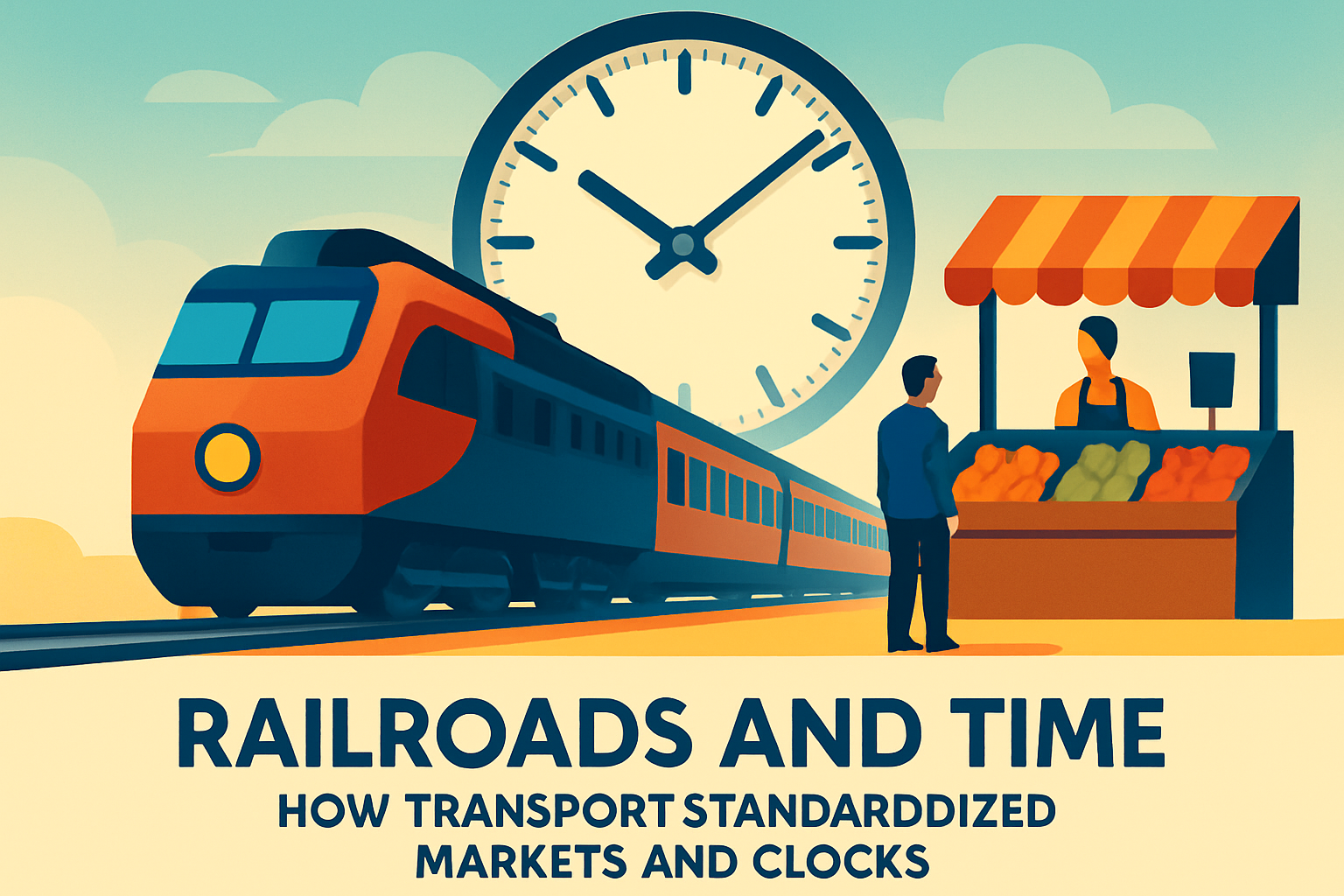
Railroads did more than move coal, grain, mail, and passengers; they reorganized economic life by forcing societies to agree on time. Before the railway age, most towns set clocks by local solar noon, so midday in one place could differ by several minutes from midday in the next. That variation worked tolerably well in a world of horse carts and coastal shipping, but it became dangerous and expensive once trains began running at high speed across long distances. “Railroads and time” is therefore not a poetic phrase but a literal historical process: transport networks standardized schedules, synchronized markets, reduced transaction costs, and helped create the modern expectation that a minute means the same thing everywhere.
I have worked on transport and economic history content for business audiences, and one pattern appears in every archive and timetable I study: coordination problems become market problems. If a merchant cannot predict when a train will arrive, inventory planning weakens. If two cities disagree on the hour, dispatching becomes hazardous. If exchanges receive prices late, arbitrage widens and producers earn less reliable returns. Railroads mattered because they solved these frictions at scale. They linked inland producers to ports, industrial cities to labor pools, and regional prices to national benchmarks. At the same time, they pushed governments, observatories, telegraph operators, and railway companies toward shared clock standards that eventually shaped daily work, finance, news, and law.
The key terms are straightforward. Local time means time measured by the sun at a particular location. Standard time means a shared legal or operational time across a wider region, usually organized by time zones. Market standardization means that goods, prices, contracts, and expectations become more uniform across places because transport and communication reduce distance-related uncertainty. The railroad system did not act alone, because telegraphy was its essential partner, yet the railroad created the business need for temporal discipline and made the value of synchronized time obvious to the public.
This matters today for the same reason supply chain reliability, API timestamps, and exchange trading hours matter: markets depend on coordination. Modern logistics software, warehouse slotting, airline networks, and global financial systems all rest on standardized time conventions that were politically contested and commercially proven during the nineteenth century. Understanding how rail transport standardized clocks and markets clarifies why infrastructure changes more than speed. It changes pricing power, labor rhythms, capital allocation, and the geographic reach of competition. The railroad age shows, with unusual clarity, that a technical scheduling problem can become the foundation of national integration and global commerce.
Before Standard Time, Every Town Kept Its Own Noon
Before railways spread, local solar time was normal. A town clock was set when the sun reached its highest point, and nearby communities often differed by minutes because longitude differs. Bristol ran roughly ten minutes behind London; towns farther apart could differ much more. For local life, that was manageable. Farmers, shopkeepers, and stagecoach operators worked with broad windows rather than exact minutes. The problem was not that people lacked clocks; the problem was that they had no compelling economic reason to align them beyond local custom.
Railroads changed that calculus immediately. A single line connecting multiple towns could not safely run frequent trains if every station followed its own noon. In early operations, companies published timetables with columns adjusted to local times, but this was cumbersome and error-prone. Dispatchers, station masters, conductors, and passengers needed one operational standard. On double-track systems the issue was efficiency; on single-track lines it was safety, because trains traveling in opposite directions relied on precise meeting times at sidings. A few minutes of confusion could produce delays, missed connections, or collisions.
Britain offers the clearest early case. Railway companies increasingly adopted Greenwich Mean Time during the 1840s, helped by telegraph connections from the Royal Observatory at Greenwich. Public clocks lagged behind railway clocks in some places, creating the famous distinction between “railway time” and local time. Yet commercial logic won. By the mid-nineteenth century, most British towns had effectively shifted to GMT for practical purposes. The railway timetable trained the public to accept a national clock because the alternative was missed trains, disrupted mail, and unreliable business appointments.
Railroads and Telegraphs Created the First Real-Time Economy
Railways alone sped up movement, but railways plus telegraphs created real-time coordination. This combination is one of the most important infrastructure pairings in economic history. Telegraph lines often followed railroad rights-of-way because the corridor already existed, security was easier, and stations offered operational nodes. Railway managers used telegraphy to report departures, track train locations, manage single-track authority, and respond to disruptions. Once time signals and train orders could move nearly instantly, the value of standardized clocks increased further.
In practice, I see this as the nineteenth-century equivalent of linking logistics software to a shared cloud database. Everyone in the network gains from one trusted timestamp. For railroads, that meant fewer accidents, tighter headways, and more reliable interchange between lines. For shippers, it meant predictable handoffs between rail depots, warehouses, ports, and wholesalers. For newspapers and exchanges, telegraphy allowed distant market prices to circulate while railroads physically moved the goods those prices represented. Information and transport began operating on the same clock.
The economic effect was substantial. Grain traders in the interior could respond more quickly to prices in major cities. Manufacturers could time deliveries of coal, iron, and machine parts with less buffer inventory. Retailers could promise arrival windows based on timetable discipline rather than rough estimates. Standardized time lowered transaction costs because contracts, insurance terms, and labor schedules could reference dependable hours. That may sound abstract, but it changed margins. Reliable coordination reduces idle capital, spoilage, and labor downtime. In transport economics, that is how infrastructure turns speed into productivity.
How Railroads Standardized Markets Across Regions
When transport becomes faster, cheaper, and more reliable, separate local markets begin to merge into wider regional and national markets. Railroads did this dramatically. Before extensive rail networks, bulky goods such as grain, lumber, coal, and livestock were constrained by waterways, turnpikes, and seasonal conditions. Price differences between nearby towns could remain large because moving goods was difficult. Rail service reduced those frictions, allowing products to flow toward higher-value markets and aligning prices across distance.
Economists describe this as market integration. In historical terms, it meant that a poor harvest in one region no longer guaranteed extreme local scarcity if rail links could bring in supply from elsewhere. It also meant producers faced wider competition. A miller or merchant once protected by geography now had to match prices influenced by distant firms. Consumers often benefited through lower prices and more stable supply, while businesses gained access to bigger customer bases. The tradeoff was that local monopolies weakened and some traditional intermediaries lost power.
Railroads also encouraged standardization beyond time itself. Freight classification systems, published tariffs, waybills, consignment procedures, and through-rates all made transactions more legible. Grain grading in the United States, for example, became more important as rail and elevator systems connected farms to urban and export markets. Chicago’s rise as a grain hub depended on transport coordination, storage technology, and standardized contracts. Once a shipment could move on schedule and be described in recognized grades, it became easier to finance, insure, and trade. That is market standardization in operational form.
| Area | Before rail standardization | After rail standardization |
|---|---|---|
| Timekeeping | Local solar time by town | Shared railway or legal standard time |
| Pricing | Wide local price gaps | Closer regional and national price alignment |
| Scheduling | Approximate departure windows | Published timetables and timed connections |
| Contracts | Locally interpreted terms | Uniform freight rules, rates, and waybills |
| Inventory | Large safety stock | Lower buffer needs through predictable delivery |
North America and the 1883 Time Zone Turning Point
The United States and Canada show the issue at continental scale. By the early 1880s, North American railroads operated across thousands of miles and confronted hundreds of local times. Timetables became extraordinarily complex, and the risk of error was obvious. On November 18, 1883, U.S. and Canadian railroads adopted a system of standard time zones, often called the “Day of Two Noons.” Although governments did not create the initial shift, public institutions soon followed because commercial reality had moved first.
The railroad-led system divided the continent into broad zones tied to meridians, making scheduling manageable for intercity travel and freight operations. This was a practical business decision, not a philosophical one. Rail executives needed a standard that dispatchers and passengers could use without constant conversion. The arrangement later influenced formal legal adoption, including the U.S. Standard Time Act of 1918, which also addressed daylight saving. The sequence matters for understanding infrastructure power: corporations solving network coordination problems often create standards that states later codify.
The market effect was equally important. Standard time supported national distribution. Mail-order firms, commodity exchanges, newspaper syndicates, and manufacturing supply chains all benefited from predictable cross-country timing. A wholesaler in Chicago could coordinate with suppliers, rail agents, and retailers using a common temporal framework. Banks and brokers could align operating hours more effectively across cities. In my experience writing about logistics transitions, this is the decisive point: once time becomes standardized, scale stops being merely geographic and becomes managerial. Firms can run integrated systems rather than disconnected local outposts.
Railway Time Changed Daily Life, Labor, and Business Culture
Standardized time did not remain inside stations. It spread into factories, schools, courts, and homes. Employers could impose stricter shift discipline. Urban transit systems could coordinate with mainline rail connections. Newspapers could announce precise schedules and deadlines. People began carrying watches not simply as status objects but as practical tools for participating in synchronized society. Railway stations became public theaters of punctuality, displaying large clocks that taught communities to trust official time over the sun overhead.
There were social costs and cultural tensions. Standard time represented abstraction and external authority. Local communities lost a small measure of autonomy when observatory time, corporate timetables, or national law overrode familiar routines. Labor historians also note that more exact timekeeping strengthened managerial control. When work could be measured to the minute, lateness and productivity could be monitored more aggressively. Railroads thus contributed to both economic opportunity and stricter temporal discipline, a dual legacy still visible in modern workplaces.
Yet the broad benefits were undeniable. Coordinated clocks improved safety, simplified travel, and made commercial promises more credible. They helped ports connect to inland production, enabled tourism, and supported national news cycles. Today’s synchronized digital infrastructure, from GPS time signals to global container tracking, follows the same principle established in the railway era: shared time is a public good for complex networks. The historic lesson is not simply that trains ran on time. It is that standard time allowed markets, institutions, and ordinary people to operate inside a common framework of expectation.
Railroads standardized markets and clocks by solving the same core problem: coordination across distance. Once trains moved faster than local custom could manage, societies needed shared schedules, and once those schedules existed, wider markets became more efficient, legible, and competitive. Local solar time gave way to railway time, railway time informed legal time zones, and synchronized clocks helped create integrated national economies.
The strongest takeaway is practical. Transport infrastructure does not only reduce travel time; it reshapes how prices form, how contracts work, how labor is managed, and how institutions trust one another. Railroads, reinforced by telegraphy, created the first large-scale system in which timekeeping, logistics, and market integration advanced together. Britain’s adoption of Greenwich Mean Time and North America’s 1883 time zones show that standards often emerge because commerce cannot function smoothly without them.
For anyone studying economic history, supply chains, or infrastructure policy, the railroad era remains the clearest example of how a technical network can reorder daily life. If you want to understand modern logistics, platform coordination, or global trading hours, start with railway time. The clocks on station walls still explain the structure of connected markets.
Frequently Asked Questions
Why did railroads make standardized time necessary?
Before railroads, most communities kept time locally by the sun. When the sun reached its highest point, that was noon, and nearby towns could easily differ by a few minutes without causing major problems. In a slower economy built around walking, horse carts, canals, and coastal shipping, those small differences rarely mattered. Railroads changed that completely. Trains moved fast, ran on tight schedules, and shared tracks over long distances, so even minor discrepancies between local clocks could create confusion, delays, and serious safety risks.
Standardized time became necessary because rail systems depended on precise coordination. A train departing one town at “2:00” and arriving in another at “2:15” only made sense if both stations agreed on what those times meant. Without a common time standard, published timetables became unreliable, freight connections were harder to manage, and dispatchers faced dangerous uncertainty when routing trains on single-track lines. In practical terms, standardized time was not just a convenience for passengers; it was an operational requirement for a modern transport network. Once railroads linked cities, markets, and regions more tightly, they pushed societies toward a shared clock in order to make commerce safer, faster, and more predictable.
How did local solar time work before the railway age?
Local solar time was based on the sun’s position in the sky at a particular place. When the sun reached its highest point overhead, that location marked noon. Because towns at different longitudes experience that moment at slightly different times, every community effectively had its own clock. A town a little farther east would reach noon a few minutes earlier than a town to the west. This arrangement reflected the rhythms of a pre-industrial world, where most activity was local and exact synchronization across long distances was rarely essential.
In everyday life, local solar time worked well enough. Shopkeepers, farmers, churches, and municipal officials could organize routines around familiar local clocks or public sundials. The system was flexible because travel was relatively slow and communication was limited. If a journey took days rather than hours, a time difference of several minutes between destinations had little practical effect. The problem emerged when railroads compressed distance. Suddenly, those once-harmless differences became obstacles to scheduling, coordination, and safety. What had been a natural and acceptable form of timekeeping in a local economy became increasingly impractical in an interconnected transport and market system.
How did standardized railway time affect markets and the broader economy?
Standardized railway time reshaped markets by making economic activity more regular, coordinated, and predictable. Railroads did not simply transport goods; they accelerated the circulation of coal, grain, manufactured products, mail, and people. To handle that volume efficiently, businesses needed dependable timetables for departures, arrivals, transfers, and deliveries. A shared time system reduced uncertainty in logistics and allowed firms to plan production, inventory, pricing, and distribution with greater confidence. In that sense, standardized time became part of the infrastructure of capitalism, just as important as tracks, stations, and telegraph lines.
The economic effects spread far beyond railway companies. Merchants could coordinate shipments across wider regions, wholesalers could promise more reliable delivery windows, and financial markets benefited from better synchronization between commercial centers. Standard time also helped newspapers, post offices, factories, and government agencies align their operations. As regional economies became more integrated, the pressure grew for everyone to use the same temporal framework. Markets function more efficiently when participants agree not only on weights, measures, and currency, but also on the clock. Railroads helped turn time itself into a standardized economic tool, supporting national market integration and reducing the frictions that came from a patchwork of local times.
Was the adoption of standard time immediate, or did people resist it?
The adoption of standard time was gradual, and in many places it faced resistance. People were accustomed to local time because it reflected visible daily experience: noon was when the sun stood highest, not when a distant railway company or national authority said it was noon. For some communities, switching to a standardized system felt artificial, imposed, or overly commercial. Local pride could also play a role, since public clocks and civic routines had long been part of a town’s identity. Accepting railway time often meant accepting that a broader network now mattered more than strictly local custom.
Even so, practical pressures steadily pushed societies toward standardization. Railroads published timetables, stations synchronized clocks, and telegraph systems helped transmit accurate time signals across long distances. Businesses, government offices, and newspapers increasingly adopted railway time because it reduced confusion and aligned them with national economic life. Over time, what began as a railway necessity evolved into a social norm and eventually into law in many countries. Resistance did not disappear overnight, but the advantages of uniform timekeeping were so clear in transport, trade, administration, and daily coordination that standard time became a defining feature of modern life.
Why is the history of railroads and time important today?
The history of railroads and time matters because it shows how technology can reshape basic social habits and institutions. We often think of clocks and time zones as neutral, natural features of modern life, but they were historically constructed in response to the demands of faster transport, wider markets, and more complex coordination. Railroads revealed that time was not just a scientific or personal matter; it was also an economic and political one. Once societies depended on synchronized movement across great distances, they had to create shared standards that allowed millions of people to operate within the same temporal system.
This history also offers a broader lesson about infrastructure. Railways changed more than travel times; they changed how people worked, traded, communicated, and imagined national space. The standardization of time helped create the conditions for integrated markets, coordinated administration, and mass mobility. In the present, digital networks, global logistics, and real-time communication continue that legacy in new forms. Understanding how railroads standardized markets and clocks helps explain why modern economies depend so heavily on precision, synchronization, and common standards. It is a reminder that even something as ordinary as the time on a clock carries the imprint of historical change.