
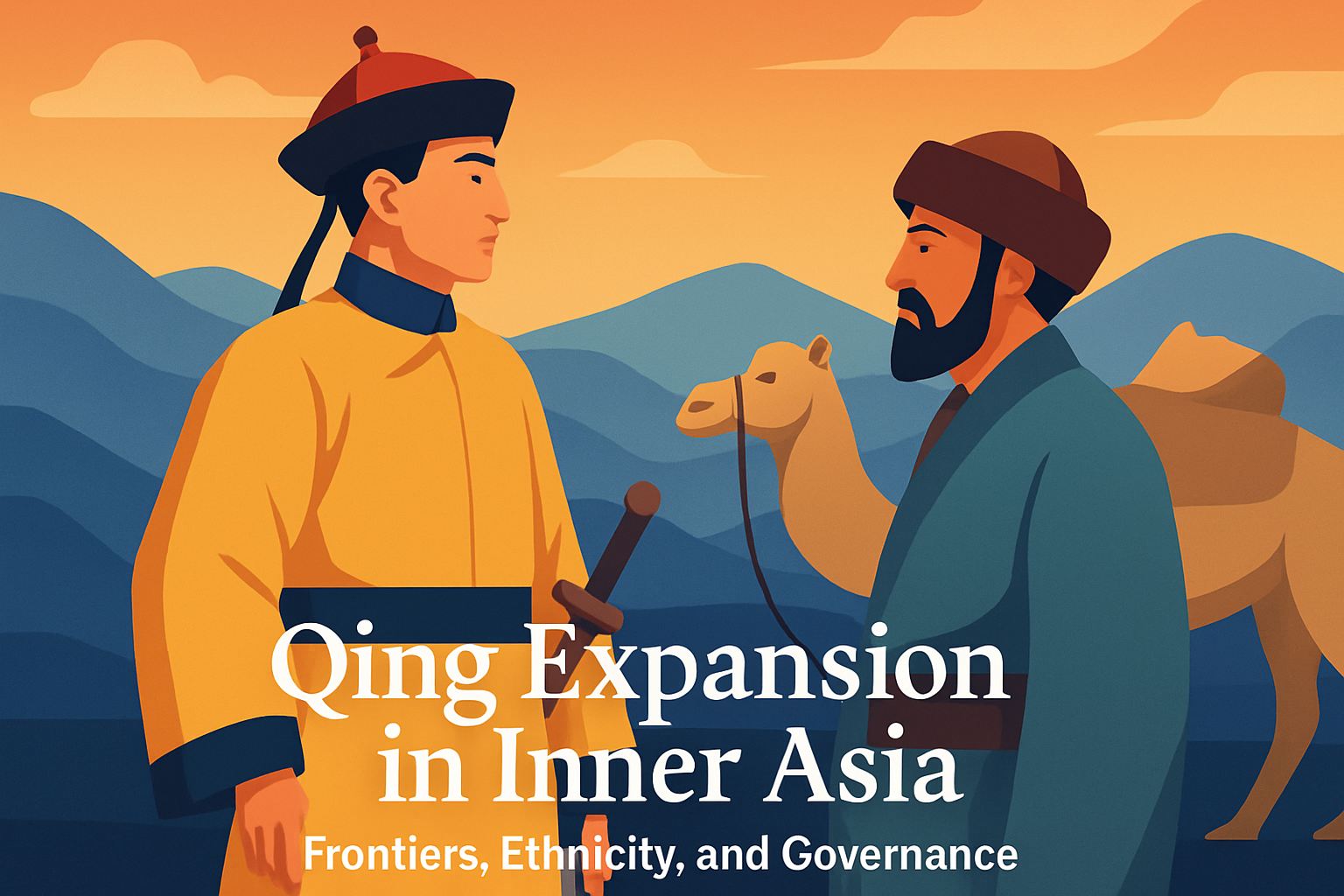
Qing expansion in Inner Asia transformed East and Central Eurasia by combining conquest, alliance, and administrative innovation across Mongolia, Tibet, Xinjiang, and the frontier zones linking China proper with the steppe. In this context, “Inner Asia” refers to the belt of grasslands, deserts, mountain corridors, and oasis regions stretching north and west of the agrarian heartland, while “frontiers” means not a fixed line on a map but a shifting zone of military movement, trade, migration, and negotiation. “Ethnicity” in the Qing world did not function exactly like modern nationalism; it was expressed through banners, tribes, lineages, religious communities, and legal categories that the dynasty recognized and managed differently. “Governance” therefore meant more than civil bureaucracy. It included garrison rule, tributary diplomacy, imperial patronage of religion, population registration, legal pluralism, and calibrated use of local elites. Understanding this system matters because the Qing did not merely inherit a Chinese empire and extend it outward. It built a composite imperial order whose legacies still shape debates about sovereignty, ethnic policy, and regional history in modern China, Mongolia, Tibet, and Xinjiang.
From working through Qing memorials, maps, and frontier case studies, I have found that the dynasty’s success in Inner Asia came from flexibility rather than uniformity. The court in Beijing did not apply one standard model everywhere. Instead, it used different languages, institutions, and claims of legitimacy depending on the audience. A Mongol prince, a Tibetan lama, a Turkic oasis notable, and a Han magistrate encountered the Qing state in different forms. The emperor could appear simultaneously as Confucian ruler, Great Khan, Chakravartin patron of Buddhism, and military commander. That multi-layered sovereignty is the key concept for reading Qing frontiers accurately. It explains why the dynasty held vast territories for so long, but also why these regions remained politically sensitive. The Qing empire was strongest when it balanced military coercion with local accommodation; it faced recurring crises when ecological stress, fiscal strain, or ethnic distrust upset that balance.
The expansion itself unfolded mainly between the seventeenth and eighteenth centuries. The Manchus consolidated power in Manchuria, defeated the Ming in China proper, then turned toward the steppe and plateau. Their campaigns against the Zunghar Mongols, intervention in Tibet, and incorporation of Xinjiang were not isolated episodes. They were strategically connected. Control of Mongolia protected the northern approaches to Beijing. Influence in Tibet reduced rival Mongol and Central Asian networks while enhancing the emperor’s Buddhist legitimacy. Conquest of Zungharia and the Tarim Basin eliminated the most serious Inner Asian competitor to Qing power. By the late eighteenth century, the dynasty ruled one of the largest land empires in the world. Yet it governed that empire through layered institutions rather than direct assimilation, and that administrative complexity is essential to any serious account of Qing expansion in Inner Asia.
Conquest and strategic integration across Inner Asia
Qing expansion was driven by security concerns as much as by ambition. The early Manchu rulers understood steppe politics from experience. Before taking Beijing in 1644, they had already built alliances with Mongol groups and incorporated them into the banner system. This mattered because mobile cavalry forces, marriage diplomacy, and control of grazing routes remained central to power in the north. The greatest threat emerged from the Zunghar Khanate, an Oirat Mongol polity that dominated parts of present-day Xinjiang and challenged Qing influence across Mongolia and Tibet. The Kangxi, Yongzheng, and especially Qianlong emperors treated the Zunghars as a strategic rival whose defeat was necessary to secure the dynasty’s continental position.
The conflict was long and expensive. Qing campaigns in the late seventeenth and early eighteenth centuries combined banner armies, Green Standard troops, supply depots, relay stations, and negotiated defections. In my reading of frontier logistics, the decisive advantage was not simply battlefield strength but sustained provisioning across distance. Grain, horses, silver, and intelligence moved through carefully managed corridors. The 1696 campaign against Galdan is a classic example: the Qing used multiple converging columns and superior logistics to wear down a mobile enemy. Later operations against the Zunghars became even more destructive. By the 1750s, after internal succession disputes weakened the khanate, Qing forces and allied groups destroyed Zunghar resistance. Historians widely describe the result as catastrophic depopulation caused by war, disease, and displacement. That destruction opened the way for full Qing incorporation of both Zungharia and the Tarim Basin.
Xinjiang, literally “new frontier” in later Qing terminology, was not a single region but two distinct zones: Zungharia in the north and the oasis cities of the Tarim Basin in the south. The Qing understood this difference clearly. Northern pastoral lands required military colonies and resettlement. Southern oasis society depended on irrigation agriculture, Islamic institutions, merchant networks, and local begs who could mediate rule. This distinction shaped policy and is one reason the conquest lasted. The dynasty did not simply annex territory; it reconfigured human geography by moving Manchus, Mongols, Han soldiers, merchants, Sibe, Solons, and others into strategic spaces. Frontier security was therefore inseparable from demographic engineering.
Ethnicity as an administrative category, not a modern nation
One of the biggest misunderstandings in popular writing is treating Qing ethnicity as if it mapped neatly onto modern national identities. In practice, the dynasty categorized people through overlapping markers: banner status, tribal affiliation, religion, language, occupation, and locality. Manchu identity itself was political and institutional, anchored in the Eight Banners. Mongol identity was recognized through leagues and banners. Tibetans were often approached through religious hierarchies and regional authorities. In Xinjiang, the court distinguished Oirats, Kazakhs, Kyrgyz, Taranchis, and Muslim oasis communities, often using terms that reflected Qing priorities rather than local self-understanding. These categories mattered because they shaped taxation, judicial procedure, mobility rights, and military obligations.
The court’s approach was neither fully pluralist nor assimilationist. It preserved difference where difference served order. Separate legal handling for banners, restrictions on migration, and differential administrative channels helped maintain a hierarchy of groups under imperial supervision. The Lifan Yuan, often translated as the Court of Colonial Affairs or Board for the Administration of Outlying Regions, was crucial here. It managed many relations with Mongols and Tibetans and operated outside the standard six-board system used in China proper. That institutional separation signals an important fact: the Qing knew Inner Asia could not be governed effectively by simply extending county administration everywhere. Frontier ethnicity was therefore not only cultural; it was bureaucratic.
At the same time, the dynasty was capable of sharp exclusion. Manchu rulers guarded banner privilege and worried about cultural erosion through debt, language loss, and intermarriage. In Mongolia, the Qing restricted certain forms of Han settlement for long periods to prevent unrest and preserve banner structures, though these controls weakened over time. In Xinjiang, Muslim oasis elites could hold office under Qing oversight, but they were not treated as interchangeable with banner populations or Han settlers. This selective recognition created stability in some periods, yet it also hardened boundaries. Once a population was defined administratively as a frontier group, governance often reinforced that identity through law and surveillance.
| Region | Main Qing Institutions | Ethnic or Social Categories Emphasized | Core Governance Objective |
|---|---|---|---|
| Mongolia | Lifan Yuan, leagues, banners, princely rule | Mongol banners, nobles, lamas | Secure steppe loyalty and prevent rival confederations |
| Tibet | Ambans, patronage of monasteries, selected local rulers | Clerical hierarchies, regional elites | Stabilize religion and block hostile intervention |
| Xinjiang | Military governor, garrisons, begs, prefectural hybrids | Oirats, oasis Muslims, settlers, merchants | Hold strategic corridors and manage diverse populations |
Governing Mongolia and Tibet through layered sovereignty
Mongolia shows the Qing method at its most sophisticated. Rather than abolishing Mongol aristocratic authority, the dynasty subordinated it. Khalkha Mongol nobles retained status within a framework of leagues and banners overseen by the Qing court. This prevented the re-emergence of a unified steppe power while preserving local intermediaries who could mobilize labor, tribute, and military support. The system also tied nobles materially to Beijing through titles, stipends, and ritual recognition. In practical terms, it was cheaper and more stable than replacing them with dense civilian administration across sparsely populated grasslands. When I compare Mongolia with provinces in China proper, the contrast is striking: one was ruled through territorially nested counties and magistrates, the other through controlled aristocratic autonomy.
Tibet required a different strategy because legitimacy there was deeply bound to Buddhist institutions. The Qing cultivated the image of the emperor as a universal Buddhist ruler, especially in Tibetan and Mongolian contexts. This was not decorative symbolism. It had real political value. By supporting major monasteries and recognizing leading incarnate lamas, the Qing inserted themselves into networks that crossed ethnic and geographic boundaries. After the 1720 intervention against the Zunghars in Lhasa, and especially after the 1751 reforms, the dynasty increased its influence through ambans, resident imperial representatives, while still working through Tibetan elites and the Dalai Lama’s government.
Direct control remained limited and uneven. Travel constraints, local factionalism, and difficult terrain meant that Qing authority in Tibet depended heavily on cooperation. Yet the court repeatedly intervened at decisive moments, including the response to the Gurkha invasions in the 1790s. The resulting regulations, often cited in scholarship on imperial oversight, aimed to tighten selection procedures, frontier defense, and the role of ambans. Even so, Tibet was never administered just like a province. The dynasty’s aim was strategic supervision, not bureaucratic homogenization. That distinction is central for understanding both Qing durability and later disputes over historical sovereignty.
Xinjiang as a laboratory of military governance and managed diversity
After the defeat of the Zunghars and the subjugation of the Tarim oases in the 1750s and 1760s, Xinjiang became the clearest example of Qing frontier experimentation. The region was too large, too diverse, and too recently conquered for a standard provincial model. The court therefore relied on military governors, garrisons, and segmented administration. In the southern oases, local begs continued to handle taxation, policing, and mediation under Qing supervision. In the north, the state created new military-agricultural settlements and stationed bannermen and soldiers from multiple ethnic backgrounds. This was an empire of corridors and nodes: Ili, Urumqi, Kashgar, Yarkand, and Kucha mattered as administrative anchors connected by transport and intelligence lines.
The Qing also used migration deliberately. Sibe communities were moved to the Ili Valley in 1764 to strengthen garrison society. Han merchants entered market towns, though the court often monitored or restricted broader settlement patterns. Hui and other Muslim intermediaries played commercial roles, linking the frontier to Gansu and beyond. Such policies reveal a principle I see repeatedly in Qing archives: diversity was not an accidental byproduct of conquest but an instrument of rule. By placing groups with different loyalties and functions into the same frontier, the state reduced the chance that any single local coalition could dominate without imperial approval.
This strategy had limits. Rebellions in the nineteenth century exposed vulnerabilities in communication, fiscal capacity, and trust. The Jahangir Khoja uprising in the 1820s and the larger Muslim rebellions of the 1860s and 1870s showed that indirect rule through begs could fail when legitimacy collapsed. Only after reconquest under Zuo Zongtang did the Qing create Xinjiang Province in 1884, marking a major institutional shift toward tighter territorial administration. That late provincialization is one of the strongest pieces of evidence that earlier Qing governance in Inner Asia was intentionally differentiated rather than incomplete by accident.
Why Qing frontier governance still matters
The history of Qing expansion in Inner Asia matters because it explains how a dynasty built a continental empire without relying on one culture, one law, or one administrative template. Its rulers succeeded by matching institutions to terrain, population, and strategic threat. Mongolia was managed through banner aristocracy, Tibet through religious patronage and resident oversight, and Xinjiang through military command layered with local intermediaries. Ethnicity was neither ignored nor romanticized; it was classified, negotiated, and sometimes hardened into durable administrative boundaries. The empire’s frontiers were therefore active political systems, not empty margins awaiting incorporation.
For modern readers, the main lesson is analytical precision. If we describe Qing Inner Asia simply as national unification, we miss the empire’s plural structure. If we describe it only as colonial domination, we risk flattening local agency and the genuine bargaining power of frontier elites. The strongest interpretation holds both realities together: the Qing was an expansionist empire that ruled different peoples through unequal but adaptive institutions. That is why its legacy remains so contested and so important.
To understand contemporary debates about sovereignty, ethnicity, and borderlands, start with the Qing frontier on its own terms. Study the Lifan Yuan, the banner system, the Zunghar wars, the role of ambans, and the late creation of Xinjiang Province. These are not peripheral details. They are the framework that explains how Inner Asia was conquered, governed, and remembered.
Frequently Asked Questions
What does “Inner Asia” mean in the context of Qing expansion?
In the context of Qing history, “Inner Asia” refers to the vast region of steppe, desert, mountain, and oasis territories lying to the north and west of China’s agrarian core. This includes Mongolia, Tibet, Xinjiang, and the frontier corridors that connected the Qing Empire to Central Eurasia. It was not a single cultural or political unit. Rather, it was a diverse zone inhabited by Mongols, Tibetans, Uyghurs, Manchus, Kazakhs, and many other peoples whose economies, religions, and political traditions differed sharply from those of the sedentary farming regions of China proper.
Understanding Inner Asia is essential because Qing expansion was not simply a matter of pushing a border outward. The empire moved into spaces defined by mobility, seasonal migration, caravan trade, military campaigning, and layered loyalties. These were regions where control depended less on drawing neat lines on a map and more on managing routes, alliances, garrisons, tribute networks, and local elites. The Qing court therefore approached Inner Asia as a strategic and political environment that demanded flexible forms of rule.
This is also why historians emphasize that Qing expansion changed the shape of East and Central Eurasia. By incorporating Inner Asian territories, the Qing became not just a dynasty ruling China proper but a continental empire that governed multiple peoples through different institutions. The conquest and administration of Inner Asia helped define the territorial scale, ethnic complexity, and geopolitical reach of the Qing state.
How did the Qing Empire expand into Mongolia, Tibet, and Xinjiang?
Qing expansion into Inner Asia unfolded through a combination of military conquest, diplomacy, alliance-building, and political incorporation rather than through one single model. In Mongolia, the Qing worked to bind Mongol nobles to the imperial order through patronage, titles, marriage politics, and military pressure. The defeat of rival steppe powers, especially the Zunghars, was crucial in bringing much of the Mongolian world into the Qing sphere. The court understood that controlling Mongolia was vital not only for prestige but also for the security of the northern frontier and for managing the steppe routes that linked different Inner Asian regions.
In Tibet, Qing influence developed through a different mix of intervention and indirect rule. The court presented itself as a protector of Tibetan Buddhism while also intervening in moments of political instability. Rather than fully replacing local authority, the Qing often worked through existing religious and aristocratic structures, while stationing imperial representatives and troops when necessary. This allowed the dynasty to shape Tibetan politics without attempting to govern Tibet exactly as it governed provinces in China proper.
Xinjiang was incorporated through especially intense warfare in the eighteenth century, above all during the campaigns against the Zunghar state. After military victory, the Qing moved to reorganize the region through garrisons, new administrative divisions, and the cultivation of ties with oasis elites and Muslim begs. The empire also invested in provisioning armies, securing transport routes, and encouraging selective migration to stabilize rule. Across all three regions, the pattern was clear: the Qing advanced by adapting to local conditions, combining force with negotiation, and building institutions suited to each frontier environment.
Why do historians describe Qing frontiers as shifting zones rather than fixed borders?
Historians describe Qing frontiers as shifting zones because imperial power in Inner Asia did not operate along a modern border in the strict sense. Instead, frontier rule depended on control over movement, military strongpoints, trade arteries, ecological corridors, and relationships with local communities. In steppe and mountain regions especially, authority was often exercised through patrols, garrisons, banners, tribute ties, and negotiated access rather than by policing a sharply demarcated line. Seasonal migration, caravan commerce, pilgrimage, and military mobilization made these spaces dynamic and difficult to define in rigid territorial terms.
This matters because a frontier was not just the edge of the state. It was also a zone where cultures met, where legal practices overlapped, and where imperial officials had to respond to changing conditions. A region might be tightly controlled in one season and more loosely supervised in another. Some areas were governed directly through military colonies or administrative offices, while others were managed through local rulers, monastery networks, tribal leaders, or intermediary officials. The degree of Qing presence could vary significantly across short distances.
Thinking in terms of frontier zones also helps explain how the Qing maintained a large empire. The dynasty’s power rested not only on conquest but on its ability to manage complexity. It had to monitor migration, prevent rival coalitions, secure supply lines, and channel commerce without always imposing uniform governance. In other words, the frontier was a living political space shaped by interaction, adaptation, and continual negotiation.
How did the Qing govern such ethnically and culturally diverse frontier regions?
The Qing governed frontier diversity through a highly plural approach that recognized different peoples, legal traditions, and political institutions within the same imperial framework. Rather than attempting immediate and total uniformity, the court often ruled through separate administrative arrangements tailored to local conditions. Mongol banner structures, Tibetan religious hierarchies, and Muslim intermediary elites in Xinjiang all played roles in frontier governance. This allowed the Qing to incorporate new territories while limiting disruption and making use of existing forms of authority.
Language, ritual, and imperial identity were also central to this process. The Qing court was led by Manchu rulers who did not present themselves only as Chinese-style emperors. They also acted as khans to Mongols, patrons of Tibetan Buddhism, and universal sovereigns in a wider Inner Asian political world. Official communication often appeared in multiple languages, including Manchu, Mongolian, Chinese, and Tibetan, reflecting the empire’s need to speak differently to different audiences. This multilingual and multivalent style of rule was not incidental; it was a core feature of Qing imperial governance.
At the same time, plural governance did not mean weak control. The empire used garrisons, surveillance, reporting systems, tribute management, regulated trade, and carefully structured appointments to maintain authority. It monitored local elites, intervened when instability threatened, and balanced accommodation with coercion. The result was a system in which ethnic and cultural difference was not erased but organized within an imperial order. That capacity to govern through difference was one of the main reasons the Qing could sustain a vast Inner Asian empire for so long.
What was the long-term significance of Qing expansion in Inner Asia?
The long-term significance of Qing expansion in Inner Asia is enormous because it reshaped the political geography of Eurasia and helped define the territorial inheritance of later states. By incorporating Mongolia, Tibet, and Xinjiang, the Qing established an empire whose scale far exceeded the agrarian core of China proper. These conquests and administrative innovations laid foundations for later claims about sovereignty, territory, and national space that continued into the late imperial, republican, and modern eras.
Qing expansion also transformed the internal character of the empire. It made the dynasty a multiethnic imperial state that had to govern pastoralists, monks, oasis merchants, military settlers, and agrarian populations under one overarching political structure. This forced the development of flexible institutions, multilingual administration, and frontier strategies suited to very different environments. In that sense, Inner Asia was not peripheral to Qing history. It was central to how the dynasty defined power, security, and legitimacy.
Finally, the consequences extended beyond the Qing itself. The defeat of rival Inner Asian powers, the reordering of trade routes, and the extension of imperial military infrastructure altered the balance of power across East and Central Eurasia. Frontier management in these regions influenced diplomacy, commerce, migration, and interethnic relations for generations. For historians, Qing expansion in Inner Asia is therefore not just a story of territorial growth. It is a story about how empire, ethnicity, and governance interacted to produce a new political order across one of the most strategically important regions of the early modern world.