
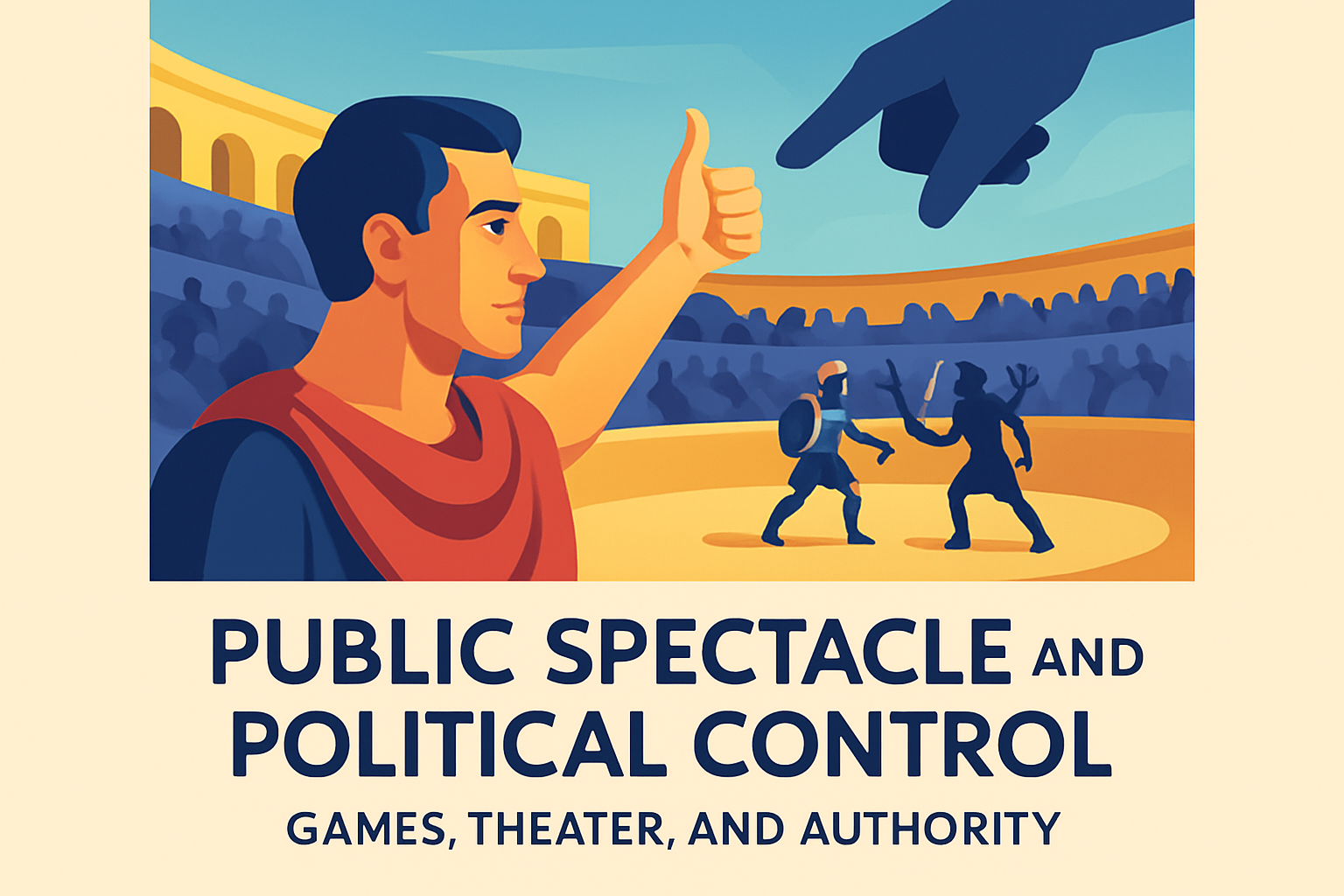
Public spectacles have been instrumental tools in political control throughout history, shaping opinions, delivering narratives, and reinforcing the authority of those in power. From the gladiatorial games of ancient Rome to the carefully orchestrated public rallies of modern political campaigns, spectacles hold a dual purpose of entertainment and influence. Defining key concepts such as ‘spectacle,’ which refers to grand events meant to impress and captivate audiences, and ‘political control,’ the exertion of authority to maintain power, helps clarify their interdependent relationship. Understanding how these elements interact is crucial, as modern society continues to see these performances played out on both local and global stages. By dissecting the mechanics behind them, we can better comprehend their impact on democratic processes and societal norms.
Historical Use of Public Spectacles in Ancient Civilizations
Ancient civilizations such as Rome cleverly utilized public spectacles to consolidate political power. The Roman gladiatorial games, held in massive amphitheaters, are a prime example. These spectacles served as a tool for emperors to gain and solidify popularity among the masses. Providing free games was an effective method to pacify the populace, dubbed ‘bread and circuses,’ suggesting that Roman citizens were more content with entertaining distractions than political freedoms. The spectacles also demonstrated the immense power and grandeur of the Roman state, underscoring the emperor’s position at the top of this hierarchy.
- Example: In AD 80, Emperor Titus inaugurated the Colosseum with a hundred-day spectacle of games that included gladiatorial combat, animal fights, and naval battles.
- Lesson: These events diverted the public’s focus from socio-political grievances and towards state-sanctioned entertainment, reinforcing imperial authority.
The strategy of using public entertainment to control perception is timeless. By harnessing the emotional power and community bonding ingrained in these events, governments maintained control over large populations without overt displays of force.
The Role of Theater and Performance in Modern Political Campaigns
In modern political contexts, public spectacles have evolved into sophisticated media productions. Political campaigns extensively use televised debates, rallies, and advertisements to sway public opinion. One remarkable evolution is the use of staged town hall meetings and well-choreographed speeches as mechanisms for candidates to project their image and connect with voters, much like theatrical performances.
In the 21st century, these spectacles have transformed through the digital age, employing social media and virtual rallies as their stage. In 2008, Barack Obama’s presidential campaign leveraged technology to create an unprecedented spectacle of inclusion and digital engagement. This use of online social networks and rich media content was pivotal in mobilizing young voters and creating a sense of personal connection and participation among supporters.
- Example: Obama’s campaign utilized social media platforms like Facebook and Twitter to engage with millions of voters, treating each as participants in an ongoing narrative.
- Lesson: The interplay of spectacle and political control is evident as campaigns curate public perceptions by blending reality with strategically presented ideals and narratives.
Modern media provides a platform for the continuous construction and deconstruction of public perception, demonstrating how political figures today manage to exercise control via digital spectacles aimed at shaping narrative and identity in real-time.
Impact of Entertainment and Media Industries in Framing Politics
Entertainment and political discourse are increasingly intertwined, creating hybrid spectacles where the lines between information and sensationalism are blurred. The news media industry plays a crucial role, often framing political events within an entertainment context to captivate audiences. This shift towards infotainment reshapes public discourse by prioritizing charismatic presentation over substantive analysis.
Infotainment Table
| Aspect | Traditional News | Infotainment News |
|---|---|---|
| Focus | Facts and Analysis | Entertainment and Sensationalism |
| Goal | Inform Public | Engage Audience |
| Outcome | Informed Debate | Polarized Views |
Many political analysts argue that this phenomenon distorts democratic processes, as citizens may be swayed by emotional appeals rather than rational deliberation on policies. A notable example of infotainment in politics is the rise of ‘political reality shows,’ where drama and spectacle overshadow political substance.
Ultimately, this convergence invites concerns about the sustainability of informed citizenry as electoral decisions are increasingly influenced by media-savvy performances rather than facts and policy discussions.
The Audience’s Role in Reinforcing or Resisting Spectacles
The audience is not merely a passive observer but rather an active participant in the perpetuation or resistance of public spectacles. How people engage with these spectacles can either reinforce or challenge existing power structures. The ability of an audience to critically evaluate and question the legitimacy of these performances determines the degree to which they offer genuine political insight or sheer propaganda.
In modern protest movements, the attempt to challenge mainstream narratives is evident. The 2011 Occupy Wall Street movement, for instance, turned public spectacle on its head by using the same theatricality to draw attention to socio-economic inequalities. The movement’s tactics, with its dramatic occupations and visual symbols, disrupted the traditional spectacle by creating an alternative narrative.
- Example: Protesters erected tents and used slogans like “We are the 99%” to choreograph an emotionally powerful counter-spectacle.
- Lesson: By appealing to public emotion and fostering participation, the movement highlighted the potential of public spectacles as tools for social change rather than only political control.
This example demonstrates the power individuals and communities have in shaping or challenging the spectacle, emphasizing the need for an engaged and critical populace capable of distinguishing between genuine discourse and superficial allure.
Conclusion: Understanding and Engaging with Spectacles
In summary, public spectacles have consistently played influential roles in the realm of political control, serving as both tools for influence and mediums of resistance. By delving into historical examples like the Roman games and exploring their evolution in modern politics and media, we’ve uncovered how these spectacles serve as conduits for authority and narrative shaping. From staged rallies and political theater to the rise of infotainment and counter-movements like Occupy Wall Street, the potency of a spectacle lies in its ability to either unite or divide audiences.
The primary takeaways for readers are recognizing the mechanisms behind these public displays and encouraging critical engagement to discern their true intentions. Public spectacles can distort realities, but understanding their intricacies empowers individuals to navigate them more effectively. By adopting an inquisitive mindset, audiences can hold power accountable and contribute to a more informed and equitable political landscape.
To foster change, we encourage readers to participate actively in civil discourse, question narratives presented in both traditional and modern media, and embrace their role in shaping the political conversation. By doing so, individuals can transform the spectacle from a tool of manipulation into a platform for informed engagement and democratic empowerment.
Empower yourself with knowledge and be part of the change you wish to see in the world of public spectacles.
Frequently Asked Questions
1. What is the historical significance of public spectacles in political control?
Public spectacles have long served as powerful devices for political control and shaping public perception. Historically, these events have been used by leaders and ruling classes to consolidate power, project authority, and influence the populace. In ancient Rome, gladiatorial games were not merely entertainment; they were strategic tools to distract, appease, and exert control over the masses. These spectacles reinforced the emperor’s power and instilled a sense of unity among the public through shared experiences. Similarly, monarchs of the past utilized grand parades, coronations, and public addresses to communicate their divine right to rule. Fast forward to modern times, political rallies and media events serve similar purposes, orchestrated to create favorable narratives and ensure public allegiance.
2. How do modern political campaigns use public spectacles?
Modern political campaigns are deeply embedded within the framework of spectacle. Campaign rallies are meticulously designed events that aim to captivate and energize supporters while showcasing a candidate’s strengths. These rallies often feature elaborate stages, light shows, and musical performances to create a larger-than-life experience. Television debates, press conferences, and social media events are crafted to gain maximum visibility and influence public opinion. Furthermore, political leaders use symbolic spectacle, such as visiting disaster sites or military installations, to project competence, empathy, or patriotism. The spectacle in politics today is not just about grand events but extends to a continuous media strategy that keeps candidates in the public eye and shapes their image in the public’s mind.
3. What are the key elements that make a spectacle effective for political control?
An effective spectacle for political control relies on several key elements. Firstly, the spectacle must captivate and hold the audience’s attention through impressive visuals, emotional appeal, and engaging narratives. The content should resonate with the audience’s values, hopes, and fears, creating a shared experience that fosters inclusion and agreement. Secondly, the spectacle should have symbolic significance, using imagery, sound, and performance to convey messages that reinforce the desired narrative. This can include the use of national symbols, cultural icons, or influential figures to lend credibility and authority. Finally, the timing of a spectacle is crucial. It must be orchestrated around significant events, anniversaries, or crises to heighten its impact and relevance. When these elements are combined deftly, spectacles can sway public opinion, reinforce ideologies, and maintain political control.
4. Can public spectacles backfire on those in power?
Yes, while public spectacles are powerful tools for political control, they have the potential to backfire if not managed carefully. This can happen if the audience perceives the spectacle as insincere, manipulative, or exaggerated. For instance, if a political rally is too focused on theatrics and lacks genuine substance, it may alienate voters and attract criticism. In the age of social media, public scrutiny is heightened, and any misstep or gaffe during a spectacle can quickly go viral, damaging a leader’s image. Furthermore, a poorly timed or insensitive spectacle can appear out of touch with public sentiment, particularly during times of crisis or hardship. Leaders must gauge public mood and adjust their spectacles accordingly to avoid backlash and maintain control.
5. How do different cultures view the role of spectacle in political control?
The role of spectacle in political control is seen differently across cultures, influenced by historical, social, and political contexts. In some cultures, grand public displays are routine parts of political life, deeply ingrained in tradition and collective identity. They are viewed positively, as a means of cultural expression, cohesion, and state power. However, other cultures may view these spectacles with skepticism, associating them with manipulation and propaganda, especially where there is a history of autocratic rule. For example, in Western democratic societies, spectacles might be scrutinized for authenticity and transparency. By contrast, in authoritarian regimes, they may be accepted or even expected as a means for the regime to display power and stability. Understanding these nuances is critical for political leaders who seek to utilize spectacles effectively within diverse cultural landscapes.