
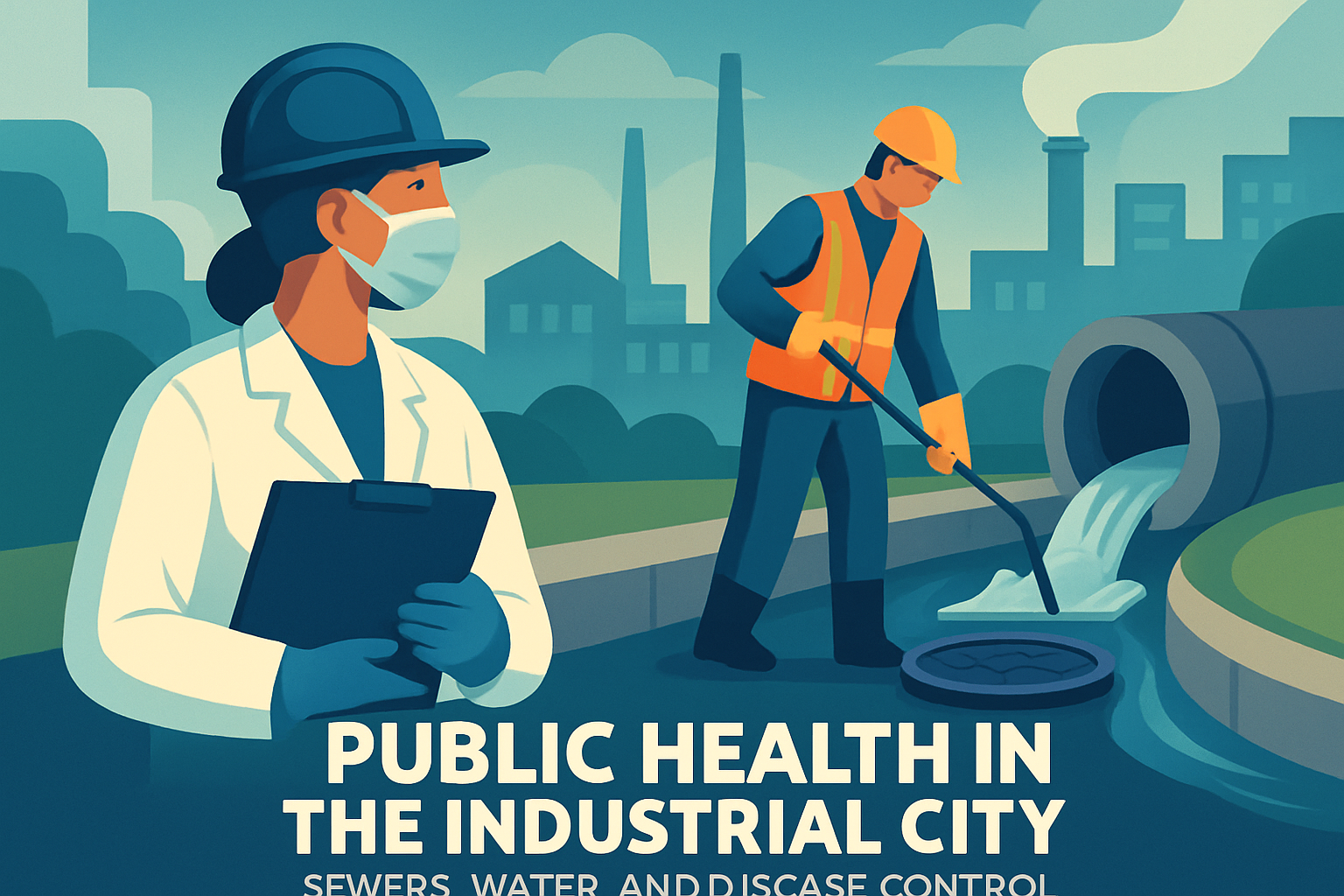
Public health in the industrial city was built not in lecture halls but under streets, along riverbanks, and inside crowded tenements where sewage, unsafe water, and infectious disease shaped daily life. The phrase “industrial city” refers to the rapidly growing urban centers of the eighteenth, nineteenth, and early twentieth centuries, where factories drew workers faster than housing and sanitation systems could expand. In those places, public health meant creating the physical conditions that allowed large populations to survive: clean drinking water, reliable sewerage, waste removal, drainage, inspection, and disease surveillance. Sewers carried human waste away from homes, water systems reduced exposure to pathogens, and disease control linked engineering with medicine. Together, they transformed cities from recurring epidemic zones into healthier places to live and work.
The subject matters because urbanization still follows the same biological rules. When population density rises without sanitation infrastructure, microbes exploit the gap. I have worked on content and research involving municipal infrastructure history and environmental health, and one lesson is consistent across cities and eras: mortality falls fastest when governments solve contamination at scale. Individual hygiene helps, but cholera, typhoid, dysentery, and hepatitis A spread through systems, not isolated choices. That is why public health historians often point to the sanitary revolution as one of the most important developments in modern life expectancy. The story is also central to current debates about aging water mains, combined sewer overflows, and urban resilience, because the basic challenge has never disappeared.
Three key terms define the topic. First, sewerage means the network of pipes, drains, pumping stations, and outfalls that collect and transport wastewater and stormwater. Second, potable water means water safe to drink, usually protected at the source and treated before distribution. Third, disease control includes surveillance, quarantine, vaccination, inspection, and reporting systems used to interrupt transmission. In an industrial city, these systems were interconnected. A leaking privy could contaminate a well; a polluted river could seed an epidemic; overcrowding could amplify every exposure. Public health, therefore, was never only about hospitals. It was an urban operating system that linked engineering, governance, and epidemiology.
Industrial growth created conditions that made older sanitation methods fail. Preindustrial towns could rely on cesspits, surface drains, and local wells because populations were smaller and waste volumes lower. Once factories concentrated tens or hundreds of thousands of people into dense districts, those methods broke down. Housing was often built quickly, with narrow courts, shared privies, damp basements, and poor ventilation. Waste accumulated near homes, slaughterhouses discharged into streams, and rain washed filth into the same water sources used for drinking. Reformers such as Edwin Chadwick in Britain argued that urban poverty and disease were linked to environmental conditions, while physicians like John Snow showed with practical evidence that specific diseases could move through contaminated water. The industrial city forced a new understanding: health depended on infrastructure as much as medicine.
Why sewers became the foundation of urban public health
Sewers became essential because they solved a basic public health problem: how to remove excreta and wastewater from dense neighborhoods before those materials contaminated living space or drinking supplies. In early industrial districts, the common alternatives were privy pits, cesspools, open drains, and night soil collection. All could work at small scale, but each struggled when streets filled with row housing and tenements. Privies overflowed, cesspools leaked, and open drains became stagnant channels of organic waste. The public saw foul smells; health officials increasingly saw transmission pathways.
London provides the clearest example. Repeated cholera epidemics in the nineteenth century exposed the danger of disposing waste close to water sources. The Great Stink of 1858, when hot weather intensified the smell from the Thames, pushed Parliament to fund a comprehensive sewer network designed by Joseph Bazalgette. His intercepting sewers redirected waste away from central London, reducing contamination of populated riverfront areas and creating a model copied worldwide. Bazalgette also built with future growth in mind, using generous pipe dimensions that proved remarkably durable. That is a lesson modern planners still admire: public health infrastructure must be sized for tomorrow, not just today.
Other cities followed different paths but reached the same conclusion. Paris expanded sewer tunnels under Baron Haussmann’s urban redesign. Hamburg improved drainage and wastewater handling after cholera exposed systemic weaknesses in 1892. In the United States, cities such as Chicago, Boston, and New York invested heavily in sewer construction as mortality data, nuisance complaints, and commercial pressure aligned. Sewerage was expensive, disruptive, and politically contested, yet once operating, it delivered benefits impossible to achieve through household effort alone.
Safe water supply changed the disease equation
If sewers removed hazards, safe water supply prevented them from reentering the body. That distinction is crucial. A city could build drains and still suffer epidemics if residents drank from contaminated wells, standpipes, or rivers. Waterborne diseases thrive when fecal contamination reaches a communal source. In the industrial city, this happened constantly because wastewater disposal, surface runoff, and drinking water intake were often poorly separated. The answer was source protection, filtration, pressure systems, and later disinfection.
The best known case is John Snow’s investigation of the 1854 cholera outbreak in Soho. By mapping deaths and linking many cases to the Broad Street pump, he demonstrated that cholera spread through contaminated water rather than bad air alone. His intervention, removing the pump handle, was symbolically powerful, but the deeper lesson was infrastructural. If a whole water supply is unsafe, medical treatment cannot stop an epidemic quickly enough. Cities must interrupt exposure upstream.
By the late nineteenth and early twentieth centuries, filtration plants and chlorination sharply reduced typhoid fever in many cities. Lawrence, Massachusetts, built one of the first modern municipal sand filtration plants in the United States in the 1890s. Jersey City adopted chlorination in 1908, helping establish routine disinfection as standard practice. These measures worked because they attacked pathogen transmission directly. Historical mortality records show dramatic declines in typhoid where protected watersheds, filtered supplies, and disinfected distribution systems were implemented together.
| Public health measure | Primary problem addressed | Typical urban result |
|---|---|---|
| Intercepting sewers | Waste accumulation and river contamination near dense districts | Lower exposure to fecal matter and fewer localized outbreaks |
| Water filtration | Pathogens and sediment in source water | Reduced typhoid and diarrheal disease |
| Chlorination | Microbial contamination in treated water and pipes | Safer municipal supplies at large scale |
| Drainage improvements | Standing water, damp housing, flooding | Healthier living conditions and better sanitation performance |
| Disease reporting systems | Delayed outbreak detection | Faster targeted intervention by health departments |
Disease control required data, law, and local enforcement
Engineering alone did not create public health. Cities also needed administrative systems that could detect disease patterns, enforce standards, and coordinate responses. This is where industrial urban governance matured. Boards of health, sanitary inspectors, registrars, and laboratory services turned scattered complaints into actionable information. Once cities began collecting death records by district, age, season, and cause, they could identify clusters and justify interventions with evidence rather than anecdote.
I have seen repeatedly in urban health history projects that the most successful reforms combined pipes with paperwork. Notification laws required physicians to report infectious diseases. Inspectors checked lodging houses, dairies, slaughterhouses, and water connections. Local ordinances regulated privies, refuse disposal, and drainage. In Britain, the Public Health Acts created a legal framework for municipalities to address nuisances and build sanitation works. In the United States, city health departments gained authority to inspect, isolate, disinfect, and in some cases close unsafe premises. These powers were not always welcomed, but without them standards remained optional.
Laboratory science strengthened disease control further. Once bacteriology advanced in the late nineteenth century, officials could test water for indicator organisms, identify typhoid carriers, and connect outbreaks to contaminated milk or supplies with greater confidence. Public health became more precise. Instead of assuming disease was simply a consequence of poverty or climate, cities could trace vectors, reservoirs, and routes of exposure. That precision mattered because it improved targeting. Closing one polluted well could save more lives than broad moral campaigns aimed at personal behavior.
The industrial city taught hard lessons about inequality
Public health improvements were rarely distributed evenly. Working-class districts, immigrant neighborhoods, and informal housing areas often waited longest for sewers, paved streets, reliable water pressure, and garbage collection. Disease maps from industrial cities repeatedly show that mortality concentrated where infrastructure was weakest. This was not accidental. Municipal investment followed property values, political influence, and assumptions about who deserved protection. Public health rhetoric could be universal, but implementation often reflected class and ethnic hierarchies.
Manchester, Glasgow, and New York all illustrate this pattern. Overcrowded tenement districts experienced higher rates of tuberculosis, diarrheal disease, and infant mortality because residents faced cumulative risks: shared sanitation, damp rooms, poor ventilation, contaminated food, and insecure employment. Reformers sometimes blamed residents for uncleanliness, but field investigations often showed that the real issue was structural neglect. A family cannot maintain sanitary conditions if one privy serves dozens of people and water is available only intermittently.
This history matters today because infrastructure inequity still drives health inequity. Lead service lines, basement flooding, illegal dumping, and sewer backups are modern versions of uneven protection. The core public health principle remains the same: environmental risk is socially distributed unless governments intervene deliberately. Effective disease control in any city requires universal service coverage, not selective modernization.
Tradeoffs, mistakes, and what modern cities still need to remember
The sanitary revolution was transformative, but it was not flawless. Early sewer systems often discharged untreated waste into downstream rivers, estuaries, or coastal waters, shifting hazards rather than eliminating them. Combined sewers, which carry both stormwater and sewage, can overflow during heavy rain and release contaminated water into streets and waterways. Water treatment can fail if source protection is neglected, as later crises in places such as Milwaukee in 1993 and Flint in the 2010s demonstrated in different ways. Public health infrastructure is not a one-time achievement; it is a continuous maintenance commitment.
There were also scientific detours. Before germ theory became widely accepted, many officials interpreted disease through miasma concepts, emphasizing foul air rather than microbes. Yet even those mistaken theories sometimes led to useful sanitation works because they targeted filth and stagnant waste. This is an important nuance. Good outcomes do not always emerge from perfect understanding, but durable progress requires accurate causal models. Once cities recognized waterborne transmission, investments in filtration, chlorination, and watershed protection became far more effective and measurable.
Modern urban planners still draw direct lessons from the industrial city. Separate sanitary and storm sewers reduce overflow risk. Asset management helps prioritize replacement of aging mains before failure. Continuous water quality monitoring catches treatment problems early. Public communication during outbreaks must be clear, rapid, and specific. Most importantly, public health and public works cannot operate in silos. The historic breakthrough came when cities treated sanitation, water engineering, housing, and disease surveillance as parts of one system. That remains the model worth defending.
Public health in the industrial city was ultimately a practical achievement: remove waste safely, protect drinking water, track disease, and enforce standards consistently. Sewers mattered because they separated people from excreta. Water systems mattered because they blocked fecal contamination at the point of consumption. Disease control mattered because data, inspection, and laboratory evidence turned infrastructure into measurable prevention. When these elements worked together, cholera retreated, typhoid declined, infant survival improved, and cities became governable at industrial scale.
The main benefit was not abstract civic progress but longer, more stable lives for ordinary urban residents. Factories, railways, and markets made industrial cities economically powerful, yet sanitation made them survivable. That is the lasting lesson for any reader interested in urban history, environmental health, or infrastructure policy: epidemics thrive where systems fail, and they recede where cities invest in universal public health protection. If you are exploring related topics, continue with municipal water treatment, housing reform, and epidemiology history, because each deepens the same story. Strong cities are built above all on clean water, effective sewers, and credible disease control.
Frequently Asked Questions
Why were sewers and clean water systems so important in the industrial city?
Sewers and reliable water supplies were central to public health because they addressed the everyday environmental conditions that allowed disease to spread in rapidly growing cities. Industrial urban centers expanded faster than streets, drains, housing, and waste systems could keep up. In many neighborhoods, human waste collected in cesspits, ran through open gutters, leaked into wells, or flowed into nearby rivers that also supplied drinking water. In crowded districts, that meant contamination was not an occasional problem but a constant feature of daily life. People cooked, drank, washed, and worked in conditions where polluted water and poor drainage were woven into the fabric of the city.
Modern sewer construction changed that reality by moving waste away from homes, yards, courtyards, and shared streets. At the same time, piped water systems made it possible to deliver cleaner water to large populations on a more consistent basis. Together, these systems reduced exposure to the sources of cholera, typhoid, dysentery, and other waterborne illnesses. They also improved general urban living conditions by reducing foul smells, flooding of waste, and the persistent dampness and filth associated with overcrowded housing. In practical terms, public health in the industrial city depended on infrastructure because disease control required more than medical treatment. It required reshaping the physical environment so that ordinary life became less dangerous.
How did unsafe water contribute to disease outbreaks in nineteenth-century cities?
Unsafe water played a direct and devastating role in urban disease outbreaks because it connected waste disposal failures to the most basic human necessity: drinking water. In many industrial cities, rivers served multiple purposes at once. They were transportation routes, dumping grounds for industrial waste, outlets for sewage, and sources of water for homes and businesses. Even where wells were used, those wells were often shallow and easily contaminated by nearby privies, drains, or overflowing cesspools. In dense working-class districts, contamination spread quickly because so many people depended on a limited number of shared water points.
When pathogens entered the water supply, disease could move through whole neighborhoods with startling speed. Cholera became the most famous example because it revealed how deeply public health was tied to urban infrastructure. Repeated cholera epidemics forced city officials, reformers, and engineers to confront the fact that disease was not simply the result of personal weakness or bad habits. It was often a consequence of systems that allowed sewage and drinking water to mix. Typhoid fever also thrived under such conditions, and recurring outbreaks exposed the danger of relying on polluted rivers or poorly protected wells. Over time, the link between contaminated water and disease helped shift public health from a narrow focus on individual behavior toward large-scale interventions such as filtration, piped water, drainage works, sewage removal, and water quality monitoring.
What role did overcrowded housing and tenements play in public health problems?
Overcrowded housing and tenements were major drivers of ill health because they concentrated people in spaces that were poorly ventilated, damp, dark, and often lacking basic sanitation. Industrial cities attracted workers faster than decent housing could be built, so landlords divided buildings into smaller and smaller units to maximize rent. Families often lived in one or two rooms, shared privies with many other residents, and relied on limited access to clean water. In these settings, waste accumulated quickly, air circulation was poor, and infectious disease spread more easily from person to person.
Tenements also highlighted the close connection between the home and the wider city environment. Even if reformers improved a street sewer or installed a public water main, health problems persisted if buildings remained overcrowded and unsanitary. Tuberculosis, diarrheal disease, skin infections, and respiratory illness all found fertile ground where nutrition was poor and living quarters were cramped. Children were especially vulnerable because they faced repeated exposure to contaminated surfaces, polluted yards, shared toilets, and unsafe drinking water. Public health officials increasingly realized that housing itself was a health issue, not just a private matter. This led to campaigns for building inspection, minimum standards for light and ventilation, improved drainage, waste removal, and later housing reform laws. In that sense, the tenement was one of the key places where industrial urban life made clear that disease control depended on social and environmental conditions, not just on hospitals or doctors.
How did cities begin to control infectious disease before modern antibiotics?
Before antibiotics, cities controlled infectious disease primarily through prevention, sanitation, surveillance, and environmental reform. This is one of the most important lessons of industrial urban history. Municipal governments and health boards learned that they could save lives by reducing exposure to infection rather than waiting to treat people after they became seriously ill. That approach included building sewer networks, improving drainage, protecting water sources, collecting garbage more regularly, cleaning streets, inspecting housing, and regulating slaughterhouses, markets, and other sites where contamination could spread.
Cities also developed administrative tools that were crucial to disease control. Officials began collecting mortality data, mapping outbreaks, enforcing quarantine in some cases, and requiring notification of certain infectious diseases. Public health departments emerged as institutions with growing authority to inspect neighborhoods, close unsafe wells, order the removal of waste, and respond to epidemics. Vaccination campaigns, especially against smallpox, also became part of the public health toolkit. Just as important, public education efforts encouraged boiling water, improving household cleanliness, isolating the sick when possible, and paying attention to symptoms during outbreaks. None of these measures eliminated disease overnight, and many were unevenly applied, especially in poor districts. Still, together they dramatically reduced mortality over time. The broader point is that industrial-era disease control depended on coordinated civic action. Streets, pipes, records, inspections, and local government capacity mattered as much as medicine.
Why is the history of public health in the industrial city still relevant today?
The history remains highly relevant because it shows that public health is inseparable from infrastructure, housing, inequality, and political decision-making. Industrial cities teach a clear lesson: disease spreads most effectively where basic systems fail or where access to those systems is uneven. Safe water, sewage treatment, waste removal, decent housing, and effective local administration were not luxuries in the past, and they are not luxuries now. They are foundational conditions that shape whether communities can live safely. When those systems are neglected, underfunded, or distributed unequally, familiar health dangers return in new forms.
This history also matters because it challenges the idea that public health is only about hospitals, laboratories, or individual choices. The industrial city demonstrates that some of the greatest health advances came from investments buried underground and built into everyday environments. It took engineers, reformers, municipal officials, inspectors, and community pressure to create healthier cities. Today, debates over aging water systems, environmental justice, urban crowding, sanitation access, and emergency preparedness echo many of the same issues faced in the nineteenth and early twentieth centuries. Understanding how earlier cities confronted sewage, unsafe water, and infectious disease helps explain why public health succeeds best when it combines science with strong institutions and practical improvements to the places where people actually live and work.