
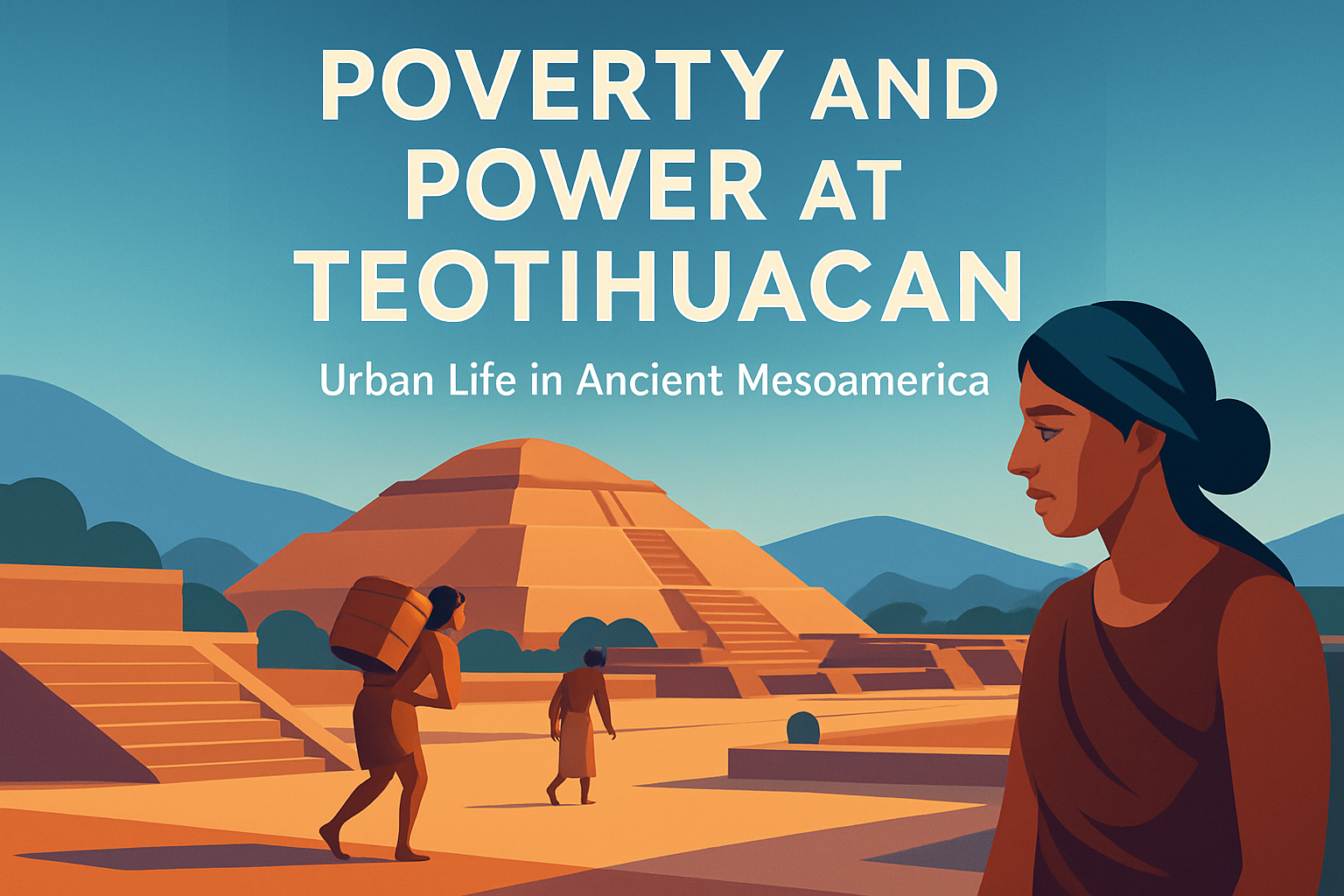
Introduction to Teotihuacan, Poverty, and Power Dynamics
Teotihuacan, a grand city of ancient Mesoamerica, has long intrigued historians, archaeologists, and enthusiasts alike with its sprawling urban landscape and enigmatic history. Located in the Basin of Mexico, it was one of the largest urban centers in the pre-Columbian Americas, thriving from around 100 BCE to 550 CE. But beyond its monumental pyramids and awe-inspiring architecture lies a complex social structure dominated by powerful elites, contrasted starkly by systemic poverty.
Understanding poverty and power dynamics at Teotihuacan provides significant insights into the broader socio-political landscape of ancient Mesoamerican societies. To unravel these layers, it is crucial to define what ‘poverty’ and ‘power’ meant in this context. Poverty at Teotihuacan was not merely a lack of resources but a limitation on social mobility and access to essential societal roles. Power, in contrast, was wielded by a select few who controlled resources, political influence, and religious authority.
Recognizing these dynamics matters because studying ancient power hierarchies and socio-economic systems offers valuable lessons for contemporary urban societies. Exploring Teotihuacan’s intricate tapestry of poverty and power aids current scholars, urban planners, and sociologists in understanding how ancient urban environments were structured, how they thrived, and ultimately, what led to their decline.
The Urban Structure of Teotihuacan: A Duality of Wealth and Poverty
The hallmark of Teotihuacan’s urban layout was its order and meticulously planned avenues, particularly the grand Avenue of the Dead. Archaeological evidence suggests that this layout was a manifestation of both religious symbolism and a clear social hierarchy. Power was physically entrenched in this urban design where major religious and administrative buildings, such as the Pyramid of the Sun and Pyramid of the Moon, were centrally located, providing elites unparalleled access and control over the city’s spiritual life.
In contrast, the majority lived in apartment compounds, which, while remarkably uniform in their organization, often lacked in luxury. These compounds housed craftspeople, farmers, and other laborers in a collective fashion that indicated limited individual wealth. Historical records and excavations point toward a class disparity that was marked not just economically, but also spatially across the cityscape.
Power in the Hands of the Few: The Elite Class of Teotihuacan
Teotihuacan’s social structure was heavily controlled by a minority elite. This elite class consisted of rulers, priests, and powerful families who had access to significant wealth and resources. Their authority was not only political but also religious, as they were considered intermediaries with the gods, reinforcing their power through elaborate rituals and ceremonies.
Elaborate murals found in elite residences depict scenes of festivals and offerings to deities, showcasing their role in maintaining social order and religious commitments. One particular example is the complex mural at the Tepantitla compound, illustrating the ‘Paradise of Tlaloc’, a vividly colored mural that is believed to represent a prosperous vision of the afterlife for those who live in accordance with the spiritual and social norms dictated by the elite. Such art not only adorned their homes but also served as a tool for propaganda, reinforcing societal norms that kept the elite at the top.
The Role of Religion: A Pillar of Authority
Religion at Teotihuacan was a pivotal pillar supporting the city’s hierarchical structure. The elite used religion to justify their rule and employed religious architecture as symbols of power. Temples within the city were sites of elaborate public rituals presided over by the elite, emphasizing their connection to divine forces.
Newsletter and iconography evidence suggest that these public ceremonies were vital in maintaining social cohesion and controlling the lower classes through fear and reverence. These religious practices ensured that all classes were kept in check, with the promise of divine protection and the threat of divine wrath serving as compelling motivators.
Trade and Economy: Lifelines and Inequities
Teotihuacan was at the heart of ancient Mesoamerican trade networks, serving as a hub for goods ranging from obsidian to textiles. However, the management and profits of this bustling trade were predominantly in the hands of the elite. They facilitated and controlled these trade routes, further entrenching their power base through the accumulation of wealth.
Most residents, particularly those involved in the production of tradable goods, reaped minimal benefits from this economic engine. Laborers and artisans, who lived in the apartment compounds mentioned earlier, formed the backbone of this economic structure yet remained economically marginalized, illustrating a clear dichotomy between the wealth amassed by the elite and the subsistence living of the lower classes.
| Economic Aspect | Control and Benefits |
|---|---|
| Trade Routes | Controlled by the elite, benefiting primarily them. |
| Crafts and Artisan Work | Craftspeople produced goods, received basic sustenance. |
| Religious Offerings | High-value items funneled to religious institutions, managed by elites. |
Depiction and Documentation: Insights from Pottery and Artifacts
Archaeological discoveries, including pottery and stone sculptures, stand testament to the disparities in Teotihuacan’s social classes. These artifacts often reflect the lives of the elite, portraying grandeur and divine affiliation through intricate designs and depictions of gods and rituals. In contrast, items used by the lower classes are far more utilitarian, reflecting the pragmatic existence of poverty.
Notably, the substantial presence of imported luxury goods within elite compounds underscores their power to access and control regional economies. Meanwhile, findings of basic yet essential everyday items at commoner sites reveal endurance and resourcefulness amidst scarcity, offering a silent narrative of the lower class’s resilience in the face of systemic inequality.
The Decline of Teotihuacan: Lessons from History
Teotihuacan’s eventual decline in the 6th century CE remains a subject of scholarly debate, often attributed to internal strife, resource depletion, or external invasions. However, many researchers suggest that the deep socio-economic divisions might have played a significant role. As resource distribution became increasingly unequal and the ruling class faced pressure from both internal lower classes and external rival cities, the societal fabric began to unravel.
This collapse exemplifies how deeply entrenched socio-economic disparities can contribute to the fall of even the most impressive urban centers. The decline of Teotihuacan is a powerful reminder of the consequences of neglecting to address poverty and misallocated power, themes that resonate with today’s urban societies coping with similar challenges.
Conclusion: Key Takeaways and Future Path
Teotihuacan’s historical narrative of poverty and power is a profound reminder of the complexities underlying ancient urban life. By delving into the socio-economic structures of one of the great cities of Mesoamerica, we understand the intricate dance of control and desperation that defined life at Teotihuacan. The duality of prosperity and poverty here illustrates vital lessons: unchecked power amassed by the few at the expense of the many can lead to societal instability and eventual decline.
For readers and scholars alike, the key takeaway is the importance of balanced resource distribution and inclusive governance in sustainable urban development. As modern societies navigate their paths, understanding these age-old dynamics offers a wealth of knowledge to avoid past mistakes. The study of Teotihuacan prompts modern policy makers, social scientists, and urban developers to look deeply into socio-economic structures, addressing inequities to foster more equitable and enduring cities.
This reflection on Teotihuacan urges a call to action for anyone engaged in building or studying urban environments today: Let the past inform the present, striving for cities that truly serve their citizens, fostering equity, opportunity, and resilience across all strata of society.
Frequently Asked Questions
1. What was the social hierarchy in Teotihuacan, and how did it influence urban life?
Teotihuacan’s social hierarchy was a complex system that was central to the organization and functioning of the city. At the top of the hierarchy were influential elites, possibly including kings or ruling families, who exerted significant control over the city’s resources and governance. These elites likely lived in luxurious palatial complexes, far removed from the everyday struggles of the lower classes.
Beneath the elite class, there were priests and religious leaders who played a crucial role in maintaining the spiritual and cosmic order through ritualistic practices, impacting the social life significantly. Artisans and traders formed the middle echelons, contributing to the city’s economic vitality through craft production and commerce. They lived in modest but relatively well-planned residential areas, benefiting from their economic roles.
The majority of the city’s populace consisted of laborers and farmers, who sustained the city through agriculture and manual labor. Evidence suggests that these people lived in apartment-like compounds that housed extended families, revealing a communal lifestyle that was both a necessity and a cultural choice.
The hierarchy deeply influenced urban living, with distinct neighborhoods and varying access to resources and political power. The structured social classes created a clear division of labor and status, which was visibly reflected in the urban design and distribution of amenities.
2. How did power dynamics shape the architecture and layout of Teotihuacan?
The power structures in Teotihuacan deeply informed its urban planning and architectural grandeur. The city’s layout is meticulously organized along a north-south axis, with the Avenue of the Dead serving as a central spine. This main avenue connects significant structures such as the Pyramid of the Sun and the Pyramid of the Moon—massive constructions that reflect the might and religious beliefs of the ruling elite.
The architecture of Teotihuacan is characterized by large public and ceremonial spaces that emphasize the city’s political and religious power. Elite residences, adorned with elaborate murals and built using superior construction techniques, highlight the social stratification. Conversely, the residential compounds of ordinary citizens, although less grandiose, were functionally well-designed, indicating a level of uniformity imposed by central governance.
Furthermore, the scale and disposition of the public buildings and plazas suggest that power was not only used for celebratory purposes but also as a means of societal cohesion, bringing people together through large-scale events and religious celebrations, thereby reinforcing the centralized power structures.
3. What evidence do archaeologists use to determine poverty levels in ancient Teotihuacan, and what have they found?
Archaeologists employ various methodologies to assess poverty and living standards among the ancient inhabitants of Teotihuacan. The examination of residential compounds is a primary method, as these provide tangible insights into the standard of living. Dwellings that lack elaborate decoration and are built with less durable materials often indicate lower economic status.
Material culture plays a significant role in this analysis. The presence or absence of luxury goods, such as jewelry, finely-crafted ceramics, and imported materials, helps archaeologists infer wealth distribution. The limited access to these non-essential items in certain areas suggests economic disparity and varying degrees of poverty.
Skeletal analysis is another critical tool. Indicators of malnutrition or inadequate healthcare, reflected in skeletons recovered from burial sites, offer direct evidence of impoverishment and living conditions. These findings are often complemented by isotopic analysis, which can reveal dietary differences among residents, further elucidating the economic stratification.
Archaeologists have discovered that while some communities thrived, others faced significant hardships. Despite the city’s wealth and power, a noticeable segment of the population lived with limited resources, indicating a complex tapestry of social and economic experiences in Teotihuacan.
4. In what ways did economic activities reflect the power dynamics of Teotihuacan?
Economic activities in Teotihuacan were primarily reflective of the relationships between different social classes and their access to resources and trade networks. The city’s economy was vibrant and multifaceted, dominated by craft production, agriculture, and trade, which were controlled by the elites and benefited from their power and influence.
The concentration of workshops in specific areas, likely controlled by wealthy patrons, exemplifies the centralization of economic power. Certain industries, such as obsidian tool production, were highly specialized and controlled by skilled artisans under the patronage of elite sponsors, who facilitated both local use and trade exports.
Teotihuacan’s strategic location in the Basin of Mexico also made it a crucial trading hub, allowing it to establish connections with distant regions. The reach of these trade networks is seen in the diversity of materials and artifacts found within the city, including items from Central America and beyond. These exchanges reinforced the city’s power, fostering wealth that was unevenly distributed among its residents.
The prominence of such economic activities supported the ruling class’s continued influence, enabling them to maintain their social status and reinforcing the hierarchical structure of Teotihuacan society.
5. How does the study of Teotihuacan inform our understanding of ancient urban life in Mesoamerica?
The exploration of Teotihuacan provides critical insights into the complexities of ancient urban life in Mesoamerica by offering a window into the interactions between power, society, and economy. As one of the earliest and largest urban centers of the pre-Columbian Americas, Teotihuacan illustrates the capacity for sophisticated urban planning and the execution of large-scale architectural projects, which necessitated a high degree of organization and central authority.
Understanding the city’s social stratification and economic activities reveals how deeply interconnected social classes and economic roles were, contributing to the city’s overall stability and development. Teotihuacan also exemplifies the role of religion and cosmology in urban life, as seen through ceremonial practices and the alignment of buildings, reflecting a worldview that permeated daily life.
The study of Teotihuacan helps in understanding the disparity of wealth and resources, giving a broader context to the social inequalities that existed in ancient pasts. These insights offer valuable lessons about the sustainability challenges faced by ancient urban societies, the management of complex social systems, and the cultural resilience necessary to build and maintain large communities.
In sum, the study of Teotihuacan offers a multifaceted view into how ancient societies organized themselves, balanced power, and thrived, making it an essential piece of the puzzle in the larger narrative of human urban development.