
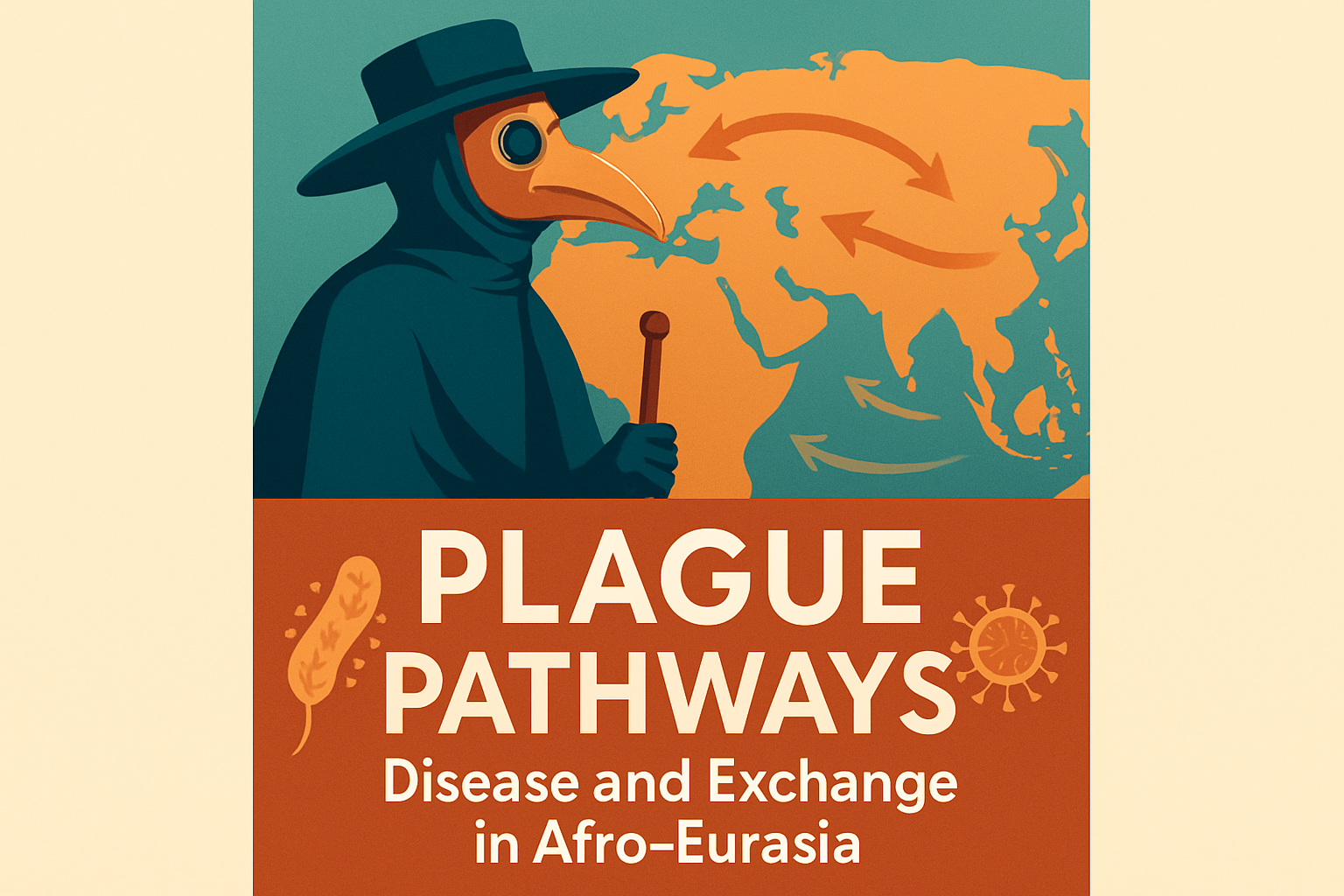
Afro-Eurasia became the world’s largest connected disease environment when merchants, pilgrims, soldiers, and imperial officials linked Africa, Europe, and Asia through regular exchange. “Plague Pathways: Disease and Exchange in Afro-Eurasia” captures a central historical fact: the same roads and sea lanes that moved silk, horses, spices, silver, and ideas also carried microbes. In historical epidemiology, “disease exchange” refers to the movement of pathogens, hosts, and vectors across regions through human networks. “Plague” can mean epidemic disease broadly, but in strict medical terms it refers to infection by Yersinia pestis, a bacterium usually transmitted through fleas that live on rodents. Both meanings matter because Afro-Eurasian history was shaped not only by the Black Death, but also by smallpox, cholera, measles, influenza, and other infections that followed trade routes.
This subject matters because disease was not a side effect of exchange; it was one of its most powerful consequences. I have worked through trade-route case studies and outbreak records enough to see a consistent pattern: when connectivity deepened, prosperity often rose, but biological risk rose with it. Caravanserais concentrated travelers, ports mixed crews from distant ecologies, and armies bridged regions that had previously been separated by terrain or climate. The result was a continental system in which local outbreaks could become transregional crises. Understanding that system helps explain demographic collapse, labor shortages, state responses, religious change, urban planning, and public health traditions across Afro-Eurasia.
Afro-Eurasia was especially vulnerable because it combined enormous population density with long-distance commerce. China, India, the Islamic world, East Africa, and Europe were tied together by Silk Road caravans, Indian Ocean shipping, Red Sea connections, and Mediterranean trade. Monsoon navigation let merchants move predictably between ports such as Calicut, Aden, and Malacca. Overland empires, especially the Mongol Empire in the thirteenth and fourteenth centuries, reduced barriers to movement across inner Asia. In practical terms, that meant pathogens could travel farther, faster, and more repeatedly than in earlier eras. Once historians combine shipping evidence, climate records, and burial data, the picture becomes clear: exchange networks created durable epidemic corridors.
Trade routes as microbial highways
Trade routes spread disease because they moved more than goods. They moved infected people during incubation periods, animals carrying parasites, and commodities stored in conditions that attracted rodents. On caravan routes, merchants slept in enclosed stations where fleas could shift hosts. In ports, grain stores and ship holds offered ideal environments for rats. Even when a disease did not depend on rodents, busy markets amplified person-to-person transmission. Measles and smallpox thrived in dense settlements because they required large pools of susceptible hosts. Cholera later exploited water systems tied to urban growth and pilgrimage traffic.
From experience analyzing medieval logistics, I can say the critical factor was repetition, not just distance. A single expedition might fail to seed an epidemic, but regular circulation created resilience for pathogens. The Silk Roads were not one road; they were a web linking northern China, Central Asia, Persia, the Levant, and the Black Sea. The Indian Ocean was similar, with dhows and larger vessels timing departures to monsoon winds. Those rhythms mattered. Seasonal travel synchronized human mixing, and repeated docking at commercial hubs ensured microbes had multiple opportunities to establish themselves.
Environmental conditions shaped these pathways. Steppe ecology affected rodent populations; drought and rainfall altered flea and host behavior; port sanitation influenced outbreak severity. Historians increasingly pair written chronicles with paleogenetics and climate proxies to map transmission. That approach has strengthened the case that exchange networks were not abstract “connections” but physical systems with biological consequences. The best way to understand plague pathways is to follow specific nodes where people, animals, and goods repeatedly converged.
The Black Death and the Mongol-connected world
The clearest example is the Black Death of the fourteenth century. Most scholars connect its spread to the wider integration of Eurasia under Mongol rule, often called the Pax Mongolica. Mongol governance improved security across major stretches of the Silk Roads, supported diplomatic mobility, and intensified commerce from China to the Mediterranean. That integration did not cause Yersinia pestis to exist, but it did create conditions in which a localized zoonotic disease could move through imperial relay systems, caravan traffic, and siege warfare into densely settled regions.
One famous episode involves the Genoese trading port of Caffa on the Crimean coast. Contemporary accounts describe a Mongol siege in the 1340s during which plague struck the attackers. Although the dramatic story of catapulted corpses may be embellished, the larger point stands: Caffa was a hinge between steppe, Black Sea, and Mediterranean networks. From such ports, ships carried infected rats and fleas toward Constantinople, Messina, Venice, Marseille, and beyond. By 1347 to 1351, plague had killed a devastating share of populations across the Middle East, North Africa, and Europe. Regional mortality estimates vary, but many historians place losses in the range of 30 to 50 percent in heavily affected areas.
The Black Death was not a single wave ending neatly in 1351. It became recurrent. Once established in trade-linked environments, plague returned in later outbreaks for centuries. That recurrence reveals an important principle for both SEO-style direct answering and sound history: major exchange systems do not merely transmit a pathogen once; they can normalize periodic reintroduction. In Egypt, Mamluk urban centers remained highly vulnerable because Red Sea and Mediterranean connections kept commerce active. In Ottoman lands and early modern Europe, continued shipping sustained risk even as communities developed quarantine policies.
Ports, pilgrimages, and urban disease ecology
Ports were among the most dangerous and productive spaces in Afro-Eurasia because they compressed diversity into tight urban ecologies. Alexandria, Aden, Venice, Calicut, Hormuz, and Canton connected inland production zones to maritime circuits. In each case, warehouses, animal traffic, limited sanitation, and constant arrivals created ideal conditions for epidemic spread. Disease moved not only through trade crews but also through port laborers, innkeepers, tax officials, and local families who depended on maritime commerce. That is why outbreaks often appeared first in littoral cities before moving inland along river valleys and roads.
Pilgrimage routes magnified the effect. The Hajj connected Muslims from West Africa, North Africa, the Middle East, Central Asia, South Asia, and Southeast Asia. Pilgrimage generated profound religious and commercial benefits, but from an epidemiological perspective it assembled large, mobile, immunologically varied populations. Later cholera outbreaks in the nineteenth century repeatedly intersected with pilgrimage mobility through the Red Sea. Similar dynamics applied to Buddhist, Hindu, and Christian pilgrimage circuits, though disease outcomes depended on crowding, season, water quality, and return travel patterns.
| Network node | Main exchange function | Disease risk mechanism | Historical example |
|---|---|---|---|
| Caravanserai | Overland lodging and trade | Crowding, fleas, shared bedding | Silk Road stations in Central Asia |
| Port city | Maritime loading and warehousing | Rats, contaminated water, dense contact | Alexandria and Venice |
| Pilgrimage center | Religious gathering and commerce | Mass mixing of distant populations | Mecca during cholera eras |
| Military camp | Campaign logistics and troop movement | Malnutrition, stress, rapid mobility | Mongol and later Ottoman campaigns |
Urban response varied. Some cities improved waste removal, burial practices, and inspection of arriving vessels. Venetian authorities developed one of the best-known quarantine systems, including the lazzaretto, or isolation station, in the fifteenth century. Quarantine did not eliminate plague, but it represented a major administrative adaptation to exchange-driven disease. It also shows that Afro-Eurasian societies were not passive victims. They observed patterns, experimented with controls, and institutionalized lessons when commerce made complete closure impossible.
Beyond plague: smallpox, cholera, influenza, and measles
Focusing only on the Black Death misses the broader disease exchange of Afro-Eurasia. Smallpox circulated for centuries across Asia, the Middle East, Africa, and Europe, thriving in dense populations and periodically striking rulers and commoners alike. Measles similarly depended on sustained chains of transmission in larger communities. Influenza moved rapidly along military and commercial routes because respiratory viruses spread efficiently in crowded, mobile populations. Cholera, associated with Vibrio cholerae, emerged from South Asian ecological settings but became a transregional threat when steam travel, imperial trade, and pilgrimage linked contaminated water sources to wider human movement.
Each disease interacted with exchange differently. Plague relied heavily on vector and host ecology. Cholera depended on water and sanitation. Smallpox and measles spread directly between people. That distinction matters because historical responses had to match transmission mode. Isolating ships could help with some threats, but not if urban water remained contaminated. Restricting caravans might slow one epidemic, while vaccination later transformed the smallpox equation. In my reading of port records and public health ordinances, the most effective authorities were those that recognized these differences rather than treating every outbreak as the same event.
The common denominator was connectivity. Exchange increased exposure to pathogens from distant disease pools and reduced the protective effect of isolation. It also altered immunity patterns. Communities previously unexposed to a disease often suffered more severe mortality when first contact occurred. Even where mortality was lower, repeated illness weakened labor systems, strained grain supply, and reduced tax revenue. Disease therefore acted as an economic force inside exchange networks, not just a medical one.
Economic, social, and political consequences across regions
Disease reshaped Afro-Eurasian societies by changing labor, prices, state capacity, and belief. After the Black Death, labor scarcity in parts of Europe increased bargaining power for surviving workers and contributed to wage pressure, tenancy shifts, and conflict over labor control. In Mamluk Egypt, recurrent plague damaged military-fiscal structures by reducing population and disrupting agriculture and trade. In parts of the Islamic world, charitable endowments, hospitals, and legal debate addressed epidemic realities even when germ theory did not yet exist. In China, epidemic stress interacted with famine, warfare, and dynastic transition, reminding us that disease rarely acts alone.
Socially, epidemics changed burial customs, family formation, and attitudes toward strangers. They could intensify xenophobia, as frightened populations blamed outsiders, minorities, or merchants. Yet they could also stimulate new forms of care, recordkeeping, and state intervention. One of the clearest lessons from Afro-Eurasian disease exchange is that commercial openness always requires governance. Markets flourish when movement is predictable, but public trust depends on mechanisms to manage the hazards of movement. Medieval quarantines, port inspections, travel documentation, and hospital expansion were early versions of that balancing act.
For historians, the value of studying these plague pathways is explanatory power. It connects environmental history, economic history, and the history of medicine. It also corrects simplistic narratives that treat trade as purely beneficial or disease as purely natural. Epidemics were produced through interaction between nature and human systems. Roads, ships, taxation regimes, imperial protections, warehousing practices, and urban density all mattered. Afro-Eurasia became historically dynamic partly because it was connected; it became epidemiologically vulnerable for the same reason.
Plague pathways in Afro-Eurasia reveal a hard truth with enduring relevance: every expansion of exchange creates new channels for disease as well as wealth. Trade routes, empires, ports, and pilgrimages bound Africa, Europe, and Asia into a shared biological world long before modern globalization. The Black Death remains the most famous case, but it was part of a larger pattern that included smallpox, measles, influenza, and cholera. When people, animals, goods, and water systems moved across distance with increasing regularity, pathogens moved with them.
The main benefit of studying this history is clarity. It helps explain why some cities prospered yet remained fragile, why states developed quarantine and inspection regimes, and why economic integration always carries public health consequences. It also shows that historical societies observed epidemic patterns carefully and built practical responses, even without modern microbiology. If you want to understand Afro-Eurasian trade, empire, or urban growth, you have to understand disease exchange as part of the same story.
Use this framework the next time you read about the Silk Roads, the Indian Ocean, or the Black Death: ask not only what goods moved, but what microbes, vectors, and vulnerabilities traveled alongside them. That question opens a deeper view of world history and makes the connections of Afro-Eurasia far more concrete.
Frequently Asked Questions
What does “disease exchange” mean in the context of Afro-Eurasia?
In the context of Afro-Eurasia, “disease exchange” refers to the movement of pathogens, animal hosts, and disease-carrying vectors across connected regions through trade, travel, warfare, migration, and imperial administration. As Africa, Europe, and Asia became more tightly linked by caravan routes, maritime networks, pilgrimage roads, and expanding empires, they formed an enormous shared epidemiological zone. That meant diseases were no longer confined to isolated local environments. Instead, infections could move with merchants transporting spices and textiles, soldiers marching across frontiers, pilgrims traveling to sacred centers, or officials maintaining long-distance states.
This exchange was not limited to one famous outbreak or one single disease. It included recurring waves of plague, as well as the spread of illnesses shaped by changing ecology, urban crowding, and intensified human-animal contact. The term also highlights that disease transmission depended on systems of exchange: ports, market towns, garrison cities, shipping routes, pack animals, and storage sites all created opportunities for microbes to travel. In other words, disease exchange was the biological side of globalization before the modern era. The same networks that circulated goods and ideas also created pathways for epidemic disease.
Why did Afro-Eurasia become such a large connected disease environment?
Afro-Eurasia became the world’s largest connected disease environment because it contained dense populations, major urban centers, extensive trade routes, and powerful states that encouraged movement across vast distances. Over centuries, commercial and political networks linked the Mediterranean, the Indian Ocean, the Sahara, Central Asia, the Persian Gulf, East Africa, South Asia, and East Asia. Once these regions were connected with some regularity, diseases gained repeated opportunities to move from one ecological zone to another.
Several conditions made this especially important. First, large cities concentrated people in close quarters, making transmission easier. Second, long-distance commerce depended on animals, ships, caravans, warehouses, and markets, all of which could shelter rodents, fleas, contaminated goods, or infected travelers. Third, imperial systems often stabilized roads, secured frontiers, standardized administration, and protected trade, unintentionally making movement more reliable not just for merchants and diplomats, but for pathogens as well. Fourth, religious travel and military campaigns regularly brought together people from different regions, increasing exposure to unfamiliar diseases.
The result was not a perfectly unified disease world in a modern sense, but a broad and increasingly interconnected one. Illnesses could move in stages, from inland caravan hubs to coastal ports, from port cities to river systems, and from regional outbreaks to intercontinental epidemics. This is why historians describe Afro-Eurasia as a connected disease environment: human mobility and ecological exchange created sustained channels through which disease could spread over great distances.
How did trade routes and sea lanes help spread plague and other diseases?
Trade routes and sea lanes helped spread disease by moving infected people, animals, and vectors between regions that would otherwise have remained more isolated. On overland routes, caravans carried not only luxury goods and raw materials but also the biological conditions for disease transmission. Caravanserais, market centers, and oasis towns acted as stopping points where traders, animals, and local populations mixed closely. If a disease entered one of these nodes, it could travel onward with the next group of merchants or officials.
Maritime trade worked in similar ways, often even faster. Ships connected Red Sea ports, East African harbors, Persian Gulf entrepôts, Indian Ocean trading cities, and Mediterranean markets in regular cycles. A vessel might carry infected crew members, stowaway rodents, contaminated supplies, or fleas embedded in cargo environments. Because ports were crowded, commercially active, and tied to inland networks, they became especially important gateways for epidemic spread. Once disease arrived at a port, it could move inland via river transport, road systems, or local market exchanges.
Plague is the best-known example because it is closely associated in historical scholarship with the movement of rodents and fleas through trade environments, but the broader pattern applies to many diseases. Trade did not “cause” microbes to exist, but it dramatically increased their mobility. Routes built for commerce became transmission corridors. The more regular, profitable, and geographically expansive the exchange system became, the more effectively diseases could circulate through Afro-Eurasia.
Who were the main agents of disease movement across Afro-Eurasia?
The main agents of disease movement were not only merchants, though they played a major role. Pilgrims, soldiers, sailors, imperial messengers, tax collectors, enslaved people, migrants, and nomadic groups all contributed to the circulation of disease. Any population moving between regions could carry infection directly or create the conditions for indirect spread. A pilgrimage route, for example, might gather thousands of travelers from distant lands into shared lodgings, ritual spaces, and crowded urban centers, making transmission more likely. Armies could spread disease even more aggressively by moving large groups quickly, disrupting food supplies, besieging cities, and exposing populations to stress and unsanitary conditions.
Animals were also critical agents. Pack animals, horses, camels, and livestock were part of the transport infrastructure of Afro-Eurasia, while rodents and fleas often served as vectors in plague transmission. These nonhuman participants remind us that disease exchange was ecological as well as human. Goods storage, grain transport, animal fodder, ship holds, and urban waste created environments where vectors could survive and spread.
Imperial institutions also mattered. Administrators and officials maintained communications across long distances, while empires often fostered roads, relay stations, and protected trade circuits. These systems were designed to increase order and connectivity, but they also increased biological exposure. So when historians ask who carried disease across Afro-Eurasia, the answer is broad: virtually every group involved in exchange, movement, conquest, worship, labor, or governance could become part of the process.
Why is the study of disease exchange important for understanding Afro-Eurasian history?
Studying disease exchange is essential because it shows that connectivity brought both prosperity and vulnerability. Afro-Eurasian exchange is often remembered for the spread of technologies, religions, crops, artistic styles, and commercial wealth. But disease was one of the most consequential things that moved along these same networks. Epidemics could reduce populations, weaken armies, disrupt trade, transform labor systems, challenge state authority, and reshape patterns of settlement. In some periods, disease outbreaks altered the balance of power as dramatically as war or economic change.
This perspective also helps historians understand that disease is not separate from political and economic history. Epidemics were tied to urban growth, environmental change, imperial integration, and commercial expansion. Looking at disease exchange reveals the hidden biological costs of interregional contact. It shows that roads and sea lanes were not neutral channels; they carried risk as well as opportunity.
More broadly, the topic offers a powerful lesson about historical globalization. Afro-Eurasia became interconnected long before the modern world economy, and that interconnection had profound epidemiological consequences. By tracing how disease moved through exchange networks, historians can better explain why outbreaks spread when they did, why some regions were especially vulnerable, and how human societies adapted to recurring epidemic threats. In that sense, disease exchange is not a side story. It is central to understanding how Afro-Eurasian history actually worked.