
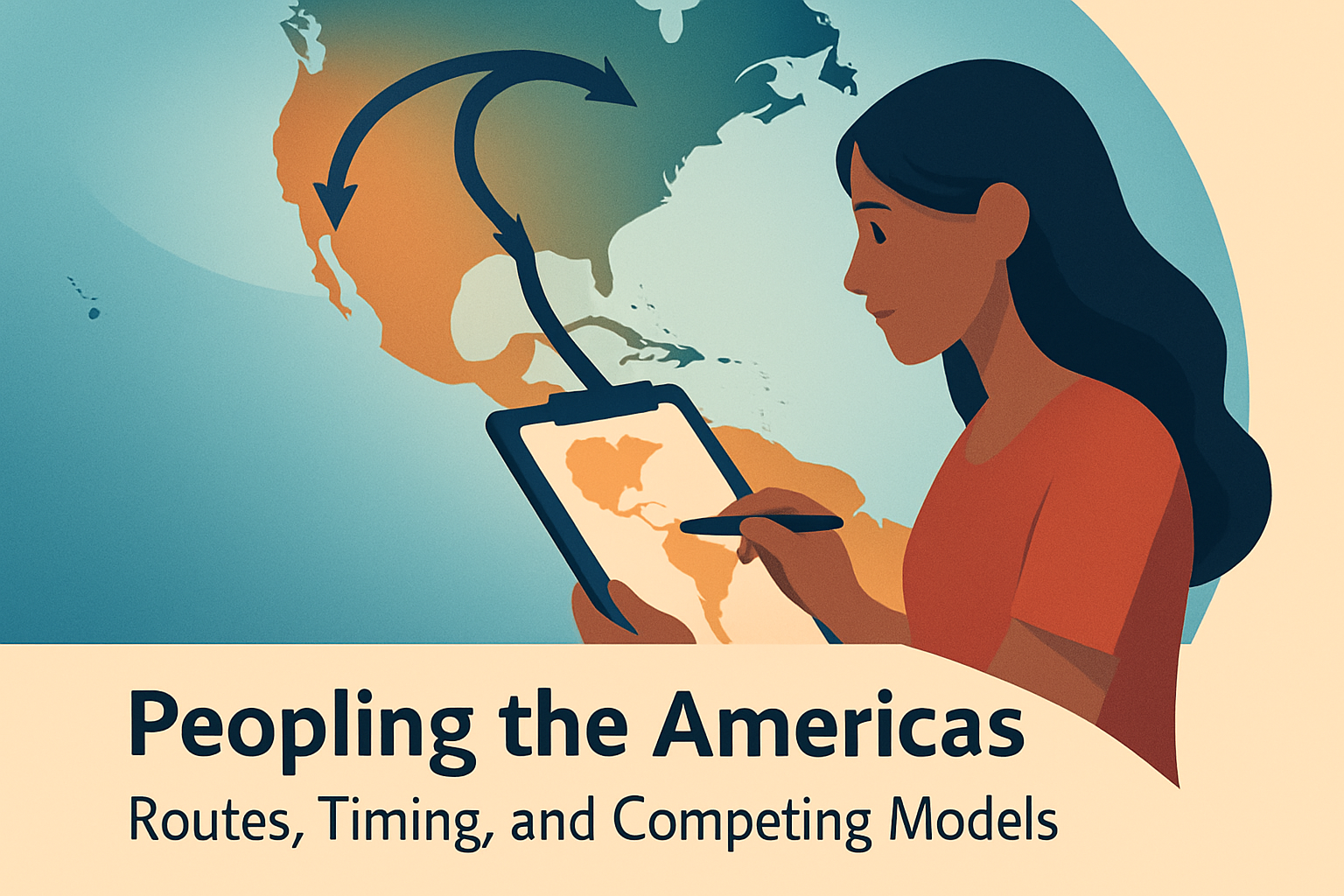
In tracing the ancient footsteps of humanity, one of the most gripping narratives emerges in the story of how people first came to inhabit the Americas. This vast continent, teeming with diverse ecosystems and landscapes, was one of the last regions to be settled by humans. The mystery of how, when, and by which routes humans journeyed into the Americas gives an insight into our collective past. It involves archaeology, anthropology, genetics, and even climatology. Our understanding of the timing and means of peopling the Americas could impact theories about cultural evolution, adaptation, and human resilience. Grasping this topic is pivotal for appreciating the extensive history and settling disputes or misconceptions over indigenous ancestry and rights. Let’s delve into the primary routes, dating estimates, and the different models proposed to shed light on this historical migration.
The Beringia Land Bridge and Its Pathways
One of the most renowned theories suggests that the ancestors of today’s Native Americans traversed a vast land bridge known as Beringia. Connecting northeastern Asia with what is now Alaska, this land bridge emerged during the Last Glacial Maximum, around 20,000 to 15,000 years ago, when global sea levels dropped. When it existed, Beringia offered a fertile, albeit cold, landscape covered with steppe tundra where large herbivores roamed, providing sustenance for Paleolithic hunter-gatherers.
Once across Beringia, these early travelers faced another formidable barrier in the form of glaciers that blanketed much of the North American continent. According to the Ice-Free Corridor theory, a narrow path eventually opened along the eastern flank of the Rockies. This corridor may have become passable roughly 13,000 years ago, facilitating southward migration into the heart and fringes of the continent.
Evidence supporting this theory can be found in Clovis sites, characterized by their unique stone tool technology, scattered throughout North America. For instance, the Clovis culture, which dates to roughly 13,000 years ago, reveals widespread human presence facilitated by these routes.
Coastal Migration: Skirting the Pacific Rim
While the land bridge theory holds considerable sway, an alternative posits that early humans adhered to a coastal route from Asia into the Americas. Known as the Kelp Highway Hypothesis, this theory suggests that maritime adaptations developed along the Pacific coasts allowed humans to exploit marine resources. As sea levels rose and fell, people potentially navigated from Asia along the ice-free corridors of the Pacific Rim, cascading down to the Americas.
This model gains traction from archaeological findings at sites like Monte Verde in Chile, where artifacts point to human presence as early as 14,800 years ago. Such early dates challenge the timeline postulated by inland migration theories.
- Monte Verde, Chile (14,800 years ago)
- Manis Mastodon, Washington (14,000 years ago)
- Paisley Caves, Oregon (14,300 years ago)
Moreover, genetic studies hint at a diverse gene pool among coastal dwellers, consistent with multiple waves of migration. This coastal route also matches theories of rapid coastal colonization seen in other parts of the world, including Australasia.
Solutrean Hypothesis: A Transatlantic Theory
While the Beringia and coastal migration models dominate discussions, the Solutrean hypothesis offers an intriguing and controversial alternative. This theory suggests a European migration wave around 20,000 years ago during the Last Glacial Maximum. Proponents argue that people of the Solutrean culture, known for their distinct stone tools, traveled across the Atlantic from the Iberian Peninsula, perhaps via an ice bridge or through short stays on ice floes.
The discovery of archeological points similar to Solutrean artifacts at Eastern North American sites, such as the Cactus Hill in Virginia, has fostered curiosity around this hypothesis. However, it faces criticism due to its circumstantial evidence and lack of genetic support. Skeptics argue that the observed similarities are the product of convergent evolution in tool-making techniques rather than direct ancestral links.
Dating Discrepancies and Genetic Evidence
The timeline of these migrations is critical to understanding human settlement patterns. Radiocarbon dating, DNA analysis, sediment studies, and other advanced methods help piece together the timeline, but discrepancies remain. Initial genetic evidence suggested a “single wave” model consistent with the Clovis-first approach. Yet, mitochondrial DNA and ancient DNA studies have revealed more complex layers. People such as those discovered at the Anzick site (one of a very few known Clovis burial sites) show genetic ties pointing to multiple migration events.
Modern genetic analysis techniques, including comparisons of nuclear and mitochondrial DNA, have shaken the foundation of preconceived timing models. Scientists have found evidence for at least three distinct waves of migration from Asia into the Americas: the Amerinds, the Na-Dene, and the Eskimo-Aleut. Each of these groups contributed uniquely to the genetic tapestry of indigenous populations across the Americas today.
Impact of Climate Change on Migration Patterns
The role of changing climates cannot be underestimated in these ancient journeys. The climatic shifts distorted landscapes, opened migratory corridors, and sometimes forced changes in migratory paths. For instance, glacial melting resulted in dietary and habitat shifts, making some areas either more habitable or uninhabitable. These transitions in landscape had profound effects on early migrations.
As global temperatures rose post the Last Glacial Maximum, generational adjustments to climate became a recurring pattern. Adaptations not only included new subsistence patterns but also alterations in societal organization, art, and regional spread. With contemporary climate issues, an understanding of how past peoples responded to similar challenges provides insights into potential future human adaptations.
Competing Models and Their Implications
The diversity of models—the Beringian land bridge, coastal migration, Solutrean theory, and climate-driven adaptations—all paint a complex picture of the peopling of the Americas. Each model captures distinct aspects of human adaptability and innovation. This diversity of theories reflects broader questions about human movement, adaptability, and cultural evolution.
However, these competing models occasionally fuel volatile discussions over cultural heritage, historical claims, and rights of indigenous peoples. Scientific inquiry must pave the way for discussions rooted in evidence rather than conjecture or politically motivated narratives.
Conclusion: Unveiling the Threads of Our Past
The ongoing quest to piece together how the Americas were populated not only illuminates the past but also shapes our understanding of cultural origins and human adaptability. It reveals intricate webs of migration, interaction, and adaptation that pose as a testament to human resilience. By appreciating these systems, we appreciate our shared human heritage, offering perspectives to address present challenges and foster global unity.
To continue this journey of discovery, one can delve into archaeological publications, engage with indigenous narratives, and support ongoing research endeavors. Championing evidence-based discussions encourages respect for both historical truths and the present cultural legacies they leave behind.
Gaining a profound understanding of how humanity has migrated, adapted, and flourished underpins our quest for knowledge and progress. Only through learning the intertwined stories of how the Americas were settled can we acknowledge the endurance and ingenuity of our ancestors, urging us to preserve this wisdom for future generations.
Frequently Asked Questions
1. How did the first humans migrate to the Americas?
The question of how the first humans made their way into the Americas is both fascinating and complex. While traditional theories suggested that a single migration happened over the Bering Land Bridge from Siberia to Alaska during the last Ice Age, modern research has indicated that the peopling of the Americas was likely a multifaceted process. The Bering Land Bridge, known as Beringia, was exposed when sea levels dropped, allowing humans to cross over from Asia to North America. This migration is thought to have happened in multiple waves, with people possibly traveling down into the continent along the Pacific Coast, taking advantage of less icy routes known as the “kelp highway.” These early travelers could have utilized boats, island-hopped, and hunted marine life, thereby moving southward along the Pacific coastline. Additionally, new evidence suggests a possibility of earlier maritime journeys before the Bering Land Bridge became accessible, adding an extra layer to our understanding of these ancient migrations.
2. When did humans first arrive in the Americas?
Pinpointing the exact timing of when humans first set foot in the Americas has been a challenging endeavor for scientists. For many years, the Clovis culture, associated with the distinctive Clovis points used for hunting, was considered among the earliest human presence in the Americas around 13,000 years ago. However, this view has been reshaped in the light of new archaeological evidence suggesting a pre-Clovis human presence potentially as far back as 16,000 years ago or more. Sites like Monte Verde in Chile, Bluefish Caves in Canada, and the recently studied White Sands National Monument in New Mexico, displaying what’s been interpreted as human footprints, challenge the previously accepted timelines, indicating that humans might have been present much earlier than once thought. These findings show that the timeline of human migration into the Americas is not only complex but continues to be refined as new evidence comes to light.
3. What methods do researchers use to study the migration routes into the Americas?
Understanding the migration paths into the Americas involves a multidisciplinary approach. Archaeologists excavate ancient sites looking for tools, hearths, and other traces of human activity to piece together paths of migration and cultures. Geneticists analyze ancient and modern DNA to trace lineages and establish connections between ancient populations in Asia and indigenous groups in the Americas, providing a genetic map of ancestral migration routes. Anthropologists interpret cultural artifacts and skeletal remains to gain better insight into the lives and movements of these early peoples. Additionally, climatologists contribute by studying past climatic conditions and landscape changes that influenced migration routes. These combined efforts paint a detailed picture of how humans moved into new territories and adapted to varied environments.
4. Why are there competing models for the peopling of the Americas?
The existence of competing models for the peopling of the Americas stems from the complexity and the evolving nature of archaeological and genetic evidence. As new findings emerge, they sometimes contradict previously accepted theories. The Clovis-first model, for instance, was predominant for many years until discoveries suggested earlier human presence in the Americas, leading to the development of pre-Clovis and alternative coastal migration models. Discrepancies can also arise from the interpretation of data, the dating methods used, and the discovery of new sites that challenge established timelines. The incorporation of new technologies and techniques, such as advanced radiocarbon dating, DNA analysis, and geophysical surveys, constantly refine our understanding and often inspire the proposal of new models to explain the arrival and spread of human populations across the continent.
5. How have recent discoveries changed our understanding of the migration into the Americas?
Recent discoveries have dramatically reshaped our understanding of human migration into the Americas, challenging long-held beliefs and introducing new dimensions to the narrative. New evidence from sites like Cooper’s Ferry in Idaho, which dates back approximately 16,000 years, strengthens the case for a pre-Clovis human presence. Discoveries at White Sands National Monument, marking what could be human footprints dating back over 20,000 years, suggest even earlier habitation than previously considered. Advances in ancient DNA analysis have provided fresh insights into how populations dispersed, intermixed, and adapted over millennia. These breakthroughs suggest not just a singular linear migration but a more complex and dynamic process involving multiple waves of populations taking varied routes, influenced by shifting climates and environmental conditions. These findings exemplify how each new discovery adds nuance, depth, and sometimes overturn conventional wisdom regarding the peopling of the Americas.