
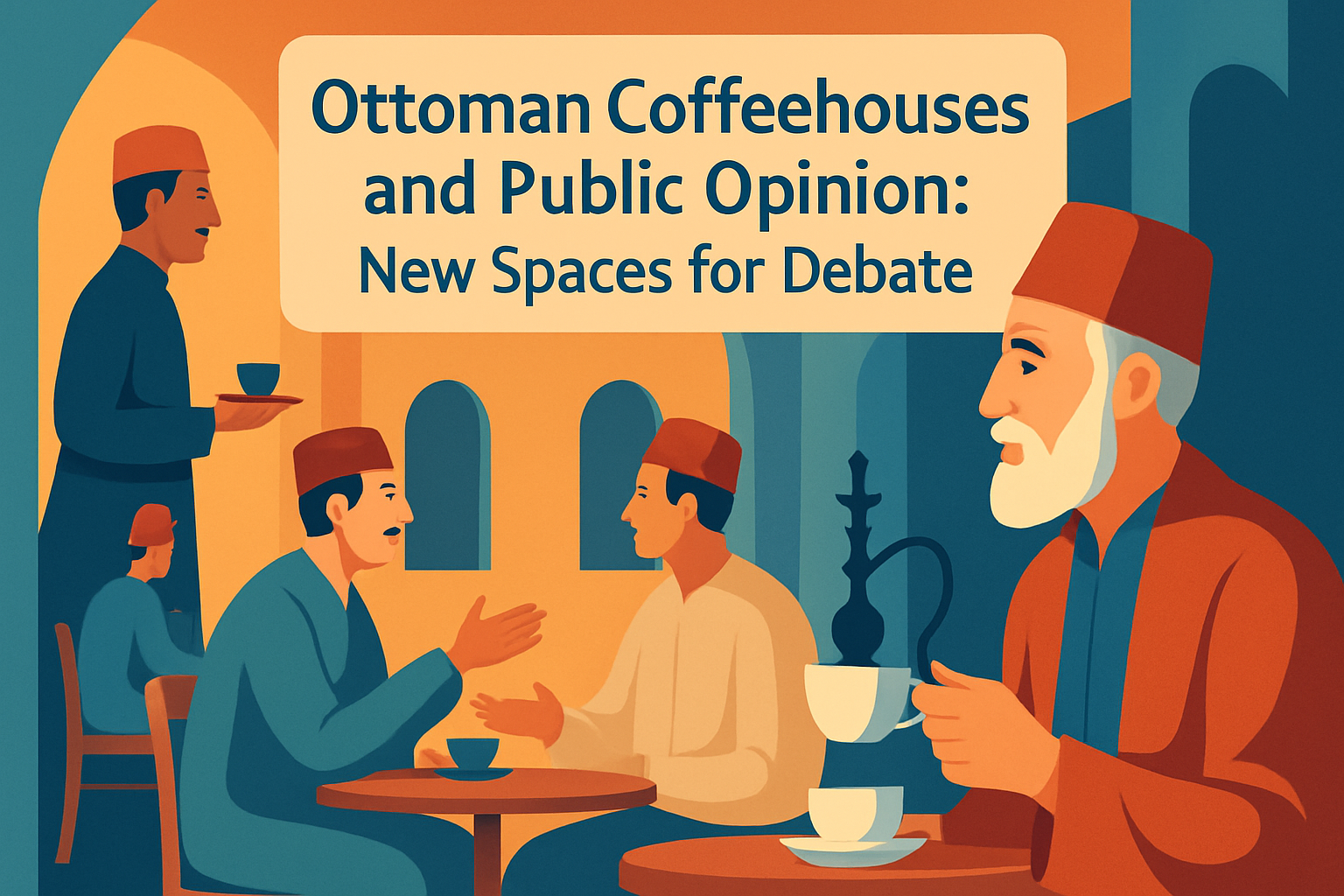
Ottoman coffeehouses transformed urban life by creating semi-public rooms where strangers gathered, news circulated, and political judgment took shape. In the Ottoman context, a coffeehouse was more than a place to drink a stimulating beverage introduced from Yemen in the sixteenth century. It was a commercial venue, a social club, an information hub, and, at critical moments, a forum where men from different occupations could test arguments about war, taxation, religion, and imperial authority. When historians discuss public opinion in the empire, they do not mean a modern polling system or a fully open democratic sphere. They mean the collective climate of judgment expressed through conversation, rumor, petitioning, sermon, satire, and neighborhood pressure. Ottoman coffeehouses mattered because they helped connect these forms of judgment to daily urban routines.
I have worked extensively with early modern urban history, and coffeehouses appear again and again in court records, travel narratives, imperial orders, and literary descriptions because officials knew these spaces could amplify voices quickly. A market rumor might die in a street, but in a busy coffeehouse it could be repeated, challenged, embellished, and carried onward by janissaries, artisans, scribes, boatmen, students, and merchants. That circulation made coffeehouses central to the history of communication in Istanbul, Cairo, Aleppo, Damascus, Salonica, and other Ottoman cities. They offered what many people needed in a sprawling empire: a regular place to meet beyond household and workshop, access shared information, and hear interpretations of events from people outside one’s immediate circle.
The rise of the coffeehouse also mattered economically and culturally. Coffee consumption created supply chains linking Red Sea commerce, port cities, tax farms, transport networks, and urban retailers. At the same time, coffeehouse culture encouraged storytelling, poetry recitation, shadow theater, chess, backgammon, and the reading aloud of chronicles or news letters. These activities made discussion habitual. Public opinion did not emerge only when a crisis erupted; it formed gradually through repeated exposure to argument, commentary, and performance. That distinction is essential. Debate in the Ottoman world was not confined to formal institutions such as the imperial council, the mosque classroom, or the law court. Informal sociability often shaped how official decisions were interpreted on the street.
Scholars sometimes compare Ottoman coffeehouses to the European public sphere associated with Jürgen Habermas, but the fit is imperfect. Ottoman debate was not secular in a modern sense, and access was unequal by gender, status, and region. Yet coffeehouses still functioned as vital arenas of civic conversation. They were open enough to mix groups that otherwise met separately, structured enough to create regular audiences, and visible enough to worry rulers. To understand Ottoman public opinion, it is necessary to understand how these establishments operated, why they drew suspicion, and how they connected everyday talk to larger political outcomes.
The emergence of the Ottoman coffeehouse
Coffee reached the central Ottoman lands during the sixteenth century, probably through merchants and pilgrims moving from Yemen and the Hijaz into Cairo and Istanbul. By the 1550s, chroniclers were already describing coffeehouses in Istanbul, often linking their spread to entrepreneurs from Aleppo and Damascus. The timing mattered. Ottoman cities were growing, commercial life was expanding, and mobile male populations needed places to pause between work, prayer, and lodging. Unlike a private home, the coffeehouse invited repeat attendance without kinship ties. Unlike a tavern, it centered on a legal stimulant that sharpened conversation rather than encouraging drunkenness. That combination made it unusually adaptable.
From my reading of period sources, the most striking feature is how quickly contemporaries recognized the novelty. Writers did not describe coffeehouses as simple shops. They described them as gathering places for idlers, wit, scholars, pleasure-seekers, and troublemakers, often all at once. The same room could host elite literary banter in one hour and neighborhood gossip in the next. Because customers usually sat for extended periods, the business model depended on sociability, not rapid turnover. Owners cultivated regulars, tolerated long discussions, and benefited from the prestige of being known as a house where important news first arrived. In practical terms, that made coffeehouses early modern media spaces.
The physical environment reinforced this role. Benches along the walls, shared cups, braziers, and a steady flow of entrants created a setting where listening was almost unavoidable. Even customers who did not speak much absorbed political language simply by being present. In large cities, some coffeehouses developed reputations tied to occupational groups, ethnic networks, or military affiliations. Others served mixed clienteles near markets, mosques, docks, or administrative buildings. This variation matters because public opinion in the empire was not one single voice. It formed through overlapping urban micro-publics that met in distinct venues, then interacted through movement across the city.
How coffeehouses created public opinion
Ottoman coffeehouses produced public opinion through repetition, comparison, and social validation. A person might enter with a rumor about grain shortages, a new tax demand, a military defeat, or a governor’s misconduct. In the coffeehouse, others could compare that rumor with reports from caravan routes, court sessions, mosque sermons, guild meetings, or barracks. If the story survived scrutiny, it gained credibility. If it matched broader anxieties, it spread faster. This mechanism resembles what modern media analysts call network amplification, but in an oral environment. The crucial point is that coffeehouses did not merely transmit information; they evaluated it collectively.
Conversation in these spaces also translated complex state actions into plain language. Few urban residents had direct access to the imperial center, and even fewer could read bureaucratic Ottoman comfortably. Coffeehouse regulars served as interpreters. A scribe might explain a decree, a merchant might assess its market effect, and a janissary might discuss its impact on the barracks. Through that process, policy became discussable. Once people could discuss a measure in shared terms, they could develop a common attitude toward it. This is one reason imperial authorities monitored coffeehouses closely. A tax reform was dangerous only if subjects viewed it as unjust, and coffeehouses helped define that judgment.
Performance mattered as much as direct argument. Storytellers, satirists, and shadow plays converted political critique into memorable scenes. Satire was especially effective because it allowed audiences to laugh at officials while preserving some deniability. In practice, ridicule could damage legitimacy. A feared governor might still command troops, but if his name became a joke repeated across multiple coffeehouses, his authority weakened socially before it weakened administratively. Public opinion in the Ottoman world often moved through tone: praise, skepticism, irony, and moral outrage. Coffeehouses gave those tones a stage.
| Function | How the coffeehouse enabled it | Political effect |
|---|---|---|
| News exchange | Travelers, merchants, and scribes brought reports from other districts | Expanded awareness beyond the neighborhood |
| Interpretation | Regulars explained decrees, prices, wars, and appointments in everyday language | Turned state action into discussable public issues |
| Verification | Multiple listeners compared rumors with personal contacts and local evidence | Strengthened or discredited circulating claims |
| Satire and performance | Storytelling and shadow theater packaged criticism memorably | Spread political attitudes quickly across audiences |
| Network building | Artisans, soldiers, and traders met repeatedly in the same venue | Created channels for petitions, protest, and collective pressure |
Why rulers and jurists were suspicious
Ottoman authorities did not oppose coffeehouses simply because coffee was new. Their concern was social concentration. Repeated bans under Sultan Süleyman, Murad III, and Murad IV reflected fear that gatherings beyond direct state supervision could foster sedition, religious heterodoxy, gambling, neglect of prayer, or military conspiracy. Jurists debated coffee’s legal status, but political officials often cared more about the assemblies it encouraged than the beverage itself. Orders to close coffeehouses usually increased during unrest, fires, military setbacks, or moments when the court suspected janissary agitation. The pattern is revealing: when the state felt insecure, coffeehouses looked dangerous.
This suspicion was not irrational. Coffeehouses linked groups who could mobilize crowds. Janissaries in particular played an outsized role in urban politics, and many were embedded in commercial and neighborhood life. A coffeehouse near a barracks or market could become a relay point where grievances turned into coordinated action. In several episodes of unrest in Istanbul, authorities accused coffeehouses of spreading inflammatory talk against high officials. Even if those accusations exaggerated the venues’ role, they show that contemporaries recognized the power of sustained conversation among semi-regular publics. Public opinion did not need formal representation to exert pressure; it needed density, circulation, and shared language.
Yet repression had limits. Coffeehouses kept returning because they fulfilled genuine urban needs. Attempts to eliminate them entirely usually failed, and officials often shifted from outright prohibition to surveillance and selective discipline. This mixed strategy reveals an important Ottoman reality: the empire was not governed only through top-down command. It was governed through negotiation with social practices too widespread to abolish. Coffeehouses survived because they were woven into commerce, leisure, and communication. Their persistence itself is evidence of their importance.
Who met there and what they discussed
Ottoman coffeehouses were not socially uniform. Some catered to artisans, porters, water carriers, sailors, or guild members. Others attracted literati, minor officials, madrasa students, or Sufis. In port cities, foreign merchants and dragomans might appear. In provincial centers, local notables used them to assess mood in the town without entering a formal audience chamber. This diversity is one reason coffeehouses matter so much for historians of debate. They created contact zones among men whose daily work connected different parts of urban society. No single participant controlled the conversation, and that openness gave public opinion its layered character.
The topics were equally wide-ranging. Prices and provisioning were constant concerns because food costs affected household survival directly. Military news drew attention in a frontier empire, especially when campaigns strained tax collection or supply lines. Judicial controversies, appointments, corruption allegations, neighborhood disputes, and religious questions also appeared frequently. During Ramadan or major festivals, crowds could swell and discussions intensify. In my experience working through local studies, the most revealing conversations are often the ordinary ones. People rarely announced that they were producing public opinion. They complained about bread, mocked officials, repeated a sermon, argued over fairness, and in doing so defined what good rule should look like.
It is also necessary to note the gendered limits of these spaces. Most Ottoman coffeehouses were overwhelmingly male environments, which means the public opinion formed there was partial rather than universal. Women influenced urban reputation through households, bathhouses, markets, kin networks, and charitable institutions, but they were not equally present in coffeehouse debate. Any serious analysis must acknowledge that limitation. Even so, male coffeehouse publics could affect decisions that touched entire communities, especially in matters of provisioning, order, and taxation.
From conversation to action
The strongest evidence for the political significance of Ottoman coffeehouses appears when talk turned into coordinated behavior. A shared judgment formed in conversation could lead to petitioning, refusal to comply, public shaming of an official, or participation in crowd action. Coffeehouses did not cause every protest, but they often helped prepare the interpretive ground. Before people marched, complained to a judge, or supported the dismissal of a governor, they usually needed to agree on a narrative: who had acted unjustly, what norm had been violated, and what remedy was acceptable. Coffeehouses supplied the venue for building that narrative.
Consider urban provisioning crises. When bread prices rose sharply or grain shipments stalled, residents needed reliable explanations. Was the shortage caused by hoarding, official negligence, transport disruption, or war? Different answers implied different targets for blame. Coffeehouse discussion sorted these possibilities and could focus anger on a baker, a merchant, a tax farmer, or an administrator. Similarly, in periods of military defeat, rumors from the front mixed with household anxieties over pay, conscription, and security. Coffeehouses translated distant imperial events into local political emotion. That translation is exactly how public opinion gains force.
These spaces also influenced elite behavior indirectly. Governors, judges, and military commanders listened to intermediaries who reported what was being said in the city. They understood that reputation mattered. A measure that looked efficient on paper might be abandoned if it triggered visible hostility in markets and coffeehouses. In that sense, coffeehouses functioned as barometers of urban sentiment. They rarely replaced formal institutions, but they shaped the environment in which formal institutions operated.
Regional variation across the empire
There was no single Ottoman coffeehouse culture. Istanbul set many patterns because of its size, court politics, and dense commercial life, yet provincial cities adapted the institution to local conditions. In Cairo, coffeehouses interacted with Mamluk legacies, scholarly networks, and neighborhood solidarities. In Aleppo, long-distance trade gave them a cosmopolitan edge, with merchants exchanging intelligence from Iran, Anatolia, and the Mediterranean. In Damascus, pilgrimage traffic added another layer of news and authority. In Balkan towns, coffeehouses became embedded in local rhythms of market exchange and imperial administration. The common thread was not uniform clientele or architecture but a repeatable social function: creating a place where information, reputation, and argument circulated together.
Regional variation also affected state oversight. A coffeehouse near the imperial capital faced different scrutiny than one in a provincial market town. Likewise, a venue tied to soldiers or urban notables could be more politically sensitive than a small neighborhood establishment. Historians should resist flattening these differences. Public opinion in the Ottoman Empire was imperial in scale but local in formation. Coffeehouses connected the two levels by allowing local conversations to absorb imperial news and local grievances to echo upward through petitions, patronage networks, or unrest.
The long legacy of coffeehouse debate
Ottoman coffeehouses left a durable legacy because they normalized the idea that ordinary urban people could gather regularly to discuss matters beyond private life. Later nineteenth-century developments such as newspapers, reform edicts, reading rooms, and constitutional politics did not emerge from nowhere. They built on older habits of discussion, listening, and collective judgment. Coffeehouses trained audiences to expect commentary on events, to evaluate competing claims, and to treat political information as a shared civic resource. Even when literacy expanded and print became more influential, oral debate remained essential. In many settings, newspapers were still read aloud in coffeehouses, proving the continuity.
The main lesson is clear. Ottoman coffeehouses were new spaces for debate because they joined commerce, sociability, and information in one accessible venue. They helped create public opinion not by inventing criticism from scratch but by giving criticism a durable urban home. That home was noisy, unequal, and sometimes unruly, yet it mattered precisely because it was woven into everyday life. If you want to understand how Ottoman subjects judged power, track the places where they gathered repeatedly, heard news collectively, and tested interpretations in public. Again and again, that trail leads to the coffeehouse. Explore related urban history and media history topics next, and the political world of the Ottoman city becomes far sharper.
Frequently Asked Questions
Why were Ottoman coffeehouses so important to urban life?
Ottoman coffeehouses mattered because they brought together functions that had previously been scattered across homes, markets, workshops, mosques, and streets. A coffeehouse was a business, but it was also a place for conversation, listening, observation, and informal learning. As coffee spread from Yemen into Ottoman cities in the sixteenth century, these venues quickly became regular gathering points where artisans, merchants, scholars, janissaries, travelers, and other townsmen could spend extended time in shared company. That mattered in practical terms: people could hear the latest reports, exchange rumors, discuss prices, compare local grievances, and interpret political events together.
What made the coffeehouse especially significant was its semi-public character. It was not fully open like a marketplace, but it was more socially mixed than a private home. That combination created an environment where strangers and acquaintances could interact with unusual frequency. In these spaces, urban residents did not simply consume information; they evaluated it. News about military campaigns, new taxes, officials, religious controversies, or court politics could be repeated, challenged, embellished, or doubted in real time. The result was a setting in which collective judgment began to form.
In this sense, coffeehouses helped reshape urban sociability. They created routines of gathering that encouraged repeated debate and regular participation in public talk. For many city dwellers, they became part of everyday life, a predictable site where one could take the pulse of the neighborhood or the wider empire. That is why historians often see Ottoman coffeehouses as institutions that transformed not only leisure but also the circulation of opinion, making them central to the social and political life of the city.
How did coffeehouses help shape public opinion in the Ottoman Empire?
Coffeehouses shaped public opinion by providing a physical setting where information and interpretation met. News in the Ottoman world traveled through many channels: official announcements, sermons, merchants, soldiers, court networks, travelers, and handwritten reports. But information alone does not create public opinion. People need spaces where they can test what they have heard, compare versions of events, and decide what seems credible or meaningful. Coffeehouses offered exactly that kind of setting.
Inside these establishments, customers talked through matters that affected daily life and imperial stability. They debated war and diplomacy, military setbacks, taxation, corruption, prices, appointments, moral conduct, and religious authority. Because the participants often came from different occupations and neighborhoods, a discussion could bring multiple perspectives into the same room. A merchant might focus on trade disruption, an artisan on shortages or taxes, a soldier on campaign realities, and a religiously educated participant on questions of legitimacy or justice. Through these exchanges, individual reactions could turn into broader, shared assessments.
Just as important, coffeehouses amplified both news and mood. A rumor repeated by one person might gain force when confirmed by another or transformed by collective retelling. Discontent could sharpen when listeners found that others shared the same concerns. Enthusiasm for a military victory or hostility toward a particular official could spread socially before it ever appeared in a formal record. In that way, coffeehouses became arenas where opinion was not merely expressed but produced, revised, and circulated. They did not create a modern democratic public sphere in a simple or complete sense, but they undeniably created new urban spaces in which political judgment became more visible, more social, and more consequential.
What kinds of people gathered in Ottoman coffeehouses, and were these spaces open to everyone?
Ottoman coffeehouses were socially mixed, but they were not universally open in the modern sense. Their importance came partly from the range of men who gathered there. Depending on the city, neighborhood, and type of coffeehouse, one might encounter artisans, shopkeepers, laborers, merchants, scribes, students, janissaries, scholars, entertainers, and travelers. This variety made the coffeehouse unusually dynamic. People with different levels of education, wealth, and institutional connection could occupy the same room and listen to the same conversation, even if they did not participate on equal terms.
At the same time, access was structured by custom, class, gender, and local reputation. Most Ottoman coffeehouses were overwhelmingly male spaces. Women’s participation in urban social life took place through other venues and networks, so coffeehouses did not represent the whole population. In addition, some coffeehouses were associated with particular trades, ethnic communities, districts, or military groups, which meant that not every establishment had the same degree of diversity. A neighborhood coffeehouse could feel familiar and local, while another venue near a market or port might attract a wider and more transient crowd.
Even with these limits, coffeehouses were still remarkable for their relative openness compared with private households or elite courtly settings. They lowered the barriers to listening in on conversations about matters that might otherwise remain confined to official circles. A person did not need to be a high-ranking administrator to hear debate about imperial policy or local abuses. That made the coffeehouse socially influential: it connected everyday urban life to larger questions of governance and legitimacy. So while these spaces were not equal, inclusive forums in a modern democratic sense, they were far more porous and interactive than many other institutions of the period.
Why did Ottoman authorities sometimes worry about coffeehouses?
Ottoman authorities worried about coffeehouses because they recognized that these spaces concentrated people, talk, and emotion in ways that could be politically unpredictable. Any government that depends on managing information and preserving public order tends to watch places where large numbers of people gather informally. Coffeehouses were precisely such places. Men could spend hours there discussing military defeats, criticizing officials, mocking policy, spreading rumors, or voicing dissatisfaction about taxes and shortages. Even when no organized opposition existed, repeated conversation could intensify suspicion and create a shared sense of grievance.
The concern was not only about explicit rebellion. Coffeehouses also troubled officials because they blurred the line between harmless sociability and political commentary. A gathering that began with entertainment, storytelling, or casual news could shift into judgment about imperial competence or justice. From the state’s perspective, that made the coffeehouse difficult to classify and therefore difficult to control. Authorities feared sedition, moral disorder, idleness, and the possibility that conversation could spill into unrest, especially in moments of crisis such as war, inflation, or factional conflict.
This helps explain periodic attempts to regulate, monitor, or suppress coffeehouses. Such efforts were rarely just about the drink itself. Coffee could be criticized on religious or moral grounds, but the deeper issue was often the social world built around it. Authorities understood that coffeehouses had become information hubs where unofficial interpretations of events could compete with official narratives. Their very popularity made them powerful. The state’s ambivalence toward them reveals their significance: coffeehouses were useful, normal features of urban life, yet also potential centers of criticism that reminded rulers how difficult it was to contain public opinion once people had regular places to gather and talk.
Can Ottoman coffeehouses be compared to modern public forums or media spaces?
Yes, but only with careful qualification. Ottoman coffeehouses can be compared to modern public forums because they were places where people gathered to exchange information, argue over current events, and form shared judgments about power. In that sense, they resemble a blend of café culture, neighborhood meeting place, news hub, and informal political forum. They offered repeated face-to-face contact, allowed commentary on public affairs, and connected local experience to imperial events. For historians interested in communication and political culture, they are an important example of how opinion can develop outside formal state institutions.
Still, coffeehouses were not the same as modern newspapers, social media platforms, or democratic assemblies. Information in coffeehouses circulated primarily through speech, performance, memory, rumor, and handwritten materials rather than mass print in the early period. Participation also depended on presence, local custom, and social position. These spaces were shaped by hierarchy and exclusion, especially along gender lines, and they did not operate under modern ideals of universal citizenship or free speech. Their influence was real, but it was exercised through urban sociability rather than formal representation.
The best way to understand the comparison is to see Ottoman coffeehouses as early and highly influential venues of public conversation. They helped create habits of commentary, listening, and collective interpretation that made politics more discussable in everyday life. Like today’s media spaces, they could spread both insight and misinformation, encourage solidarity or deepen conflict, and turn private concerns into shared public issues. The comparison works when it highlights their role in shaping communication and opinion, but it becomes misleading if it assumes that early modern Ottoman cities functioned like modern democracies. Their importance lies precisely in showing that robust public debate can emerge in forms very different from the institutions we recognize today.