
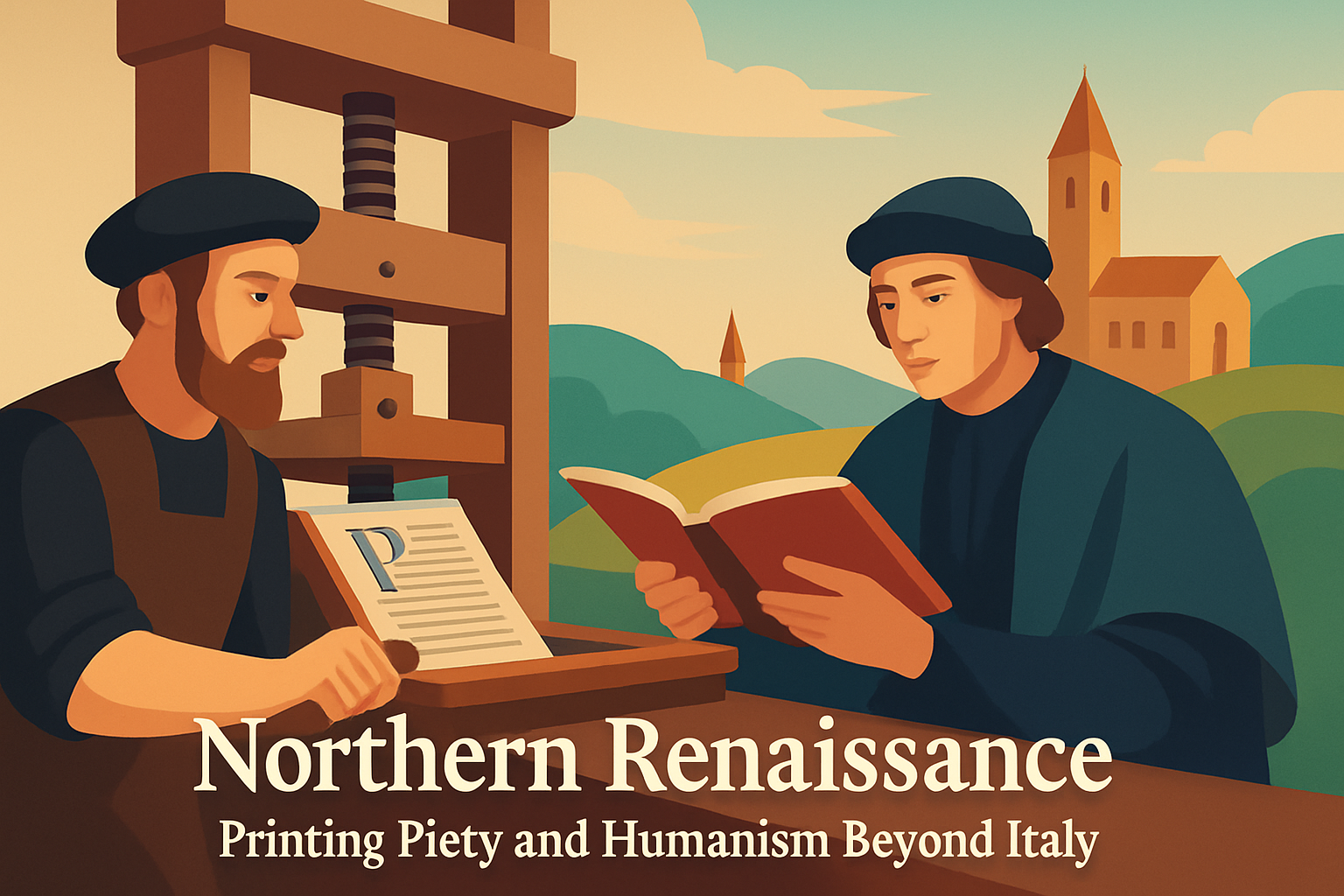
The Northern Renaissance transformed Europe by carrying the ideals of classical learning, religious reform, and artistic innovation beyond Italy into the cities, courts, and workshops of the Low Countries, France, England, and the German-speaking lands. In practical terms, the phrase “Northern Renaissance” refers to the cultural rebirth that flourished north of the Alps from the fifteenth through the sixteenth centuries, shaped less by direct imitation of ancient Rome and more by the combined power of Christian devotion, urban commerce, vernacular literacy, and print. When I explain this period to readers, I begin with three linked forces: printing multiplied ideas, piety redirected personal faith, and humanism reframed education and public life. Together, those forces created a distinctly northern culture that was intellectually ambitious, visually detailed, morally serious, and socially influential.
Unlike the Italian Renaissance, which often centered on classical architecture, civic republicanism, and the visual recovery of Greco-Roman ideals, the Northern Renaissance developed within regions marked by strong guild traditions, powerful monarchies, expanding universities, and intense concern with salvation. Its leading figures did study classical texts, but they usually integrated them with biblical scholarship and reform-minded Christianity. That is why Desiderius Erasmus matters as much as Albrecht Dürer, and why the printing press matters as much as oil painting. In my work with Renaissance source material, I have found that northern culture becomes clearer when we stop treating it as a delayed version of Italy. It was its own movement, with its own methods, institutions, audiences, and ambitions.
The subject matters because the Northern Renaissance helped build modern Europe. It widened access to knowledge through cheaper books, encouraged critical reading of scripture and ancient texts, expanded literacy in both Latin and the vernacular, and trained citizens to think about conscience, education, governance, and moral reform in new ways. It also provided the communication infrastructure that made the Protestant Reformation possible, even though not every humanist wanted schism and not every printer sought religious revolution. To understand the Northern Renaissance is to understand how media technology, scholarship, and spirituality can combine to reshape society. Its legacy still informs publishing, education, religious debate, and the idea that learning should improve both the individual soul and the common good.
Printing Press and the Spread of Northern Renaissance Ideas
The decisive engine of the Northern Renaissance was print. Johannes Gutenberg’s development of movable metal type in Mainz around the mid-fifteenth century did not merely speed up copying; it changed the economics, accuracy, and scale of communication. Before print, manuscripts were expensive, slow to reproduce, and vulnerable to scribal variation. After print, texts could be standardized, corrected across editions, and sold to wider reading publics. In northern Europe, where commercial networks were dense and cities such as Antwerp, Nuremberg, Basel, Paris, and Lyon linked merchants, scholars, and craftsmen, printing quickly became the ideal vehicle for new scholarship and devotional reading.
Printers were not passive technicians. They acted as editors, investors, marketers, and cultural brokers. I often point to Aldus Manutius in Venice for Italian humanism, but north of the Alps the equivalent influence came from houses such as Johann Froben’s press in Basel, which published Erasmus and helped distribute scholarly editions across Europe. Basel became a hub because it combined university culture, skilled printing labor, and trade access. The same pattern appeared elsewhere: cities with educated buyers, paper supply, and merchant capital became intellectual magnets. This is a core Northern Renaissance fact: ideas spread because physical production systems supported them.
Print also changed reading habits. Small-format books made private study easier. Devotional manuals, prayer books, sermons, saints’ lives, and eventually vernacular Bibles entered homes that would never have owned a handwritten codex. The result was not instant mass literacy, but it was a measurable expansion of text-centered religion and education. Scholars could compare editions; teachers could assign consistent materials; preachers could quote from more accurate sources; lay believers could engage with faith more directly. That combination of standardization and access is why historians rightly connect print to both humanism and reform.
Woodcuts and engravings extended the same revolution to images. A print by Dürer could circulate far beyond the city where it was designed. Visual motifs, symbolic programs, and even artistic reputations could now travel. In this sense, the Northern Renaissance was the first major European culture shaped by reproducible media. If a searcher asks, “Why was printing important to the Northern Renaissance?” the direct answer is this: it enabled faster distribution of scholarship, devotion, and art, creating a shared intellectual world across politically fragmented regions.
Christian Humanism: Learning for Moral and Spiritual Reform
Humanism in northern Europe took a notably Christian form. While Italian humanists often celebrated rhetoric, civic virtue, and classical eloquence, northern humanists usually insisted that learning must serve ethical reform and scriptural understanding. The phrase “Christian humanism” best captures this synthesis. It emphasized ad fontes, or “back to the sources,” meaning scholars should return to the earliest and best texts, especially scripture and the Church Fathers, rather than rely uncritically on later commentaries. In practice, this meant stronger philology, better editions, and a moral program aimed at inner renewal.
Desiderius Erasmus of Rotterdam stands at the center of this movement. He was a brilliant stylist, editor, and satirist, but his deepest goal was practical Christianity rooted in learning. His 1516 Greek New Testament, published with a new Latin translation and annotations, was a landmark because it encouraged scholars to examine the biblical text with fresh precision. Erasmus believed that educated reading could purify religious life, correct errors, and reduce empty ritualism. In works such as The Praise of Folly and the Handbook of the Christian Soldier, he criticized clerical corruption, formalism, and superstition without rejecting the Church itself. That balance is essential: he sought reform through scholarship, not revolution through rupture.
Other northern humanists advanced similar goals in local contexts. Jacques Lefèvre d’Étaples in France pursued biblical scholarship. John Colet in England advocated educational and religious renewal. Thomas More combined civic office, classical learning, and moral critique in Utopia, a text that remains central to debates about social order, justice, and ideal government. What unites these figures is not identical doctrine but a shared conviction that language study, textual criticism, and moral seriousness belonged together. They were not antiquarians collecting dead knowledge. They were reformers of mind and manners.
One reason Christian humanism spread effectively was that it answered practical questions people already had: How should a Christian read the Bible? What kind of education forms good judgment? Can institutions be corrected without destroying social unity? Those questions gave the movement lasting relevance. It offered a disciplined method, not just a mood: learn languages, compare sources, teach clearly, and connect knowledge to virtue.
Piety, Devotion, and Everyday Religious Life
To understand the Northern Renaissance, you have to take piety seriously. Modern readers sometimes focus on elite scholarship and overlook the devotional environment that gave northern culture its emotional force. Long before Luther, many believers wanted a more personal, sincere, and interior religious life. The movement commonly called the devotio moderna, associated with the Low Countries, encouraged humility, meditation, practical ethics, and imitation of Christ. Thomas à Kempis’s Imitation of Christ became one of the most widely read devotional books in Europe because it spoke directly to the believer seeking inward discipline rather than public display.
This devotional culture influenced education, reading habits, and art. In workshops and households, people used books of hours, prayer collections, and illustrated religious texts for structured devotion. In paintings by Jan van Eyck, Rogier van der Weyden, and Hans Memling, sacred scenes were rendered with extraordinary material realism: glass reflects light, fabric folds with tactile precision, domestic interiors resemble familiar spaces. That realism was not merely decorative. It invited contemplation by bringing the holy into recognizable human settings. Northern artists made devotion intimate. A worshipper could see the divine within ordinary objects and daily life.
At the same time, piety in the north had tensions. Pilgrimages, relics, indulgences, confraternities, and sacramental practices remained deeply important, yet they also drew criticism when they seemed commercialized or spiritually superficial. This is where the Northern Renaissance becomes especially significant: it did not reject religion; it intensified the demand for authentic religion. Many humanists and reform-minded clergy wanted better preaching, better education for priests, and more meaningful engagement with scripture. Their concerns formed part of the wider environment from which later confessional conflict emerged.
When readers ask, “What made northern piety different?” I answer that it stressed interior devotion, practical morality, and lay participation supported by books, images, and schooling. It was not anti-institutional by definition, but it pushed institutions to justify themselves morally and pastorally.
Art Beyond Italy: Detail, Symbolism, and the Printed Image
Northern Renaissance art developed a visual language distinct from the monumental classicism of Italy. Oil painting, refined in the Low Countries, allowed artists to layer color, create luminous surfaces, and represent minute textures with unprecedented subtlety. Jan van Eyck’s Arnolfini Portrait remains a standard example because every object appears charged with meaning: the mirror, the dog, the fruit, the chandelier. Whether scholars agree on every symbol is less important than the broader point: northern artists expected viewers to read images closely. Observation and symbolism worked together.
Rogier van der Weyden intensified emotional expression, especially in scenes of suffering and grief. Hugo van der Goes and Hans Holbein the Younger linked realism to psychological presence. Holbein, working across the Holy Roman Empire and England, demonstrated how portraiture could become a tool of politics, status, and confessional identity. Albrecht Dürer absorbed Italian proportion theory and perspective, yet his work remained unmistakably northern in its printmaking mastery, line precision, and intellectual density. His engravings, including Melencolia I and Knight, Death, and the Devil, are not simply artworks; they are visual arguments about knowledge, virtue, temptation, and the limits of human understanding.
Printmaking deserves special emphasis because it democratized art. Engravings and woodcuts cost far less than panel paintings and could circulate internationally. Workshops could reproduce devotional scenes, portraits, allegories, and illustrated pamphlets at scale. During the Reformation, this capacity became politically explosive, but even before confessional conflict, it had already transformed the relationship between image and audience. People who never entered elite courts could own visual culture. In modern terms, print created a distribution network for ideas embedded in images.
| Figure | Region | Primary Contribution | Why It Matters |
|---|---|---|---|
| Johannes Gutenberg | Mainz | Movable-type printing | Made large-scale book production and textual standardization possible |
| Desiderius Erasmus | Low Countries/Basel | Christian humanist scholarship | Linked classical learning to biblical reform and moral criticism |
| Thomas à Kempis | Low Countries | Devotional writing | Popularized interior piety through accessible spiritual guidance |
| Jan van Eyck | Burgundian Netherlands | Oil painting and symbolic realism | Showed how meticulous detail could deepen devotional meaning |
| Albrecht Dürer | Nuremberg | Printmaking and artistic theory | Connected northern art, humanism, and reproducible images |
| Thomas More | England | Humanist political thought | Used literature to question justice, governance, and social order |
The clearest answer to “How did Northern Renaissance art differ from Italian Renaissance art?” is that northern artists prioritized surface detail, symbolic richness, and devotional intimacy, while also embracing print as a major medium of cultural transmission. The distinction is real, though not absolute; artists, objects, and ideas moved constantly across Europe.
Schools, Cities, and the Social Geography of the Movement
The Northern Renaissance grew in specific environments: commercial cities, courtly centers, cathedral schools, universities, and printing hubs. Bruges, Ghent, Antwerp, Nuremberg, Augsburg, Basel, Paris, Oxford, and London all mattered for different reasons. Some offered merchant wealth and patronage; some specialized in metalwork, paper, or trade routes; some hosted scholars and students; some connected royal power to cultural prestige. A movement this wide was never uniform. It was a network.
Urbanization played a major role. Merchant elites funded chapels, altarpieces, schools, and libraries. Guild culture fostered discipline, apprenticeship, and professional standards. Courts, especially in Burgundy and France, demanded luxury manuscripts, tapestries, portraits, and ceremonial literature. Universities trained clerics, lawyers, and administrators who needed books and rhetorical education. From my perspective, one of the most revealing features of the Northern Renaissance is its institutional diversity. It did not depend on a single city-state model, as Florence often did in narratives of Italy. Instead, it thrived by adapting to many local structures.
Education changed alongside these institutions. Humanist curricula emphasized grammar, rhetoric, history, moral philosophy, and the study of classical languages, yet northern schools often aligned those subjects with religious discipline. Reformers wanted students to write better Latin, but also to become more ethical Christians and more useful public servants. This educational ideal spread through textbooks, model letters, dialogues, and school ordinances. Once again, print was central. Pedagogy became reproducible.
Socially, the movement reached beyond elites but not equally. Literacy still varied sharply by gender, class, and region. Rural populations often participated indirectly through sermons, images, songs, and cheap devotional print rather than advanced humanist study. That limitation matters. The Northern Renaissance expanded access to ideas, but it did not create universal education. Its achievements were real, yet uneven.
From Renaissance Reform to Reformation Conflict
No account of the Northern Renaissance is complete without addressing its relationship to the Protestant Reformation. The connection was profound but not simple. Humanists did not cause the Reformation in any single sense, and many remained Catholic. Yet the tools they sharpened—philology, textual criticism, educational reform, and suspicion of corruption—made traditional authorities easier to question. Printing then accelerated every dispute. Luther’s challenge after 1517 spread with extraordinary speed because pamphlets, sermons, broadsheets, and vernacular treatises could move through the same networks that had circulated humanist scholarship.
Erasmus illustrates the tension perfectly. He criticized clerical abuses and encouraged scriptural literacy, but he rejected the divisiveness and dogmatic rigidity that followed. Luther admired Erasmus’s learning, yet their disagreement over free will revealed deep differences about human nature, grace, and reform strategy. This split shows why the Northern Renaissance cannot be reduced to “the beginning of Protestantism.” It was broader than that. It contained Catholics, reformers, moderates, radicals, scholars, artists, and printers whose aims overlapped only partially.
Still, the era’s media ecology changed religion permanently. Vernacular Bibles expanded lay engagement. Polemical prints shaped public opinion. Confessional identities hardened through catechisms, hymnals, and illustrated propaganda. In practical historical terms, the Northern Renaissance created the intellectual and technological conditions for Europe’s most consequential religious upheaval. It taught people to compare texts, question mediators, and expect faith to be intelligible, personal, and morally serious. Once those expectations were widespread, institutional Christianity could not remain unchanged.
The Northern Renaissance matters today because it shows what happens when new media, rigorous scholarship, and urgent moral questions converge. Printing gave scale to ideas, piety gave them emotional force, and humanism gave them method. Beyond Italy, this combination produced a culture that prized learned reform, careful reading, and vivid artistic communication. Its major figures—Gutenberg, Erasmus, Thomas à Kempis, van Eyck, Dürer, More, and many others—did more than decorate an age. They helped build Europe’s habits of study, debate, and self-examination.
The most useful takeaway is simple: the Northern Renaissance was not a secondary echo of Italy but a powerful movement in its own right, defined by Christian humanism, print culture, and devotional intensity. If you want to understand how books changed belief, how art taught theology, or how scholarship can unsettle institutions while renewing culture, start here. Read Erasmus, look closely at northern paintings and prints, and trace how ideas traveled through presses, schools, and cities. That is where the Northern Renaissance still speaks with clarity.
Frequently Asked Questions
What was the Northern Renaissance, and how was it different from the Italian Renaissance?
The Northern Renaissance was the cultural flowering that spread across the Low Countries, the German-speaking lands, France, and England from the fifteenth into the sixteenth century. Like the Italian Renaissance, it valued learning, artistic achievement, and a renewed interest in the human person. But north of the Alps, these ideals developed under different social, religious, and economic conditions. Rather than focusing primarily on the civic traditions and classical models of ancient Rome, Northern thinkers and artists often blended humanist learning with deep Christian devotion, moral reform, and close observation of everyday life.
One of the clearest differences lies in emphasis. Italian Renaissance culture often celebrated balance, proportion, and the recovery of Greco-Roman antiquity in art, architecture, and political thought. In the North, scholars and writers were certainly interested in classical texts, but they were just as concerned with how learning could improve Christian life. This gave Northern humanism a practical and ethical tone. It encouraged better education, more accurate biblical scholarship, and criticism of corruption in church and society. The result was not a rejection of religion in favor of classical culture, but a creative fusion of the two.
Artistically, the Northern Renaissance is known for extraordinary realism, technical precision, and symbolic richness. Painters such as Jan van Eyck, Rogier van der Weyden, Albrecht Dürer, and Hans Holbein the Younger brought intense attention to surface, texture, domestic interiors, landscapes, and the individuality of faces. Their works often joined spiritual meaning with minute detail, turning ordinary objects into carriers of religious and moral significance. In short, the Northern Renaissance was distinct because it translated Renaissance ideals into a world shaped by urban trade, devotional culture, the printed book, and growing calls for reform.
Why was printing so important to the spread of piety and humanism in Northern Europe?
Printing was one of the most transformative forces behind the Northern Renaissance because it allowed ideas to move faster, farther, and more cheaply than ever before. Before the printing press, books had to be copied by hand, which made them expensive and relatively rare. With the spread of printing after Johannes Gutenberg’s innovations in the mid-fifteenth century, religious texts, devotional manuals, classical works, schoolbooks, pamphlets, and scholarly editions could be produced in much larger numbers. This created an intellectual network that linked cities, universities, monasteries, courts, and workshops across Europe.
For piety, printing made religious life more personal and accessible. Lay readers could purchase prayer books, psalters, devotional guides, and vernacular translations that helped them cultivate private reflection and moral discipline. Movements such as the Devotio Moderna, which stressed inward devotion, humility, and practical Christian living, benefited enormously from print culture. Printed texts encouraged believers to read, meditate, and examine their conscience in new ways. This did not simply make religion more widespread; it also made it more individualized and text-centered.
For humanism, printing helped standardize and circulate the works of both classical authors and contemporary scholars. Humanists depended on the recovery, editing, comparison, and correction of texts. Print made those efforts far more effective. Scholars could publish improved editions of ancient writers, grammars, dictionaries, and biblical texts, while readers across Europe could engage with the same material. Figures such as Erasmus used the press brilliantly, reaching a broad audience with works that promoted education, moral reform, and a return to the sources of Christian teaching. In that sense, printing was not just a tool of communication; it was the engine that connected scholarship, devotion, reform, and public debate throughout the Northern Renaissance.
How did Northern humanism combine classical learning with Christian reform?
Northern humanism took the core humanist commitment to language, rhetoric, history, and textual study and directed it toward moral and religious renewal. Humanists in the North believed that education should form character, not merely display erudition. They studied Latin and Greek, collected manuscripts, and admired classical eloquence, but they did so with the conviction that learning should produce wiser Christians, more ethical rulers, and a healthier church. This gave their work a reforming edge that was especially distinctive.
A major part of this project involved returning “to the sources,” meaning both the classics and the earliest Christian texts. Scholars examined scripture, the Church Fathers, and ancient authors in their original languages to recover meanings that had been blurred by centuries of copying, commentary, or poor translation. Erasmus is the best-known example. His edition of the Greek New Testament and his writings on education, morality, and church reform embodied the Northern humanist ideal: use philology, reason, and eloquence not to attack faith, but to purify and strengthen it. He criticized superstition, empty ritualism, and clerical abuses while still affirming the importance of sincere Christian devotion.
This blend of learning and reform also shaped schools, court culture, and public life. Humanists promoted curricula centered on grammar, history, moral philosophy, and rhetoric because they believed educated people could improve society. They advised princes, taught students, translated texts, and wrote for lay audiences as well as scholars. Their influence can be seen in the push for better preaching, more informed reading of scripture, and a more ethical understanding of political authority. Northern humanism was therefore neither narrowly secular nor narrowly theological. It was an attempt to unite intellectual discipline with spiritual seriousness and to make learning serve the common good.
Who were some of the most important figures of the Northern Renaissance?
The Northern Renaissance included a remarkable range of scholars, artists, and religious thinkers whose work shaped European culture for generations. Erasmus of Rotterdam stands at the center as the leading humanist of the North. Through his editions of Christian texts, satirical critiques, educational writings, and calls for moral reform, he became an international voice for learned piety. Thomas More, his friend and fellow humanist in England, contributed to political and moral thought through works such as Utopia, which used imaginative literature to explore justice, society, and human limitations.
In the visual arts, Jan van Eyck played a foundational role through his mastery of oil painting and his astonishing realism. His works demonstrated how precise detail, luminous surfaces, and symbolic depth could coexist in a single image. Albrecht Dürer, working in the German lands, became one of the most versatile artists of the age, combining Northern precision with knowledge of Italian proportion and perspective. He excelled in painting, drawing, engraving, and woodcut, and his prints helped spread Renaissance visual culture across Europe. Hans Holbein the Younger, famous for his portraits, captured both the individuality and the status of his sitters with remarkable clarity, making him a key figure in court art and the visual politics of the era.
Other important names include Rogier van der Weyden and Pieter Bruegel the Elder in art, as well as Johannes Reuchlin in scholarship, especially for his work in Hebrew studies. Gutenberg must also be counted among the era’s most consequential figures because printing altered the entire cultural landscape in which Northern Renaissance ideas circulated. Even Martin Luther, though primarily associated with the Reformation, emerged from the same broader world of print, textual criticism, and calls for religious renewal that the Northern Renaissance helped foster. Together, these figures reveal how broad the movement was: it extended from scholarship to painting, from technology to theology, and from private devotion to public controversy.
What lasting impact did the Northern Renaissance have on Europe?
The Northern Renaissance had a profound and lasting impact because it reshaped how Europeans read, worshiped, learned, created art, and argued about truth. One of its greatest legacies was the union of scholarship and public life. By promoting textual accuracy, language study, and historically informed reading, Northern humanists changed education and intellectual standards across Europe. Schools and universities increasingly emphasized grammar, rhetoric, history, and moral philosophy, and these changes influenced generations of students, officials, clergy, and writers.
Its religious effects were equally significant. By encouraging direct engagement with scripture, more personal devotion, and criticism of institutional abuses, the Northern Renaissance helped create the climate in which the Reformation could take root. Not all Northern humanists supported religious division, and many hoped for reform within the existing church. Even so, their insistence on returning to foundational texts and their willingness to expose corruption changed the religious conversation permanently. Print amplified these developments, making theological debate a mass phenomenon in ways earlier centuries had never experienced.
In art, the movement left behind a visual tradition defined by realism, symbolism, portraiture, and close attention to material life. Northern artists expanded what painting could do by dignifying domestic settings, everyday objects, and individual identity without losing sight of spiritual meaning. Their technical innovations, especially in oil painting and printmaking, influenced artists far beyond their own regions. More broadly, the Northern Renaissance helped create a distinctly European culture of exchange in which books, images, and ideas crossed borders with increasing speed. Its enduring importance lies in that combination of piety, humanism, and media revolution: it did not simply imitate Italy, but transformed Renaissance culture into something broader, more textual, more devotional, and more socially far-reaching.