
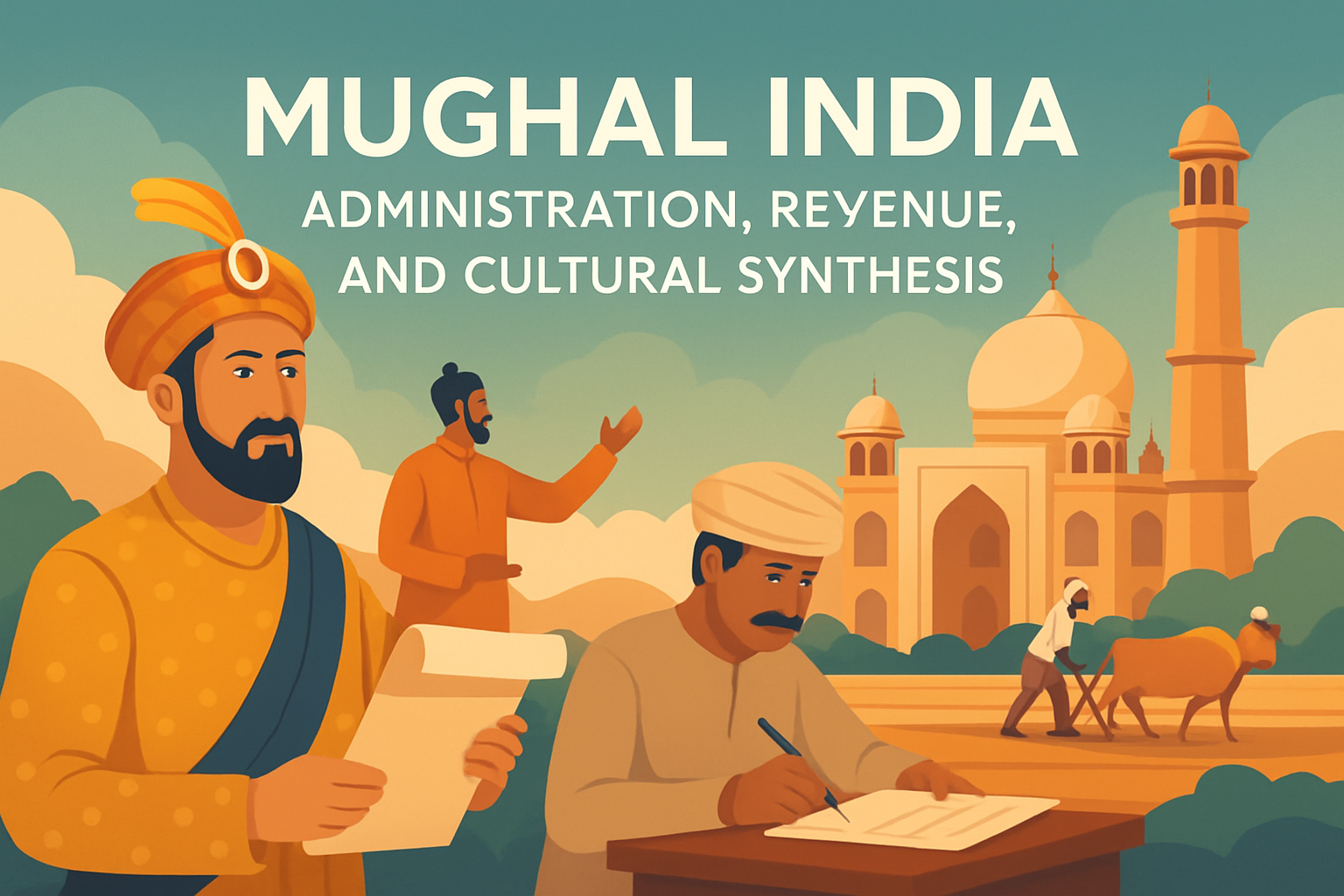
Mughal India was one of the early modern world’s most sophisticated imperial systems, combining military power, intricate administration, disciplined revenue extraction, and a remarkable culture of synthesis across Persian, Central Asian, and Indian traditions. When historians discuss “Mughal India: administration, revenue and cultural synthesis,” they are examining how the empire governed vast territories, financed itself through agrarian surplus, and built a political culture that could rule diverse peoples. The term administration refers to the institutions, offices, ranks, and procedures through which emperors exercised authority. Revenue refers chiefly to land revenue, the fiscal foundation of the state, though customs, tribute, and monopolies also mattered. Cultural synthesis describes the blending of artistic forms, languages, religious ideas, courtly practices, and everyday customs that emerged under Mughal rule.
I have found that this topic matters most when it is treated as a connected system rather than three separate themes. Mughal governance was not an abstract bureaucracy; it depended on reliable income. Revenue collection was not just taxation; it shaped local society, agrarian production, and political loyalty. Cultural synthesis was not merely decorative; it helped legitimize power, integrate elites, and create a shared imperial idiom. From Babur’s foundation in 1526 to Aurangzeb’s death in 1707 and the fragmented afterlife of the empire, Mughal institutions left deep marks on South Asian statecraft, architecture, language, and social memory. Modern debates on land rights, bureaucracy, pluralism, and regional identity still echo Mughal precedents.
The Mughal Empire did not emerge fully formed. Babur brought Timurid political ideas and a war-tested military tradition, but the durable framework of empire was built above all under Akbar, then refined by Jahangir, Shah Jahan, and Aurangzeb. Akbar’s reign was the turning point because he expanded territory, reorganized the nobility, standardized revenue assessment, and articulated a model of imperial sovereignty that was broader than narrow clan rule. Persian became the language of high administration, yet the empire operated through cooperation with Rajputs, Indian Muslim lineages, zamindars, scribal groups, merchants, and village communities. This flexible, layered character is exactly why Mughal India remains central to understanding precolonial governance in South Asia.
Any serious explanation must also avoid two common mistakes. The first is to imagine Mughal rule as either perfectly centralized or completely loose. In practice, it was centralized in ambition, record keeping, rank classification, and imperial ideology, but negotiated in the provinces through local intermediaries. The second mistake is to romanticize cultural blending as effortless harmony. Mughal cultural synthesis was real and productive, yet it was also shaped by hierarchy, court patronage, political calculation, and moments of conflict. Understanding those tensions makes the empire more intelligible, not less impressive. Seen clearly, Mughal India reveals how a major agrarian empire organized authority, monetized resources, and fostered a composite civilization whose influence outlasted its political zenith.
Administrative structure and the logic of imperial rule
The Mughal administrative system rested on the emperor’s supreme authority, but it functioned through carefully differentiated offices and chains of responsibility. At the center stood the padshah, whose legitimacy drew on Timurid inheritance, military success, justice, and divine favor. In practice, the emperor presided over a court that was also a governing machine. Key officers included the wakil in the early period, the wazir or diwan overseeing finance, the mir bakhshi managing military appointments and mansabs, the sadr handling religious endowments and charity, and the qazi supervising aspects of judicial practice. Orders circulated through a literate bureaucracy trained in Persian documentary culture. Farmans, sanads, and revenue records were not peripheral paperwork; they were the skeleton of imperial control.
The empire was divided into subas, or provinces, especially after Akbar’s reforms. Each suba was headed by a subadar or governor, balanced by a provincial diwan responsible for revenue, a bakhshi, and other officers. Below the province were sarkars, then parganas, and finally villages, where much of the actual social negotiation occurred. This multilayered arrangement allowed the center to project power across immense distances while preventing any one official from becoming too autonomous. In the records I have worked through, the pattern is clear: Mughal rule favored overlapping jurisdictions because mutual surveillance reduced the risk of rebellion and fiscal leakage. The system was not modern bureaucracy in the Weberian sense, but it was disciplined, record conscious, and remarkably scalable for its time.
The mansabdari system was the empire’s most distinctive administrative-military mechanism. A mansab was a ranked position assigned to an imperial servant, defining status, salary, and military obligation. Mansabdars were graded numerically, often through the categories of zat, indicating personal rank, and sawar, indicating cavalry quota. This system tied the nobility directly to the emperor and weakened hereditary feudal fragmentation. It also created a service elite that could include Turanis, Iranis, Afghans, Indian Muslims, and Rajputs. The genius of mansabdari lay in convertibility: rank could be raised, reduced, transferred, or revoked. Loyalty therefore depended on imperial favor and continued service. At the same time, this structure was expensive and vulnerable to corruption through false musters, over-assessment, and local resistance.
Administrative effectiveness also depended on inclusion. Akbar’s policy toward Rajput rulers is the clearest example. By incorporating Rajput chiefs into the mansabdari order and recognizing their status, the Mughals gained military allies and regional stability without destroying established lineages. Marital alliances reinforced this process, but administrative integration mattered more than symbolism. In many regions, zamindars retained local influence as intermediaries who collected revenue, maintained order, and represented rural interests. The Mughal state did not abolish local power; it subordinated and monetized it. That strategy explains both the empire’s durability and its limits. When imperial authority was strong, local actors cooperated. When the center weakened in the late seventeenth and eighteenth centuries, the same local structures became bases for regional assertion.
Revenue administration and the agrarian basis of empire
Land revenue was the fiscal heart of Mughal India. The empire was overwhelmingly agrarian, so the state’s wealth depended on measuring cultivation, estimating produce, fixing demand, and ensuring collection without destroying the productive base. Although there were multiple methods in different regions, the most famous settlement is associated with Raja Todar Mal under Akbar. His reforms did not invent revenue collection, but they standardized and rationalized it on a scale earlier regimes rarely matched. Measurement of land, classification of soils and crops, compilation of average yields, and conversion of produce values into cash assessments were all designed to stabilize imperial income. The resulting system is often described as zabt, especially in the core provinces where measurement and schedule-based assessment were feasible.
The state demand was substantial, often around one-third of the produce value, though actual burden varied by crop, region, and local conditions. Collection could occur in cash or kind, but cash assessment became increasingly important because it supported a large cavalry state, urban markets, and long-distance trade. Revenue records such as the dastur rates and provincial registers gave officials benchmarks for expected returns. In areas where direct measurement was difficult, alternative methods such as batai, or crop-sharing, and nasaq, based on rough estimation or previous demand, were used. This flexibility is important. Mughal revenue administration was not one uniform formula applied mechanically everywhere; it was a repertoire of methods adapted to ecology, political control, and administrative capacity.
At village level, the revenue system depended on a chain of actors: cultivators, village headmen, patwaris, qanungos, zamindars, jagirdars, and imperial officials. Peasants were the primary producers, but their relationship with the state was mediated. Zamindars possessed varying combinations of customary rights, local dominance, and revenue claims. Jagirdars, meanwhile, were mansabdars assigned revenue rights over designated territories in lieu of salary. This jagir system was central to Mughal finance because the empire often paid officials not from a single central treasury but through assignments on local revenue streams. In theory, jagirs were transferable, preventing entrenched localism. In practice, pressure to extract revenue quickly from temporary assignments could intensify exploitation, especially when jagirdars feared transfer before recovering expected income.
| Revenue term | Meaning | Why it mattered |
|---|---|---|
| Zabt | Measured assessment based on area, yield, and price schedules | Improved predictability in core provinces and supported cash revenue |
| Batai | Division of actual crop between cultivator and state share | Useful where precise measurement was difficult or crop variation was high |
| Jagir | Assignment of revenue from a territory to an imperial officer | Financed the mansabdari system without paying everyone directly in cash |
| Zamindar | Local intermediary with social authority and revenue claims | Linked imperial demand to village society and regional power structures |
The strengths of the Mughal revenue system were real. It generated enormous income, sustained one of the largest premodern states in the world, and encouraged commercialization by linking agricultural production to monetized assessment. Areas producing cash crops such as cotton, indigo, sugarcane, and opium became more deeply integrated into regional and international trade. Yet the system had clear tensions. Heavy assessment could deepen peasant vulnerability during crop failure. Administrative corruption could distort officially rational procedures. The jagirdari crisis often discussed for the later seventeenth century reflected a mismatch between the number of high-ranking mansabdars and the availability of productive jagirs. That imbalance fueled competition, short-term extraction, and administrative strain. Revenue success, paradoxically, created political pressures when imperial expansion slowed and distributable resources tightened.
Cultural synthesis in court, city, and countryside
Mughal cultural synthesis emerged from sustained interaction rather than superficial borrowing. The dynasty itself carried Timurid and Persianate traditions into India, but once established, it absorbed local forms with exceptional creativity. At court, Persian was the language of power, literature, and chronicling, yet administrative practice depended heavily on Indian scribal communities and regional knowledge. In architecture, the fusion is visible in the combination of Persian charbagh garden ideals, Central Asian spatial memory, indigenous trabeate construction, and Indian decorative motifs. Humayun’s Tomb, Fatehpur Sikri, the Agra Fort, and the Taj Mahal are not isolated monuments; they are evidence of an imperial aesthetic that translated political authority into built form. Red sandstone, white marble, inlay work, domes, chhatris, arches, and geometric planning were combined with unusual confidence.
Painting offers another striking example. Mughal miniature painting developed in imperial ateliers that initially drew from Persian manuscript conventions but soon incorporated Indian color sensibilities, portrait realism, flora and fauna studies, and even European techniques such as shading and perspective introduced through Jesuit contacts. Under Akbar, illustrated manuscripts like the Akbarnama and Hamzanama displayed narrative energy and a broad social canvas. Under Jahangir, painting became more observational, especially in portraits and natural history studies. This was not imitation for its own sake. It reflected an imperial culture curious about classification, memory, and self-representation. The Mughal court recorded people, animals, ceremonies, and victories because visual order was part of political order.
Religious and intellectual life also showed synthesis, though never without debate. Akbar’s court sponsored translation projects that brought Sanskrit works such as the Mahabharata, rendered as the Razmnama, into Persian. This was politically significant because it made major Indic traditions legible within the imperial public sphere. Akbar’s principle of sulh-i kul, often translated as “universal peace,” did not create modern secularism, but it did establish an ethic of governance that prioritized political coexistence over sectarian exclusion. Sufi networks, Bhakti traditions, Jain intellectuals, Hindu courtiers, Shia and Sunni scholars, and Christian missionaries all interacted with the court in different ways. Later emperors varied in tone and policy, and Aurangzeb in particular is often discussed through the lens of orthodoxy, yet even his reign operated within a deeply mixed administrative and social world.
Language and everyday culture reveal perhaps the most enduring Mughal legacy. What developed over time as Hindustani, later differentiated into Urdu and Hindi registers, grew in settings shaped by military camps, marketplaces, urban neighborhoods, and courtly exchange. Food, clothing, music, etiquette, and festival practices similarly reflected blending. The spread of qawwali performance traditions, the refinement of court cuisine using Central Asian and Indian techniques, and the circulation of textile styles are practical signs of synthesis, not just elite abstractions. In cities such as Lahore, Agra, Delhi, and Ahmedabad, imperial patronage connected artisans, merchants, scholars, and service groups. The result was a cosmopolitan urban culture that was unmistakably Indian yet also linked to the wider Persianate world from Istanbul to Isfahan and Central Asia.
Legacy, debates, and why Mughal institutions still matter
The legacy of Mughal India lies not only in monuments but in durable administrative habits, fiscal categories, and ideas of sovereignty that shaped later regimes, including regional successor states and the British East India Company. Colonial administrators studied Mughal revenue terminology because they inherited landscapes already structured by parganas, qanungos, zamindars, and documented claims. They also encountered a society in which state authority had long been tied to agrarian assessment and negotiated local intermediaries. Even when the British introduced new settlements, they worked through, against, or upon Mughal precedents. That continuity is a key reason the study of Mughal administration and revenue is essential for understanding the transition from precolonial to colonial governance.
Historians continue to debate how centralized the Mughal state really was, whether peasants benefited from commercialization, and how inclusive Mughal political culture remained over time. These are productive debates because the evidence is rich and regionally varied. In my reading of imperial manuals, chronicles, and later regional records, the most convincing conclusion is that the Mughal Empire was strongest when administration, revenue, and cultural legitimacy reinforced one another. Efficient rank management without fiscal stability could not endure. Revenue extraction without local accommodation generated resistance. Cultural grandeur without administrative credibility became hollow ceremony. The empire’s success was systemic, and so was its weakening.
For anyone studying South Asian history, the main takeaway is clear: Mughal India was a complex imperial formation built on disciplined governance, agrarian revenue, and a powerful culture of synthesis. Its institutions were neither timeless nor flawless, yet they were sophisticated, adaptive, and historically consequential. To understand how large states manage diversity, how taxation shapes society, and how culture can serve both power and creativity, Mughal India remains indispensable. Revisit the administrative structure, the revenue mechanisms, and the composite culture together, and the empire comes into focus as more than a dynasty: it becomes a model of how power was organized, financed, and imagined in early modern Asia.
Frequently Asked Questions
What made Mughal administration so effective across such a large and diverse empire?
Mughal administration was effective because it combined centralized imperial authority with flexible local governance. At the top stood the emperor, who served as the supreme political, military, and judicial authority. Yet the empire was far too vast to be ruled through direct personal control alone, so the Mughals developed a layered administrative structure that allowed orders, taxes, military obligations, and legal authority to flow across provinces in an organized way. The empire was divided into large provinces called subas, each under a governor or subadar, with additional officials responsible for finance, military organization, justice, and record-keeping. This distribution of authority helped prevent too much power from accumulating in one office and created internal checks within the imperial system.
A key feature of this administrative model was the mansabdari system, under which nobles and military commanders were ranked and assigned responsibilities according to their status and service. This ranking system regulated both civil and military appointments and tied elite loyalty directly to the emperor. Rather than allowing hereditary aristocracies to become fully independent, the Mughal state sought to maintain control by appointing officials, transferring them, and compensating them through revenue assignments. The result was a system that rewarded service, encouraged competition for imperial favor, and integrated diverse ethnic and regional elites into a common political order.
Another reason for Mughal administrative success was its practical inclusiveness. The empire governed a population of immense linguistic, religious, and social diversity, so it often incorporated existing local institutions instead of replacing them outright. Village headmen, zamindars, scribes, and regional intermediaries played important roles in maintaining order and facilitating tax collection. In this sense, Mughal rule was not simply imposed from above; it was negotiated through local structures. That blend of centralized ambition and local adaptation gave Mughal administration durability and made it one of the most sophisticated imperial systems of the early modern world.
How did the Mughal revenue system work, and why was it so important to the empire?
The Mughal revenue system was the financial foundation of the empire, because the state depended overwhelmingly on agrarian surplus. Land revenue was the principal source of income, and the ability to assess, collect, and distribute that revenue determined the strength of the imperial military, the reach of administration, and the grandeur of the court. Since agriculture formed the core of the economy, the Mughal state devoted enormous attention to measuring land, estimating productivity, classifying crops, and fixing tax demands. Revenue policy was therefore not a minor technical issue; it was central to imperial power itself.
One of the most famous developments in Mughal fiscal administration came under Akbar, especially through the work associated with Raja Todar Mal. The state attempted to standardize assessment by collecting information on cultivated land, average yields, and prevailing prices over a period of years. This enabled officials to estimate the expected produce of land and convert a share of that produce into a cash demand. In many areas, the state claimed roughly one-third of the produce, though actual practice varied considerably by region, crop, and local political circumstances. These efforts reflected a strong drive toward rationalization, record-keeping, and administrative uniformity.
At the same time, the system was far from purely abstract or bureaucratic. Revenue collection depended on cooperation and negotiation among imperial officials, local intermediaries, zamindars, village communities, and cultivators. In some places, taxes were collected directly; in others, revenue rights were assigned to nobles in the form of jagirs, from which they drew income in return for imperial service. This linked the fiscal system to the military-administrative elite. The strength of the empire rested on this connection: agricultural surplus funded armies, salaries, public works, architecture, and courtly culture. But it also carried risks. Heavy revenue demands could burden peasants, create tensions in the countryside, and weaken stability if local conditions such as drought, war, or corruption disrupted collection. In that sense, Mughal revenue administration was both a source of imperial greatness and a potential point of strain.
What was the mansabdari system, and how did it connect administration with military power?
The mansabdari system was one of the defining institutions of Mughal rule, because it linked rank, office, military responsibility, and access to revenue in a single imperial framework. A mansab was a numerical rank assigned by the emperor to an individual noble or official. This rank determined not only status at court but also the scale of obligations owed to the state, especially in relation to maintaining troops and cavalry. In practical terms, the system helped the Mughals organize their ruling class while preserving the emperor’s authority over appointments and promotions.
Each mansabdar was expected to serve the empire, and his rank was often expressed through two numbers associated with personal status and cavalry responsibility. Because the Mughal Empire depended heavily on military mobility and elite service, this system provided a way to transform aristocratic ambition into structured imperial duty. Nobles from different backgrounds, including Turanis, Iranis, Indian Muslims, Rajputs, and others, could all be integrated into this graded hierarchy. That made the mansabdari system not just an administrative device but also a political instrument for elite incorporation.
Mansabdars were commonly paid through jagir assignments rather than fixed cash salaries. A jagir did not usually mean outright ownership of land; instead, it granted the right to collect revenue from a designated territory. Since these assignments were transferable, the emperor could prevent nobles from establishing entirely independent territorial bases. In theory, this created a disciplined ruling class dependent on imperial favor. In practice, however, the system demanded constant oversight. The state had to monitor ranks, troop obligations, and jagir incomes while balancing the expectations of powerful nobles. Even so, the mansabdari framework was remarkably effective for much of Mughal history because it fused bureaucratic order with military organization and tied political service directly to the empire’s revenue structure.
What do historians mean by “cultural synthesis” in Mughal India?
When historians speak of cultural synthesis in Mughal India, they are referring to the creative blending of Persian, Central Asian, and Indian traditions within politics, art, language, architecture, literature, and everyday elite culture. The Mughal Empire was not culturally uniform, nor did it simply transplant one foreign model onto the subcontinent. Instead, it became a space in which different traditions interacted, adapted, and produced new forms. Persian remained the language of high administration and court culture, but it operated within an Indian social world and alongside regional languages and long-established local traditions. This interaction shaped everything from state ceremony to artistic style.
Architecture offers one of the clearest examples. Mughal buildings combined Persianate ideas of symmetry, gardens, and monumental display with Indian construction techniques, decorative forms, and materials. The result can be seen in structures such as Fatehpur Sikri, Humayun’s Tomb, and the Taj Mahal, where imperial ideology and aesthetic fusion are inseparable. Painting also reflected synthesis: Mughal miniature art drew on Persian manuscript traditions while incorporating Indian themes, landscapes, portraiture, and increasing attention to naturalistic detail. Courtly culture as a whole became a dynamic field of exchange rather than a fixed inheritance.
This synthesis also had a political dimension. Mughal rulers, especially Akbar, sought to build legitimacy across a religiously and socially diverse population. Alliances with Rajput rulers, the inclusion of Hindu elites in imperial service, and interest in intellectual exchange all contributed to a broader imperial culture that could speak to multiple constituencies. That does not mean the empire was free of hierarchy or conflict; it certainly was not. But the Mughals created a political and cultural order in which diverse traditions could be absorbed into a shared imperial framework. For historians, that process of adaptation, negotiation, and blending is exactly what makes Mughal India such an important example of cultural synthesis in the early modern world.
Why are administration, revenue, and cultural synthesis studied together in Mughal India?
These themes are studied together because they were deeply interconnected in the functioning of the Mughal Empire. Administration provided the institutional machinery of rule, revenue supplied the material resources, and cultural synthesis helped create legitimacy and cohesion across an enormous and diverse imperial space. It is difficult to understand one without the others. A strong administrative system meant little without a reliable fiscal base, and neither administration nor revenue could secure long-term stability unless the empire also built a political culture that elites and subjects could recognize and engage with.
For example, the empire’s administrative reach depended on provincial officials, record-keepers, military commanders, and local intermediaries, all of whom had to be financed through revenue extraction from agriculture. But collecting that revenue was not just a matter of force. It required cooperation from zamindars, village communities, and regional elites. That cooperation was easier to sustain when the state offered inclusion, honor, and recognition within a larger imperial order. In this way, cultural synthesis was not merely decorative or artistic; it also had practical political value. It helped the empire integrate different peoples and traditions into a functioning system of governance.
Studying these themes together also reveals both the achievements and the vulnerabilities of Mughal rule. The empire was capable of impressive administrative coordination, substantial resource mobilization, and extraordinary cultural production. Yet the same system could become strained when revenue demands intensified, jagir assignments became contentious, regional powers asserted themselves, or imperial consensus weakened. By examining administration, revenue, and cultural synthesis as connected processes, historians gain a fuller understanding of how the Mughal Empire rose, operated, and faced internal pressures over time. That broader perspective is why the phrase “Mughal India: administration, revenue and cultural synthesis” captures so much of what made the empire historically significant.