
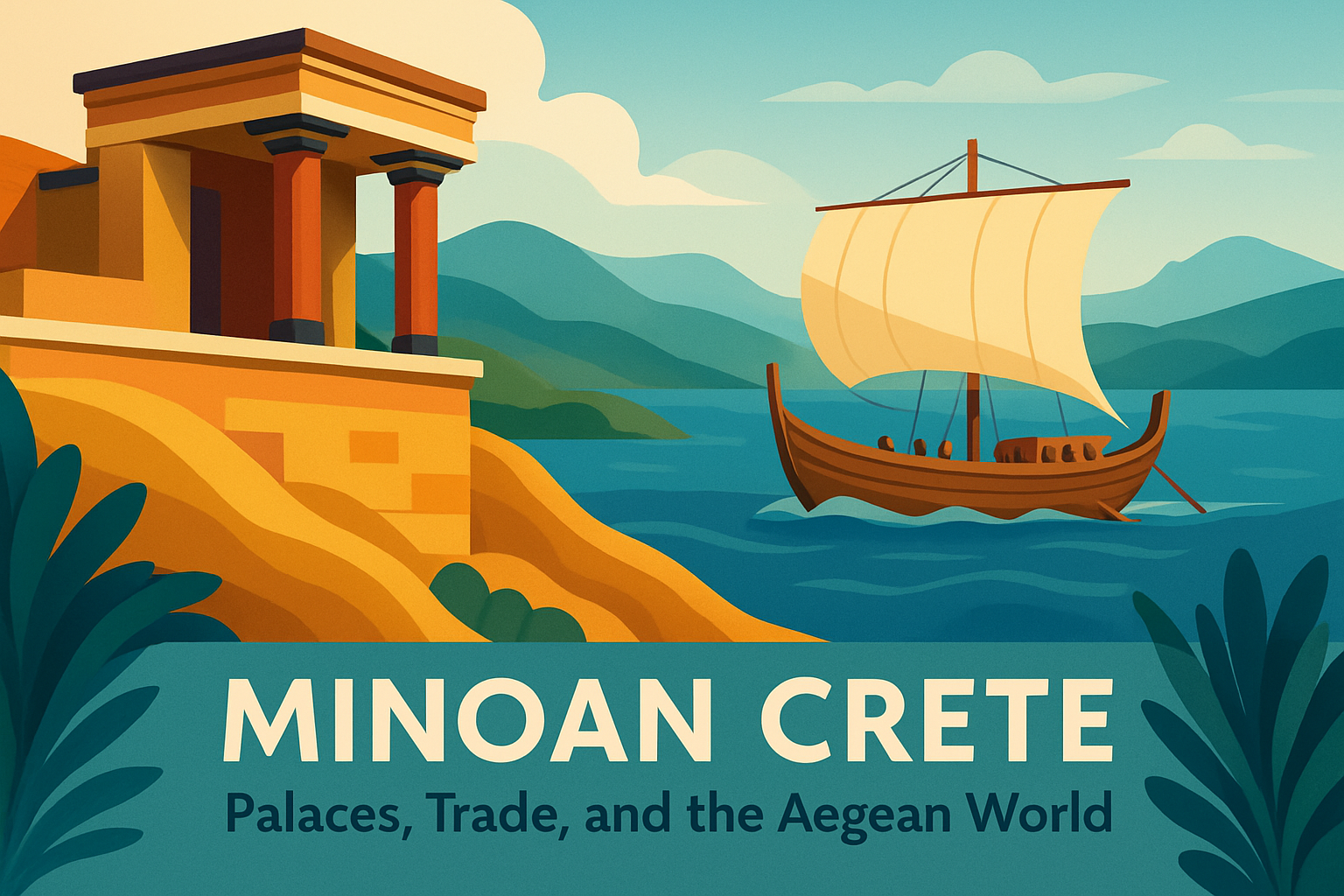
The Minoan civilization, one of Europe’s earliest sophisticated societies, emerged on Crete, a mountainous island strategically nestled in the Mediterranean Sea. Existing approximately from 2600 to 1100 BCE, this ancient civilization is known for its impressive architecture, vibrant art, and advanced economic systems. The Minoans significantly impacted the Mediterranean cultural and economic landscape, with their influence reaching beyond Crete into the Aegean world. In understanding the Minoan society, we gain insights into early forms of political organization, trade networks, and cultural exchanges that laid the foundations for Europe’s subsequent historical developments. For historians, archaeologists, and enthusiasts of ancient history, studying Minoan Crete underscores the interconnectedness of ancient civilizations and its effect on world history.
The Significance of Minoan Palaces
The architectural ingenuity and social complexity of Minoan Crete were primarily encapsulated within their palatial structures. The palaces of Knossos, Phaistos, Malia, and Zakros are the most renowned, known for their grand scale and intricate designs. These structures served not only as residences for rulers but as multifunctional centers for administrative, religious, and economic activities.
One real-world example of this architectural marvel is the Palace of Knossos. Excavated by Sir Arthur Evans in the early 20th century, Knossos revealed insights into Minoan societal organization. The palace featured complex layouts with storerooms, workshops, and religious spaces indicating that these structures held pivotal economic functions. The plethora of artifacts found at Knossos, including Linear A tablets, reveal a bureaucracy capable of administrating trade, agriculture, and religious ceremonies.
Understanding the functions of these palaces provides a glimpse into the highly organized structure of Minoan society, showcasing their ability to marshal resources and influence over the Aegean Sea. These palaces also illuminate how the Minoans managed societal cohesion through centralized governance.
Trade Networks and Economic Influence
The Minoan civilization’s economy was largely dependent on maritime trade, given Crete’s strategic location in the Mediterranean. Minoan traders established extensive networks, exchanging goods with cultures across the Aegean, including Egypt, the Levant, and Anatolia. This network was pivotal in disseminating cultural influences, technological innovations, and trade goods such as pottery, oils, and crafts.
To comprehend the breadth of their economic influence, consider the archaeological finds at Akrotiri, a Bronze Age settlement on the island of Thera (modern-day Santorini). The discovery of Minoan frescoes and artifacts in Akrotiri illustrates the robust connectivity and shared cultural influences between the Aegean islands, spearheaded by Minoan traders. Such exchanges not only facilitated economic prosperity but also cultural syncretism, enhancing technological and artistic progress across the region.
| Traded Goods | Origin | Destination |
|---|---|---|
| Phoenician Purple Dye | Levant | Minoan Crete |
| Olive Oil | Minoan Crete | Egypt |
| Papyrus | Egypt | Minoan Crete |
| Ceramic Pottery | Minoan Crete | Mycenaean Greece |
These interactions underscore the Minoan’s nimbleness in navigating and capitalizing on trade opportunities, which not only fortified their economy but also played a key role in their cultural expansion and increased influence over their neighbors. Such exchanges indeed aligned with what would eventually become a hallmark of later civilizations in the Mediterranean basin.
Art and Religion: Minoan Cultural Legacy
Minoan art and religious practices were characterized by vibrant imagery and symbolic motifs that reflected their deep connection to nature and the divine. This cultural richness spread across the Aegean, impacting neighboring regions and future Greek civilization profoundly.
A pertinent example of Minoan art’s influence can be seen at the Knossos palace’s famous “Prince of the Lilies” fresco, which displays a young man adorned with a crown of lilies. Artworks like this emphasize the Minoan skill in fresco production and their preference for natural themes. This artistic style, marked by movement, lively colors, and fluid forms, later found its expression in the art of Mycenae and broader Greek artistry.
Religion played an integral role in Minoan society, with reverence for nature and fertility goddesses evident in idol statues, pottery, and frescoes. The Snake Goddess figurines, found predominantly in and around Knossos, serve as symbols of their religious beliefs and practices. These figures signify the Minoan connection to earth deities and protection rituals, displaying the civilization’s intrinsic beliefs in the protective power of feminine deities and the interconnectedness of natural cycles.
Through these cultural expressions, the Minoans left an indelible mark on subsequent European civilizations. Their emphasis on the artistic and religious interpretations of the natural world fostered a cultural legacy that influenced Greek mythologies and artistic endeavors.
The Minoan Writing Systems and Legacy
Among the most fascinating aspects of the Minoan civilization is their development of writing systems, particularly Linear A and Linear B scripts. While Linear A remains undeciphered, suggesting it may have been used for religious or potentially undiscovered administrative purposes, the adoption of Linear B by the Mycenaeans for administrative records provides insight into this early communication method.
The existence of these scripts reflects the complex infrastructure and governance that Minoans orchestrated to manage their sprawling trade networks and vast societal operations. The undeciphered Linear A remains an intellectual challenge and source of intrigue for researchers, representing the unknown depths of Minoan intellectual capacity and organizational skills.
For example, Linear B tablets found at the Mycenaean site of Pylos depict detailed economic transactions and inventories, showcasing the adaptation and pragmatic use of the Minoan system by successive cultures. Translation of Linear B texts has illuminated various administrative functions within Mycenaean palaces, proving the long-lasting impact and integration of Minoan written communication into later dominant Greek cultures—bridging a critical historical period between prehistoric and classical Greece.
Environmental Adaptation and Technological Advancements
The Minoans were adept at adapting to the environmental challenges of Crete, which included navigating mountainous terrains and leveraging the fertility of coastal plains for agriculture. Their advancements in agriculture, infrastructure, and maritime technology underscored their ability to sustain a thriving civilization for centuries.
The sophisticated drainage systems discovered at Knossos and Phaistos are testaments to Minoan engineering capabilities. These systems reduced flood damage and promoted effective water management, highlighting their understanding of environmental manipulation for urban planning. Similarly, Minoan ships were designed for effective trading capabilities, reflecting their technological advancements in navigation and shipbuilding, crucial for maintaining their trade hegemonies.
This adaptability and innovation speak volumes about the Minoan legacy in technological prowess. Concepts of environmental management and technological advancements in agriculture and trade navigation seen in the Minoans laid foundational principles for future Mediterranean maritime civilizations, enabling them to sustain large populations and engage in complex trade networks.
Conclusion: The Minoan Influence on the Aegean and Beyond
The Minoan civilization illustrates the profound impact that a single society can have on subsequent generations through a blend of cultural, economic, and technological advancements. Through exploring Minoan palatial systems, trade expansions, artistic expressions, religious influences, and writing systems, we can comprehend their various dimensions and how these aspects interconnected in shaping societal development in the Mediterranean.
The primary benefit of studying Minoan Crete lies in appreciating the complexity and sophistication achieved by ancient civilizations. It illuminates the interconnectedness that existed even in prehistoric times and how the innovations of one civilization can influence an entire region. The story of Minoan Crete continues to captivate historians and enthusiasts alike, inviting further exploration of an enigmatic society that laid much of the groundwork for later cultural and historical advancements.
To delve into Minoan Crete’s legacy further, one might embark on reading specialized archaeological findings or participating in workshops focused on Bronze Age Mediterranean history. Such explorations not only deepen understanding but also spark inspiration for uncovering the many secrets lying within the annals of ancient human achievements.
Frequently Asked Questions
What are the defining features of Minoan palaces in Crete?
Minoan palaces, often referred to as “court-centered buildings,” were the hub of political, social, and economic activities in Minoan society. The most famous of these palaces is Knossos, located near modern-day Heraklion. Characterized by complex, multi-storied architectural designs, these palaces included large, open courtyards, which were central to ceremonial functions and public gatherings. They were adorned with vibrant frescoes depicting scenes of daily life, religious rituals, and nature. Additionally, Minoan palaces had advanced features like plumbing systems and storerooms filled with goods such as olive oil, grains, and wine, evidencing the Minoans’ sophisticated economic structure. These architectural wonders indicate a highly organized society with considerable wealth and artistic inclination.
How did trade influence the Minoan economy and culture?
Trade was a fundamental pillar of the Minoan economy and significantly influenced their culture. As Crete is strategically positioned in the Mediterranean Sea, it became a bustling trade hub, connecting the Minoans with other civilizations around the Aegean, Egypt, and the Near East. They exported goods like pottery, textiles, and olive oil, while importing raw materials such as copper, tin, gold, and luxury items. The influx of foreign goods and ideas enriched Minoan art and culture, incorporating a variety of influences and new technologies into their own creations. Economically, trade allowed the Minoans to amass wealth, supporting a robust economy that sustained their palatial structures and elaborate societal customs.
What role did the geography of Crete play in the development of Minoan civilization?
The geography of Crete played a crucial role in shaping the Minoan civilization. The island’s location in the Mediterranean Sea made it a natural crossroads for trade routes, enabling easy access to and interaction with other cultures, which fueled Minoan prosperity and cultural exchange. The mountainous terrain of Crete provided natural fortifications, contributing to the relatively peaceful and secure environment in which the Minoans thrived. Additionally, the rich, fertile plains supported agriculture, allowing the cultivation of grains, olives, and grapes, which became staples in the Minoan diet and trade. The proximity to the sea also facilitated maritime activities, allowing them to develop into skilled shipbuilders and navigators.
What happened to the Minoan civilization, and what are some theories about its decline?
The decline of the Minoan civilization remains a somewhat enigmatic subject, with several theories attempting to explain it. A major factor often credited with precipitating their downfall is the volcanic eruption of Thera (modern-day Santorini) around 1600 BCE, which would have caused significant environmental damage and disruption to their society. Evidence also suggests that the subsequent tidal waves and earthquakes could have devastated Crete’s coastal settlements. Another theory posits that Mycenaean Greeks from mainland Greece invaded and overtook Minoan territories, supported by archaeological finds indicating cultural shift and assimilation. Additionally, some suggest that internal socio-political factors, such as economic distress or political unrest, may have played a role. Regardless of the cause, by approximately 1100 BCE, the distinct features of Minoan civilization waned in favor of Mycenaean dominion.
How did religious practices in Minoan Crete differ from those of other contemporaneous civilizations?
Minoan religious practices were unique and distinct from many of their contemporaries. They practiced a form of polytheism with an emphasis on goddess worship, illustrated by numerous artifacts suggesting a possible primary goddess or a series of powerful female deities central to their pantheon. The Minoans placed a strong focus on fertility and nature, which is reflected in their religious art and symbols, such as horns of consecration and double axes (labrys). Unlike the monumental temples found in Egypt or Mesopotamia, Minoan religious activities appear to have been conducted in natural settings such as caves, mountain peaks, and sacred groves, alongside designated sanctuaries within their palaces. Ritual practices often included processions, dance, and possibly even bull-leaping, conveying the spiritual and communal aspects of their religious expression.