
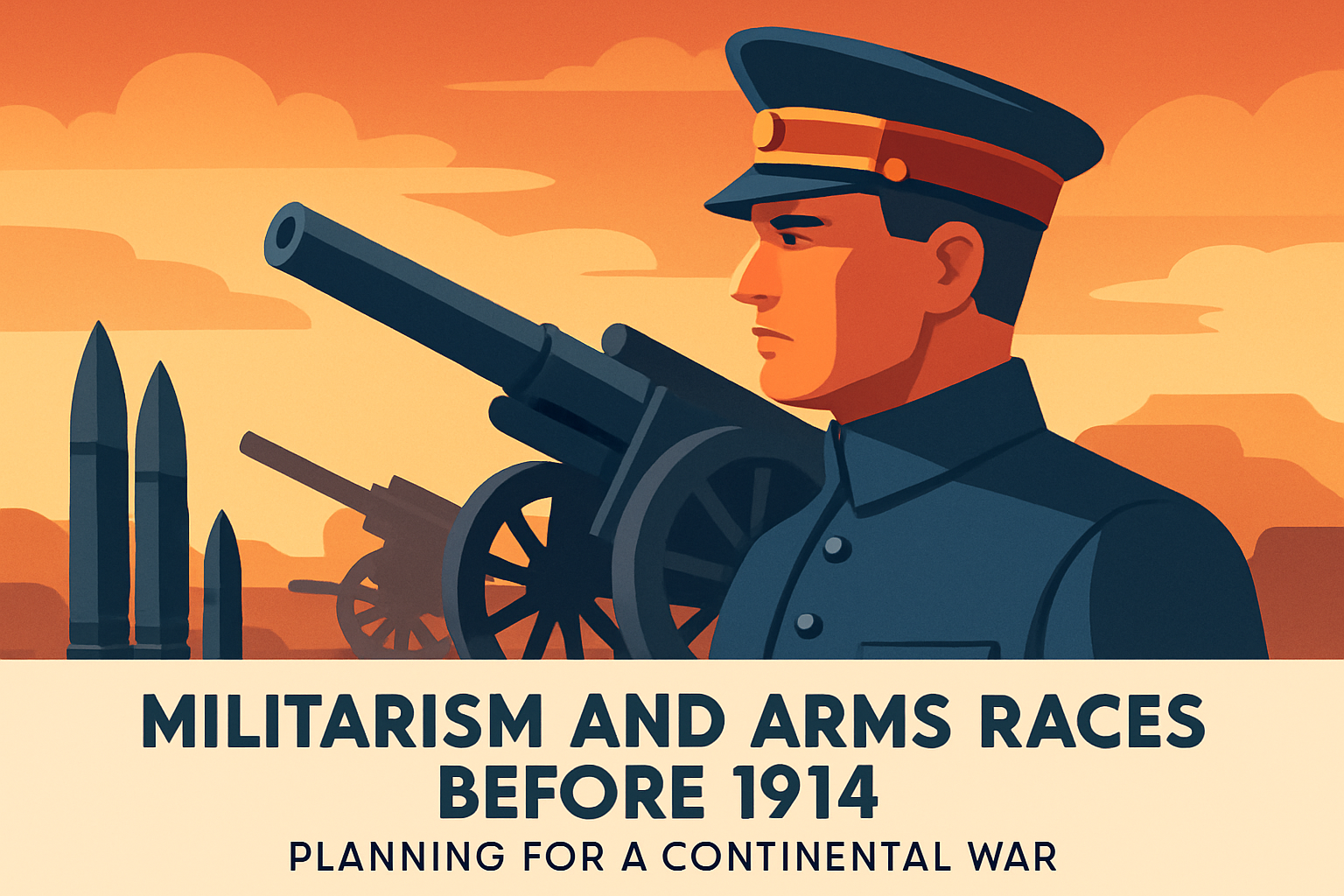
Militarism and arms races shaped Europe before 1914 by turning political rivalry into detailed military preparation, making a continental war thinkable, actionable, and increasingly likely. Militarism means more than having a large army or respecting soldiers. In the decades before the First World War, it meant giving military institutions unusual prestige, allowing generals strong influence over policy, and treating war planning as a normal instrument of statecraft. An arms race is the competitive expansion of military power between rival states, usually through larger armies, bigger budgets, improved weapons, and faster mobilization systems. Before 1914, both trends fed each other. Governments feared weakness, publics celebrated national strength, and military staffs translated diplomatic tension into timetables, railway charts, and deployment orders.
I have worked through prewar planning documents, staff memoranda, and mobilization studies enough to know that the danger did not come from one dramatic decision alone. It grew from routines. Once states built conscript armies, invested in steel battleships, and promised allies rapid support, they also created incentives to act quickly in a crisis. Delay looked dangerous. Caution could appear equivalent to defeat. That is why militarism matters historically. It did not cause every dispute, but it changed how leaders understood risk. A border crisis that might once have stayed local now threatened to activate alliance commitments, rigid plans, and public expectations of firmness.
The key terms for understanding this period are militarism, mobilization, conscription, deterrence, and offensive doctrine. Mobilization was the process of calling up reservists, moving units by rail, issuing equipment, and concentrating forces near frontiers. Because millions of men were involved, mobilization required years of administrative planning. Conscription supplied those armies with trained reserves. Deterrence was the belief that strength could prevent attack, yet it often encouraged competitors to match that strength. Offensive doctrine reflected the widespread assumption that speed, morale, and the first blow would decide victory. Across Europe, these concepts interacted within a strategic culture that prized readiness and distrusted diplomatic improvisation.
Understanding militarism and arms races before 1914 matters because they help explain why the July Crisis after the assassination of Archduke Franz Ferdinand escalated so rapidly into world war. Historians rightly emphasize nationalism, imperial rivalry, alliance politics, and domestic tensions, but military planning linked all of them. It supplied the mechanisms through which fear became movement orders. It also gave governments a language of necessity. Leaders repeatedly claimed they were forced by timetables or by enemy preparation. That claim was sometimes exaggerated, yet not invented. The systems they had built constrained them. To see why Europe marched toward continental war, you have to examine how armies, navies, and plans became central to politics.
The rise of militarism in European politics
Militarism expanded in late nineteenth-century Europe because military success seemed to validate national power. Prussia’s victories over Denmark in 1864, Austria in 1866, and France in 1870–71 offered a powerful model: efficient organization, universal service, and rapid mobilization appeared to produce geopolitical results. The newly unified German Empire institutionalized this lesson. Its General Staff became the most admired planning body in Europe, and foreign observers studied its methods closely. France reformed after defeat, Russia expanded its conscript system, Austria-Hungary adjusted its military administration, and even Britain, traditionally focused on naval supremacy, watched continental trends with concern.
Militarism was not simply imposed from above. It was reinforced by schools, veterans’ groups, youth organizations, patriotic newspapers, and popular culture. Uniforms carried prestige. Parades dramatized national unity. Budget debates often treated military spending as a test of seriousness. In Germany, the army enjoyed extraordinary social standing, especially among conservative elites. In France, memories of Alsace-Lorraine and fears of German power sustained support for military readiness. In Russia, the empire’s size and vulnerability encouraged heavy investment despite administrative weakness. Austria-Hungary relied on the army as one of the few institutions spanning its diverse nationalities, though that diversity also complicated command and loyalty.
Political systems often gave military professionals unusual access to decision making. Germany is the clearest example. The Kaiser, the General Staff, and senior commanders could shape strategy with limited parliamentary restraint. Helmuth von Moltke the Elder had shown what coordinated planning could accomplish, and later chiefs inherited immense authority. Civilian leaders elsewhere were not powerless, but many deferred to technical military expertise, especially during crises. The result was a recurring pattern I have seen in staff records: diplomats negotiated possibilities while generals prepared certainties. Plans were concrete, quantified, and rehearsed; diplomacy was contingent, slow, and vulnerable to misreading.
The arms race on land and sea
The prewar arms race unfolded in two distinct but connected arenas: land armies on the continent and naval competition at sea. On land, France, Germany, Russia, and Austria-Hungary expanded peacetime forces and, more importantly, reserve capacity. Because conscription allowed states to train huge numbers of men, wartime strength mattered more than standing armies alone. Railway building became a military asset. So did industrial capacity, artillery production, and stockpiles of shells. Germany’s Army Bills increased manpower repeatedly, while France responded with the Three-Year Law in 1913, extending service to keep more men under arms. Russia’s “Great Program,” approved after the Bosnian Crisis and Balkan Wars exposed weakness, aimed to improve railways and mobilization capacity by 1917.
The naval race centered on Britain and Germany. Britain followed the two-power standard for much of the nineteenth century, seeking a fleet as strong as the next two navies combined. Germany challenged that posture under Kaiser Wilhelm II and Admiral Alfred von Tirpitz. The Naval Laws of 1898 and 1900 launched a major High Seas Fleet program. Tirpitz’s “risk theory” held that a powerful German fleet could deter Britain by threatening unacceptable losses, even if Germany remained numerically inferior. Britain did not accept that logic. The launch of HMS Dreadnought in 1906 revolutionized battleship design with all-big-gun armament and steam turbine propulsion, resetting naval competition and intensifying budgetary pressure.
| State | Main military focus before 1914 | Representative program or doctrine | Strategic effect |
|---|---|---|---|
| Germany | Rapid offensive war on land; fleet expansion | Schlieffen Plan tradition; Naval Laws | Pressured France and Britain simultaneously |
| France | Mass conscription and offensive spirit | Three-Year Law; Plan XVII | Improved readiness but encouraged attack doctrine |
| Russia | Slow but massive mobilization capacity | Great Program and rail expansion | Raised German fears of future Russian strength |
| Britain | Naval supremacy and expeditionary support | Dreadnought construction | Deepened Anglo-German rivalry |
| Austria-Hungary | Regional land warfare in the Balkans | Plans against Serbia and Russia | Increased instability during Balkan crises |
Arms races are often described as irrational, but participants usually framed them as prudent responses to insecurity. That is the security dilemma in practice: one state’s defensive preparation looks offensive to another. Germany saw Russian railway construction as a future threat. France saw German manpower increases as a direct danger. Britain interpreted German fleet building not as abstract prestige but as a challenge in the North Sea. Each move justified a countermove. The resulting competition was expensive and politically visible, which made compromise harder. Once publics had been told that security depended on new ships or larger intakes of conscripts, scaling back could be portrayed as national surrender.
War plans and the logic of mobilization
War planning before 1914 was defined by scale, timing, and geography. Millions of reservists could not be improvised into armies at short notice. They had to be assigned to units in advance, given depot locations, and linked to railway schedules precise to the hour. In every major power, planning staffs treated mobilization as the opening act of war, not a neutral precaution. That assumption mattered enormously. If mobilization effectively meant commitment, then any crisis carried built-in momentum. Leaders worried that starting late would hand the initiative to the enemy. Military necessity therefore narrowed political choice.
Germany’s planning is the best-known case. The so-called Schlieffen Plan was never a single unchanging document, but a family of assumptions derived from Alfred von Schlieffen’s effort to avoid a prolonged two-front war. Since Russia was expected to mobilize more slowly than France, Germany aimed to defeat France first through a sweeping movement via Belgium, then shift forces east. Moltke the Younger modified the balance of forces, yet the core logic remained speed and concentration in the west. This was not merely operational preference. German rail deployment, reserve organization, and alliance expectations were built around it. A partial response was hard to execute.
France answered with Plan XVII, implemented in 1914. Contrary to simplified textbook summaries, it was not a single blind charge but a concentration scheme shaped by intelligence uncertainties and alliance commitments. Still, it reflected the doctrine of offensive à outrance, the belief that offensive spirit and elan could overcome firepower and positional defense. I have found that many officers did recognize modern lethality, yet doctrine still rewarded attack. The opening offensives into Alsace-Lorraine produced devastating losses. Planning had emphasized morale and rapid action, but machine guns, quick-firing artillery, and entrenched defenders punished frontal advances.
Russia and Austria-Hungary faced even greater planning problems because their territories were vast, infrastructure uneven, and political priorities divided. Russian mobilization was slower, but sheer manpower made it formidable once underway. Austria-Hungary had to prepare for Serbia and Russia simultaneously while managing linguistic diversity and complex command arrangements. Its plans shifted repeatedly between “Balkan” and “Russian” variants, creating confusion. During the July Crisis, these complications mattered. Mobilization was not just a military act; it was a political signal to allies and enemies. Partial mobilization options existed on paper in some states, but in practice they were administratively awkward and often distrusted.
Crises, alliances, and the road to 1914
Prewar militarism became especially dangerous because it interacted with alliance politics and repeated international crises. The Dual Alliance of Germany and Austria-Hungary, the Franco-Russian Alliance, and the later Triple Entente linking France, Russia, and Britain did not make war inevitable, but they widened the consequences of local conflict. The Moroccan Crises of 1905 and 1911, the Bosnian Crisis of 1908, and the Balkan Wars of 1912–13 all tested resolve. Each episode reinforced the lesson that prestige mattered and that backing down carried strategic cost. Military preparations during these confrontations normalized exceptional measures.
The Balkan Wars were particularly consequential. They weakened Ottoman control in southeastern Europe, emboldened Serbia, alarmed Austria-Hungary, and demonstrated both the effectiveness and brutality of modern mobilized warfare. Austrian leaders increasingly viewed Serbia as a subversive threat to imperial cohesion, especially given South Slav nationalism. Russia, recovering from defeat by Japan in 1905 and from internal revolution, resumed a more assertive Balkan role. Germany worried that time was no longer on its side because Russian reforms would eventually shift the balance. This belief in a closing window is one of the most important pre-1914 dynamics. Arms races can create not only fear of attack but fear of future disadvantage.
When Archduke Franz Ferdinand was assassinated at Sarajevo on 28 June 1914, the crisis that followed moved through channels already shaped by militarism. Austria-Hungary sought to punish Serbia decisively. Germany offered strong backing through the so-called blank cheque. Russia signaled support for Serbia. France upheld alliance commitments to Russia. Britain initially sought mediation but could not ignore German violation of Belgian neutrality once the western offensive began. At every stage, planners and schedules weighed heavily. Germany declared war on Russia on 1 August and on France on 3 August. Britain entered on 4 August. In little more than a month, a dynastic assassination had triggered continental war.
It would be misleading to say mobilization alone caused this outcome. Political decisions remained decisive. Leaders chose ultimatums, rejected compromises, and accepted escalation. Yet military structures shaped those choices by redefining what counted as feasible. Once Russia ordered general mobilization, German leaders treated the moment as strategically decisive. Once Germany activated its western deployment, Belgian neutrality became central. The alliance system then widened the conflict further. This is why historians speak of a war by timetable without reducing everything to machinery. Plans did not erase agency, but they concentrated pressure, shortened deliberation, and rewarded those prepared to move first.
What militarism really changed
The deepest effect of militarism before 1914 was mental as much as material. It encouraged leaders to imagine war as manageable through planning, quick victory, and disciplined execution. That confidence was false. Industrial firepower, mass conscript armies, and extended fronts produced stalemate and slaughter on a scale few anticipated. Still, before the war, many decision makers believed that readiness would preserve peace or, if peace failed, deliver a short campaign. That belief helps explain why risk tolerance was so high. The same systems designed to deter conflict also made escalation faster and compromise politically harder.
The central lesson is not that military preparation is inherently reckless. States need defense institutions, and some pre-1914 fears were grounded in real strategic problems. The lesson is narrower and more durable: when arms races combine with rigid planning, alliance commitments, and offensive doctrine, crises become far more dangerous. Europe before 1914 built exactly that combination. Militarism elevated generals, arms races magnified insecurity, and mobilization plans translated suspicion into action. For anyone studying international relations, this period remains the clearest warning that preparation for war can become one of war’s strongest causes. To understand modern security debates, start with the continental plans and rival arsenals that made 1914 possible.
Frequently Asked Questions
What did militarism mean in Europe before 1914?
Before 1914, militarism meant far more than simply maintaining a large army or admiring military discipline. In many European states, especially the great powers, military institutions gained exceptional prestige and influence over public life, political debate, and foreign policy. Generals and admirals were not seen merely as technical advisers. They often shaped national priorities, influenced diplomatic choices, and promoted the idea that war could be a legitimate, even necessary, tool of statecraft. This gave military thinking a central place in government at precisely the moment when international tensions were rising.
Militarism also encouraged societies to treat preparation for war as normal. Governments expanded conscription, improved rail networks for mobilization, increased officer training, and invested heavily in armaments. Newspapers, patriotic organizations, and school systems often reinforced the belief that national greatness depended on military strength. In that atmosphere, military readiness was tied to honor, security, and international status. As a result, diplomatic crises were increasingly viewed through a military lens, making compromise more difficult.
Most importantly, militarism changed how leaders thought about time and risk. If military staffs insisted that victory depended on striking first, mobilizing faster, or executing rigid plans without delay, then hesitation could look dangerous. That mindset did not make war inevitable on its own, but it made war more thinkable and more actionable. By 1914, Europe was not just armed; it was mentally and institutionally prepared for a continental conflict.
How did the arms race increase tensions among the European powers?
An arms race increased tensions by turning rivalry into a constant competition for military advantage. When one power expanded its army, built more artillery, or launched new battleships, its rivals usually interpreted that move as a threat rather than a defensive precaution. They responded with military expansion of their own, which then confirmed the original fears. This created a cycle of mutual suspicion in which every effort to improve security made the overall situation less stable.
The most famous example was the naval arms race between Britain and Germany. Britain depended on naval supremacy to protect its empire, trade routes, and home islands, so German naval expansion was especially alarming. Germany, meanwhile, saw a stronger fleet as a sign of world-power status and as leverage against Britain. Each side justified its actions as prudent defense, but together those decisions deepened distrust and made political reconciliation harder. Naval construction became a symbol of national prestige, which meant leaders could not easily back down without appearing weak.
On land, the arms race was just as important. Continental powers increased troop numbers, improved reserves systems, modernized artillery, and refined mobilization timetables. Because armies relied on rapid railway movement and detailed planning, military expansion was closely linked to the ability to launch war quickly. This meant that arms racing was not only about possessing more weapons. It was about building the administrative and logistical machinery for large-scale conflict. In that environment, crises no longer unfolded slowly. They developed under pressure from military schedules, alliance commitments, and fear of falling behind.
Why were war plans so important in making a continental war more likely?
War plans mattered because they transformed abstract rivalry into practical readiness. By the early twentieth century, European powers had developed highly detailed plans for mobilizing millions of men, transporting them by rail, supplying them in the field, and coordinating operations across multiple fronts. These plans were the result of years of staff work and assumed that any major war would involve rapid action. Once governments had invested so much in preparing for a specific kind of conflict, those plans began to shape political choices.
The danger was that military plans were often rigid. Mobilization was not a simple act of calling up troops; it was a complex national process involving timetables, rail schedules, reserve systems, and strategic assumptions. Military leaders frequently argued that delay would be disastrous because it would give the enemy time to mobilize first. As a result, political leaders in a crisis could feel trapped. Even if they wanted negotiation, they faced pressure from generals who insisted that any pause might sacrifice victory or even national survival.
This rigidity was especially dangerous in a Europe divided by alliances and mutual fears. A conflict involving one state could quickly trigger wider mobilizations, and mobilization itself could be interpreted as an aggressive act. Plans designed for deterrence therefore increased the risk of escalation. In effect, war planning made a continental war more likely not because leaders necessarily wanted one, but because the machinery for fighting one was already built, rehearsed, and waiting to be activated.
What role did generals and military institutions play in pre-1914 politics?
Generals and military institutions played an unusually prominent role in pre-1914 politics because governments often treated military expertise as essential to national survival. In countries facing alliance pressures, border vulnerabilities, or imperial competition, military staffs became central to strategic decision-making. They advised on mobilization, force expansion, and war planning, but their influence often extended beyond technical matters. Senior officers could shape assumptions about threats, push for larger budgets, and argue that political decisions had to fit military requirements rather than the other way around.
This mattered because military institutions tended to emphasize worst-case scenarios. Their job was to prepare for danger, so they often assumed hostile intent on the part of rival powers and preferred readiness over restraint. In a tense international climate, that perspective carried enormous weight. Civilian leaders did not always surrender control, but they frequently found it difficult to challenge military judgments, especially during crises. Public respect for the army and fears of national weakness made resistance politically costly.
The influence of generals also strengthened the broader culture of militarism. Military service was associated with discipline, patriotism, and social status, while officers often enjoyed prestige in court, government, and society. This elevated position helped normalize the idea that military solutions were practical and respectable. By 1914, the authority of military institutions meant that diplomacy was increasingly conducted in the shadow of mobilization plans, strategic calculations, and professional expectations about how a future war should be fought.
Did militarism and arms races make World War I inevitable?
Militarism and arms races did not make World War I strictly inevitable, but they made a large European war much more likely. History is rarely driven by a single cause, and the outbreak of war in 1914 also depended on nationalism, imperial rivalry, alliance politics, regional instability in the Balkans, and the immediate crisis following the assassination of Archduke Franz Ferdinand. Even so, militarism and the arms race created the conditions in which a diplomatic crisis could become a continental war with alarming speed.
The key point is that militarism shaped attitudes, while arms races built capabilities. Leaders and publics had become accustomed to viewing strength, preparedness, and even preventive action as rational responses to insecurity. At the same time, states had assembled huge armies, naval fleets, mobilization systems, and war plans that could be activated quickly. This meant that when a crisis arrived, Europe was not improvising. It was responding with institutions and assumptions already designed for conflict.
So the better conclusion is not that war was unavoidable, but that peace had become increasingly fragile. Diplomatic alternatives still existed, yet they operated in a political environment crowded by military prestige, strategic fear, and competitive armament. Under those conditions, miscalculation became more dangerous, compromise became harder to sustain, and escalation became easier to imagine. Militarism and arms races did not guarantee war, but they made it far easier for Europe to slide from rivalry into catastrophe.