
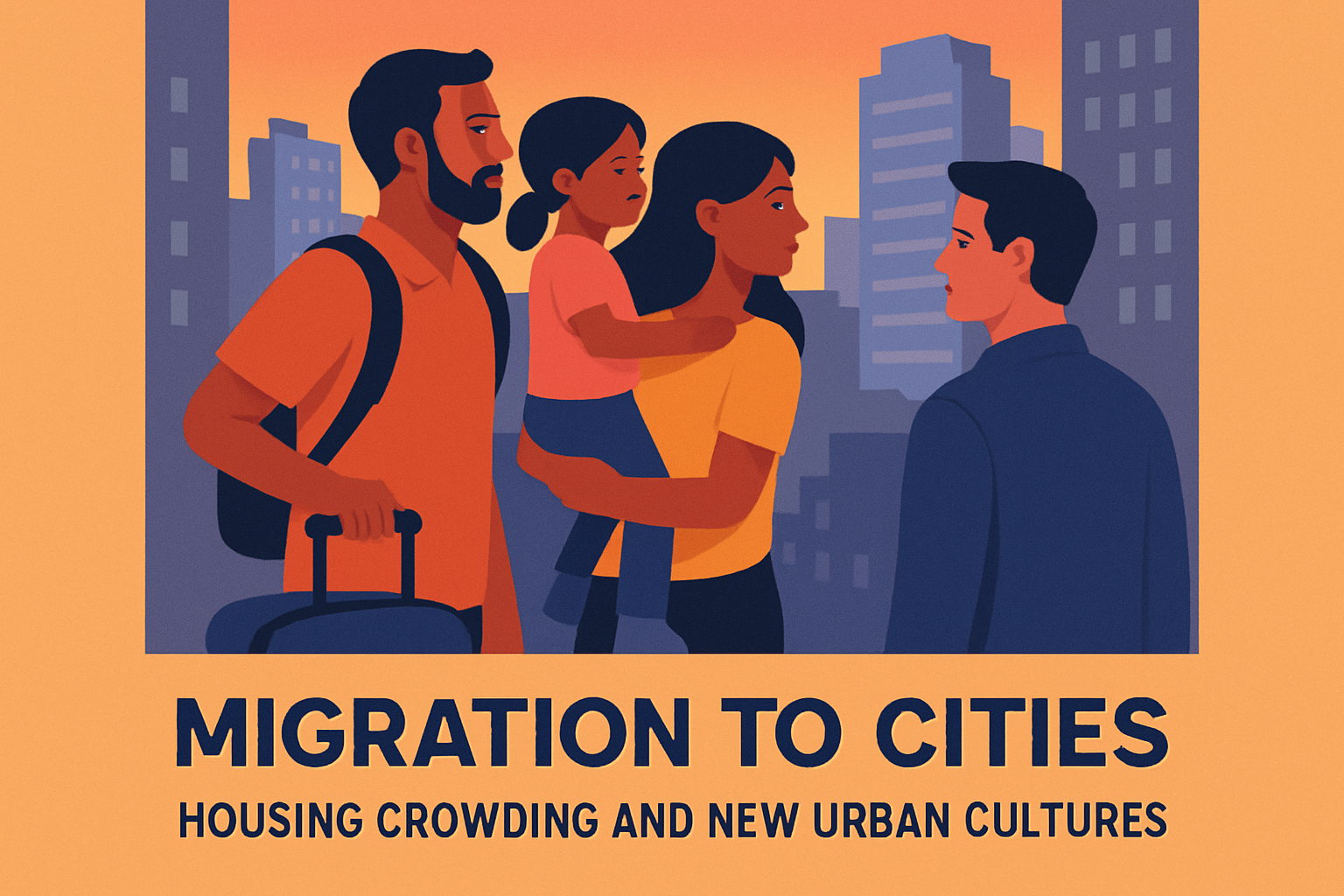
Migration to cities reshapes housing, work, identity, and daily life faster than almost any other social force. In planning meetings, housing audits, and neighborhood interviews, I have seen one pattern repeat across regions: when people move to cities in large numbers, the first visible pressure appears inside homes, not on skylines. Migration to cities refers to the movement of people from rural areas, smaller towns, or other countries into urban centers in search of jobs, education, safety, services, and social mobility. Housing crowding describes a condition in which too many people occupy too little living space, often measured by persons per room, bedroom sharing, or floor area per resident. New urban cultures are the evolving habits, languages, foodways, business models, and community norms that emerge when migrants interact with existing city populations.
This topic matters because urban migration is now a defining reality of modern development. According to the United Nations, more than half of the world’s population lives in urban areas, and the urban share continues to rise. Cities concentrate opportunity, but they also concentrate risk when housing supply, transport, water systems, schools, and labor markets fail to keep pace. The result is not simply overcrowded apartments. It can include informal settlements, inflated rents, unsafe conversions of basements and garages, increased commuting times, and tension over public space. At the same time, migration fuels entrepreneurship, revives declining districts, expands cultural production, and creates new forms of solidarity. Any serious discussion of urban growth must therefore connect housing crowding with the cultural creativity that migration brings.
Searchers usually ask three practical questions: why do migrants cluster in particular neighborhoods, what problems does crowding create, and how do cities adapt without suppressing the cultures migrants build. The short answer is that people follow networks, not maps; crowding becomes harmful when affordability collapses and regulation is weak; and good urban policy supports density while improving housing quality, transit access, and neighborhood inclusion. Understanding those links is essential for planners, landlords, employers, educators, and residents who want cities that are both productive and livable.
Why migration to cities concentrates people in crowded housing
Migrants rarely choose housing through an open, frictionless market. In practice, they rely on kinship ties, village networks, religious communities, labor recruiters, and social media groups that reduce uncertainty. When I have mapped newcomer settlement patterns, the strongest predictor was often not proximity to the city center but proximity to someone trusted. A cousin offers a sofa, a coworker shares a room, or a community association points newcomers toward a landlord who rents without extensive credit checks. This process lowers entry barriers but concentrates demand in a limited number of blocks.
Urban economists explain this through agglomeration and network effects. Jobs cluster in cities because firms benefit from shared labor pools, suppliers, and knowledge spillovers. Migrants cluster for similar reasons. Living near people who speak the same language or understand the same bureaucratic systems reduces search costs for work, childcare, transport, and legal documentation. In London, Toronto, Mumbai, Lagos, and São Paulo, migrant neighborhoods often emerge near industrial corridors, wholesale markets, port zones, transit hubs, or older rental stock. These are places where entry costs are lower, even if living conditions are worse.
Housing crowding intensifies when the formal housing market cannot expand quickly. Zoning restrictions, slow approvals, infrastructure limits, construction costs, and speculative landholding all constrain supply. Meanwhile, wages for new arrivals are often low and unstable, making security deposits and formal leases difficult to obtain. The market responds through subdivision: single-family homes become rooming houses, living rooms become sleeping areas, and unauthorized additions appear in courtyards or on roofs. In many cities, crowding is therefore not a cultural preference but an affordability strategy shaped by exclusion from formal housing pathways.
How housing crowding affects health, safety, and economic mobility
Housing crowding becomes a serious urban problem when it undermines health, privacy, and long-term advancement. Public health research has consistently linked overcrowded housing to higher transmission of respiratory and gastrointestinal illness, poorer sleep quality, stress, and reduced mental well-being. During the COVID-19 pandemic, these risks became especially visible. Households that could not isolate sick members faced higher exposure, and essential workers often returned to tightly shared homes where distancing was impossible. Crowding did not cause the virus, but it magnified vulnerability in predictable ways.
Safety is another major concern. In field inspections, the most troubling conditions were rarely visible from the street: blocked exits, overloaded electrical circuits, unsafe gas connections, illegal partitions, and basement rooms without adequate light or ventilation. When landlords maximize rent from every square meter, residents pay for space with elevated fire risk and reduced dignity. Children struggle to study in noisy, shared rooms. Adults working night shifts lose sleep. Women and girls may experience heightened insecurity when bathrooms and sleeping areas are shared among unrelated tenants. These are not secondary effects; they shape life chances.
Economic mobility also suffers. A crowded address can place workers close to opportunity in the short term, but it often limits progress over time. Without stable housing, it is harder to maintain documentation, receive mail, build credit histories, or enroll children consistently in school. Frequent moves disrupt labor market advancement. Informal tenancies can discourage residents from reporting abuse or requesting repairs because eviction risk is high. The city appears full of opportunity, yet the housing system extracts time, health, and income that migrants need to climb upward.
| Urban pressure | Typical cause | Common effect on migrants | Policy response that works |
|---|---|---|---|
| Overcrowded rentals | Low supply and high deposits | Room sharing, unsafe conversions | Legal affordable rentals and inspections |
| Rising rents | Speculation and job concentration | Displacement to peripheral areas | Housing production near transit |
| Long commutes | Peripheral settlement patterns | Lost income and family time | Reliable mass transit integration |
| Social exclusion | Language and legal barriers | Informal work and weak service access | Multilingual local service delivery |
How migrants create new urban cultures in crowded neighborhoods
Crowded housing is one side of the urban migration story; cultural invention is the other. When newcomers settle together, they build institutions that help people survive and belong. I have watched ordinary commercial strips change within two years as remittance shops, groceries, repair services, cafés, prayer spaces, and street food vendors appear. These are not superficial lifestyle additions. They are social infrastructure. They circulate information about jobs, schools, visas, housing vacancies, and healthcare. They also create the public face of new urban cultures.
Food is often the first visible layer. A district once known for warehouses may become known for Somali tea houses, Oaxacan tlayudas, Bangladeshi sweet shops, or West African fabric markets. Music, fashion, and language follow. In cities such as New York, Paris, Johannesburg, and Dubai, migrant communities have shaped slang, nightlife, beauty standards, and small-business ecosystems. Hybrid forms emerge quickly: second-generation entrepreneurs fuse local ingredients with family recipes, while musicians mix neighborhood beats with transnational influences shared through streaming platforms. This is how urban culture actually evolves—through repetition, adaptation, and exchange in dense everyday spaces.
Religious and civic organizations matter just as much. Churches, mosques, temples, mutual aid groups, football clubs, and tenant associations often become the first institutions newcomers trust. They mediate disputes, translate official notices, organize funerals, help residents navigate schools, and pool savings for emergencies. In policy language, these are bridging and bonding institutions. In lived city life, they are what prevent anonymity from becoming isolation. New urban cultures are therefore not only about consumption and creativity. They are also about governance from below.
What city governments and planners can do to reduce crowding without harming community
The best response to migration-driven housing pressure is not to stop migration. Cities need workers, and migrants are central to construction, care work, logistics, food systems, retail, and innovation. The better approach is to expand safe, legal, affordable housing while preserving the social networks that make arrival possible. In practice, that means permitting more homes in high-opportunity areas, speeding approvals for multifamily construction, legalizing accessory dwelling units where infrastructure can support them, and funding rehabilitation of older rental stock instead of relying only on luxury-led development.
Enforcement must be smarter than simple crackdowns. If inspectors close overcrowded properties without relocation plans, residents are pushed into worse conditions or homelessness. Effective enforcement pairs safety inspections with tenant protections, temporary accommodation, legal aid, and pathways for landlords to bring units up to code. Several cities have learned this the hard way. Aggressive raids may produce headlines, but they often destroy trust and make exploitation harder to detect. Trust-based reporting systems, multilingual hotlines, and partnerships with community organizations produce better compliance.
Transport planning is equally important. When affordable housing exists only at the urban fringe, crowding near employment hubs persists because proximity still matters. Frequent buses, metro expansion, integrated fares, and safe last-mile connections widen the geography of opportunity. Schools and clinics also need to follow population growth. A city cannot claim successful integration if new residents spend hours traveling to basic services. Housing policy, labor policy, and transport policy are inseparable in real urban migration systems.
How residents, employers, and institutions can support inclusive urban growth
Inclusive urban growth is not the responsibility of government alone. Employers influence housing outcomes when they recruit migrant labor without considering whether workers can secure lawful accommodation near job sites. Universities do the same when they expand enrollment but fail to increase student housing, pushing young migrants into informal sublets. Hospitals, warehouses, hotels, and farms connected to metropolitan labor markets should treat housing risk as part of workforce planning. In my experience, the most effective employers provide verified housing referrals, transport assistance, and predictable scheduling that helps workers manage shared living arrangements.
Residents also shape whether migrant neighborhoods become stable communities or flashpoints for resentment. The most constructive local responses focus on practical coexistence: support fair zoning reform, attend school and council meetings, back tenant protections, and resist the false idea that every visible change signals decline. Density is not the same as disorder. A busy street with multilingual storefronts can indicate economic vitality, especially when sanitation, lighting, safety standards, and public space are well managed. Cities become stronger when long-term residents recognize migrant businesses and institutions as contributors, not temporary intrusions.
For anyone researching migration to cities, the central lesson is clear. Housing crowding is a structural problem created by mismatches between population growth, income, land regulation, and infrastructure. New urban cultures are a structural response created by human adaptability, entrepreneurship, and mutual aid. Treat the first problem with better housing supply, enforcement, transit, and services. Value the second outcome as a source of urban resilience and renewal. If you work in planning, real estate, education, or community development, start with one actionable step: examine whether your city’s housing rules match the reality of who is already arriving and building its future.
Frequently Asked Questions
Why does migration to cities so often lead to housing crowding before other urban changes become visible?
Housing crowding usually appears first because homes absorb population change faster than formal urban systems can respond. When large numbers of people move into a city for work, education, safety, or family networks, they need shelter immediately. New housing construction, infrastructure upgrades, zoning adjustments, and public services all take much longer. As a result, the earliest adaptation often happens inside existing apartments, rented rooms, informal settlements, subdivided houses, and shared family dwellings. A two-bedroom unit may become home to multiple generations, unrelated workers, or several recent arrivals pooling rent to stay close to jobs and transport.
This matters because crowding is not just about visible density. It affects privacy, sleep, health, childcare, study time, cooking space, sanitation, and emotional stress. In many cities, families and newcomers make rational, resourceful decisions under pressure: they share rooms, rotate sleeping schedules, convert living areas into bedrooms, or take in lodgers to manage rising costs. These practices can help people survive and establish themselves, but they also reveal deeper structural problems such as housing shortages, high rents, weak tenant protections, and uneven planning. In other words, crowding is often the first household-level sign that migration is reshaping the city faster than policy, housing supply, and labor protections can keep up.
How does housing crowding affect daily life for migrants and long-term urban residents?
Housing crowding changes daily life in practical and deeply personal ways. For migrants, crowded housing can be an entry point into the city because it reduces costs and provides immediate social support. New arrivals often rely on relatives, co-workers, fellow villagers, or community contacts for a place to stay while they look for work and learn how the city functions. That arrangement can offer safety, information, and belonging during a vulnerable transition. At the same time, crowding can create constant pressure. People may have limited control over routines, noise, hygiene, storage, food preparation, and household rules. Rest becomes harder, tensions can rise, and children may struggle to study in homes with little quiet space.
Long-term residents are affected as well, though not always in the same ways. In neighborhoods receiving large numbers of newcomers, landlords may subdivide units, convert single-family homes into multi-tenant properties, or raise rents based on rising demand. Shared utilities, waste systems, public transport, and local clinics can come under strain. Yet it is important not to reduce the story to decline or conflict. Many neighborhoods also gain new businesses, mutual-aid networks, cultural energy, and labor force diversity. The key point is that crowding shifts the rhythms of everyday urban life. It changes how space is used, how neighborhoods function, and how people negotiate coexistence, opportunity, and stress in very close quarters.
What kinds of new urban cultures emerge when migrants reshape city neighborhoods?
New urban cultures emerge through everyday adaptation rather than through a single dramatic transformation. As migrants settle into city life, they bring languages, food traditions, religious practices, music, styles of work, family structures, and social networks that begin to interact with existing urban norms. Over time, this produces hybrid neighborhood cultures: markets offer new ingredients, streets gain informal vending patterns, places of worship expand or diversify, public spaces are used differently, and local businesses evolve to serve mixed communities. What starts as practical adaptation often becomes part of the neighborhood’s identity.
These cultural changes are not superficial. They influence how people define belonging, respectability, success, and community. A district may become known for migrant entrepreneurship, shared housing networks, late-night food economies, multilingual social life, or strong remittance-based family obligations. Young people often play a major role here, combining inherited traditions with urban fashion, digital culture, local slang, and new political identities. The result is a city culture that is constantly negotiated rather than fixed. Some residents celebrate this creativity and resilience, while others experience it as disruption. Both reactions are part of the urban story. In practice, migration does not simply add one culture to another; it changes the meaning of urban life itself by producing new routines, symbols, and forms of collective identity.
Is housing crowding always a sign of urban failure, or can it also reflect adaptation and opportunity?
Housing crowding is best understood as both a warning sign and an adaptive response. It can absolutely indicate serious urban failure: too little affordable housing, inadequate planning, speculative real estate markets, exclusionary zoning, low wages, and weak social protections. When people are forced into unsafe, unhealthy, or unstable living conditions because they have no real alternatives, crowding reveals inequality built into the city’s housing system. In these cases, overcrowded homes are not temporary inconveniences; they are symptoms of structural neglect that can affect health, education, safety, and long-term social mobility.
At the same time, crowding can reflect how people create opportunity under constrained conditions. Shared housing often allows migrants to access urban labor markets, reduce commuting costs, save money, support relatives, and establish a foothold in the city. Many successful migration stories begin in very tight domestic arrangements. Informal living networks can help newcomers find jobs, navigate documentation, access childcare, and avoid homelessness. So the presence of crowding does not automatically mean a neighborhood lacks resilience or agency. The more useful question is whether crowding is a short-term strategy that helps people move upward, or a long-term trap that cities normalize instead of fixing. Good urban analysis distinguishes between survival-based adaptation and policy environments that leave residents with no dignified housing options.
What can cities do to respond more effectively to migration, housing pressure, and changing urban identities?
Cities respond best when they treat migration as a normal and recurring part of urban growth rather than as a temporary disruption. The first priority is expanding safe, affordable, and well-located housing. That includes not only building new units, but also legalizing and improving existing rental stock, supporting social and public housing, strengthening tenant protections, and encouraging forms of housing that match how people actually live, such as multi-generational households, shared rentals, and incremental housing. Urban leaders also need better local data. Housing audits, neighborhood interviews, occupancy trends, and service mapping can reveal crowding long before it appears in skyline development statistics.
But housing alone is not enough. Effective responses connect shelter to transport, schools, healthcare, labor rights, and neighborhood inclusion. Migrants need access to information, legal support, language services where relevant, and pathways into formal systems without fear or unnecessary bureaucracy. Cities should also invest in public spaces, markets, cultural institutions, and community organizations that help different groups interact constructively. When urban policy recognizes migrants not just as housing demand, but as workers, tenants, parents, entrepreneurs, and culture-makers, the result is more stable and cohesive neighborhoods. The strongest cities do not try to freeze identity or stop change. They plan for mobility, protect dignity, and build institutions that can absorb growth without pushing the costs of adaptation entirely onto the household.