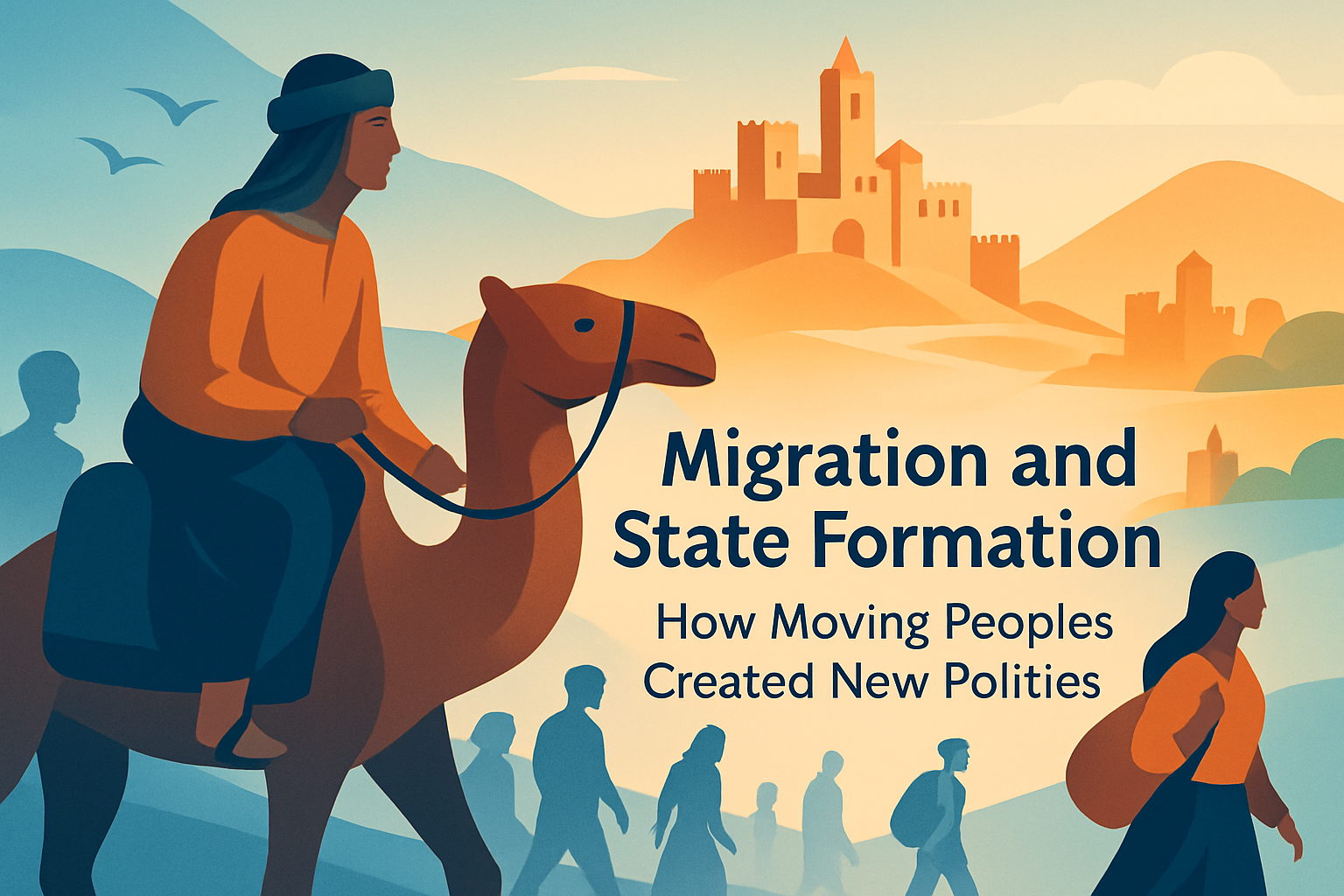
Migration has been a pivotal force in shaping the social, cultural, and political landscapes of the world. Defined as the movement of people from one region to another, migration can occur for various reasons such as economic, social, political, or environmental factors. This movement is not just a transition of individuals, but often acts as a catalyst for broader transformational shifts, including the formation of new states and political entities, a process known as state formation. Understanding the dynamics of migration and its impact on state formation is crucial because these processes influence current global politics, economic systems, and cultural movements.
Migration matters significantly in today’s global landscape; it has long-term implications for social cohesion, economic policy, and international relations. Historical evidence shows that the migration of peoples has repeatedly led to the birth of new political structures. As such, analyzing past instances of migration-induced state formation can provide insights into present and future trends in governance and society. This exploration reveals how migration creates opportunities for development and cultural enrichment and sometimes leads to conflict and turbulence. The focus here is to unravel the complex relationship between migration and the emergence of new political entities, offering a comprehensive understanding of this dynamic interplay.
The Role of Migration in Historical State Formation
The phenomenon of migration-induced state formation is not recent. Throughout history, mass movements of people have led to the creation of new political entities. For instance, the migration of the Indo-Europeans around 4000 to 1000 BCE drastically changed the political atmosphere of Europe and Asia. These migratory movements brought about significant cultural and linguistic shifts, which eventually led to the establishment of new ethnic identities and political territories. By adapting to the new land and resources, these groups built complex societies that were markedly different from those of their origins.
One noteworthy example is the migration of the Angles, Saxons, and Jutes to Britain during the Early Middle Ages. These tribes migrated from continental Europe to the British Isles, leading to the establishment of several kingdoms such as Wessex, Mercia, and Northumbria. This migration not only changed the social landscapes but also led to the political reorganization of the region, laying the foundation for modern-day England. The integration of these migrant groups often involved conflicts and alliances, reshaping the political map through diverse and interlinked processes.
The Impact of Colonial Migrations
Colonial migrations marked another significant period where migration played a crucial role in state formation. The European colonial expansions led to the migration of settlers and soldiers to the Americas, Africa, and Asia. These migrations were instrumental in establishing colonial states and reshaping indigenous political structures. For example, the Spanish migration to Latin America in the 16th century resulted in the creation of viceroyalties, which became the foundational political units in the New World.
The migration of Europeans introduced new governance models, legal systems, and economic practices. This fundamentally altered indigenous societies, often erasing existing political structures and integrating them into broader colonial frameworks. The formation of these new polities posed challenges and benefits: while they led to significant development and cultural exchanges, they also instigated significant demographic and social disruptions. Ultimately, the legacies of these colonial migrations continue to affect post-colonial state structures and relations in modern times.
Modern-Day Examples of Migration and State Formation
Contemporary migration continues to play a critical role in shaping the political landscape. While modern states are less likely to be formed solely by migration today, movements of people still greatly influence socio-political dynamics. One pertinent modern example is the post-World War II migration in Europe, which led to significant internal and external migration flows. The displacement of millions in the aftermath of the war contributed to the reconfiguration of European borders and the formation of new states in Eastern Europe.
In the context of state formation, migration also includes economic migration, forced migration due to conflict, and climate change-induced migration. These migrations have the potential to challenge existing state structures by altering demographic compositions and necessitating new governance models. Today, the European Union represents a unique modern form of state arrangement significantly influenced by internal migrations and policy integration among its member states, despite their individual sovereignty.
Migration, Social Integration, and Political Transformation
Migrations provide a continuous test for social integration mechanisms and political transformation. In regions significantly influenced by migration, such as North America, the political landscape is perpetually evolving. The influx of diverse populations leads to cultural blends and sometimes tensions, demanding new forms of governance and integration policies. The United States is a prime example of a state shaped by waves of migration over centuries, resulting in an evolving identity and continuous political development.
- Economic opportunities attract migrants, influencing urban development and regional demographics.
- Social integration policies become critical in managing diverse populations with different cultural backgrounds.
- Migration influences political debates and policymaking regarding citizenship, rights, and national security.
Migration-induced political transformations are evident in the formation of multicultural policies and practices that aim to foster inclusion and prevent conflict. The ongoing debate in many Western democracies about immigration policies illustrates how migration remains a powerful force in shaping political discourse and societal evolution.
The Future of State Formation Through Migration
As the world faces challenges such as climate change, geopolitical tensions, and economic disparities, migration will undoubtedly remain a significant factor in future state formation processes. Predictions suggest that climate refugees will be a major demographic trend, as rising sea levels and harsh climates displace millions. These migratory pressures may result in new political alliances, altered national boundaries, and innovative governance models.
As mass migrations continue, the international community must work collaboratively to manage state formation processes to ensure they are peaceful and beneficial. Cooperation between nations, international organizations, and communities is vital to handling the complexities of migration-induced state formation effectively.
Conclusion: Navigating State Formation in a Migratory World
In conclusion, understanding the intricate relationship between migration and state formation is essential to addressing contemporary political challenges. Migration has historically facilitated the emergence of new polities, offering lessons in adaptability, integration, and resilience. This understanding benefits policymakers, leaders, and citizens as they navigate the challenges and opportunities presented by migration. By embracing this dynamic process, societies can create inclusive, prospering states that harness the richness of diverse cultures and peoples.
To engage further, individuals and communities can advocate for fair migration policies and participate in cross-cultural dialogues, fostering a global environment that supports peaceful and cooperative state formation. The next step for readers is to delve into local migration histories, examining how these shaped their communities, and consider participation in movements advocating for positive changes in migration policies. The ongoing narrative of migration and state formation continues to shape our world, offering exciting possibilities for those willing to engage thoughtfully with these transformative forces.
Frequently Asked Questions
1. How does migration lead to the formation of new states or political entities?
Migration can lead to the formation of new states or political entities through a range of dynamic processes. Firstly, when groups migrate, they often bring with them new ideologies, traditions, and ways of governance. As these groups settle into new regions, their interactions with existing societies can lead to the establishment of new social structures. This cross-pollination of ideas and practices can lead to the creation of new political frameworks suited to handle the diverse needs of the emerging population. Moreover, in scenarios where the original governing authority is either absent or weak, migrant groups may step in to fill the vacuum, establishing their own systems of governance that eventually evolve into new state entities.
Historically, such processes are evident in various instances where migrations significantly altered political landscapes. For instance, the migrations of various Germanic tribes during the decline of the Roman Empire led to the establishment of new kingdoms in Western Europe. Similarly, the Bantu migrations across sub-Saharan Africa resulted in the formation of powerful polities that managed to control vast territories and influence regional cultures and political systems.
2. What roles do economics and demographics play in migration-driven state formation?
Economics and demographics are central to understanding how migration can influence and drive state formation. Migrants are often driven by the pursuit of resources and economic opportunities, which can lead them to settle in areas that are favorable for agriculture, trade, or industry. As these new settlements grow in population and economic importance, they can solidify their position as centers of power and influence, eventually evolving into new political states.
Demographics, on the other hand, play a crucial role in determining the viability and sustainability of these emergent states. An increase in population, bolstered by continuous inflow from migration, can lead to an essential workforce and also create a market for goods and services. This demographic expansion can enhance economic development and military strength, essential components for the stability and expansion of emerging states.
Additionally, migrants often consist of a diverse range of individuals with various skills and knowledge, enriching the host society’s economic potential and encouraging innovation. This diversity can contribute to the resilience and growth of new polities, ensuring that they can adapt to changing conditions and thrive in the long term.
3. Can you provide examples of modern states or regions that emerged due to migration processes?
There are many examples of modern states or regions that owe their origins to influential migration processes. A significant example is the spread of the Polynesian peoples across the vast Pacific Ocean. Their migrations led to the establishment of distinct societies and political systems on islands such as Hawaii and New Zealand, where they became dominant cultural and political forces.
Another contemporary example can be seen in Latin America. The ancient Incas, through a series of migrations and conquests, built an empire across a substantial portion of South America, forming a complex political system that included various subject peoples. When European colonizers later arrived, new migrations and the interplay of different groups resulted in the political boundaries and states we see today.
In more recent times, the mass migration of European settlers to the Americas, Australia, and parts of Africa during the age of exploration and colonization drastically reshaped these regions’ political landscapes. These migrations gave rise to the creation of numerous new states that were fundamentally different politically and culturally from the indigenous formations they encountered.
4. What impact does migration have on the cultural identity of emerging states?
Migration has a profound impact on the cultural identities of emerging states. As people move and settle in new areas, they bring with them their unique cultural practices, languages, and belief systems. This cultural infusion can significantly alter the social fabric of the host society, leading to a rich tapestry of traditions and customs.
The resulting cultural identity of these emerging states is often a blend of the old and the new. Migrant groups may adopt certain aspects of the host culture while retaining core elements of their own. Over time, this hybridization process can lead to the development of a distinct cultural identity that reflects the diversity and adaptability of the population.
On the other hand, migration can also lead to cultural conflicts, especially if there is resistance to change from existing populations. However, these conflicts often give way to accommodation and integration, leading to a more cohesive and unified national identity in the long run. For example, the United States, often described as a “melting pot,” has its cultural identity deeply rooted in its history of immigration and the amalgamation of various cultural influences.
5. Are there specific historical periods where migration was particularly significant in shaping new states?
Yes, there are several historical periods where migration was particularly influential in shaping new states. During the ancient and medieval periods, migrations such as the Barbarian Invasions, where different tribes like the Visigoths and Vandals moved into Roman territories, played crucial roles in the decline of the Roman Empire and the establishment of early medieval European kingdoms.
The Age of Exploration, spanning the 15th to 17th centuries, marked another significant period where European powers sought new territories across the globe. These movements led to the creation and restructuring of states across Africa, the Americas, Asia, and Oceania. The settlements and colonization efforts brought about by these migrations fundamentally altered the political landscapes and resulted in the formation of numerous modern nation-states.
Moreover, the 19th and early 20th centuries saw large-scale migrations sparked by industrialization, wars, and socio-economic factors, leading to significant urbanization and the emergence of new state configurations. Notably, the Great Migration in the United States and the political realignments following World War I and World War II, where millions were displaced or relocated, significantly impacted state boundaries and the formation of new political entities worldwide.