
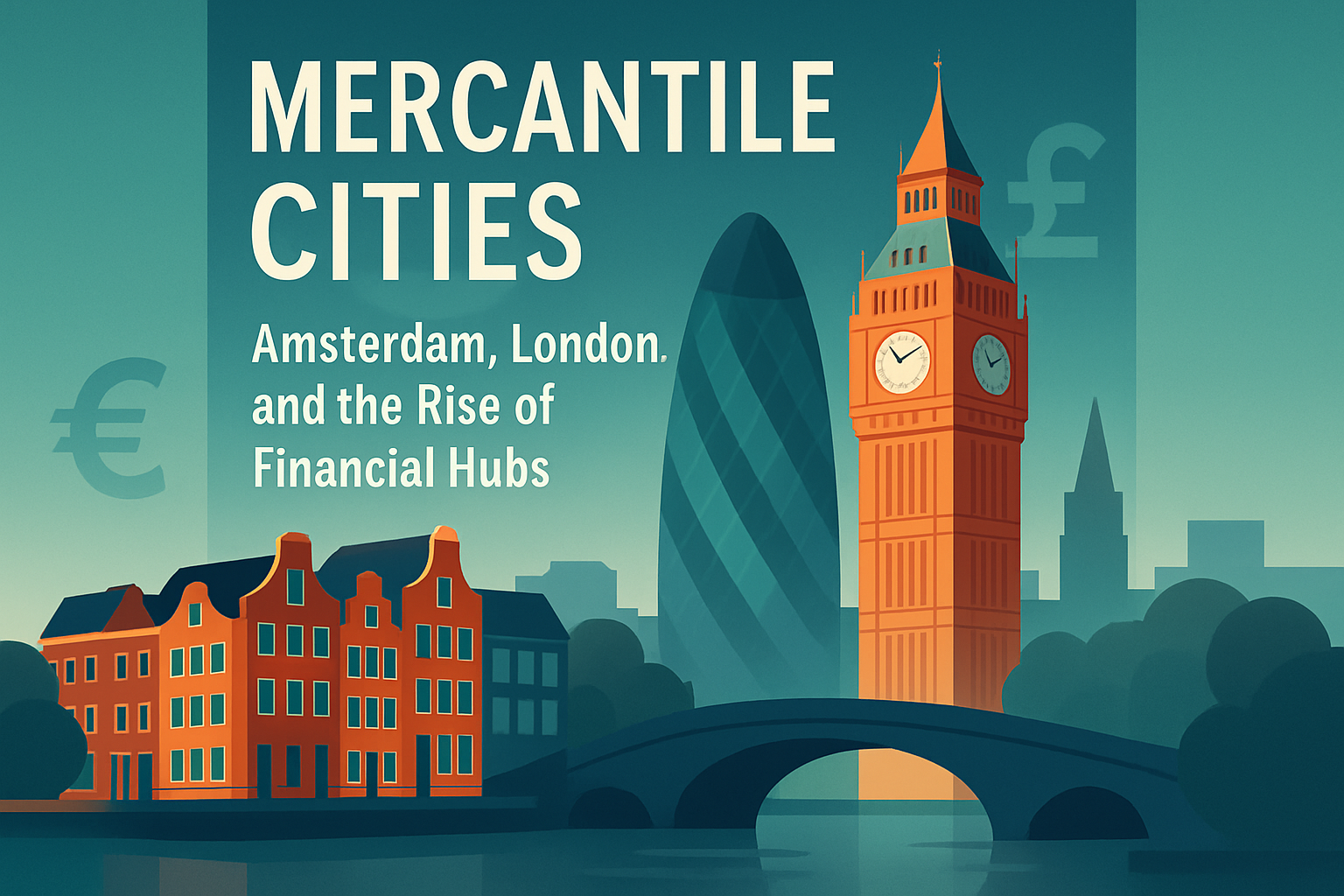
Mercantile cities transformed the world economy by concentrating trade, credit, information, and political power in dense urban centers, and no pair illustrates that process better than Amsterdam and London. In economic history, a mercantile city is more than a busy port. It is a place where merchants, shipowners, insurers, brokers, and governments build institutions that reduce risk, speed exchange, and turn commerce into sustained financial power. When historians discuss the rise of financial hubs, they usually mean the shift from scattered merchant networks to organized markets for bills of exchange, public debt, insurance, company shares, and foreign currency. Amsterdam led that transformation in the seventeenth century, and London adapted, expanded, and eventually surpassed the Dutch model in the eighteenth and nineteenth centuries.
I have worked with archival trade records, early exchange manuals, and modern market structure research, and the pattern is consistent across centuries: finance grows where trust can be standardized. Ports attract goods, but financial hubs attract promises about future goods, future payments, and future profits. That distinction matters because the modern global economy still runs on the same foundations these cities developed: liquid markets, credible institutions, and reliable information. Understanding Amsterdam and London is not only useful for students of history. It explains why New York, Singapore, and Hong Kong function the way they do, why central banking matters, and why legal credibility often matters more than raw commercial volume.
The story begins with geography but does not end there. Both cities benefited from access to sea routes, navigable rivers, and expanding hinterlands. Yet geography alone never creates a financial center. Many ports handled heavy trade without becoming capitals of credit. Amsterdam and London became exceptional because they paired trade with institutional innovation. They built exchanges where prices could be discovered openly, banking systems that facilitated settlement, and legal frameworks that made contracts enforceable across large networks of strangers. In plain terms, they made it easier for merchants to do business with people they did not know personally. That lowered transaction costs, widened participation, and encouraged scale.
Religion, migration, warfare, and state formation also shaped these cities. Amsterdam benefited from the Dutch Republic’s commercial tolerance, high literacy, and decentralized political structure, which gave merchants unusual influence. London benefited from England’s growing fiscal-military state, parliamentary taxation, imperial expansion, and population growth. Both cities absorbed talent from abroad. Sephardic Jews, Flemish merchants, Huguenot refugees, German traders, and Scottish financiers all left marks on urban finance. Financial hubs are rarely pure national creations. In practice, they are magnets for mobile expertise. That was true in 1650, and it is true in 2025.
What made these cities decisive was not simply wealth, but the way they organized wealth. They turned individual capital into market capital through institutions that could survive the death, bankruptcy, or departure of any one merchant. Once that happened, trade became less personal and more systematized. Bills could be discounted, ships could be insured in syndicates, state debt could be traded, and joint-stock companies could mobilize resources on a scale impossible for family firms alone. That is the real rise of financial hubs: the conversion of commerce into a durable urban system for managing risk, time, and information.
Amsterdam and the invention of a modern market ecology
Amsterdam’s rise in the late sixteenth and seventeenth centuries was rooted in the Dutch revolt against Spain, the decline of Antwerp after 1585, and the rapid reorientation of European trade toward the Dutch Republic. Merchants, capital, and commercial knowledge fled south to north, and Amsterdam became the chief entrepôt of Europe. Grain from the Baltic, timber from Scandinavia, spices from Asia, sugar from the Atlantic, and textiles from across Europe moved through its warehouses. But the city’s true advantage was not warehousing alone. It built a market ecology in which goods trading, shipping, insurance, and finance reinforced each other daily.
The Amsterdam Exchange, established in 1602 in its mature form, concentrated merchants in one place for price discovery and deal making. The same year, the Dutch East India Company, or VOC, was chartered as a permanent joint-stock company. That innovation mattered enormously. Investors could buy shares in a firm with ongoing operations rather than financing a single voyage and waiting years for liquidation. Tradable shares created liquidity, and liquidity attracted more capital. In my experience explaining early capitalism to non-specialists, this is the point where the modern system becomes recognizable. Secondary markets let investors exit without shutting down productive enterprises.
Another cornerstone was the Bank of Amsterdam, founded in 1609. The bank did not operate like a modern retail bank. It functioned primarily as a settlement institution, allowing merchants to hold stable bank money backed by coin deposits and to transfer balances on its books. In a world of clipped, worn, and heterogeneous coinage, that was revolutionary. Reliable settlement reduced disputes, simplified large transactions, and made Amsterdam’s payments system more trustworthy than those of many rivals. Historians still debate the bank’s exact reserve practices over time, but its reputation for sound money was a central reason the city became Europe’s clearing center.
Amsterdam also developed sophisticated techniques in bills of exchange, commodity futures, marine insurance, and securities trading. Joseph de la Vega’s 1688 account, Confusion de Confusiones, described the city’s stock market with remarkable clarity, including speculation, rumor, and the psychology of price movements. That text is often cited because it shows how advanced Amsterdam had become. Financial hubs do not eliminate human emotion; they institutionalize it. Bulls, bears, leverage, and panic were already present. What mattered was that the city had enough market depth to absorb continuous trading and enough legal credibility to keep participants returning after losses.
Why merchants trusted Amsterdam
Trust in Amsterdam was built through a combination of formal institutions and repeated commercial practice. The Dutch Republic offered relatively strong property rights, an impressive notarial culture, and courts that merchants generally found usable. Notaries recorded contracts, wills, partnerships, powers of attorney, and shipping agreements with a level of precision that historians can still trace. Standardized documentation lowered uncertainty. Merchants knew that if a dispute arose, evidence would exist and procedures would be familiar. In modern terms, Amsterdam reduced counterparty risk through documentation, settlement discipline, and legal enforceability rather than through personal reputation alone.
Information moved efficiently through the city as well. Printed price currents, shipping reports, merchant correspondence, and exchange rates circulated constantly. A financial hub is always an information hub. Traders in Amsterdam knew not only what goods were worth locally, but how war, weather, harvests, and politics affected prices elsewhere. The city’s dense networks made arbitrage possible and profitable. If Baltic grain prices shifted or silver flows changed, merchants could respond quickly. This information advantage was a form of capital in its own right, much like data infrastructure in contemporary finance.
Tolerance played a practical role. Amsterdam was not perfectly free or modern in a contemporary sense, yet it was comparatively open for its time. Religious minorities and foreign merchants often found space to operate, worship privately, and invest. That openness widened the talent pool and increased capital inflows. I have seen this same pattern in later financial centers: openness does not remove social tension, but it does enlarge markets. Cities that welcome skilled outsiders usually outperform cities that police commercial identity too narrowly. Amsterdam’s cosmopolitan culture made it easier to connect local institutions to international trade routes.
There were limits, however. Dutch political decentralization could slow coordinated state action, and the Republic’s smaller population constrained military and imperial scale relative to later Britain. Amsterdam was brilliant at commerce, but eventually it faced a rival with a larger domestic market, stronger tax capacity, and expanding naval power. Financial leadership is never permanent. It depends on whether institutions can keep adapting when the scale of war, empire, and industry changes.
London’s ascent from commercial capital to global financial center
London did not simply copy Amsterdam, but it learned from Dutch precedents and then fused them with English state power. By the late seventeenth century, England had already become a major trading nation, yet the Glorious Revolution of 1688 and the institutional changes that followed were decisive. Parliament strengthened the credibility of public borrowing by limiting arbitrary royal finance and tying debt service to more dependable taxation. The founding of the Bank of England in 1694 created a central institution for government finance and note issuance. In practical terms, London became the place where private capital and state capacity met.
That partnership mattered because eighteenth-century warfare was expensive. Britain’s contests with France required sustained borrowing on a scale few states could manage cheaply. London’s deepening capital markets allowed the state to fund war through long-term debt rather than repeated fiscal improvisation. Lower borrowing costs translated into strategic endurance. Economists often describe this as the rise of the fiscal-military state, and the term is useful because it captures the connection between credible finance and geopolitical success. Investors bought government securities because they believed taxes would service them, and that belief strengthened British power at sea and overseas.
The City of London also benefited from clustering. The Royal Exchange, the Bank of England, marine insurers, goldsmith bankers, bill brokers, and later stockjobbers operated within a concentrated urban area. Lloyd’s coffee house emerged as a center for marine insurance because merchants needed a place to share shipping intelligence and spread risk among underwriters. This is a classic financial hub dynamic: once information, expertise, and capital are close together, the city becomes more valuable to each participant. Modern economists call this agglomeration. Seventeenth-century merchants would simply have called it convenience backed by reputation.
Imperial commerce further enlarged London’s reach. Atlantic trade in sugar, tobacco, enslaved labor, and manufactured goods generated enormous profits and connected the city to colonial markets. The East India Company added Asian trade and state-like administrative power. These networks were morally and politically complex, and any serious account must state plainly that London’s rise was entangled with coercion, empire, and slavery. Financial innovation did not occur in an ethical vacuum. Yet from a structural perspective, empire widened the asset base, deepened insurance demand, increased shipping finance, and fed customs revenue that supported the British state.
Amsterdam and London compared
The transition from Amsterdam to London was not a simple case of one city declining while another rose overnight. For long periods they were deeply interconnected, with capital moving between them and Dutch expertise influencing English practice. The better question is why leadership gradually shifted. The answer lies in scale, state structure, and adaptability.
| Factor | Amsterdam | London |
|---|---|---|
| Core strength | Commercial intermediation and efficient settlement | Integration of private finance with state borrowing |
| Signature institution | Bank of Amsterdam | Bank of England |
| Market innovation | VOC shares and active secondary trading | Deep market in government debt and insurance |
| Political structure | Decentralized Dutch Republic | Centralizing parliamentary state |
| Long-run advantage | Early lead in trade efficiency | Larger population, empire, and tax base |
Amsterdam remained rich and financially sophisticated long after London began to overtake it. Dutch investors continued to supply capital across Europe, including to Britain. But London’s larger hinterland and stronger fiscal apparatus gave it a compounding advantage. As industrialization gathered force, access to coal, manufacturing districts, and a rapidly growing domestic economy mattered more. London was not just a trading port; it became the command center for an industrial and imperial system. That broadened the range of assets, borrowers, and financial services located in the city.
Another difference was central banking evolution. The Bank of Amsterdam excelled at settlement credibility in a commercial republic, whereas the Bank of England became increasingly central to public finance and later to lender-of-last-resort functions identified by Walter Bagehot in the nineteenth century. That distinction points to a larger truth: financial hubs thrive when they can handle crisis, not only boom. London built institutions suited to repeated shocks, from wartime borrowing to banking panics.
What these mercantile cities teach modern financial centers
Amsterdam and London established principles that still define leading financial hubs. First, liquidity is built, not declared. It requires enough participants, transparent rules, trusted settlement, and continuous information flow. Second, law matters as much as capital. Traders will tolerate taxes and fees more readily than arbitrary enforcement or uncertain property rights. Third, openness to migrants and foreign capital usually strengthens a city’s financial system, provided institutions can integrate newcomers into predictable rules. Fourth, financial leadership depends on adaptation. A city that dominates one era’s instruments can lose ground if it fails to support the next era’s needs.
Consider how these lessons map onto modern hubs. New York combines deep securities markets with federal fiscal credibility, much as London paired private finance with state capacity. Singapore emphasizes legal predictability, efficient infrastructure, and cross-border openness, echoing key strengths of Amsterdam. Hong Kong historically thrived as an intermediary market with strong information flows and international connectivity. In every case, the successful hub does more than host money. It organizes transactions so efficiently that global participants prefer to route business through it.
The same framework helps explain failures. Ports with impressive trade volume sometimes never become top financial centers because they lack judicial reliability, currency stability, or credible regulation. I have seen businesses choose a slightly costlier jurisdiction simply because settlement, documentation, and dispute resolution are more dependable. That decision logic is centuries old. Merchants in 1650 and investors today both ask the same question: where is it safest and easiest to transact at scale?
For readers researching economic history, urban development, or capital markets, the main takeaway is clear. Mercantile cities rise when they turn commercial density into institutional trust. Amsterdam pioneered the architecture of market liquidity, tradable shares, and dependable clearing. London absorbed those lessons and added powerful state finance, imperial reach, and industrial scale. Together they created the template for the modern financial hub. If you want to understand today’s global markets, start with these cities, follow the institutions they built, and pay attention to the enduring connection between trade, law, information, and credit.
Frequently Asked Questions
What made Amsterdam and London more than just successful port cities?
Amsterdam and London became far more than busy harbors because they developed the institutions that allowed trade to scale into durable financial power. A major port can move goods, but a true mercantile city also organizes credit, insurance, legal enforcement, market information, and state support in ways that reduce uncertainty for merchants and investors. In Amsterdam, the combination of commercial tolerance, sophisticated bookkeeping, active merchant networks, and institutions such as the Amsterdam Exchange Bank helped create trust in payments and contracts. That trust mattered because long-distance trade was full of risk, from storms and piracy to price volatility and delayed information.
London followed a similar path but eventually built an even broader financial ecosystem. Its merchants, shipowners, insurers, and government offices became deeply connected, allowing the city to finance trade, warfare, infrastructure, and imperial expansion at the same time. Markets for bills of exchange, government debt, and marine insurance linked private commerce to public finance. In both cities, urban density was crucial. Merchants could gather information quickly, negotiate face to face, spread risk through partnerships, and resolve disputes in relatively reliable legal settings. That concentration of expertise and capital is what transformed Amsterdam and London from commercial centers into financial hubs with global influence.
Why is Amsterdam often seen as the first great modern financial center?
Amsterdam is often described this way because it combined trade dominance with institutional innovation at a very early stage. During the seventeenth century, the city sat at the center of vast trading networks reaching the Baltic, the Mediterranean, Asia, Africa, and the Atlantic world. Yet its importance was not just that ships arrived there in large numbers. Amsterdam also offered merchants an unusually effective environment for settling accounts, obtaining credit, insuring cargoes, and investing in large enterprises.
The Amsterdam Exchange Bank, founded in 1609, is one reason historians treat the city as a foundational financial center. It improved confidence in payments by providing a stable unit for clearing large commercial transactions in an era when coinage was often inconsistent in weight and quality. The city also hosted active securities trading, most famously connected to the Dutch East India Company, whose shares could be bought and sold in a secondary market. This encouraged liquidity, speculation, and broader participation in commercial finance. Just as important, Amsterdam thrived on information. Merchants there had access to shipping news, commodity prices, and credit relationships that gave them an edge in international trade. Put together, these features made Amsterdam a place where finance did not merely support commerce; it became a central engine of economic power in its own right.
How did London overtake Amsterdam as the leading financial hub?
London did not surpass Amsterdam overnight. The shift happened gradually as England, and later Britain, developed advantages in political scale, naval strength, public finance, and imperial reach. Amsterdam remained enormously important for a long time, but London built a system that could mobilize larger pools of capital and connect them to a growing state and empire. One key factor was the evolution of British public credit after the late seventeenth century. Institutions such as the Bank of England, along with an expanding market for government debt, gave investors confidence that the state could borrow on a large scale and service its obligations over time.
This mattered because military power, overseas trade, and financial credibility reinforced one another. London became the place where merchants financed cargoes, insurers priced maritime risk, and investors purchased state securities that supported war and imperial expansion. The city also benefited from a large domestic economy, a rising manufacturing base, and access to colonial markets. Over time, London’s financial markets became deeper and more diversified than Amsterdam’s, with stronger links between banking, insurance, shipping, and government borrowing. By the eighteenth and nineteenth centuries, London had become the central node in a worldwide system of trade and payments. In short, Amsterdam pioneered many of the mechanisms of modern finance, but London eventually scaled them to a wider geopolitical and economic framework.
What role did institutions like banks, exchanges, and insurers play in mercantile cities?
These institutions were essential because they made long-distance commerce more predictable, more liquid, and less dangerous. Banks helped merchants move money without relying entirely on physical coin, which reduced transaction costs and improved trust in settlement. Exchanges created organized spaces where traders could meet, compare prices, negotiate contracts, and buy or sell financial claims. Insurers allowed merchants and shipowners to spread the risks of loss at sea, making it easier to invest in voyages that might otherwise have seemed too hazardous. Together, these institutions transformed trade from a series of isolated ventures into a system supported by regularized financial practices.
In mercantile cities such as Amsterdam and London, these institutions also fed one another. A merchant might borrow against expected cargo revenues, insure the shipment, hedge price changes through market connections, and settle obligations through a trusted banking network. This web of services made capital more mobile and encouraged larger ventures. It also tied private commerce to public authority, because governments often chartered companies, enforced contracts, regulated coinage, and borrowed from the same financial markets that served merchants. The result was a powerful urban ecosystem in which commercial knowledge, political influence, and financial innovation were concentrated in one place. That is why historians treat banks, exchanges, and insurers not as side features of mercantile cities, but as core institutions behind their rise.
Why do historians still care about Amsterdam and London when studying the history of global finance?
Historians care because these cities help explain how the modern world economy was built. Amsterdam and London show that global finance did not emerge abstractly or automatically. It grew out of specific urban settings where merchants, investors, and governments developed practical tools for dealing with uncertainty, distance, and scale. Many features that still define financial centers today were visible in early form in these cities: deep capital markets, dense information networks, internationally trusted legal frameworks, sophisticated credit systems, and close interaction between private finance and public power.
They also matter because their histories reveal both the strengths and tensions of financial globalization. On one hand, these cities increased efficiency, lowered the costs of exchange, and made it possible to coordinate trade across continents. On the other hand, their success was tied to war, empire, exclusion, and unequal access to capital. Studying Amsterdam and London therefore gives historians a richer understanding of how finance can drive growth while also concentrating wealth and influence. In that sense, they are not just chapters in European urban history. They are foundational case studies in how commercial cities become command centers of the international economy.