
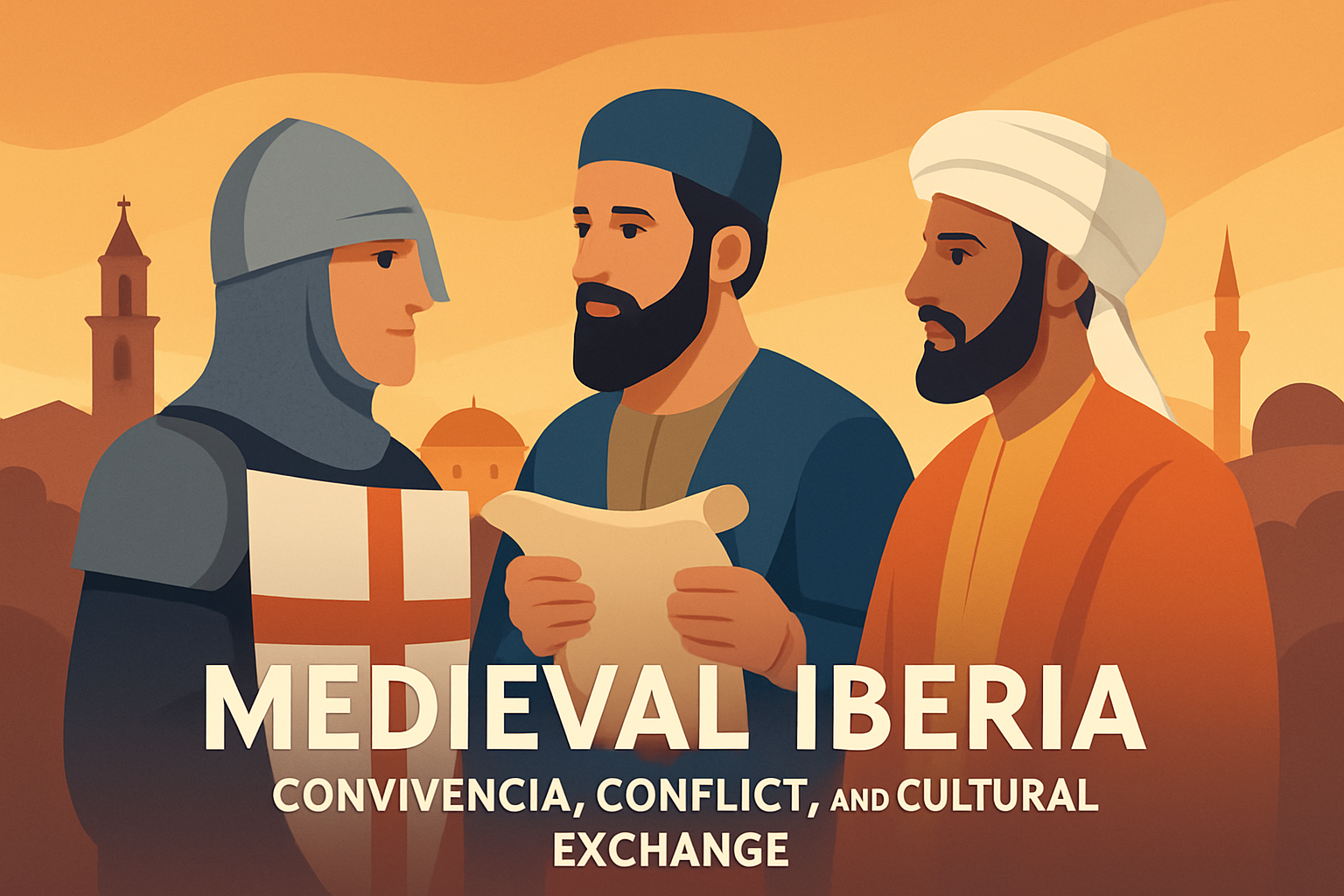
Medieval Iberia was shaped by conquest, coexistence, and constant negotiation among Muslims, Christians, and Jews, making the idea of convivencia both essential and contested. In the simplest terms, convivencia refers to the shared life of different religious communities in the Iberian Peninsula during the Middle Ages, especially under Islamic and later mixed political rule. Yet anyone who has worked closely with medieval Iberian sources knows the term can mislead if it suggests harmony without friction. The historical reality was more complex: cooperation in trade, administration, scholarship, and urban life existed alongside war, legal inequality, forced conversion, and periodic violence. That tension is precisely why the subject matters. Medieval Iberia offers one of history’s clearest examples of how cultural exchange can flourish even under unequal power structures, and how conflict can coexist with remarkable intellectual creativity.
The Iberian Peninsula between the eighth and fifteenth centuries included al-Andalus, the Muslim-ruled territories established after the Umayyad conquest of 711, and a patchwork of expanding Christian kingdoms in the north and center, including León, Castile, Aragón, Navarre, and Portugal. Jewish communities lived throughout these regions, often serving as merchants, physicians, diplomats, tax administrators, artisans, and scholars. Christians under Muslim rule were often called Mozarabs; Muslims under Christian rule later became known as Mudéjars. These labels matter because they signal that medieval Iberia was not divided into sealed civilizations. Instead, populations moved, translated, intermarried in some settings, adopted each other’s words, borrowed artistic forms, and navigated legal systems that categorized them differently depending on who ruled the territory.
Understanding medieval Iberia also requires rejecting two simplistic stories. The first is the romantic myth of perfect tolerance, often projected backward from modern desires for pluralism. The second is the equally distorted view of permanent civilizational warfare with no meaningful exchange. Neither matches the documentary record. Arabic, Latin, Hebrew, and Romance texts reveal a world in which rulers prized talented administrators regardless of origin, where legal distinctions could both protect and subordinate minority communities, and where translation schools, commercial networks, and courtly culture connected societies across confessional lines. At the same time, chronicles, legal codes, and religious polemic show deep anxieties about identity, conversion, taxation, and sovereignty. To study convivencia seriously is to study both collaboration and coercion together, not one at the expense of the other.
This matters beyond medieval history. Debates about pluralism, migration, minority rights, and cultural borrowing often use Iberia as a case study, sometimes carelessly. A rigorous understanding helps us avoid using the past as a slogan. It also explains why Iberia became such a powerful engine of transmission between the Islamic world, the Latin West, and Jewish intellectual traditions. The agricultural systems, urban crafts, architecture, philosophy, medicine, music, and administrative practices that crossed Iberia affected Europe and the Mediterranean for centuries. If readers want a precise answer to the central question, it is this: medieval Iberia was neither a utopia nor an endless battlefield, but a layered society where political conflict repeatedly generated spaces for cultural exchange.
Political Landscapes: Rule, Frontiers, and the Conditions of Convivencia
The political setting of medieval Iberia changed repeatedly, and those shifts directly shaped everyday coexistence. After 711, Muslim forces rapidly overthrew most Visigothic rule and incorporated Iberia into the Umayyad world. By 756, the Umayyad Emirate of Córdoba had emerged as an independent polity, and in 929 Abd al-Rahman III proclaimed the Caliphate of Córdoba. Under the caliphate, Córdoba became one of the largest and most sophisticated cities in Europe, with complex administration, court culture, long-distance trade, and monumental architecture such as the Great Mosque. In practical terms, this period created strong institutions capable of managing diverse populations, collecting taxes, and incorporating Christians and Jews into urban and fiscal life, though always within a hierarchy that privileged Islam.
Under Islamic rule, Jews and Christians generally fell into the category of dhimmis, protected but subordinate non-Muslim communities. In exchange for paying taxes such as the jizya and accepting legal restrictions, they were allowed communal worship, property holding, and internal jurisdiction in certain matters. This system was not modern equality, but it was also not random persecution. In my experience reading administrative and legal materials from the period, the key point is predictability: status groups were unequal, but they were often legible to the state. That administrative legibility made sustained coexistence possible, especially in cities where artisans, translators, and merchants of different faiths depended on one another. Still, treatment varied by region, ruler, and moment, and periods of stability could give way quickly to stricter enforcement or political repression.
The collapse of the caliphate in the early eleventh century produced the taifa kingdoms, smaller rival states that often competed through patronage as much as warfare. Taifa rulers employed Jewish viziers, hired Christian mercenaries, cultivated poets, and paid tribute to Christian kings when politically necessary. This fragmentation intensified both conflict and exchange. A famous example is Samuel ibn Naghrila, known in Arabic as Isma’il ibn Nagrila and in Hebrew as Shmuel ha-Nagid, a Jewish scholar and statesman who rose to high office in Granada. His career shows that social mobility across communal lines was possible in exceptional cases. Yet the 1066 massacre of Granada, in which a Jewish community suffered devastating violence, shows equally clearly how fragile such arrangements could be when court politics, resentment, and factionalism converged.
As Christian kingdoms expanded through processes often grouped under the term Reconquista, they inherited large Muslim and Jewish populations. Conquest did not automatically mean expulsion. Practical rulers needed taxpayers, irrigation experts, artisans, and stable urban administrations. Capitulation agreements sometimes guaranteed religious practice, property rights, and legal autonomy to conquered Muslims. In places like Toledo after 1085, continuity mattered. Christian rulers adapted existing administrative knowledge, preserved Arabic-speaking populations, and benefited from established scholarly networks. But frontier society was never static. New settlers arrived, church institutions claimed authority, and military orders reshaped landscapes. The conditions for convivencia therefore depended less on abstract tolerance than on state capacity, elite incentives, and whether rulers saw diversity as an asset or a threat.
Daily Life Across Communities: Law, Work, Language, and Urban Exchange
Convivencia was lived most concretely in streets, markets, workshops, fields, and courts. Urban neighborhoods were often associated with particular communities, but segregation was rarely absolute. People bought grain from one another, rented property, shared water infrastructure, borrowed money, hired labor, and sought specialized medical care across confessional boundaries. Notarial records and municipal documents from later medieval Iberia show this pragmatic entanglement clearly. A Christian landowner might depend on Muslim irrigators; a Muslim artisan might sell to Jewish and Christian clients; a Jewish physician might serve a Christian bishop or a Muslim notable. Such interactions were ordinary rather than exceptional, and they remind us that cultural exchange was not only an elite literary phenomenon.
Language provides one of the best indicators of this contact. Arabic was a prestige language of government, scholarship, and high culture in al-Andalus, while Latin remained important in ecclesiastical settings and emerging Romance vernaculars spread in speech and writing across Christian territories. Hebrew flourished in liturgy, philosophy, poetry, and science. Many people navigated more than one linguistic world. Mozarabs adopted Arabic styles and vocabulary; Jewish writers composed in both Hebrew and Arabic; Christian rulers prized translators who could move knowledge from Arabic into Latin or Castilian. Even today, Iberian languages preserve this exchange through words related to agriculture, administration, architecture, and everyday objects, from acequia for irrigation canal to alcalde for municipal authority, both rooted in Arabic usage.
Architecture and material culture also reveal sustained exchange. Horseshoe arches, geometric ornament, stucco work, carved wood ceilings, and courtyard planning circulated across political borders. The phenomenon later called Mudéjar style in Christian-ruled territories is especially important because it demonstrates that Muslim craftsmen and Islamic artistic languages continued to shape churches, synagogues, palaces, and civic buildings under Christian patronage. The synagogue of Santa María la Blanca in Toledo, though a Jewish house of worship under Christian rule, uses forms associated with Islamic aesthetics. That is not a contradiction; it is exactly what medieval Iberia produced. Patrons selected skilled artisans and respected prestigious styles, often regardless of confessional origin.
Food and farming changed too. Irrigation systems expanded with techniques refined under Islamic governance, including waterwheels, channels, and sophisticated rights over water distribution. Crops such as citrus, rice, sugarcane, eggplant, spinach, saffron, and cotton became more significant in parts of Iberia through connections with wider Islamic agronomy. Historians still debate how revolutionary this “Arab Agricultural Revolution” was in every region, but no serious account denies the transfer of agricultural knowledge. Manuals on cultivation, grafting, and soil management circulated; landscapes were engineered for productivity; and culinary habits changed with new ingredients. When cultural exchange is discussed only in terms of philosophy or translation, this practical transformation of land and diet is too often overlooked.
| Area of exchange | What moved across communities | Concrete Iberian example |
|---|---|---|
| Administration | Tax practices, scribal methods, diplomacy | Christian rulers in Toledo using Arabic-speaking officials after conquest |
| Architecture | Decorative motifs, construction techniques, spatial design | Mudéjar ceilings and arches in churches and synagogues |
| Agriculture | Irrigation systems, crop knowledge, agronomic texts | Acequia networks in eastern Iberia supporting intensive farming |
| Language | Loanwords, translation practices, multilingual literacy | Arabic terms entering Castilian civic and agricultural vocabulary |
| Medicine and science | Texts, pharmacology, astronomical knowledge | Arabic works translated in Toledo for Latin Christian audiences |
Knowledge Transfer: Translation, Philosophy, Science, and the Making of Europe
If one asks why medieval Iberia matters for global intellectual history, the answer begins with translation. From the twelfth century onward, places such as Toledo became centers where Arabic scientific and philosophical texts were rendered into Latin and sometimes into Castilian. This process was not a simple one-step transfer. It often involved collaboration among Arabic speakers, Jewish scholars, and Latin clerics. Texts by Aristotle, Galen, Ptolemy, Avicenna, Averroes, and many others became more widely available to Latin Christendom through Iberian channels. In the classroom and archive, I have found that students are often surprised by how collective this work was. The celebrated “translator” was frequently part of a chain including interpreters, scribes, patrons, and scholars working across languages.
Toledo’s translation movement is the most famous example, but it was not unique. Courts and cathedral schools elsewhere participated in similar exchanges. Gerard of Cremona famously sought Arabic texts unavailable in Italy and translated major works on astronomy, medicine, and natural philosophy. These included Ptolemy’s Almagest in Arabic transmission and medical authorities that became central to European universities. The significance is hard to overstate. Scholastic philosophy, university medicine, and late medieval astronomy were all shaped by materials that reached Latin readers through Iberia. This is one reason modern searchers asking whether Islamic Spain influenced Europe deserve a clear answer: yes, decisively, through preserved, commented, and expanded knowledge moving across multilingual networks.
Jewish intellectual life in Iberia formed another vital bridge. Figures such as Moses Maimonides, born in Córdoba in 1138, worked within Arabic philosophical culture while reshaping Jewish thought for generations. Maimonides wrote the Guide for the Perplexed in Judeo-Arabic, engaging Aristotle, Islamic philosophy, and rabbinic tradition with extraordinary precision. Judah Halevi, though critical of philosophy in some respects, also reflects the sophistication of Hebrew literary culture formed in conversation with Arabic poetics. Hebrew grammar, biblical exegesis, secular poetry, and legal scholarship all developed in deep contact with Arabic models. Iberian Jewish communities were not passive recipients between Islam and Christianity; they were active producers of knowledge with their own institutions, debates, and literary standards.
Music, mathematics, cartography, and astronomy also moved through these channels. The astrolabe, astronomical tables, and navigational knowledge were refined and transmitted in ways that mattered well beyond Iberia. Alfonso X of Castile, known as Alfonso the Wise, sponsored learned projects in the thirteenth century that drew on Muslim, Jewish, and Christian expertise. The Alfonsine Tables, legal compilations, historical chronicles, and works of translation all show a monarchy deliberately using multilingual scholarship to strengthen royal authority and intellectual prestige. That political dimension matters. Cultural exchange did not happen in a vacuum. Rulers funded it because knowledge improved governance, enhanced legitimacy, and connected courts to wider traditions of science and law.
Conflict, Intolerance, and the Limits of Coexistence
Any serious account of medieval Iberia must state plainly that convivencia had strict limits and often broke down. Warfare between Muslim and Christian polities was frequent, and dynastic conflict within each sphere could be equally brutal. Legal pluralism could facilitate coexistence, but it also entrenched hierarchy. Dhimmi status involved taxes and restrictions; in Christian kingdoms, Jews and Muslims likewise faced distinct legal burdens and social vulnerabilities. These systems could preserve communal life while reinforcing subordination. That dual reality is essential for accurate interpretation. Coexistence was real, but it was not equality.
The arrival of the Almoravids in the late eleventh century and the Almohads in the twelfth altered conditions significantly in parts of al-Andalus. The Almohads in particular pursued more rigorous religious policies than many earlier Andalusi rulers, and their rule contributed to migration, conversion pressure, and instability for Christians and Jews. Maimonides’ family famously left Iberia in this context. On the Christian side, anti-Jewish preaching, fiscal exploitation, and political crisis intensified in the later Middle Ages. The pogroms of 1391 devastated Jewish communities across Castile and Aragón, producing mass death, forced conversion, and the rapid growth of the converso population. These events were not marginal episodes. They transformed Iberian society and destabilized older forms of communal separation.
By the late fifteenth century, the conquest of Granada in 1492, the expulsion of the Jews the same year, and later forced conversions of Muslims marked the end of medieval pluralism in any meaningful institutional sense. The Spanish Inquisition, established in 1478, targeted primarily converted Christians suspected of heresy, revealing that anxiety had shifted from visible religious diversity to hidden difference within a formally Christian polity. This is the opposite of a convivencia ideal. It shows how states that once governed diversity pragmatically could come to prize confessional uniformity as a tool of centralization. Anyone evaluating medieval Iberia should therefore resist nostalgia. Cultural brilliance did not prevent persecution, and exchange did not guarantee security.
Still, it would be wrong to let the violence erase the centuries of collaboration that preceded it. Historical interpretation fails when it swings from romanticization to negation. The better conclusion, supported by legal records, chronicles, architecture, poetry, and economic history, is that medieval Iberia developed durable mechanisms of intercommunal interaction without ever resolving the underlying tensions of sovereignty, religion, and social rank. Those tensions could be managed for long periods, especially when elites benefited materially and administratively from diversity. They became explosive when political authority fractured, reform movements hardened boundaries, or rulers sought legitimacy through exclusion.
Legacy: What Medieval Iberia Still Teaches About Cultural Exchange
The legacy of medieval Iberia lies not in a comforting parable but in a demanding historical lesson. Cultural exchange is often strongest where communities live in sustained proximity, share institutions, and need one another’s skills, even when trust is incomplete. Iberia demonstrates that translation, artistic borrowing, scientific transmission, and economic cooperation can thrive under unequal systems. It also demonstrates that such achievements are vulnerable when politics rewards purity over pragmatism. For modern readers, that combination is more instructive than any myth of seamless harmony.
Its influence remains visible across Spain and Portugal in urban form, vocabulary, music, farming landscapes, and archival memory. It also remains central to European intellectual history because so much classical and Arabic learning entered Latin Christendom through Iberian mediation. When historians describe medieval Iberia as a contact zone, they mean something precise: a region where power, identity, and knowledge were constantly renegotiated. The main benefit of studying it is clarity. It helps us understand how societies actually absorb difference: through law, labor, patronage, translation, and conflict management, not through idealized goodwill alone.
The essential takeaway is simple. Medieval Iberia was a place of convivencia, conflict, and cultural exchange all at once. Muslims, Christians, and Jews built cities, argued theology, traded goods, translated texts, and shaped one another’s worlds, even as rulers taxed, ranked, expelled, or attacked them. That complexity is not a problem to smooth away; it is the history. If you want to explore the subject further, start with Córdoba, Toledo, Granada, and the major figures of the translation movement, then compare how each city handled diversity differently.
Frequently Asked Questions
What does convivencia actually mean in the context of medieval Iberia?
In medieval Iberian history, convivencia usually refers to the shared life of Muslims, Christians, and Jews on the Iberian Peninsula during the Middle Ages. At its most basic level, the term points to the fact that these communities lived in close proximity, interacted in cities and rural areas, traded with one another, worked in royal administrations, and participated in overlapping cultural worlds. It is especially associated with periods of Islamic rule in al-Andalus and with frontier and mixed political zones where religious difference was part of everyday life.
At the same time, historians use the term cautiously because it can create the false impression that medieval Iberia was a model of effortless tolerance. It was not. Coexistence existed, but it was structured by law, power, taxation, social hierarchy, and shifting political realities. Religious minorities could enjoy protection and opportunities in some periods, yet also face restrictions, discrimination, forced conversion, expulsion, or violence in others. So convivencia is best understood not as a golden age of harmony, but as a complex framework of negotiation, accommodation, competition, and conflict among communities that shared the same spaces while remaining distinct.
Was medieval Iberia really a peaceful society where Muslims, Christians, and Jews lived in harmony?
No serious reading of the sources supports the idea that medieval Iberia was uniformly peaceful or harmonious. The peninsula was marked by conquest, dynastic rivalry, military campaigns, shifting borders, and political fragmentation. The Christian kingdoms in the north expanded southward over centuries, while Muslim polities themselves experienced internal divisions, civil war, and changing ruling dynasties. In that setting, relations among Muslims, Christians, and Jews could be cooperative in one context and hostile in another.
What makes medieval Iberia historically important is not that it eliminated conflict, but that it developed many forms of contact across religious lines. People served rulers of different faiths, translated texts across Arabic, Latin, Hebrew, and Romance languages, shared artistic techniques, and borrowed legal, scientific, and intellectual traditions. Yet these exchanges took place within unequal systems. Religious identity shaped taxation, legal standing, dress regulations, access to office, and public worship. Periods of relative stability could give way to persecution, anti-Jewish violence, stricter religious policies, or pressure on minorities to convert. The reality was neither utopia nor constant war, but a deeply entangled society where cooperation and coercion existed side by side.
How did cultural exchange happen among Muslims, Christians, and Jews in medieval Iberia?
Cultural exchange in medieval Iberia happened through many ordinary and institutional channels. Trade connected markets across religious boundaries. Courts employed multilingual administrators, diplomats, physicians, scribes, and scholars. Urban life brought communities into contact through neighborhoods, workshops, taxation systems, and legal disputes. Intermediaries such as translators, merchants, captives, clerics, and scholars carried ideas from one setting to another. Even warfare contributed to exchange by moving people, technologies, artistic styles, and administrative practices across political frontiers.
One of the clearest examples is translation. In places such as Toledo, texts in Arabic were translated into Latin and sometimes into Castilian, making ancient Greek learning preserved and expanded in Arabic available to wider Christian Europe. Fields such as philosophy, astronomy, medicine, mathematics, and geography benefited from this transfer. But cultural exchange was not limited to books. Architecture reflects it in striking ways, including the adoption of horseshoe arches, intricate geometric decoration, and artistic forms often described as Mudejar in Christian-ruled territories. Language also shows the depth of contact, with Arabic leaving a major imprint on Iberian vocabularies. Foodways, irrigation techniques, music, poetic forms, and courtly etiquette likewise developed through sustained interaction. The key point is that exchange was not accidental; it emerged from centuries of practical coexistence, political necessity, and social interdependence.
Why do historians debate the usefulness of the term convivencia?
Historians debate convivencia because the word is both helpful and potentially misleading. It is helpful because it captures a basic historical truth: medieval Iberia cannot be understood without recognizing that Muslims, Christians, and Jews lived in relation to one another for centuries. Their histories were not separate parallel stories. They shaped one another’s institutions, economies, languages, and intellectual traditions. The term gives scholars and readers a shorthand for that shared, entangled world.
However, the term becomes problematic when it smooths over inequality or implies mutual respect where the evidence shows hierarchy, suspicion, and periodic violence. Medieval rulers often tolerated minorities for practical and political reasons, but tolerance in this context did not mean modern equality. Protected status could exist alongside special taxes, legal disabilities, and public restrictions. In addition, convivencia risks becoming too broad if it is used to describe every kind of contact, from peaceful exchange to domination. For that reason, many historians prefer to speak in more precise terms such as coexistence, interdependence, acculturation, frontier society, minority status, or negotiated difference. The debate is less about rejecting the word entirely and more about ensuring that it does not hide the hard realities of power.
What is the historical legacy of convivencia in medieval Iberia?
The legacy of convivencia is one of the most important reasons medieval Iberia continues to attract scholarly and public attention. Its history demonstrates that religiously diverse societies can produce extraordinary cultural creativity, especially when people move across linguistic, political, and confessional boundaries. Iberia helped transmit classical knowledge, reshape philosophical debate, advance scientific and medical learning, and create distinctive architectural and literary traditions that were neither exclusively Muslim, Christian, nor Jewish. The peninsula became a zone of exchange that influenced not only local society but also the wider Mediterranean and Latin Christian Europe.
At the same time, the legacy is cautionary. The eventual hardening of confessional boundaries, the growth of anti-Jewish violence, the mass conversions of Jews and Muslims, the establishment of the Inquisition, and the expulsions of 1492 and the early seventeenth century reveal how fragile coexistence could be. Medieval Iberia shows that pluralism is not a permanent condition; it depends on institutions, political choices, and social practices that can erode. That is why convivencia remains such a contested but valuable concept. It reminds us that shared life across religious difference was real and historically productive, but it also warns us against romanticizing the past or ignoring the unequal structures that shaped that shared world.