
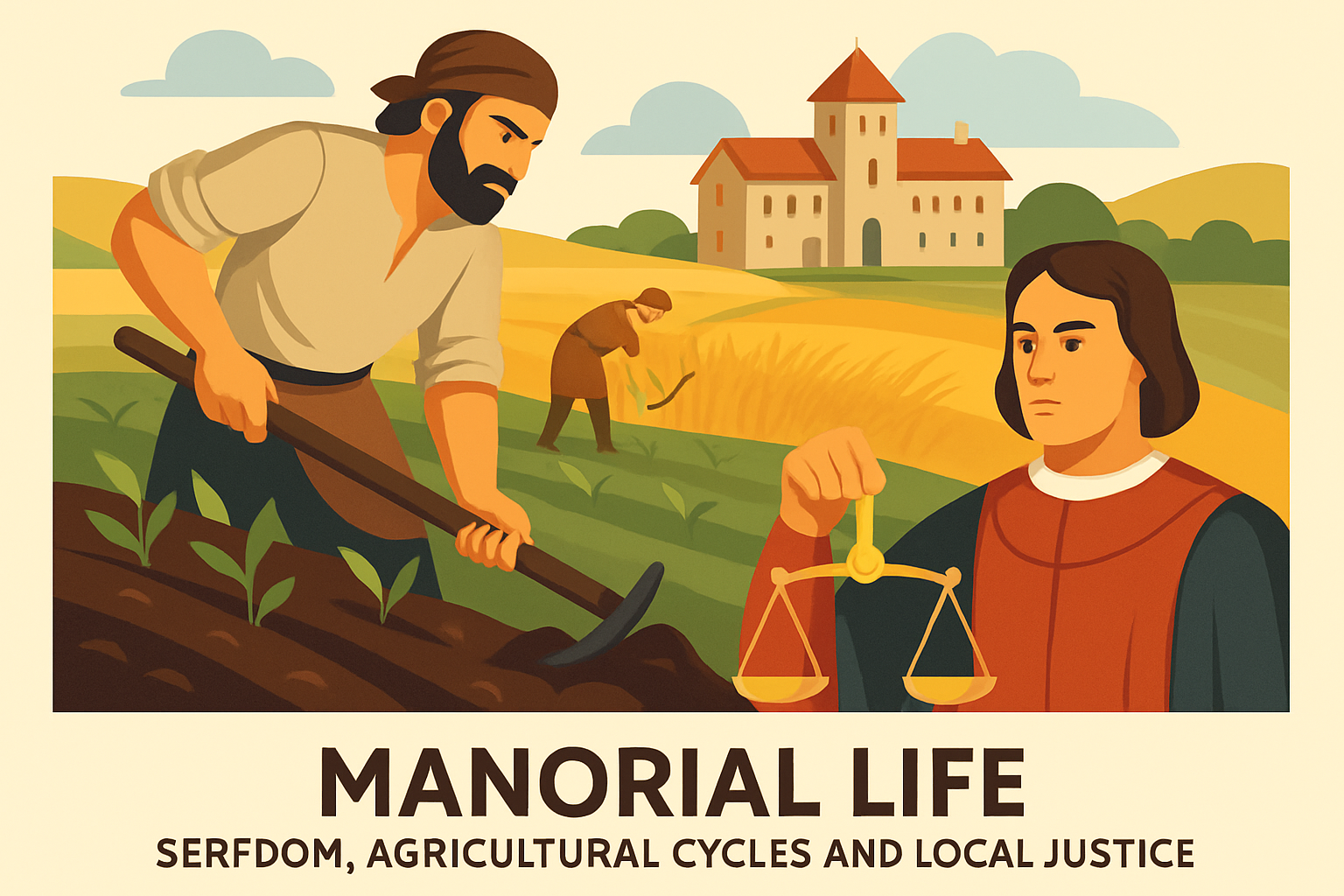
The manorial system, once a cornerstone of medieval European life, offers a fascinating glimpse into the organization and function of past societies. Centered around the manor, this system was pivotal in structuring agricultural production, social hierarchy, and local governance. At the heart of this setup lay the serfs—laborers bound to the land, whose lives revolved around agricultural cycles and a unique judicial structure. Understanding the dynamics of manorial life, including serfdom’s agricultural practices and local justice forms, provides crucial insights into the evolution of modern social, economic, and legal systems. By examining these elements, one gains a deeper appreciation of how historical contexts shaped present-day lifestyles and legal traditions. The intricate relationship between landlords and serfs, alongside the community-driven justice systems, underpinned the economic and social stability of medieval Europe. This exploration not only highlights the resilience and adaptability of societies past but also enriches our perception of contemporary living and justice systems.
Understanding the Lives of Serfs
In the manorial system, serfs constituted the majority of the population, representing a vital component of manorial economies. Unlike slaves, serfs were not owned by their lords but were bound to the manor from birth, a status inherited through generations. A typical serf’s life was characterized by duties to their lord, cultivation of the lord’s demesne (land directly controlled by the lord), and payment of various dues. Serfs were granted small strips of land for subsistence farming, which formed the cornerstone of their livelihoods.
Real-world examples from medieval England depict serfs toiling from sunrise to sunset during sowing and harvest periods, showcasing their dependence on agricultural necessity. While they faced restrictions, serfs had certain rights, like the use of the common pasture. This arrangement, though restrictive, served a vital role in maintaining the economic stability of the manorial estate. Their tenacity and labor provided the necessary sustenance for both manorial residents and broader regional economies.
Agricultural Cycles in the Manorial System
The agricultural practices within the manorial system were designed to maximize productivity in a sustainable manner. Following a three-field rotation system, this agricultural technique ensured that land fertility was conserved over time. This method, typically rotating among wheat, legumes, and fallow, fostered a balance between soil recovery and crop output. Such a calibrated approach reflected an early understanding of land stewardship and environmental conservation.
| Season | Primary Activities |
|---|---|
| Spring | Sowing of barleys and oats, maintenance of pathways |
| Summer | Weeding, hay harvesting, wool collection |
| Autumn | Harvesting grains, threshing, storing crops |
| Winter | Animal care, repairing tools, brewing ale |
For instance, during medieval times, the collective effort in crop rotation reflected an early form of community-based agricultural management. Villagers often collaborated during peak farming seasons, ensuring optimal yield and surplus storage for leaner months. This cyclical nature of work, rudimentary yet efficient, showcases the resilient adaptability of medieval agrarian societies in the face of nature’s unpredictability.
Local Justice: The Manorial Court
At the heart of manorial governance was the manorial court—a foundational element in dispensing local justice and maintaining order within the manor. The court’s jurisdiction covered a range of civil and minor criminal matters, from disputes over land use to petty theft. Entrusted to the lord or a steward, these courts were instrumental in resolving conflicts swiftly within the community, emphasizing social harmony and resource distribution.
A compelling case from 13th century France demonstrates how such courts operated. Village disputes over grazing rights were mediated at the manorial court, where parties presented evidence, ensuring that judgments were communal and equitable. Through such cases, manorial courts maintained communal order by prioritizing restitution over punishment, a philosophy reflected in contemporary restorative justice practices.
The Legacy of the Manorial System
Reflecting on the legacy, we see continuing influences on contemporary agriculture, legal systems, and socio-economic frameworks. The collaborative spirit of medieval agriculture laid the groundwork for modern cooperative movements seen in today’s agrarian cooperatives. Similarly, the foundation of local self-governance apparent in manorial courts has evolved into modern local governments and civil arbitration systems.
- Agricultural cooperatives foster community agriculture.
- Local governance draws from communal decision-making processes.
- Restorative justice methodologies mirror medieval restitution practices.
This historical understanding enriches our appreciation for inherited social regimes, encouraging a re-examination of current practices based on cooperative and sustainability-focused paradigms.
Conclusion
The exploration of manorial life offers invaluable insights into the complexities of medieval societies, especially in understanding serfdom, agricultural cycles, and local justice systems. This historical perspective underscores the adaptive and resilient nature of human societies in the face of socio-economic and environmental constraints. Key takeaways include the importance of cooperative labor, the significance of sustainable agricultural practices, and the value of local justice systems in maintaining social order. As we progress further into the complexities of modernity, the lessons of the past guide us towards more equitable and sustainable societal frameworks. Engaging with this rich history not only broadens our understanding but also inspires innovative solutions to contemporary challenges. As a next step, consider exploring local history repositories or visiting heritage sites that echo these past narratives, deepening your connection to the enduring relics of manorial systems.
Frequently Asked Questions
What is the manorial system, and how did it function in medieval society?
The manorial system was a socio-economic structure dominant in medieval Europe, particularly from the 9th through the 15th centuries. At its core, it was a way to organize society around a large estate or manor, typically owned by a noble landowner—a lord. This manor was the central unit of economic activity, consisting of the lord’s residence, as well as villages and farmland controlled by the lord. The land was cultivated by serfs, who were peasants legally bound to the land. In exchange for the right to live on their leased plots and cultivate their own small parcels, serfs owed labor services, part of their crops, and sometimes rent to the landowner.
The manorial system wasn’t just about agriculture; it was also a fundamental aspect of local governance. The manor functioned as a self-sufficient unit, with the lord exercising legal and economic rights over the people living therein. The manor court, held by the lord or his steward, dealt with minor offenses and civil cases, effectively making the lord the governor of his own mini-kingdom. Thus, manorial life intertwined social, economic, and legal aspects, operating largely independent of external political or judicial systems, especially in its fundamental dealings.
Who were the serfs, and what role did they play in the manorial system?
Serfs were the backbone of the manorial system. These were laborers bound to the land who had little personal freedom. They weren’t slaves, as they couldn’t be bought or sold, but they were obligated by law or tradition to remain on their lord’s manor, working his lands as well as their plots. Their main duty was agricultural labor, which aligned with the cyclical nature of farming, from planting in the spring, tending crops in the summer, harvesting in the fall, to winter tasks like maintaining tools and caring for animals.
Despite their limited freedoms, serfs had some aspects of life regulated to their benefit. For example, they could expect a certain amount of protection and justice from their lord. If the lord failed his duties, serfs had the right to appeal to higher authorities, although such instances were rare. Generally, the stability of feudal society relied heavily on the labor and social cohesion provided by serfs, who in return depended on the manor’s sustenance and security.
How did agricultural cycles influence the lives of those living on a manor?
Agricultural cycles were the heartbeat of manorial life. They dictated the daily, seasonal, and annual routines of the population living in a manor. The cycle began with winter plowing, followed by springtime sowing of grains like barley and wheat. Summer was a busy season with various maintenance tasks and looking after livestock. Harvest in late summer and early autumn was the most labor-intensive period, often requiring every able-bodied person to work the fields exhaustively, ensuring the yield that would sustain them through the winter.
These cycles ensured that every event in people’s lives was scheduled around planting and harvest times, including social gatherings, religious festivals, and even marriages. Such routines fostered a deep connection to the land, reinforcing the serfs’ identities and their inextricable link to the manorial system through the labor they provided and the sustenance they depended upon. The predictability of these cycles also reinforced the stability and continuity of manorial society.
What was the local justice system like within a manor?
The manorial court was the locus of local justice, handling disputes, criminal cases, and enforcing the rules and customs of the manor. Presided over by the lord or a steward in his absence, these courts dealt with a wide range of issues—from petty theft and boundary disputes to breaches of agricultural agreements. The court had the authority to levy fines, order compensations, or carry out other forms of reparation to restore order.
Unlike modern legal systems, these courts were informal by contemporary standards, yet were vital in maintaining social order. The judgments were based more on customs and established traditions rather than codified laws. This system was effective, primarily because the community both depended on and respected this structure as a means to sustain harmony and continuity. The manor court thus reflected the broader feudal justice system where the king or higher nobility rarely intervened unless there were significant disputes between higher-ranking individuals or if a case was escalated beyond the manor level.
How did serfs eventually gain more freedom, leading to the decline of the manorial system?
The gradual decline of the manorial system and the freedom of serfs were influenced by various factors in the late medieval period. One of the critical triggers was the demographic shift following the Black Death in the 14th century, which drastically reduced the population. This led to labor shortages, and as a consequence, serfs started to gain better bargaining positions. Lords were often compelled to offer better terms to retain labor, leading to better conditions and sometimes wages for serfs.
The growth of towns and the rise of a more monetized economy offered alternatives to the traditional agrarian lifestyle of serfs. With the emergence of market economies and regional trade, serfs could find employment beyond the manor’s confines, gradually affording them more freedom. Many serfs bought their way to freedom with stipends earned from such ventures, leading to a slow transition from bound labor to a more mobile and economically empowered peasantry.
The combination of economic change, demographic shifts, and the gradual enfranchisement of farmland due to legal reforms contributed significantly to the dissolution of the rigid manorial system, leading to the eventual rise of a more dynamic socioeconomic structure in Europe.