
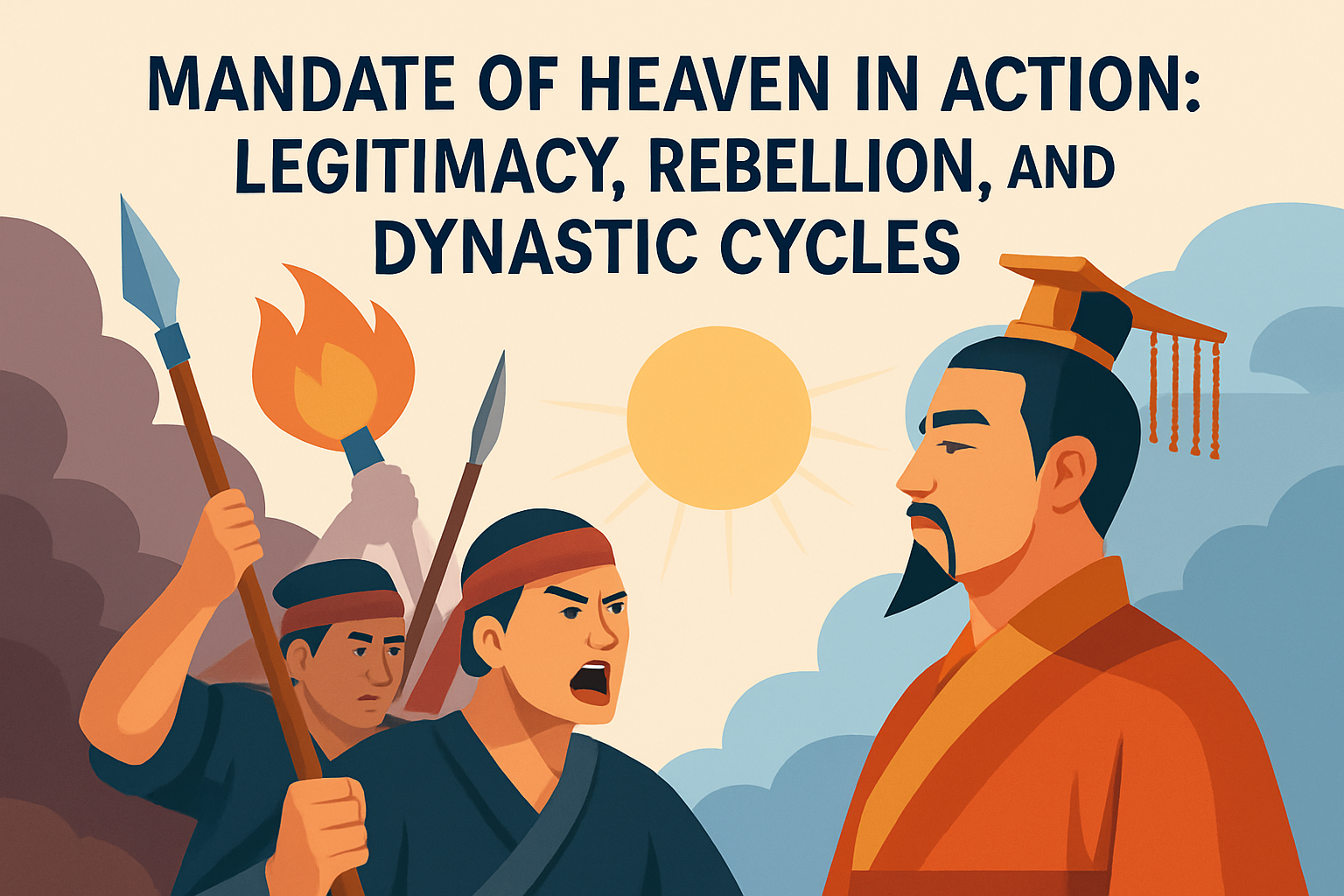
Understanding the Mandate of Heaven and Its Importance
The concept of the Mandate of Heaven is rooted in ancient Chinese philosophy and served as a crucial political and ideological governing system. This celestial belief, originating during the Zhou dynasty, held that heaven granted an emperor the right to rule based on their ability to govern well and fairly. If a ruler became despotic or cataclysmic natural phenomena plagued the empire, it was interpreted as a loss of this divine approval, suggesting that the regime should be replaced.
The Mandate of Heaven is more than just ancient lore—it is a mechanism that shaped China’s political landscape for centuries, affecting regime changes and the establishment of new dynasties. Unlike a hereditary right to rule, which sustains power through lineage regardless of the ruler’s competence, the Mandate of Heaven emphasizes accountability and ethical governance. Its historical significance rests on its influence over social order, legitimizing rebellion and thus facilitating dynastic cycles.
Understanding the Mandate of Heaven is crucial because it demonstrates how the balance of power is maintained through spiritual and ethical accountability, affects governance, and prompts change. As modern societies grapple with questions of leadership and legitimacy, exploring this concept provides timeless insights into the relationship between rulers and their subjects. It offers a sophisticated narrative of power balance where failure invites change, setting a precedent for the peaceful transfer of power that is relevant even today.
The Concept of Legitimacy through Mandate of Heaven
At its core, the Mandate of Heaven establishes a dynamic form of legitimacy—power granted not by birthright but by divine approval based on ethical governance. This legitimacy is not static; it depends on the ruler’s conduct, providing both an incentive for rulers to govern wisely and a moral justification for subjects to obey their leaders.
One historical example is the transition from the Shang to the Zhou dynasty. Around 1046 BCE, King Wu of Zhou, perceiving the Shang king as tyrannical and failing in his duties, led a rebellion that culminated in the Battle of Muye. Following Zhou’s victory, the Mandate of Heaven was invoked to justify the transfer of power. This event emphasized that a ruler’s legitimacy was not eternal and needed to be earned continually.
The Zhou’s effective use of this celestial mandate fostered a powerful precedent. It recognized the populace’s right to revolt under justifiable conditions, essentially using legitimacy as a performance metric. This philosophical principle played a vital role in the reorganization of social and political structures throughout history and remains pertinent as a means of evaluating leadership efficacy against ethical standards.
Rebellion as a Result of Losing the Mandate
The idea that a ruler can lose the Mandate of Heaven introduces the notion of justified rebellion. This is a significant departure from other areas where tyranny is often tolerated due to the divine or hereditary rights of kings, which makes the Mandate of Heaven unique in its encouragement of change when leaders fail in their responsibilities.
A notable example is the fall of the Yuan dynasty, which ruled China from 1271 to 1368. As the dynasty weakened, plagued by internal strife and corruption, natural disasters such as floods and famine spread across the land. These events were interpreted as heaven’s displeasure, sparking widespread revolts that eventually led to the rise of the Ming dynasty.
The legitimacy of rebellion was not solely grounded in human judgment but intertwined with cosmic symbolism—natural calamities were seen as signals of divine dissatisfaction. Therefore, the social acceptance of rebellion was greater under the Mandate of Heaven, as it framed revolt as a necessary step towards restoring harmony and moral governance.
Dynastic Cycles Shaped by the Mandate
Dynastic cycles are a hallmark of Chinese history, characterized by a rise to power, flourishing periods, decline, and eventual replacement of dynasties. These cycles were largely influenced by the Mandate of Heaven, which provided a socio-political framework for evaluating the performance of each dynasty. A dynasty was established under the mandate, thrived by upholding its principles, and eventually fell when perceived to have lost it.
Throughout Chinese history, such cycles were evident during the transitions of major dynasties such as the Han, Tang, Song, and Qing. Each dynasty began with strong leadership and was often credited with restoring order and prosperity. Over time, as these regimes became complacent or corrupt, signs like popular unrest and natural disasters were seen as evidence of heaven’s withdrawal of support.
Below is a table that illustrates a simplified view of major dynastic cycles:
| Dynasty | Founded | Peak | Decline |
|---|---|---|---|
| Han | 206 BCE | 100 BCE | 220 CE |
| Tang | 618 | 750 | 907 |
| Song | 960 | 1100 | 1279 |
| Qing | 1636 | 1750 | 1912 |
The concept of dynastic cycles underscored a natural flow of succession—one dynasty’s collapse was another’s opportunity to rise. By evaluating rulers through the lens of the Mandate of Heaven, it institutionalized a form of checks and balances, setting the expectation that rulers will maintain moral rectitude, given the impermanence of their celestial endorsement.
Modern Interpretations and Lessons from the Mandate of Heaven
The Mandate of Heaven is not only a relic of ancient governance but continues to offer contemporary relevance. It illustrates powerful lessons on leadership accountability and the moral obligations of governance. While modern political systems may not attribute power to divine forces, the idea that legitimacy is contingent upon a ruler’s ethical behavior is timeless.
In today’s world, comparable standards exist in democracies where governments are judged by their efficacy and ability to address their people’s needs. Just as natural events served as metaphors for divine displeasure in the past, modern equivalents might include economic downturns or corruption scandals, often prompting political change or leadership challenges. In this sense, the Mandate of Heaven’s principle of accountability serves as a prototype for contemporary political evaluation models.
By reflecting on this ancient practice, current and future generations can gain insights into the cyclical nature of leadership legitimacy and the constant requirement for those in power to adhere to ethical standards. It advocates for a governance model where power must be continually justified through competence, thus enhancing political stability and moral governance.
Key Takeaways and Conclusion
The Mandate of Heaven presents a compelling framework for understanding historical and modern governance. Key takeaways include the concept’s emphasis on ethical governance, its role in legitimizing rebellion against tyrannical rule, and its contribution to the cyclical nature of dynastic politics. It underscores the importance of continual legitimacy, driven by moral and just conduct in leadership.
For modern societies, the Mandate of Heaven teaches us about the crucial impact of accountability in leadership. It serves as a reminder that while attitudes towards divine right may have evolved, the underpinning requirement for leaders to effectively serve their people remains. It fosters a dialogue on the importance of stable and ethical governance in ensuring societal order and progress.
The enduring lessons from the Mandate of Heaven inspire contemporary leaders and citizens alike to reflect on their roles and responsibilities within their respective systems. By advocating for accountability and ethical governance, we can work towards a political future where power is rightly earned and thoughtfully wielded.
In closing, consider how the principles of the Mandate of Heaven might apply to current governance. Engage in discussions about leadership legitimacy and accountability, drawing parallels to this ancient philosophy. Reflect on how adopting such principles could improve modern governance practices, advocating for leadership that truly serves the people.
Frequently Asked Questions
What is the Mandate of Heaven, and how did it influence Chinese emperors?
The Mandate of Heaven is an ancient Chinese philosophical concept essential to the political legitimacy of Chinese emperors. Established during the Zhou dynasty, it posits that heaven bestows its mandate to a just ruler, essentially granting them divine approval to govern. Unlike divine rights in some Western philosophies, the Mandate of Heaven is conditional, tied directly to the ruler’s ability to lead well. A ruler was expected to ensure harmony, prosperity, and morality. The belief was that if a ruler became tyrannical or ineffective, this mandate could be withdrawn by heavenly forces. Signs such as natural disasters, famines, or societal unrest were interpreted as heaven’s dissatisfaction and a signal that the ruler had lost the mandate. This concept shaped the rise and fall of dynasties; it justified rebellion against failing rulers and legitimized successors who claimed to restore and uphold the heavenly mandate.
How did the Mandate of Heaven justify rebellions and changes in dynasties?
The Mandate of Heaven played a crucial role in justifying both rebellions and dynastic changes throughout Chinese history. When rulers faced severe challenges like famines, floods, earthquakes, or increased social turmoil, these were often seen as indicators that the emperor had lost the mandate due to incompetence or immorality. This framework provided a moral justification for rebellion: if heaven had withdrawn its mandate, the people and nobles were not only justified but obliged to challenge their ruler and establish a new leadership that would restore cosmic and social order. Rebellions were thus not just political movements; they were seen as realigning earthly rule with divine will and cosmic balance. Consequently, new rulers could claim legitimacy by demonstrating their ability to restore stability and moral governance, effectively showing that they had received heaven’s favor to rule.
How did natural disasters and phenomena affect the belief in the Mandate of Heaven?
Natural disasters and unusual phenomena were deeply interwoven with the belief in the Mandate of Heaven, influencing perceptions of legitimate rule. Events such as droughts, floods, earthquakes, or eclipses were not just physical occurrences but were interpreted within a cosmological and political framework. They were seen as heavenly signs indicating the emperor’s failure to maintain harmony between heaven and earth. When such disasters occurred, it put the ruler’s legitimacy into question, providing tangible evidence to the populace and nobility that the ruler had indeed lost the divine mandate. As such, these events often spurred widespread dissent and justified movements for political change. In turn, new dynasties used interpretations of such events to validate their rise, claiming that they were anointed by heaven to rectify the imbalance and restore prosperity and order.
What role did the concept of merit play in the Mandate of Heaven?
The role of merit within the Mandate of Heaven was pivotal, as the belief was fundamentally tied to the ruler’s moral and administrative ability rather than simply their birthright. Unlike hereditary divine right monarchies, the Mandate of Heaven emphasized the importance of virtuous and competent governance. It posited that heaven bestowed the right to rule based on merit. A ruler was expected to uphold moral codes, manage state affairs judiciously, and ensure the prosperity and well-being of their subjects. Successful administration, effective governance, and moral leadership were seen as fulfilling the heavenly mandate. Conversely, when a ruler failed in these areas, it was taken as a sign of losing this divine favor. Thus, both sustaining power and succession in dynastic cycles were deeply linked to the idea of meritocracy perceived through divine favor, making rulers’ actions and policies central to their legitimacy.
How does the Mandate of Heaven compare to other concepts of divine right in history?
The Mandate of Heaven shares similarities with other concepts of divine right, such as those found in European monarchies, yet it also has significant distinctions. In European traditions, the divine right of kings often suggested that a monarch had an unassailable, God-given right to rule, typically inherited by lineage, and not easily questioned once established. The Mandate of Heaven, however, was more conditional. It centered on the notion that legitimacy depended on the ruler’s ability to govern justly and maintain balance and prosperity. Therefore, unlike the often rigid and hereditary aspect of divine right in Europe, the Mandate of Heaven allowed for the dynamic transfer of rule based on moral and administrative merit. It placed greater emphasis on the ruler’s obligation to the people and heaven, allowing for the overthrow of a despot without the burden of guilt for rebelling against divinity. This difference profoundly shaped the political landscape in China, where dynastic changes could be seen as an expression of divine approval rather than mere usurpation.