
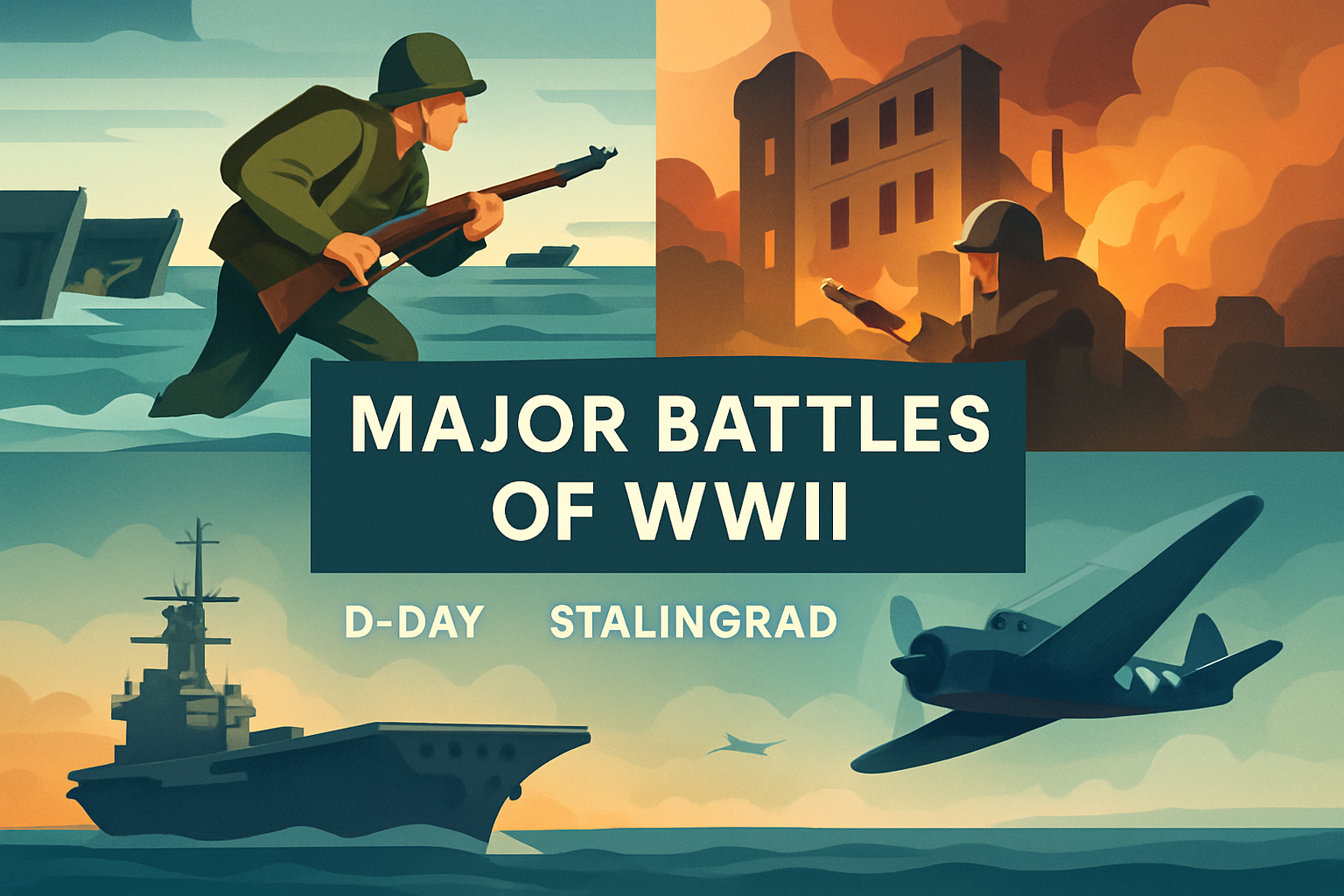
World War II, which lasted from 1939 to 1945, was one of the largest and most impactful conflicts in human history. It involved numerous countries and resulted in significant geopolitical changes across the globe. Three pivotal battles during this war were D-Day, the Battle of Stalingrad, and the Battle of Midway. These battles not only showcased extraordinary military strategies but also had profound implications on the outcome of the war. Understanding these key battles is essential as they highlight the importance of strategic planning, the resilience of forces, and how bravery and sacrifice shaped history. Each of these battles stands out for their scale, the strategies deployed, and their eventual contributions to the Allied victory over the Axis powers. By taking a closer look at each battle, we unravel not just the tactical elements employed but the underlying narratives that led to decisive turning points in World War II.
D-Day: The Normandy Landings
On June 6, 1944, the Allied forces launched Operation Overlord, commonly known as D-Day, marking the start of a massive invasion of Nazi-occupied Europe. D-Day was a meticulously planned operation that aimed to liberate Western Europe from Nazi Germany’s control. The operation involved the largest amphibious assault in history and required a remarkable level of coordination and secrecy.
The Allies conducted the invasion on the Normandy coast of France, where five beachheads were targeted: Utah, Omaha, Gold, Juno, and Sword. American, British, and Canadian forces played significant roles in this operation. The success of the operation relied heavily on the element of surprise and the significant use of deception tactics, such as Operation Bodyguard, which misled the Germans regarding the invasion’s actual location and timing.
Despite heavy resistance, especially at Omaha Beach, the Allies were able to establish a significant foothold. This success was due to meticulous planning, superior air and naval support, and the fierce fighting spirit of the infantry troops. D-Day was a turning point in the war because it opened the Western Front, which forced Nazi Germany to fight on multiple fronts. This began the process of liberating Western Europe and eventually led to the fall of Nazi Germany in May 1945.
The Battle of Stalingrad: Turning Point on the Eastern Front
The Battle of Stalingrad, lasting from August 23, 1942, to February 2, 1943, was one of the deadliest and most brutal confrontations during World War II. The battle was fought between Nazi Germany and its allies against the Soviet Union for control of the city of Stalingrad (now Volgograd) in Southern Russia.
Stalingrad was strategically significant due to its industrial capacity and its location, which barred German access to the oil-rich Caucasus region. Initially, the Germans had the upper hand, capturing large parts of the city, but the Soviets launched a counter-offensive, Operation Uranus, which encircled the German Sixth Army. This effectively trapped them within the city.
The harsh winter, dwindling supplies, and relentless Soviet attacks eventually led to the German surrender on February 2, 1943. The defeat shattered the German Wehrmacht’s reputation of invincibility and marked a significant turning point on the Eastern Front. The victory emboldened the Soviet Union and marked the beginning of a Soviet offensive that would eventually lead to the capture of Berlin in 1945.
The Battle of Midway: Turning the Tide in the Pacific
The Battle of Midway, fought from June 4 to June 7, 1942, was a crucial naval battle in the Pacific Theater of World War II between the United States and Japan. Just six months after Japan’s attack on Pearl Harbor, Midway shifted the balance in favor of the United States and stopped Japanese expansion in the Pacific.
The Japanese aimed to eliminate the United States as a strategic Pacific power, thereby giving Japan free rein in establishing its Greater East Asia Co-Prosperity Sphere. U.S. intelligence efforts had broken Japanese codes, enabling Admiral Chester Nimitz to deploy an ambush with the aircraft carriers USS Enterprise, USS Hornet, and USS Yorktown.
The result was a decisive American victory, where four Japanese aircraft carriers were sunk, while the U.S. lost only one. This victory halted the Japanese momentum and significantly reduced their naval capabilities. The Battle of Midway is considered a turning point in the Pacific War due to its strategic significance in halting Japanese aggression and showcasing the power of intelligence and air superiority.
| Battle | Date | Location | Outcome |
|---|---|---|---|
| D-Day (Normandy Landings) | June 6, 1944 | Normandy, France | Allied victory, opening of the Western Front |
| The Battle of Stalingrad | August 23, 1942 – February 2, 1943 | Stalingrad, Soviet Union | Soviet victory, turning the tide on the Eastern Front |
| The Battle of Midway | June 4–7, 1942 | Midway Atoll, Pacific Ocean | American victory, halting Japanese expansion |
Summary and Conclusion
The battles of D-Day, Stalingrad, and Midway were not only significant for their outcomes but also for their demonstration of military strategy, human resilience, and intelligence under pressure. D-Day showcased the might of a coordinated Allied force, the Battle of Stalingrad exemplified Soviet determination and endurance, and the Battle of Midway highlighted the critical role of intelligence and air power in modern naval warfare.
These battles are paramount in understanding the dynamics and pivotal moments of World War II, each serving as a turning point in respective theaters. They collectively contributed to the eventual defeat of the Axis powers by fracturing their military strategies, exhausting their resources, and boosting Allied morale.
For anyone interested in history, these battles are cornerstone events that offer invaluable insights into the intricacies of warfare. They serve as reminders of the sacrifices made and the critical importance of strategy and innovation in overcoming adversity. As we study these battles, it is essential that we continue to honor the memory of those who fought and learn from these historical events to forge a path toward a more peaceful future. To delve deeper, consider reading personal accounts from veterans, visiting historical sites, or engaging with educational resources that provide a comprehensive view of these momentous events.
Frequently Asked Questions
1. What was the significance of the D-Day invasion during World War II?
The D-Day invasion, also known as Operation Overlord, was a critical turning point in World War II. It took place on June 6, 1944, when Allied forces comprising American, British, Canadian, and other units launched the largest seaborne invasion in history on the beaches of Normandy in France. The significance of D-Day lies in its role in liberating Western Europe from Nazi occupation. It marked the beginning of the end for Hitler’s Germany as it opened up a new front that forced the Nazi forces to fight a war on two fronts. This invasion paved the way for the Allied forces to advance through France, ultimately leading to the liberation of Paris and pushing the German forces back towards Germany. The success of D-Day showcased the strength of allied cooperation and the effectiveness of naval, air, and ground warfare coordination.
2. How did the Battle of Stalingrad influence the outcome of World War II?
The Battle of Stalingrad was one of the deadliest and most significant battles of World War II. Taking place between August 23, 1942, and February 2, 1943, this battle saw the Soviet Union defend the city from a massive German offensive. The significance of Stalingrad lies in its symbolism and the immense loss it inflicted on the German troops. Stalingrad was named after the Soviet leader, Joseph Stalin, making it a critical political and military objective for Hitler. The battle was marked by brutal urban warfare and extreme conditions during the harsh Russian winter. The Soviet victory at Stalingrad effectively halted the German advance into the Soviet Union and marked the beginning of a major offensive by the Soviets. It significantly weakened the German army, both in numbers and morale, and shifted the momentum of the war in favor of the Allies. This victory is often considered one of the key turning points that led to the eventual defeat of Nazi Germany.
3. Why was the Battle of Midway a decisive moment in the Pacific Theater of World War II?
The Battle of Midway, which occurred between June 4 and June 7, 1942, was a pivotal naval encounter that changed the trajectory of the Pacific Theater in World War II. This battle was fought near the Midway Atoll, a crucial outpost for the United States in the Pacific. The significance of the battle lies in its strategic impact and the loss it dealt to the Japanese Imperial Navy. Prior to Midway, Japan had enjoyed a string of naval victories and aimed to eliminate the United States as a strategic power in the Pacific. However, thanks to successful codebreaking efforts, the U.S. Navy was able to anticipate the attack and prepare effectively. The United States managed to sink four Japanese aircraft carriers, which were a considerable part of Japan’s fleet, along with other critical vessels. The Midway victory severely weakened Japan’s naval capabilities and shifted the balance of power in the Pacific to the United States. The battle demonstrated the importance of intelligence, aircraft carriers, and naval aviation, setting the stage for future Allied successes in the region.
4. How did strategic planning contribute to the success of the D-Day invasion?
The success of the D-Day invasion was largely the result of meticulous planning and strategic deception. The Allies spent months preparing for Operation Overlord, with careful consideration given to the timing, logistics, and location of the landing. The planners chose Normandy over the more obvious target of Pas de Calais, partly due to its less fortified coast. A major part of the strategy was Operation Fortitude, a wide-scale deception plan that involved fake radio chatter, inflatable tanks, and fake camps to mislead German forces into believing that the invasion would occur elsewhere. The operation also involved the coordination of air and naval bombardments, the use of paratroopers to disrupt enemy communications and fortifications, and the employment of specialized tanks known as Hobart’s Funnies to overcome the challenges of the heavily fortified beaches. Weather played a critical role, and General Eisenhower’s decision to proceed on June 6, despite uncertainties, proved strategic since it caught the Germans unprepared. All these factors combined to ensure the success of one of the largest and most complex amphibious assaults in history.
5. What were the human and material costs of the Battle of Stalingrad for both the Axis and Soviet forces?
The Battle of Stalingrad was one of the bloodiest battles in history, with enormous human and material costs for both the Axis and Soviet forces. The battle resulted in an estimated 2 million casualties, including soldiers and civilians. The Red Army, along with Soviet citizens trapped in the city, suffered high casualties due to relentless fighting, starvation, and the harsh winter conditions. Civilians were caught in the crossfire, and the city of Stalingrad was left in ruins. On the Axis side, the German 6th Army, led by General Friedrich Paulus, suffered significant losses. Approximately 45,000 German soldiers died in the battle, and another 91,000 were taken prisoner, many of whom did not survive the harsh conditions in Soviet prisoner-of-war camps. The loss of troops and equipment at Stalingrad weakened German military power and morale significantly. Additionally, Hitler’s refusal to allow his forces to retreat despite the desperate situation only compounded the losses. This defeat marked a substantial turning point, as it shattered the image of Nazi invincibility and contributed to the rebuilding of Soviet morale and strength.