
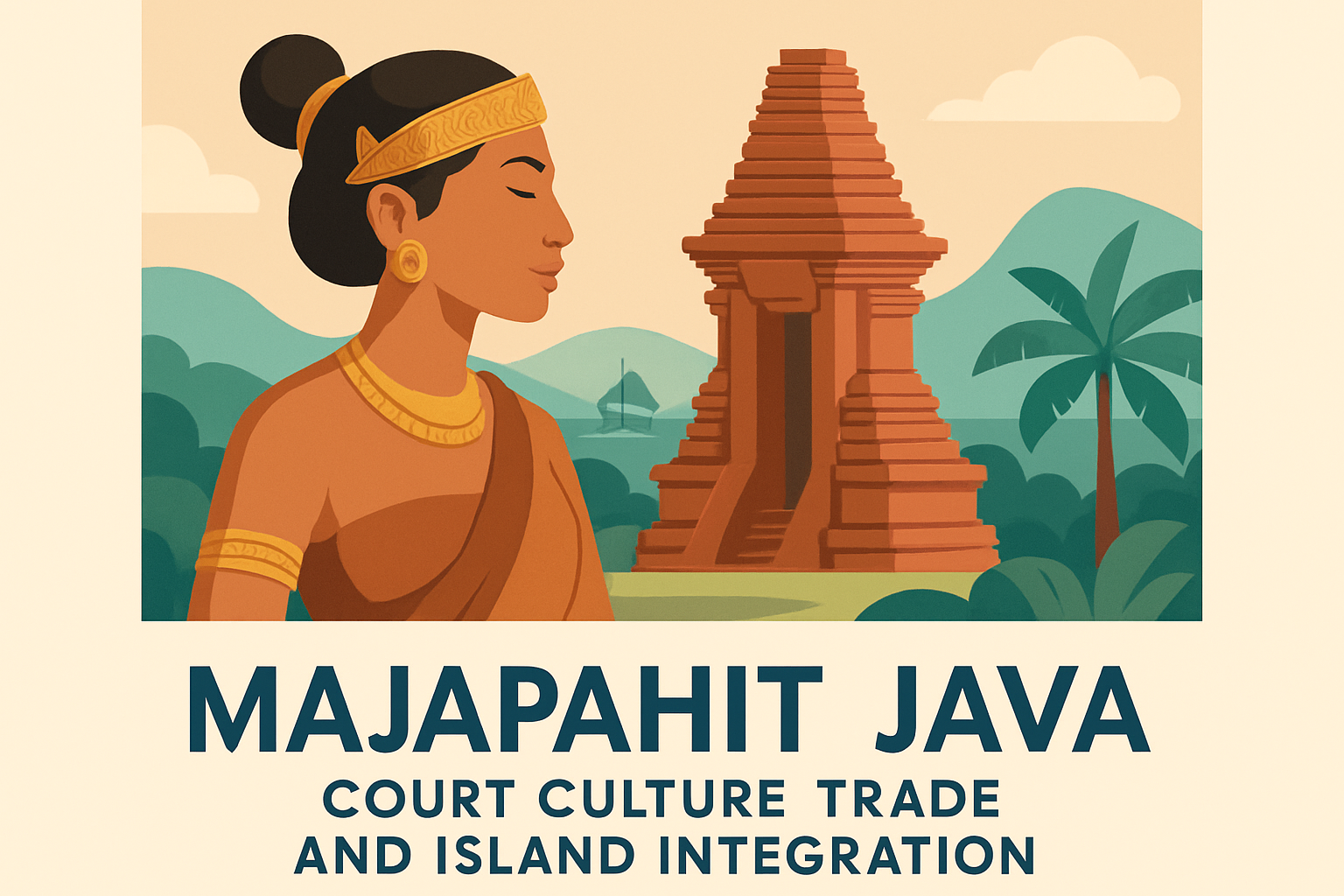
Majapahit Java was the political and cultural center of one of Southeast Asia’s most influential premodern states, a kingdom that linked court ritual, maritime trade, and island integration across the Indonesian archipelago. In historical terms, “Majapahit” refers to the polity based in eastern Java from the late thirteenth century to the early sixteenth century, while “Java” in this context means both the island homeland of its ruling elite and the administrative core from which wider influence spread. When scholars discuss Majapahit Java, they usually mean more than a royal court at Trowulan. They mean a system: a rice-rich agrarian base, a literate court culture shaped by Old Javanese and Sanskrit traditions, port networks tied to long-distance exchange, and a political model that incorporated far-flung islands through tribute, alliance, commerce, and prestige.
This topic matters because Majapahit sits at the intersection of three enduring questions in Indonesian history. First, how did a land-based court in Java project authority across seas filled with independent trading communities? Second, what role did culture play in governance, especially in a society where literary production, temple building, ritual hierarchy, and royal ceremony were part of statecraft? Third, how integrated was the archipelago before colonial rule? I have worked through Majapahit material in inscriptions, court literature, archaeological reports, and comparative Southeast Asian history, and the pattern is consistent: Majapahit was not a modern nation-state, yet it created a durable model of regional order that later political traditions would remember and reuse.
The strongest evidence comes from a combination of sources rather than a single text. The Old Javanese poem Nagarakretagama, composed in 1365 by Mpu Prapanca, offers the most famous courtly description of the kingdom under Hayam Wuruk. The Pararaton gives a different, more layered narrative about rulers and dynastic struggle. Chinese records from the Yuan and Ming periods, inscriptions, temple remains, and excavations at Trowulan add essential checks on literary exaggeration. Read together, they show a court that was highly self-conscious, commercially connected, and skilled at translating wealth into authority.
Understanding Majapahit Java also helps answer a common search question directly: was Majapahit an empire? The best answer is yes, but not in the rigid territorial sense people often imagine. Its power varied by region. Core areas in Java were governed far more directly than distant islands, where influence often depended on vassalage, trade obligations, dynastic ties, and symbolic acknowledgment of Javanese supremacy. That flexible structure was not a weakness alone. It was a practical response to monsoon trade, fragmented coastlines, and the high cost of enforcing power over sea lanes and islands.
Another key term is “court culture.” In Majapahit Java, court culture meant the organized world of kingship, rank, etiquette, ritual, literature, religious patronage, architecture, and artistic production that defined political legitimacy. It was not ornamental. It told elites who mattered, structured relations among officials, and projected refinement outward to subordinate regions. “Trade,” meanwhile, was not separate from politics. Rice, spices, forest products, cloth, ceramics, horses, metals, and prestige goods moved through networks that the court taxed, protected, and diplomatically managed. “Island integration” refers to the process by which Java became the hub of a wider maritime sphere whose parts did not become identical, but did become linked through recurring exchange and shared political language.
The Court as the Engine of Majapahit Power
Majapahit emerged after the turbulence surrounding Singhasari and the Mongol expedition to Java in 1293. Raden Wijaya, later Kertarajasa Jayawardhana, used shifting alliances to establish a new dynasty. From the beginning, the court was not just a royal household. It was the engine that coordinated land grants, official appointments, military obligations, ritual precedence, and diplomatic theater. In practical terms, this meant the palace could convert agricultural surplus into loyalty and then translate loyalty into regional influence.
Hayam Wuruk’s reign, from 1350 to 1389, is usually treated as the kingdom’s high point, especially in partnership with the powerful prime minister Gajah Mada. This is not only because later memory glorified them. It is because sources indicate a period of unusual coordination between ruler, bureaucracy, and aristocracy. The famous “Palapa oath” attributed to Gajah Mada symbolized a program of bringing the archipelago’s major regions into Majapahit’s sphere. Historians debate the literal wording and later embellishment, but the political intent is clear: the court imagined itself as the apex of a multi-island order.
Court culture made that claim credible. Majapahit rulers anchored legitimacy in both Shaiva and Buddhist traditions, often presenting kingship through a syncretic religious framework recognizable across elite circles in Java and beyond. Temple patronage reinforced this. Brick architecture, sacred complexes, bathing places, and commemorative shrines tied dynastic memory to landscape. Ceremonies displayed hierarchy physically. Clothing, titles, seating arrangements, processions, and gift exchange all carried political meaning. I have found that when readers reduce premodern courts to pageantry, they miss the administrative purpose: ritual encoded who could command labor, collect dues, and speak for the state.
The capital region, associated archaeologically with Trowulan, reflects this integration of ceremony and management. Excavations have revealed urban-scale settlement, craft activity, water systems, roads, brick structures, and imported ceramics. Scholars do not agree on every reconstruction, but few doubt that this was a substantial political center rather than a purely symbolic site. Its layout and material culture suggest a court connected to both inland production and overseas commerce.
Trade Networks and the Maritime Logic of Rule
Majapahit Java prospered because it sat between fertile agricultural zones and maritime exchange routes linking the Java Sea, the Strait of Malacca, the South China Sea, and eastern Indonesia. A direct answer to another common question is this: what did Majapahit trade? The kingdom’s economy involved rice from Java, spices from the eastern archipelago, sandalwood, resins, forest products, salt, fish products, metals, textiles, ceramics, and horses imported through regional circuits. Chinese ceramics found across Indonesian sites underscore the scale of exchange, while Javanese ports connected inland surplus to foreign merchants.
Java’s rice production mattered enormously. A court with dependable access to rice could feed retainers, finance ceremonies, support artisans, and buffer short-term disruptions. Unlike a polity dependent on a single export, Majapahit had a diversified base. It benefited from maritime trade but was not wholly captive to it. That balance helps explain resilience. The court could negotiate with merchants from China, India, mainland Southeast Asia, and the Muslim trading communities moving increasingly through the region, while still drawing strength from agrarian taxation and labor obligations inland.
Ports on Java’s north coast were especially important because they linked the interior to oceanic trade. The relationship between the court and coastal merchants was never perfectly frictionless. Merchant communities valued autonomy, speed, and stable customs regimes; courts wanted revenue and recognition. Yet this tension was productive. Majapahit did not need to micromanage every transaction to benefit. It needed predictable access, diplomatic reach, and the ability to punish defiance selectively.
| Majapahit trade element | Function in the kingdom | Example of wider impact |
|---|---|---|
| Rice surplus from Java | Fed court, laborers, and military retainers | Supported sustained ceremonial and administrative activity at the capital |
| Eastern spices and forest goods | Created high-value exchange opportunities | Connected Majapahit influence to Maluku and other outer islands |
| North coast ports | Moved inland goods to foreign merchants | Integrated agrarian Java with maritime Asia |
| Imported ceramics and textiles | Served elite consumption and redistribution | Enhanced court prestige and gift diplomacy |
| Tribute and customs | Generated political and fiscal leverage | Bound subordinate polities to Javanese authority |
Trade also shaped diplomacy. Relations with China were especially significant because Chinese courts recognized foreign polities through tributary frameworks, while Chinese merchants brought goods that local elites desired. Recognition from abroad could strengthen legitimacy at home. Majapahit was therefore embedded in an international order, not isolated within an “Indonesian” sphere. Its leaders understood that prestige, profit, and protocol were intertwined.
How Island Integration Actually Worked
Island integration under Majapahit was real, but it was uneven and negotiated. The simplest accurate explanation is that the kingdom integrated islands through a layered system of core rule, regional alliances, tributary ties, military demonstration, and commercial interdependence. In Java and nearby areas, administration was denser. Farther away, Majapahit influence often worked by compelling local rulers to acknowledge superiority, send goods, participate in exchange networks, or align dynastically with the Javanese court.
This is why modern maps that color vast regions as if Majapahit governed every village directly are misleading. The better model is a mandala-style polity, a concept used widely in Southeast Asian historiography to describe centers of power with gradated authority radiating outward. Influence depended on relationships more than surveyed borders. A port in Sumatra, Bali, Kalimantan, Sulawesi, or the eastern islands might recognize Majapahit under some conditions while maintaining substantial internal autonomy.
Bali offers one of the clearest examples of deeper cultural and political linkage. Javanese literary forms, religious ideas, courtly styles, and political models traveled there with lasting consequence. Other regions were tied more loosely through commerce and prestige. The point is not that Majapahit homogenized the archipelago. It did not. The point is that it established recurring channels through which goods, titles, scripts, stories, and political expectations moved.
Military action mattered, but not as a permanent occupation force in every region. Campaigns were often punitive, strategic, or symbolic. They demonstrated capacity, removed rivals, or reset the terms of submission. Long-term control was cheaper when local elites cooperated. That pattern is visible across maritime Southeast Asia, where sea control, port access, and alliance management usually mattered more than marching inland over great distances.
From experience reading these sources against later nationalist retellings, I would stress one nuance. Majapahit’s island integration was not proto-national integration in the modern sense. There was no shared citizenship, no standardized territorial bureaucracy across all islands, and no mass political identity called Indonesia. Yet there was a recognized hierarchy of centers and peripheries, a circulation of court ideals, and a practical framework for inter-island coordination. That historical memory would become extremely important centuries later.
Literature, Religion, and the Prestige of Refinement
Majapahit’s authority was strengthened by a sophisticated cultural program. Old Javanese kakawin poetry, inscriptions, genealogies, and ritual texts did political work by placing rulers within sacred and historical frameworks. Nagarakretagama is especially revealing because it catalogs royal journeys, sacred sites, officials, and dependent regions in a way that turns geography into ideology. The poem does not simply describe power. It performs it.
Religion in Majapahit Java was plural, courtly, and integrative. Shaivism and Buddhism coexisted in ways that modern readers sometimes misunderstand as contradiction. For Majapahit elites, the fusion or parallel honoring of these traditions could reinforce kingship rather than divide it. Deified ruler cults, ancestor commemoration, temple endowments, and ritual specialists all helped embed the dynasty within cosmic order. This was standard statecraft in much of premodern Asia, but Majapahit developed it with distinct Javanese expression.
Material culture confirms the literary record. Sculptures, temple gateways, terracotta figurines, and brick sanctuaries reflect a mature aesthetic system. Even today, the split gateway form associated with later Javanese and Balinese architecture evokes Majapahit precedents. Artistic style was not superficial decoration. It marked the court as a source of refinement that subordinate elites could emulate. That emulation had political consequences because local rulers who adopted Javanese titles, texts, or ceremonial forms were also acknowledging the prestige hierarchy that made Majapahit central.
Language mattered too. Sanskrit retained prestige, but Old Javanese functioned as a major vehicle of elite expression. This bilingual or layered literary world gave the court flexibility. It could speak in universalizing Indic concepts while grounding authority in specifically Javanese dynastic tradition. In practical governance, such symbolic resources helped bridge diversity. Different islands did not need to become culturally identical; they needed enough shared elite vocabulary to participate in Majapahit’s order.
Legacy, Decline, and Why Majapahit Still Matters
Majapahit declined gradually rather than vanishing overnight. Succession disputes, shifting trade routes, stronger Islamic port polities, and changes in regional commerce all weakened the court’s position between the late fourteenth and early sixteenth centuries. As maritime trade increasingly favored Muslim networks and port states such as Melaka transformed the commercial map, inland court-centered power in Java faced structural pressure. Internal fragmentation made adaptation harder. By the time Demak and other post-Majapahit formations rose, the old order had lost its strategic dominance.
Decline, however, is not the same as irrelevance. Majapahit’s cultural and political afterlife has been immense. In Java and Bali, artistic forms, political symbols, and historical memory outlived the dynasty. In modern Indonesia, Majapahit has often been invoked as an early precedent for archipelagic unity. That use should be handled carefully. It can oversimplify the historical record. Even so, it is not invented from nothing. Majapahit did articulate a vision of inter-island order centered on Java, and that idea remains powerful.
The key takeaway is straightforward. Majapahit Java mattered because it fused court culture, trade, and island integration into a durable system of rule. Its court gave hierarchy and meaning to power. Its trade networks turned geography into wealth and diplomacy. Its island connections created a flexible but recognizable regional order. If you want to understand how premodern Southeast Asian states actually worked, Majapahit is one of the essential case studies. Explore related topics such as Trowulan archaeology, Nagarakretagama, and north coast Javanese ports to see how this kingdom shaped the history of the archipelago.
Frequently Asked Questions
What was Majapahit Java, and why is it so important in Southeast Asian history?
Majapahit Java refers to the political and cultural heartland of the Majapahit kingdom, a major premodern state based in eastern Java from the late thirteenth century to the early sixteenth century. It was important not simply because it ruled territory on Java itself, but because it became the administrative and symbolic center of a wider archipelagic order that connected many islands through diplomacy, trade, ritual hierarchy, and military influence. In this setting, Java was both a physical homeland and a governing core from which rulers, officials, religious specialists, and merchants projected authority outward across maritime Southeast Asia.
What makes Majapahit especially significant is the way it combined inland court power with seaborne connectivity. Unlike states defined only by fixed borders, Majapahit operated through networks: ports, tributary relationships, elite alliances, and control over strategic trade routes. Its rulers and court culture helped shape political ideals that endured long after the kingdom itself declined. Literary works, royal genealogies, temple traditions, and later Javanese memory all preserved Majapahit as a model of refined kingship, ordered society, and island-wide influence. For historians, it stands as one of the clearest examples of how a Javanese court could function as the center of a complex maritime world.
How did court culture shape Majapahit’s power and identity?
Court culture was central to how Majapahit expressed and maintained authority. The royal court was not just a residence for the king; it was the ceremonial, administrative, and ideological center of the kingdom. Court ritual helped define hierarchy, establish legitimacy, and communicate the ruler’s place within both the human and cosmic order. Ceremonies, processions, offerings, literary patronage, and temple-related activities all reinforced the image of the ruler as the pivot of a harmonized realm. This was especially important in a society where political influence depended not only on force, but also on prestige, sacred sanction, and the ability to attract loyalty from regional elites.
Majapahit court culture was also highly sophisticated and deeply tied to Old Javanese literary and religious traditions. Hindu-Buddhist ideas informed political symbolism, while poets and court intellectuals produced texts that celebrated royal deeds, sacred geography, and the moral order of the state. This cultural production gave Majapahit a durable identity that outlasted specific rulers and campaigns. In practical terms, court etiquette and ranks also organized governance by defining relations between the center and provincial authorities. In other words, culture was not ornamental; it was a working part of statecraft that gave Majapahit its coherence and prestige.
What role did maritime trade play in the rise of Majapahit Java?
Maritime trade was one of the foundations of Majapahit’s strength. Although the kingdom’s political base lay in eastern Java, its prosperity depended heavily on access to the sea and participation in inter-island and international commerce. The Indonesian archipelago sat astride major maritime routes linking the South China Sea, the Java Sea, the Indian Ocean, and the spice-producing islands farther east. By positioning itself within these routes, Majapahit was able to benefit from the movement of rice, textiles, spices, forest products, metals, ceramics, and luxury goods.
Majapahit’s rulers did not need to control every port directly in a modern territorial sense. Instead, they benefited from a system in which ports, coastal settlements, and regional lords were linked to the Javanese center through shifting combinations of alliance, taxation, tribute, and recognition of rank. This flexible approach allowed the kingdom to influence trade without requiring uniform administrative control over every island. Trade also enriched the court itself, helping fund ritual life, public works, temple patronage, and political alliances. At the same time, overseas commerce brought foreign merchants, ideas, and goods into Javanese society, making Majapahit part of a wider Afro-Eurasian trading world. Its history shows that Java’s inland courts and maritime exchange were deeply interconnected rather than separate spheres.
What does “island integration” mean in the context of Majapahit?
In the Majapahit context, “island integration” does not mean a single tightly governed state with fixed borders in the modern national sense. Instead, it refers to the process by which multiple islands and coastal regions were drawn into a shared political and cultural framework centered on Java. This framework could include tributary ties, elite marriages, military expeditions, mercantile cooperation, ritual acknowledgment of the Javanese court, and participation in common networks of diplomacy and exchange. Some regions were more closely tied to Majapahit than others, and these relationships could change over time.
This kind of integration was strongest where local rulers saw benefits in aligning themselves with the Javanese center. Those benefits might include access to trade, enhanced status, military backing, or incorporation into a prestigious political order. Majapahit’s ability to integrate islands therefore depended on negotiation as much as conquest. The court’s symbolic authority, the circulation of luxury goods, and the movement of officials, sailors, and religious figures all helped create archipelagic connections. For that reason, Majapahit is often remembered as a kingdom that articulated a broad vision of island linkage, even if actual control varied from place to place. The concept is best understood as a networked sphere of influence anchored in Java but extending across much of maritime Southeast Asia.
How do historians know about Majapahit Java and its wider influence?
Historians reconstruct Majapahit Java through a combination of textual, epigraphic, archaeological, and comparative evidence. Old Javanese literary works are among the most famous sources, especially texts that describe court life, royal lineages, political ideals, and the geography of the realm. These writings are invaluable, but they must be read carefully because they often blend historical reporting with poetic convention, ideological messaging, and religious symbolism. Inscriptions provide another important body of evidence, offering more direct information about administration, land grants, taxation, religious endowments, and official titles. Together, these sources help scholars understand how the state represented itself and how its institutions functioned.
Archaeology also plays a major role. Temple remains, brick structures, settlement patterns, irrigation systems, statuary, ceramics, and trade goods all shed light on Majapahit’s economy, court culture, and external connections. Chinese records and other foreign accounts add further perspective by documenting trade contacts, diplomatic exchanges, and the reputation of Java abroad. Historians compare all of these materials to build a more balanced picture, since no single source tells the whole story. As a result, our understanding of Majapahit is both rich and evolving: it is clear that eastern Java served as a major political and cultural center, while the exact reach and form of its influence across the archipelago remain subjects of active scholarly discussion.