
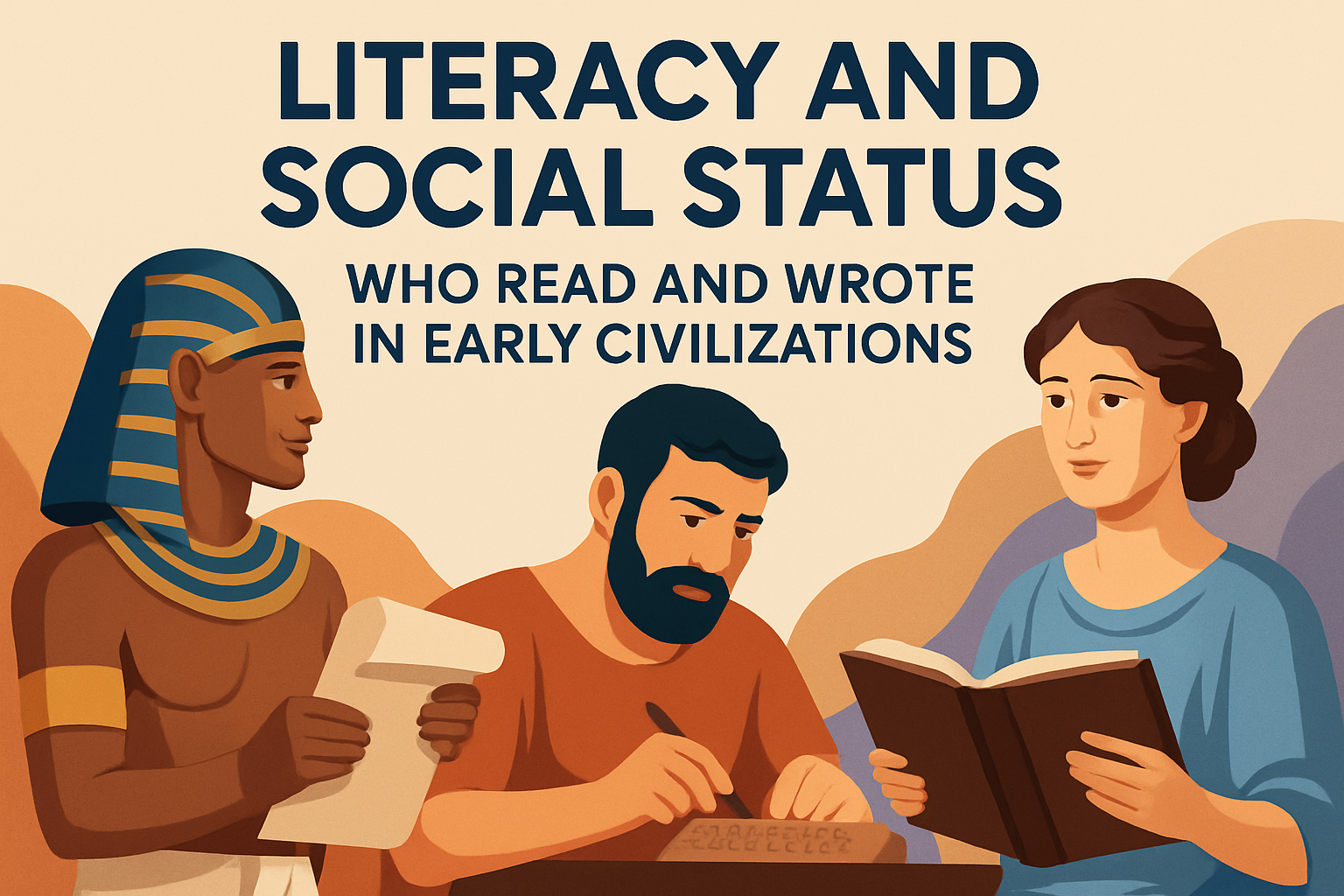
Throughout history, literacy has played a crucial role in shaping societies and determining social status. Literacy, the ability to read and write, has always been more than just a practical skill. It has been a tool of power, control, knowledge dissemination, and cultural advancement. Understanding the history of literacy in early civilizations offers valuable insights into how access to reading and writing has been both a privilege and a determinant of social hierarchy. Examining who had the ability to read and write within these early societies helps us to understand not only the evolution of written language but also the foundational structures of social class. This overview of literacy and social status in early civilizations highlights the implications for access to information and the distribution of power, ultimately shaping the course of historical development. By examining literacy’s influence across different civilizations, we can better understand how access to education and information remains a critical factor in social dynamics today.
The Role of Literacy in Ancient Mesopotamia
Mesopotamia, often called the cradle of civilization, was among the first regions to develop writing systems. The earliest known writing system, cuneiform, was used by the Sumerians around 3200 BCE. Literacy was not widespread among the general population; instead, it was primarily restricted to scribes, priests, and the elite class. These groups held significant power because they could document and control economic transactions, legal matters, and religious texts. The ability to read and write cuneiform, a complex script consisting of wedge-shaped marks on clay tablets, required years of training and was largely confined to affluent families who could afford such education.
The narrow access to literacy reinforced the power dynamics within Mesopotamian society. Scribes enjoyed a high social status, often working in temple administration or as bureaucrats for the government. This exclusivity ensured that only those in control were able to maintain and manipulate records, thus preserving their own power and influence. An example of the impact of literacy in Mesopotamia is the famous Code of Hammurabi, where written laws consolidated and systematized rules, demonstrating the intersection of literacy with governance and social order.
Literacy and Hieroglyphs in Ancient Egypt
In Ancient Egypt, hieroglyphic writing was integral to the functioning of society, mainly used for religious and monumental inscriptions. Literacy in Egypt was reserved for a small segment of society, such as priests, scribes, and high officials. Like in Mesopotamia, becoming literate necessitated rigorous education, accessible primarily to the elite. Due to the complex nature of hieroglyphs, education was intensive, organized within temple schools, and extended only to those who were part of or affiliated with the upper echelons of society.
The role of scribes in Egypt was esteemed greatly, evidenced by depictions in tomb reliefs and texts emphasizing their importance. Scribe schools, often attached to temples, trained individuals who were responsible for maintaining records, collecting taxes, and preserving religious knowledge. Literacy empowered these scribes, enabling them to influence economic and religious aspects of Egyptian life. Hieroglyphs served broader cultural and religious functions, as the literacy they facilitated in recording religious texts allowed for continuity and uniformity in religious practices across generations. This maintained the pharaonic power structure over centuries.
Chinese Script and Social Hierarchy
In Ancient China, literacy had an enduring influence on social structure and governance. Chinese script, developed during the Shang Dynasty (circa 1600–1046 BCE), was a logographic system that played a key role in the administration of the early Chinese state. Scholars, who were typically literate, held pivotal positions within the government and were respected for their education and wisdom.
Literacy among the Chinese elite was considered a mark of distinction, essential for anyone wishing to occupy official positions within the complex bureaucratic system. The importance of literacy can be seen in the later imperial examination system, which emphasized Confucian texts, requiring literacy for social advancement. This firmly embedded the link between literacy and social mobility, tying educational attainment to status and career prospects.
In a society that esteemed genealogy and historical knowledge, being literate allowed individuals to participate in maintaining and transmitting cultural values. This unique feature of ancient Chinese literacy is perhaps best exemplified through historical records like the Confucian Classics, which not only educated but cultivated societal norms and upheld moral order through written tradition.
Alphabetic Literacy and Democracy in Ancient Greece
Ancient Greece presents an interesting case for examining literacy related to social status as it shifted the paradigm through the development of the first alphabet with vowels. The Greek alphabet simplified writing and reading compared to syllabic or logographic scripts, laying the foundation for broader literacy. While literacy was not universally accessible, the potential for wider access emerged.
Literacy in Greece had ideological implications, especially noted in Athens, where literacy associated with democracy and civic participation. An example of this societal shift is reflected in Athens’s political structure, with citizen assemblies and public discourse encouraging active involvement among literate members of society. Schools in Greece, known as gymnasiums, became institutions for training male citizens in literacy among other subjects, tying education to both civic duty and status.
The relationship between literacy and social status was complex, with literate citizens participating in the judicial and legislative processes, influencing decision-making and governance. This connection encouraged philosophical and rhetorical studies, birthing intellectual traditions that stimulated inquiry and debate, both cornerstones of democratic societies.
| Civilization | Writing System | Primary Literate Class | Social Impact |
|---|---|---|---|
| Mesopotamia | Cuneiform | Scribes, Priests, Elites | Bureaucratic and Religious Control |
| Egypt | Hieroglyphs | Scribes, Priests | Religious and Administrative Authority |
| China | Logographic Script | Scholars, Bureaucrats | Maintaining Social Order and Governance |
| Greece | Alphabetic Script | Citizens, Philosophers | Fostering Democratic Participation |
Conclusions and Implications for Today’s Society
Understanding the historical correlation between literacy and social status in early civilizations provides a framework to evaluate contemporary issues surrounding education and access to information. One of the most significant takeaways is the persistent link between literacy and power—throughout history, literacy has been a tool for reinforcing or challenging power dynamics, often serving as a gatekeeper to social mobility and influence. This realization can inform contemporary educational policies aimed at more equitable distribution of resources, recognizing that literacy is fundamentally tied to empowerment and societal progress.
Modern readers should appreciate how literacy, though more accessible now than ever, still reflects underlying social inequalities. By examining past civilizations, we can see how educational access can either widen or bridge gaps within communities by either concentrating or disseminating power bases. Promoting literacy in all strata of society is essential to fostering inclusivity and encouraging the sharing of ideas and innovation, which are hallmarks of democratic and progressive societies.
As a next step, readers are encouraged to engage with their local education systems and advocate for programs that support universal literacy. Ensuring equal access to education is not just a local issue but a global necessity, critical for fostering informed, active citizens who can fully participate in shaping future history.
Frequently Asked Questions
1. How did literacy relate to social status in early civilizations?
In early civilizations, literacy was closely tied to social status and was often an indicator of an individual’s rank in society. Being able to read and write was not just about personal skill; it was a passport to power and influence. For instance, in ancient Egypt, knowledge of hieroglyphics was primarily limited to priests and scribes, who held important positions in the administration and religious practices.
Literacy provided access to critical aspects of society, such as governance, religion, and trade. Those who were literate could participate in the management of resources, record history, and share religious texts. As such, literacy was often a privilege enjoyed by the elite, who passed it down through generations within their own circles. The general populace usually did not have access to education, reinforcing the social divide.
2. Why was literacy predominantly limited to certain groups in early societies?
Several factors influenced the restriction of literacy to specific groups in early civilizations. The first was the complexity and difficulty of the writing systems themselves. For example, Sumerian cuneiform and Egyptian hieroglyphics were not simple alphabets but extensive symbolic languages requiring long periods of study to master. This limited access to education to those who could afford the time and resources to learn.
Furthermore, these societies often associated literacy with religious and governmental roles. Particular social groups, such as scribes, priests, and officials, were trained to read and write, allowing them to control the flow of information and maintain their roles in society’s infrastructure. By keeping literacy skills within a small, privileged class, elites could maintain their power and control over other societal members.
3. Did literacy affect gender roles in early civilizations?
Yes, literacy played a significant role in shaping gender roles within early civilizations. Generally, literacy was predominantly male-centered, with very few opportunities for women to learn to read and write. This was largely due to the societal roles that confined women to the domestic sphere, while men occupied positions of power and learning.
However, there were exceptions. In some cultures, such as in ancient Egypt, high-status women, especially those of royal lineage, were educated in literacy and could therefore wield considerable influence. Nonetheless, these cases were exceptional, and literacy remained largely inaccessible to women overall, reinforcing gender inequality in these societies.
4. What was the role of scribes in early civilizations, and how did it connect to literacy and social status?
Scribes played an essential role in early civilizations and were typically among the few literate members of society. They were responsible for recording information necessary for the functioning of governments and temples. Tasks included documenting transactions, preserving religious texts, and compiling historical records, all of which were crucial for maintaining the societal status quo.
Becoming a scribe required rigorous training and often the patronage of an elite family. Scribes typically enjoyed high status due to their unique and indispensable skills. In many societies, such as Mesopotamia and Egypt, scribes were respected members of the community and occupied positions just below the ruling elite. Their role was crucial in maintaining literacy as a controlling force within these early cultures.
5. How did literacy evolve as these early civilizations developed?
As early civilizations evolved, so did literacy. The spread and diversification of writing systems like the alphabet made literacy more accessible. For instance, the Phoenician alphabet streamlined the writing process and provided a foundation for the Greeks and later the Romans, who further simplified writing systems.
Over time, increases in trade, expansion of empires, and the establishment of formal education systems allowed for a broader segment of the population to become literate. Yet, even with these advances, literacy continued to reflect societal hierarchies for many centuries. Only with the advent of widespread educational reforms in later historical periods did literacy become more democratized, progressively separating it from social status while remaining a vital tool for empowerment and social mobility.