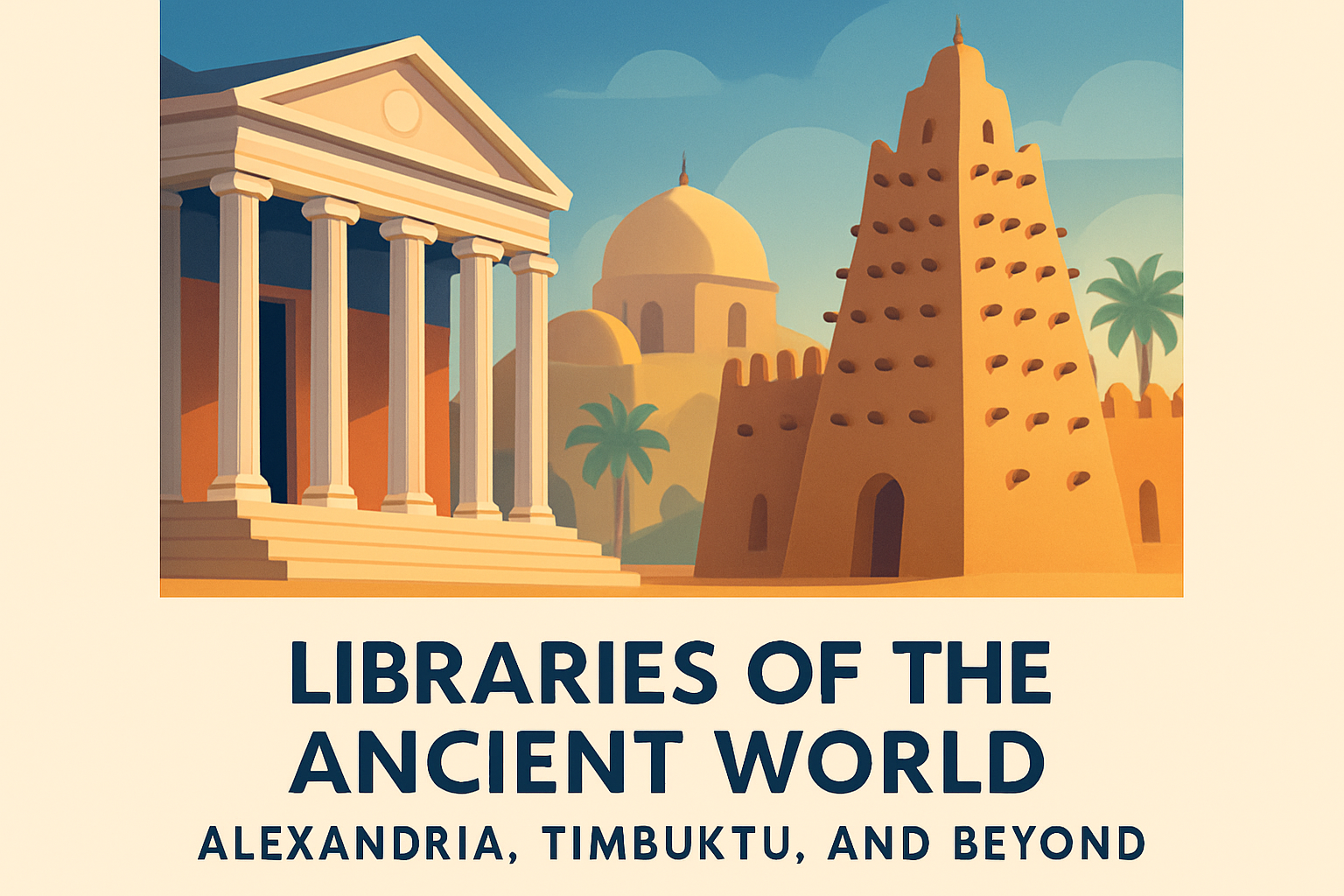
Throughout history, libraries have been cornerstones of civilization, serving as repositories of knowledge, culture, and innovation. From ancient scrolls to manuscripts and codices, libraries have preserved the wisdom of bygone eras for future generations to learn from and build upon. Today, we shine the spotlight on some of the most notable libraries of the ancient world and their lasting impact on humanity, focusing on the famed libraries of Alexandria and Timbuktu, along with a brief exploration of other significant ancient libraries. Understanding these monumental institutions’ roles in knowledge creation and preservation brings into question their place in our modern world, where digital technologies continue to shape how information is accessed and shared. This exploration will uncover both the grandeur and the challenges these libraries faced, shedding light on how they set the foundation for the libraries we know today.
The Grand Library of Alexandria
The Great Library of Alexandria, founded in the 3rd century BCE in Alexandria, Egypt, stands as one of the most renowned and iconic ancient libraries. Infamous for its vast collection of scrolls and manuscripts, the library was undoubtedly a center of scholarly endeavors and knowledge preservation. According to historical estimates, it may have housed hundreds of thousands of scrolls, covering a vast array of subjects ranging from literature and philosophy to science and technology.
As part of a larger complex known as the Mouseion or the “Temple of the Muses,” the library attracted scholars from across the ancient world, including illustrious figures like Euclid, Archimedes, and Eratosthenes. The presence of such intellectual luminaries indicates the library’s crucial role in fostering academic exchanges and promoting groundbreaking research.
The Library of Alexandria’s ambitious mission to gather all the world’s knowledge was unprecedented and made possible through the Ptolemaic dynasty’s dedication to cultural patronage. It is believed that ships docking in Alexandria were required to surrender their onboard scrolls to be copied in the library, illustrating the city’s determination to solidify its intellectual preeminence.
Despite its remarkable contribution to early scholarship, the fall of the Library of Alexandria remains shrouded in mystery. Various accounts of its destruction point to a series of tragic events, such as Julius Caesar’s accidental burning of parts of the city, civil wars, and decrees by Byzantine emperors, as contributing factors. Nonetheless, the library’s legacy endures, as its message of valuing and preserving knowledge resonates within modern society.
The Timbuktu Manuscripts
While the Library of Alexandria is often the focus of ancient library discussions, the libraries of Timbuktu in Mali provide another compelling story. During the 14th and 15th centuries, Timbuktu emerged as a scholarly hub in West Africa, playing a pivotal role in disseminating Islamic and scientific knowledge across the continent.
The libraries of Timbuktu are renowned for their vast collections of manuscripts, estimated to number between 300,000 and 700,000. These manuscripts cover various fields, including theology, astronomy, law, medicine, and more, reflecting a rich tapestry of intellectual and cultural life. Prominent centers of learning, such as the Sankore Madrasah, earned Timbuktu the moniker “The City of 333 Saints” and highlighted its pivotal role in education and scholarship.
A remarkable aspect of the Timbuktu libraries is the dedication to handwritten manuscripts. Passed down through generations, these texts illustrate the diaspora of knowledge and the fusion of Islamic cultural heritage with local traditions. The family libraries that still exist today bear testimony to this enduring legacy.
Unfortunately, the libraries of Timbuktu have not been immune to conflict. In recent years, threats from militant groups and political instability have endangered these invaluable treasures. Nonetheless, efforts by local citizens and international organizations have been instrumental in preserving these manuscripts, highlighting the global commitment to protecting cultural heritage.
Other Notable Ancient Libraries
The ancient world also boasted several other significant libraries that contributed to humanity’s knowledge accumulation and dissemination. Below is a brief overview of some noteworthy examples:
- The Library of Pergamum: Located in present-day Turkey, the Library of Pergamum rivaled that of Alexandria in the 3rd century BCE. It housed approximately 200,000 works and is credited with advancing the use of parchment as a writing material.
- The Library of Ashurbanipal: Dating back to the 7th century BCE in what is now Iraq, the library of Assyrian king Ashurbanipal comprised tens of thousands of clay tablets, covering subjects such as medicine, mythology, and divination.
- The Sumerian Tablets: Among the earliest recorded libraries, the collections in ancient Sumer (modern-day Iraq) served as libraries for temple schools, documenting administrative, literary, and mathematical knowledge on clay tablets.
- The Buddhist Nalanda University Library: Situated in India, Nalanda University flourished between the 5th and 12th centuries CE. The university library was believed to have housed hundreds of thousands of manuscripts on religious texts, philosophy, and science.
The range of these libraries across different regions and cultures emphasizes the universal drive for knowledge acquisition and preservation. While differing in size and scope, these libraries collectively underscored the importance of organized learning paths and the documentation of human progress.
Preserving the Legacy: Modern Implications and Challenges
As we look back at these ancient repositories of knowledge, it becomes evident that libraries have played a fundamental role in shaping the course of human history. Today, as digital transformation reshapes education and information access, the legacy of ancient libraries offers valuable insights.
The maintenance and protection of physical and digital repositories face challenges akin to those of the past, such as the risk of destruction due to conflict, natural disasters, and loss of cultural material. However, technology has opened new pathways for safeguarding and disseminating knowledge. Digital archives, open-access platforms, and global collaborations ensure that invaluable collections remain accessible to learners and scholars worldwide.
Modern historians, researchers, and librarians continue to derive inspiration from ancient libraries by preserving their mandates of promoting intellectual curiosity and cross-cultural exchanges. Initiatives such as UNESCO’s Memory of the World Program and numerous digitization projects have broadened efforts to safeguard endangered documents and manuscripts.
Key Takeaways and Call to Action
The ancient libraries of Alexandria, Timbuktu, and others serve as reminders of humanity’s enduring quest for knowledge and intellectual growth. As centers of scholarship and culture, these libraries fostered connection, cross-pollination of ideas, and advancements across diverse disciplines. Despite challenges and adversities, their legacies continue to resonate in modern times.
In the present age, rapid technological expansion has transformed how knowledge is curated and shared. Leveraging modern technology and collaborative initiatives allows us to ensure that the enduring spirit of ancient libraries lives on. Every individual can contribute to this endeavor by valuing and advocating for the preservation and accessibility of knowledge, whether through supporting libraries, participating in community cultural events, or simply fostering a personal love of learning.
As stewards of history, the act of safeguarding knowledge, both past and present, is a human endeavor; it acknowledges the wisdom of those before us and enriches future generations with the wealth of our intellectual heritage. Let us honor the promise of the ancient world by advocating for the growth and preservation of libraries today.
Frequently Asked Questions
1. What made the Library of Alexandria so famous and influential in the ancient world?
The Library of Alexandria is often hailed as one of the most significant libraries of the ancient world due to its vast collection and its role as a hub of knowledge and learning. Established in the 3rd century BCE in the Egyptian city of Alexandria, it aimed to gather the world’s knowledge in one place. This vision was realized by collecting thousands of scrolls on a wide range of subjects, including science, mathematics, philosophy, literature, and medicine.
The library attracted scholars from all over the ancient world, fostering an exchange of ideas that contributed to significant advancements in various fields. It served as an intellectual center where prominent philosophers, mathematicians, and scientists like Euclid, Eratosthenes, and Archimedes conducted their research. The Library of Alexandria’s influence extended beyond its physical collection, as it also encompassed a vital cultural and academic role in disseminating knowledge and nurturing educational growth.
Tragically, the library faced a series of destructive events, including fires, over several centuries, leading to the loss of countless manuscripts and the eventual decline of this great institution. Despite its disappearance, the legacy of the Library of Alexandria persists, symbolizing the quest for knowledge and the importance of preserving human wisdom across time.
2. Why is Timbuktu considered an important site for historic libraries and manuscripts?
Timbuktu, located in present-day Mali, has long held a significant place in history as a center for learning and culture, especially during its golden age in the 14th to 16th centuries. The city was a vibrant hub of trade and scholarship, attracting scholars, traders, and students from across Africa, the Middle East, and beyond. This cultural melting pot fostered the growth of libraries and the accumulation of countless manuscripts.
These manuscripts, often focusing on religious, legal, medical, and scientific topics, were housed in private and public collections, contributing to Timbuktu’s repute as a seat of learning. The manuscripts were written in Arabic and various local languages, demonstrating the city’s intellectual and cultural dynamism. Some of the most renowned libraries in Timbuktu include the Sankoré Madrasah, established in the 14th century, which functioned as both a mosque and a university, and the Ahmed Baba Institute, which continues to conserve and study these valuable manuscripts.
The importance of Timbuktu’s libraries lies not only in the content of the manuscripts, which offer insights into the political, social, and economic history of West Africa but also in Timbuktu’s role in preserving these texts against the challenges posed by time, climate, and historical turmoil. Timbuktu stands as a testament to the enduring power of written knowledge and the necessity of its preservation for future generations.
3. What other notable ancient libraries existed beyond Alexandria and Timbuktu?
While Alexandria and Timbuktu are often highlighted for their historical significance, the ancient world was home to several other notable libraries that played pivotal roles in the preservation and dissemination of knowledge. Here are a few noteworthy examples:
The Library of Ashurbanipal, located in the ancient Assyrian capital of Nineveh, is one of the oldest known libraries, dating back to the 7th century BCE. It housed a vast collection of clay tablets inscribed with cuneiform script, covering a wide range of subjects, from mythological tales like the Epic of Gilgamesh to administrative and legal texts. King Ashurbanipal’s commitment to compiling texts contributed significantly to our understanding of ancient Mesopotamian civilization.
In the Islamic world, the House of Wisdom in Baghdad, founded in the 9th century during the Abbasid Caliphate, served as a prominent intellectual center. Scholars gathered there to translate and preserve works of philosophy, astronomy, mathematics, and medicine from Greek, Persian, and Indian traditions, playing a crucial role in the Golden Age of Islam.
Moreover, the Library of Pergamum, in what is now modern-day Turkey, became a key rival to the Library of Alexandria. It was renowned for its extensive collection of scrolls and codices and also popularized the use of parchment as a writing material, leading to the term “pergamena” (parchment) deriving from Pergamum.
These libraries, among others, underline the rich tapestry of knowledge and scholarship that flourished across different cultures and times, reflecting humanity’s enduring quest for learning and enlightenment.
4. How did ancient libraries preserve their collections, and what challenges did they face?
Preservation of knowledge was a critical concern for ancient libraries, given the fragility of the materials used for writing and the numerous challenges posed by time, environment, and human actions. Ancient libraries primarily relied on materials like papyrus, parchment, clay tablets, and later, paper. Each of these materials required specific storage conditions to prevent deterioration, such as protection from humidity, pests, and excessive handling.
For instance, in places like the Library of Alexandria, scrolls were stored in wooden or clay containers, and the library itself was likely designed to mitigate environmental damage. Similarly, in Timbuktu, dry desert conditions helped preserve manuscripts despite the challenges posed by heat and sand.
However, ancient libraries were vulnerable to several threats, including natural disasters like fires, which devastated the Library of Alexandria multiple times. Political upheaval and warfare also posed significant risks, as invading armies often targeted libraries to destroy or loot valuable texts. Additionally, changes in political or religious regimes could lead to the intentional destruction of libraries to suppress opposing ideologies.
Despite these challenges, the determination to safeguard knowledge led many libraries to develop early archival methods and copy manuscripts to ensure their survival. These efforts, although not always successful in preserving entire collections, allowed some works to transcend their origins and reach future generations, underscoring the resilience and foresight of ancient librarians and scholars.
5. What lessons do modern libraries draw from their ancient counterparts?
Modern libraries owe much of their heritage to ancient libraries and continue to draw valuable lessons from their successes and challenges. One of the most critical lessons is the importance of preserving knowledge in a sustainable manner. While digitalization serves as a modern solution for safeguarding texts, libraries still prioritize the physical care of books and manuscripts, drawing on ancient practices of temperature and humidity control to preserve physical collections.
Furthermore, the inclusive and open nature of many ancient libraries inspires today’s institutions to be more accessible to diverse populations. Just as the Library of Alexandria and the centers of learning in Timbuktu attracted scholars from various cultures, modern libraries aim to serve as community spaces that encourage learning and cultural exchange.
The focus on interdisciplinary scholarship seen in ancient tenure finds a parallel in modern libraries’ support for wide-ranging research and resource sharing. Many libraries today also echo the collaborative ethos of ancient hubs like the House of Wisdom, fostering partnerships that enhance the availability and accessibility of resources worldwide.
In essence, ancient libraries provide a roadmap for stewardship, indicating the enduring value of knowledge preservation, cultural inclusivity, and collaborative learning that continue to guide modern library practices and innovations.