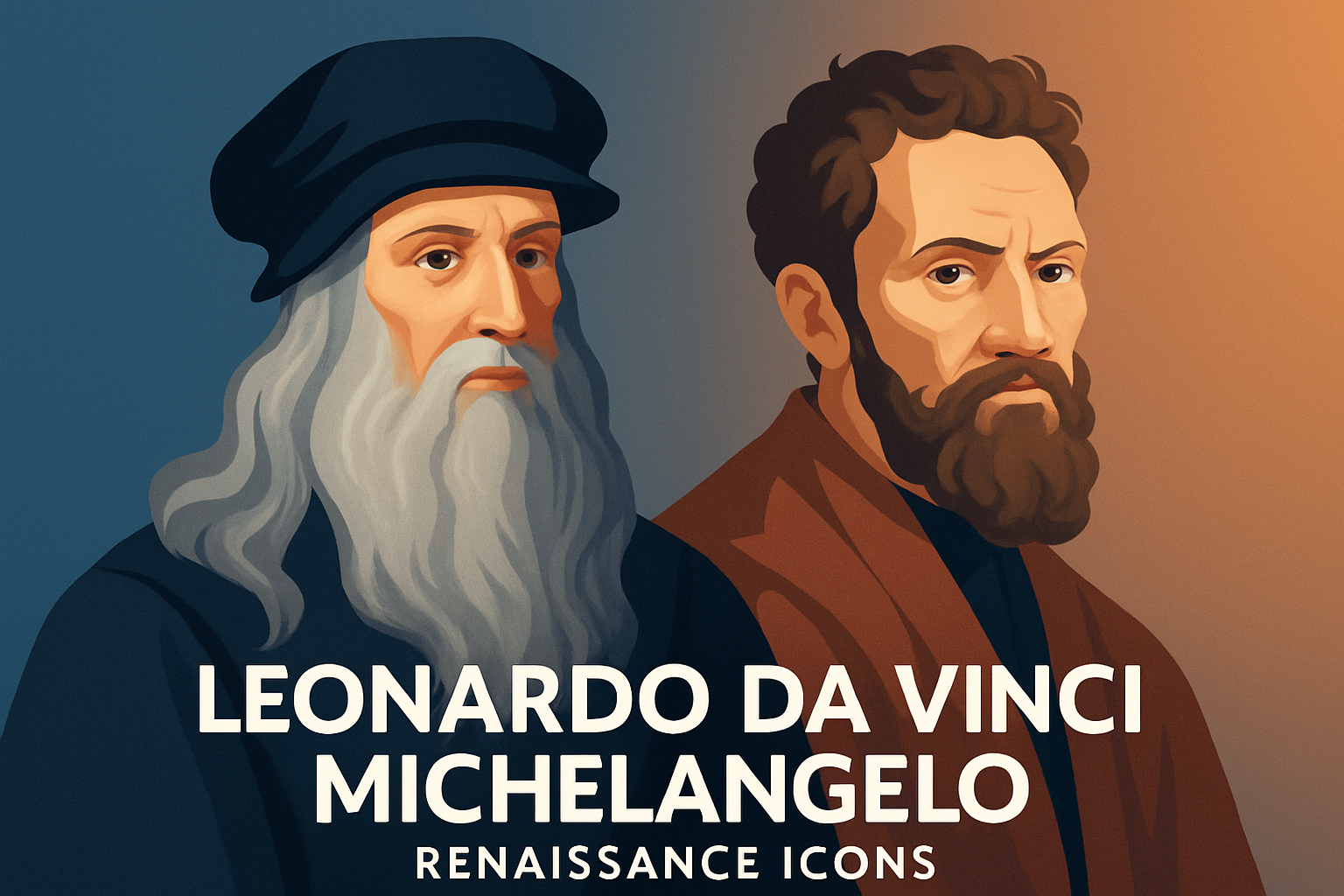
Introduction to Renaissance Icons and their Impact
The Renaissance period, spanning roughly from the 14th to 17th century, marked a pivotal chapter in European history. This era, characterized by a resurgence in art, literature, and science, laid the groundwork for the modern world. Two towering figures, Leonardo da Vinci and Michelangelo, have come to symbolize the spirit and achievements of this transformative period. Their contributions stretch far beyond mere artistic accomplishments, influencing various domains and continuing to inspire generations. The exploration of their lives and works provides invaluable insights into the Renaissance’s intellectual and cultural landscape, making it crucial for anyone interested in understanding the evolution of Western thought and aesthetics to study these extraordinary talents.
Leonardo da Vinci was a polymath with talents spanning art, science, music, mathematics, engineering, and anatomy. He is often credited for harnessing the principles of observation and empirical inquiry that heralded modern scientific techniques. Michelangelo, on the other hand, is renowned for his masterful sculptures and paintings that combine an unparalleled understanding of human anatomy and emotional expression. Both Leonardo and Michelangelo exemplified the Renaissance ideal of humanism and the pursuit of knowledge. Their rivalry and achievements not only propelled their personal growth but also set new standards and sparked advancements in the fields they touched. Their enduring legacies reflect the spirit of their time—a period marked by renewed enthusiasm for human potential and achievement.
Leonardo da Vinci: The Universal Genius
Leonardo da Vinci’s life and work epitomize the Renaissance humanist ideal. Born in Vinci, Italy, in 1452, Leonardo’s curiosity and imagination were apparent from a young age. His multidisciplinary approach blended science and art seamlessly, allowing each to inform the other. His paintings, most notably “The Last Supper” and “Mona Lisa,” showcase his innovative use of perspective, light, and shadow.
Leonardo’s scientific investigations were as groundbreaking as his art. He made significant contributions to human anatomy, understanding of flight, and hydrodynamics. By meticulously dissecting human bodies, he rendered anatomical drawings that were far ahead of his time. These drawings not only served artistic purposes but also contributed to medical knowledge. Leonardo’s notebooks contain designs for flying machines, armored vehicles, and various inventions, displaying his incredible foresight and scientific curiosity.
Leonardo’s Impact on Art and Science
Leonardo’s art influenced countless artists. His techniques for layering and texture added depth to two-dimensional compositions, transforming the portrayal of realist images. His method of “sfumato,” allowing tones and colors to blend softly into each other without harsh outlines, lent a lifelike quality to his portraits.
- “Mona Lisa” – Known for her enigmatic smile, this masterpiece showcases the subtle application of sfumato and remains one of the most famous paintings in history.
- “The Last Supper” – This iconic depiction of Jesus and his disciples demonstrates Leonardo’s mastery of perspective and human emotion.
His impact extended beyond art to scientific realms. His anatomical studies influenced future generations of scientists and artists alike, while his engineering concepts foreshadowed modern machines. Leonardo exemplified the Renaissance belief in the limitless potential of human exploration and understanding.
Michelangelo: The Sculptor of the Soul
Michelangelo Buonarroti, born in 1475 in Caprese, Italy, is celebrated for his exceptional skill in sculpture, painting, and architecture. Though often compared to Leonardo, Michelangelo’s approach was more focused on the emotive potential of the human form. His sculptures and paintings are renowned for their emotional intensity and detail. His most famous works include sculptures such as “David” and “Pietà,” and his contributions to the Sistine Chapel ceiling, including the monumental “The Creation of Adam.”
Michelangelo’s commitment to the idealized human form and his mastery of marble work set him apart as a sculptor. His deep understanding of anatomy enabled him to express complex emotions and narratives through the tense muscles and dynamic postures of his subjects.
Michelangelo’s Influence in Sculpture and Architecture
Michelangelo brought a spiritual dimension to the art of sculpture. His works focus on capturing the psychological states and divine aspects of his figures. Whether in the serene serenity captured in “Pietà” or the heroic stature of “David,” his sculptures evoke profound contemplation and admiration.
- “David” – A 17-foot marble masterpiece representing both the biblical hero and the Renaissance’s emphasis on human dignity and achievement.
- “Pietà” – A tender depiction of Mary holding the lifeless body of Jesus, showcasing Michelangelo’s ability to transform marble into supple, almost living flesh.
Michelangelo also contributed significantly to architecture, notably the design of St. Peter’s Basilica’s dome in Vatican City. His dual mastery of aesthetic and structural principles helped define the Renaissance architectural style. Michelangelo’s legacy endures through the enduring emotional power and spiritual resonance of his art and structures.
The Rivalry and Interchange of Ideas
Leonardo da Vinci and Michelangelo were contemporaries in Florence, their lives and careers intertwined in a competitive yet mutually influential dynamic. Both artists vied for prestige and commissions from the Medici family and the papacy, often leading to friction typical of two highly skilled individuals striving for excellence.
The intense rivalry between them is documented during their proposed—but unrealized—competition to paint two opposing works in the Hall of the Five Hundred in Florence’s Palazzo Vecchio. This rivalry pushed both artists to refine their styles and techniques, indirectly fostering an environment of artistic innovation and excellence.
The competitive spirit between Leonardo and Michelangelo was not solely adversarial but also an intellectual catalyst. Their different approaches to art—Leonardo’s emphasis on scientific precision and Michelangelo’s focus on emotional expression—expanded the creative horizons of the period and contributed significantly to the Renaissance ethos of interdisciplinary integration.
The Legacy of Leonardo and Michelangelo in Modern Times
The works of Leonardo da Vinci and Michelangelo continue to influence and inspire contemporary art, education, and various fields of science and engineering. They set benchmarks for aesthetic and technical prowess across disciplines, serving as foundational pillars for future artistic and intellectual endeavors.
In modern culture, their works are omnipresent in education and media, continuously attracting scholars and enthusiasts. With exhibitions, documentaries, and literature dedicated to dissecting and celebrating their achievements, Leonardo and Michelangelo remain ever-relevant. Many museums worldwide, such as the Louvre in Paris and the Vatican Museums, house their works, drawing millions of visitors seeking to understand these icons’ impact firsthand.
Their legacies remind us of the Renaissance’s core principles: the pursuit of knowledge, the blend of art with science, and the celebration of human potential. Their influences resonate in contemporary scientific research, digital art, and educational curricula, encouraging an integrative approach to human knowledge.
Conclusion: The Enduring Impact of Renaissance Icons
Leonardo da Vinci and Michelangelo stand at the zenith of Renaissance achievement, their lives and creations epitomizing the movement’s spirit. Through their unwavering dedication to advancing the human intellect and proficiency, they contributed to a vibrant period of cultural awakening. Exploring their works provides valuable insights into the synthesis of art and science and the profound impact of creative competition. As you delve into the legacies they left behind, consider how their journeys of innovation and excellence can inform and inspire your pursuits, encouraging a commitment to lifelong learning and the boundless potential of creative endeavor.
To engage with their legacies, one can visit museums, attend lectures, or explore digital archives and documentaries dedicated to Leonardo and Michelangelo’s works. Embracing the Renaissance ethos of knowledge and creativity can lead to richer personal and intellectual growth. A curiosity-driven pursuit of learning and artistic expression—inspired by these iconic figures—can serve as a stepping stone towards truly transformative achievements in our contemporary context.
Frequently Asked Questions
1. Who were Leonardo da Vinci and Michelangelo, and why are they considered icons of the Renaissance?
Leonardo da Vinci and Michelangelo Buonarroti were two of the most prominent and influential artists of the Renaissance, a period of rejuvenation in art, culture, and science. Da Vinci, often referred to as a “polymath,” was not only a master painter but also an inventor, scientist, and engineer. His famous works include “The Last Supper” and “Mona Lisa,” which showcase his mastery in the use of perspective and human anatomy. Michelangelo, on the other hand, was renowned for his exceptional skills in sculpture, painting, and architecture. His masterpiece sculptures “David” and “Pieta,” as well as his iconic paintings in the Sistine Chapel ceiling, display his profound understanding of the human form and emotional expression.
Both artists epitomized the Renaissance’s ideals of humanism, which focused on human potential and achievements. They pushed the boundaries of their crafts, blending art with science and innovation. Their contributions not only shaped the visual language of their time but also left a lasting impact on Western art and culture that continues to influence many facets of life even today.
2. What were some key differences in the artistic styles and approaches of Leonardo da Vinci and Michelangelo?
While both Leonardo and Michelangelo were trailblazers of the Renaissance, they had distinct artistic styles and approaches. Leonardo was fascinated by the natural world and often blended his observations with art and science. He was notorious for his meticulous attention to detail and for experimenting with techniques such as sfumato, which produces soft transitions between colors and tones. His work often conveys a sense of calm grace and introspective depth.
Michelangelo, conversely, focused deeply on human anatomy’s power and emotion, crafting vigorous and dynamic figures. His style is often characterized by its grandeur and expressive emotion. Unlike Leonardo’s softer compositions, Michelangelo’s art is marked by powerful poses and dramatic tension, evident in works like “The Creation of Adam” where he illustrates the tension and energy in divine creation with unparalleled skill.
3. How did Leonardo da Vinci and Michelangelo influence the world beyond their art?
Leonardo’s influence extended well beyond his paintings. His notebooks, filled with thousands of pages of sketches, scientific diagrams, and musings across disciplines like anatomy, engineering, hydrodynamics, and aeronautics, make him a forefather of modern science and engineering. His diverse interests and innovative thinking paved the way for future explorations in several fields, inspiring countless inventors and scientists.
Michelangelo’s impact also transcended his art. As an architect, he contributed significantly to the design of St. Peter’s Basilica in Rome, shaping Renaissance architecture’s trajectory. His approach to capturing profound human emotion and physical form influenced countless artists, fostering a new standard in sculpture and painting. The psychological intensity Michelangelo infused in his works has been a key inspiration for many generations of artists, perpetuating his heroic style across different eras.
4. Why is Leonardo da Vinci’s “Mona Lisa” and Michelangelo’s “David” so iconic?
“Mona Lisa” and “David” are quintessential masterpieces that embody the artistic excellence of the Renaissance and the genius of their creators. The “Mona Lisa,” housed in the Louvre Museum, is celebrated for her enigmatic smile and lifelike presence. Leonardo’s use of sfumato contributes to the painting’s mystique, making Mona Lisa seemingly animate. This piece is adored not only for its artistic finesse but also for its innovative technique, which was revolutionary for its time.
Michelangelo’s “David,” a towering marble statue residing in the Galleria dell’Accademia in Florence, exemplifies the ideal of Renaissance humanism—its precise anatomy and poised stance reveal a mastery of form and a profound understanding of human physiology. Apart from its aesthetic brilliance, “David” symbolizes the political freedom and civic pride of Florence, embodying heroism and youthful beauty. Both works continue to captivate audiences worldwide, cementing their places as cultural icons.
5. What challenges did Leonardo da Vinci and Michelangelo face during their careers?
Despite their today-celebrated statuses, Leonardo and Michelangelo faced several challenges in their lifetimes. Leonardo often struggled to see projects through to completion, leading to tensions with patrons. His insatiable curiosity and desire to perfect his techniques sometimes meant that projects were abandoned or left incomplete. Additionally, he competed against other artists for commissions, which was a common challenge of the time.
Michelangelo also contended with his share of difficulties. His colossal temper and intense perfectionism often led to conflicts with patrons and fellow artists. The gargantuan task of painting the Sistine Chapel ceiling, for instance, tested his endurance and health. Despite suffering from physical hardship while working overhead on scaffolding, his resilience allowed him to complete some of the most acclaimed works in art history. Both artists’ legacies are testament to their ability to overcome these hurdles and leave an indelible mark on the world.