
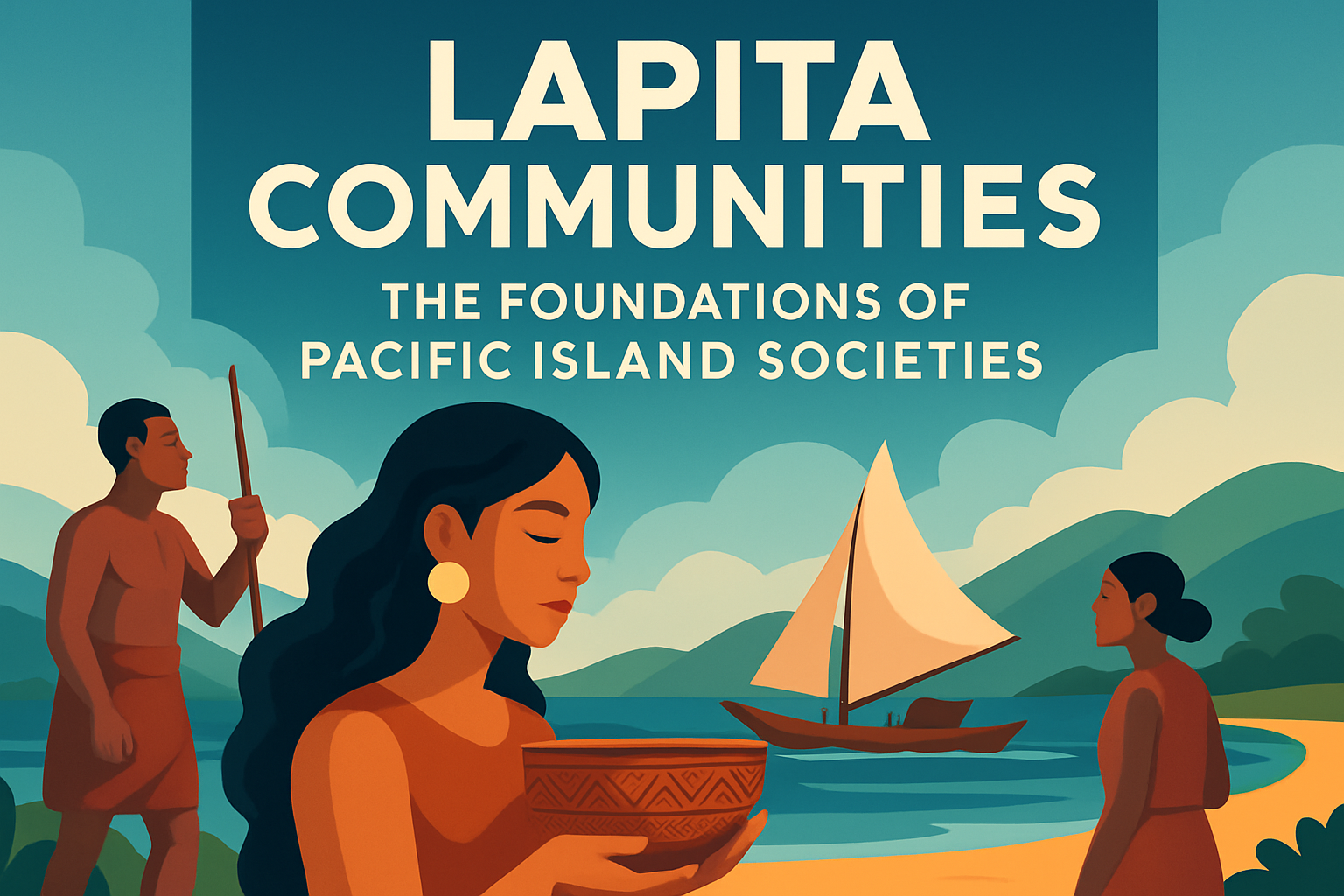
Lapita communities represent a cornerstone in the history of Pacific Island societies. Emerging around 1500 BCE, these communities are named after the distinctive pottery styled with intricate patterns and motifs. The Lapita people, known for their seafaring abilities, embarked on adventurous voyages across the vast Pacific Ocean, populating a string of islands that include aspects of modern-day Melanesia, Polynesia, and Micronesia. Understanding the Lapita culture is crucial because it lays the groundwork for the ethnological and socio-political development of these island societies. As such, they are not merely an archaeological curiosity but a pivotal chapter in human prehistory. Recognizing how the Lapita contributed to the cultural tapestry we see today across the Pacific Islands grants meaningful insights into human adaptation, migration, and societal formation in challenging environments. This understanding matters because it provides critical perspectives on humanity’s resilience and innovativeness in the face of vast unknowns, serving as a reminder of our collective heritage.
The Pottery: A Cultural Identifier
Central to the recognition of Lapita communities is their distinct pottery, which serves as both an artifact for archaeological study and a cultural identifier. These ceramics, adorned with intricate geometric patterns and anthropomorphic figures, have been discovered across various islands scattered in the Pacific. Made using a technique that involved coiling and paddle-and-anvil methods, this pottery was not just utilitarian but also held ceremonial value. For instance, in New Caledonia, Lapita pottery pieces found showcased complex designs parallel to the intricate tattoo art seen in later Pacific cultures, hinting at a shared stylistic and symbolic vocabulary. This pottery provides us with tangible evidence of the Lapita’s presence and influence, acting like a breadcrumb trail that maps the spread of their communities over time.
Navigational Prowess and Oceanic Voyages
The Lapita people were not only skilled artisans but also expert navigators. Their ability to traverse vast oceanic distances in double-hulled canoes had a profound impact on the demographics and settlement patterns of the Pacific Islands. Without modern navigation tools, the Lapita utilized stellar navigation, observing the stars and ocean currents to guide their journeys. One striking example is their migration to the islands of Tonga and Samoa, where evidence of Lapita culture indicates they arrived between 900 and 800 BCE. Through these extensive voyages, they spread their culture, language, and technological innovations, laying the groundwork for complex societal structures that arose in these isolated geographical pockets. The Lapita thus serve as a testament to early human exploration and adaptability.
Social Structures and Community Organization
A critical facet of Lapita communities was their sophisticated social structures and community-based living. Evidence suggests that these societies had established hierarchies and roles, possibly governed by chieftains or councils. Their settlements were typically arranged to accommodate large, extended family groups, indicating a social organization centered around kinship. Excavations in the Solomon Islands have unveiled community sites, where household arrangements reveal how land and resources were shared and distributed. The discovery of burial sites with grave goods further suggests complex social strata and the reverence for ancestors. These organizational paradigms set by the Lapita became foundational to later Pacific societies, influencing their governance systems and cultural traditions.
Agricultural Practices and Resource Utilization
Survival in isolated island environments demanded that the Lapita people develop innovative agricultural practices and resource utilization techniques. They introduced crops such as taro, yam, and banana, which remain staple foods in Pacific diets today. This agriculture allowed them to sustain large communities and support population growth. Of note is their successful integration of swidden, or slash-and-burn techniques, to enrich the highly variable soils of island environments. On the Islands of Vanuatu, evidence of extensive horticultural activities supports theories of how the Lapita intricately managed and altered landscapes to suit their needs, showcasing their profound understanding of ecological dynamics. Their legacy thus extends into contemporary practices in the Pacific, illustrating the enduring influence of their agricultural innovations.
Lapita Linguistic Legacy
Another critical legacy of the Lapita people is linguistic. They are believed to be the ancestors of the modern Austronesian-speaking populations scattered across the Pacific. The diffusion of the Austronesian language family, with connections all the way to Madagascar in the west and Easter Island in the east, is a testament to the expansive navigational reach of the Lapita. In regions like Fiji, where Lapita cultural markers have been extensive, modern languages still retain roots tracing back to these early settlers. By transmitting language alongside cultural practices, the Lapita ensured the survival of their legacy across generations and geographies. This linguistic impact provides a bridge to understanding historical human movements and interactions across vast distances, deepening our knowledge of global human history.
| Aspect | Features | Legacy |
|---|---|---|
| Pottery | Decorated with geometric patterns | Cultural identification across islands |
| Navigation | Oceanic voyages using stars | Settlement patterns and exploration |
| Social Structures | Kinship-based community organization | Societal and governance influences |
| Agriculture | Introduction of staple crops | Long-lasting culinary traditions |
| Language | Roots of Austronesian languages | Linguistic heritage and continuity |
Cultural Interactions and Exchange
The Lapita were active participants in an ancient network of trade and cultural exchange, interacting with neighboring island groups and coastal communities. These interactions led to the exchange of goods, such as obsidian and shell ornaments, as well as ideas and cultural practices. For example, in Fiji, a distinctive Lapita-influenced kerbstone design was uncovered, revealing the assimilation of local artistic styles with imported Lapita iconography. This cross-cultural interaction not only enriched the Lapita society but also enabled them to adapt and thrive in diverse environments, accelerating the spread of their influence across the Pacific. It demonstrates a proto-globalization of sorts, where even early societies engaged in extensive economic and cultural exchanges.
The Technological Innovations of the Lapita People
The technological achievements of the Lapita communities were not limited to crafts and navigation. They devised complex tools and techniques for fishing, one of their primary sources of sustenance. Implements like fishhooks made of shell and bone have been uncovered, showing advanced mastery in crafting tools tailored to target specific marine resources. These technologies display a deep understanding of marine ecosystems and showcase their adaptive strategies to secure survival in resource-limited environments. Through this lens, the Lapita not only highlight early innovations that were vital to their survival but also provide an example of how technology can evolve in society to meet environmental demands. Their ingenuity supports the notion of human tenacity and capability for innovation, regardless of time period or technology level.
Conclusion
In conclusion, the Lapita communities stand as a remarkable exemplar of early human innovation, resilience, and legacy in the Pacific Islands. Through their distinct pottery, adept navigation skills, and sophisticated societal structures, they laid the foundations for the cultures and societies that developed over millennia in this vast oceanic realm. Their legacy, manifest in language, agricultural practices, and social structures, endures across the numerous islands of the Pacific, reflecting a profound cultural continuity. Understanding their contributions not only enriches our knowledge of human prehistory but also inspires us to consider the ways in which we adapt and innovate in the face of challenges. Readers are encouraged to delve deeper into the stories of ancient societies like the Lapita to uncover the narratives that shape our present. By recognizing and appreciating our shared history, we foster a greater understanding of humanity’s eclectic journey and interconnected fate.
Frequently Asked Questions
1. What are Lapita communities and why are they important to Pacific Island societies?
Lapita communities were pioneering groups that emerged around 1500 BCE in the Pacific Islands. They are named after a distinctive style of pottery decorated with intricate patterns and motifs. These communities are considered the ancestors of many Pacific Islanders. The Lapita people were remarkable for their seafaring abilities, which allowed them to embark on long voyages across the vast Pacific Ocean. This led to the colonization and settlement of many islands in present-day Melanesia, Polynesia, and Micronesia. Their influence is still evident today in the cultural and genetic makeup of these regions. Studying Lapita sites offers valuable insights into prehistoric navigation, social organization, and cultural practices, which underpin modern Pacific Island societies.
2. How did Lapita communities navigate and settle across the Pacific Ocean?
Lapiata communities were adept navigators and seafarers, a skill crucial for their exploration and settlement of the Pacific Islands. They utilized their advanced understanding of oceanography and astronomy to navigate vast distances over open waters. Their sea voyages were facilitated by an intricate system of star paths, wave patterns, and weather patterns. Equipped with canoes made for long-distance travel, the Lapita people could safely transport themselves and essential resources like plants and domesticated animals. They followed a systematic settlement pattern, starting from coastal areas before venturing into the less accessible islands. Their navigational skills and maritime achievements remain fundamental components of Pacific Island heritage, giving modern communities a sense of connection to their adventurous ancestors.
3. What is unique about Lapita pottery, and what does it tell us about their culture?
Lapita pottery stands out for its elaborate and sophisticated designs, featuring intricate geometric patterns, lines, and anthropomorphic figures. This pottery is not only an art form but also a cultural relic that provides profound insights into the life of Lapita people. The technique used to create these patterns involved stamping or applying comb-like tools onto wet clay surfaces. This method allowed for the creation of uniform and repetitive designs, indicating a focus on aesthetics and advanced technical skills. Pottery fragments, often found at archaeological sites, reveal much about the social practices, trade, and daily life of the Lapita. In addition to its functional uses, such as cooking and storage, the adorned pottery likely held symbolic or ceremonial significance, reflecting the community’s values and religious beliefs.
4. Where have Lapita sites been discovered, and what can they tell us about Lapita expansion?
Archaeological discoveries of Lapita sites have been made throughout a broad swath of the Pacific, covering regions from New Guinea, the Solomon Islands, Vanuatu, New Caledonia, Fiji, to Tonga, and Samoa. These sites typically contain stretches of pottery sherds, remnants of ancient food storage, and sometimes, burial grounds. The distribution of these sites outlines a clear trajectory of expansion and colonization initiated by these early seafarers. Analyzing these locations helps archaeologists piece together the migration patterns of the Lapita people, showcasing their role as initial settlers of many islands. Each site provides a snapshot of Lapita life at a given time and place, illustrating how they adapted to different environmental conditions while maintaining cultural continuity across the expansive Pacific region.
5. How do modern technologies contribute to our understanding of Lapita communities?
Advancements in technology have truly transformed our understanding of Lapita communities. Techniques such as carbon dating have allowed for more precise timelines regarding pottery and site occupation. Genetic studies are uncovering links between ancient Lapita people and contemporary Pacific Island populations, offering a more nuanced understanding of population genetics and dynamics. Moreover, Geographic Information System (GIS) technology helps create models of Lapita settlement and expansion patterns. Remote sensing and underwater archaeology further expand the realm of discovery by allowing the exploration of areas previously overlooked. Ground-penetrating radar can locate undiscovered archaeological sites, while digital recreations illustrate how Lapita societies may have lived. These interdisciplinary approaches combine to enhance our knowledge, continually painting a more detailed picture of these influential ancient communities.