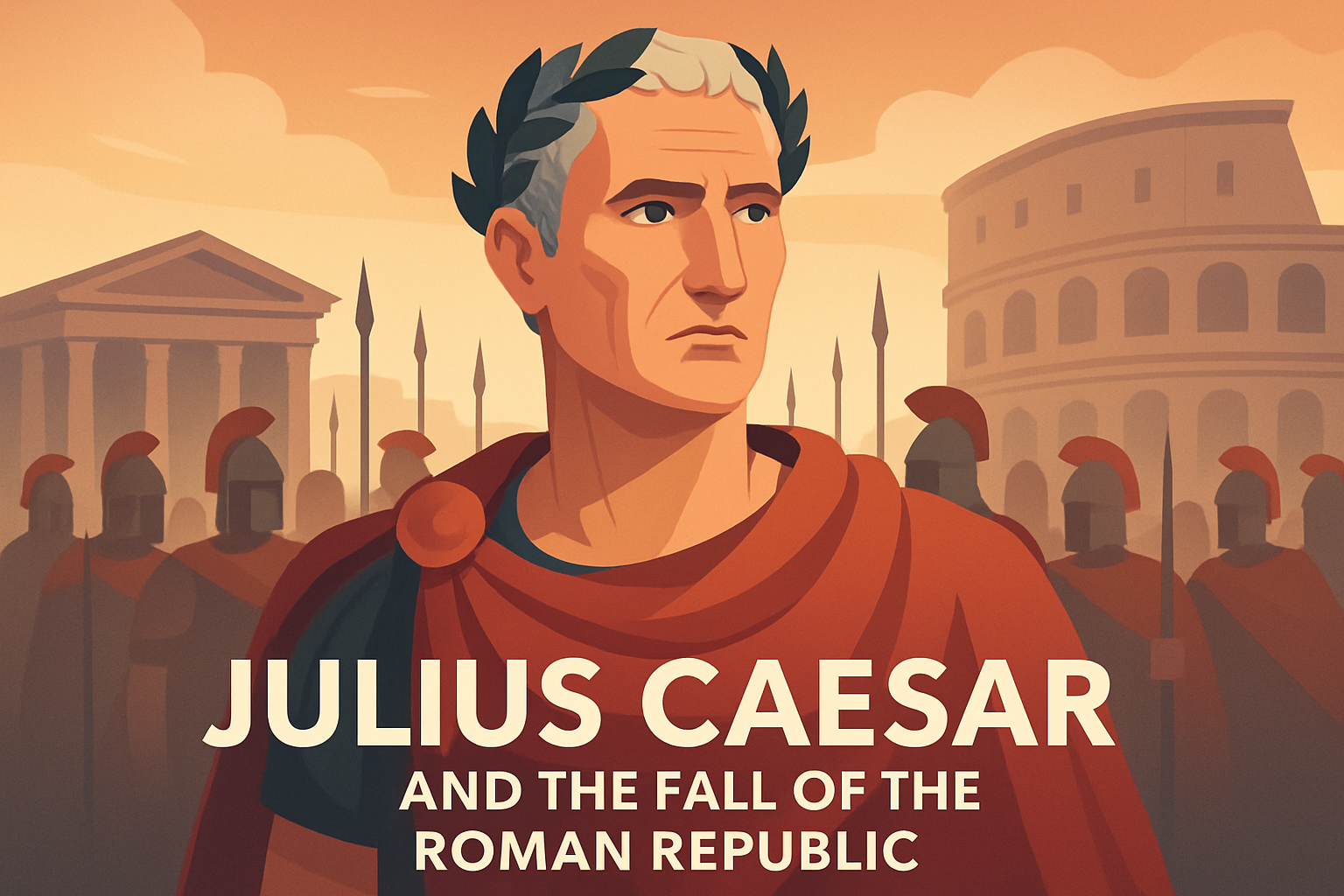
Introduction to Julius Caesar and the Roman Republic
Julius Caesar is a name that resonates through history as a transformative figure. His life and actions played a pivotal role in the transition from the Roman Republic to the Roman Empire. The Roman Republic, founded in 509 BC, was a complex political system characterized by checks and balances, a Senate, and elected officials. However, by the first century BC, internal strife, economic disparities, and external threats began destabilizing this once-mighty republic.
Understanding the life of Julius Caesar and his influence is essential because it provides insights into how power dynamics, charisma, and political ambition can reshape societies. The fall of the Roman Republic serves as a timeless lesson in governance, offering valuable perspectives on political institutions’ fragility and the perils of concentration of power. Therefore, examining Caesar’s ascent and its implications sheds light on the interplay between personality and politics that transcends time.
Caesar’s Early Life and Political Ambition
Born into the patrician Julian family in 100 BC, Julius Caesar was afforded an education that emphasized rhetoric, literature, and military tactics. From an early age, it was apparent that Caesar possessed not only intellectual acumen but also an ambition that set him apart. His rise through the political ranks commenced in less prominent roles, including positions like military tribune and quaestor, gradually allowing him to navigate the intricacies of Roman politics.
Caesar’s ambition was further reflected in his early alignment with key political figures such as Gnaeus Pompeius Magnus (Pompey) and Marcus Licinius Crassus. This alliance, later known as the First Triumvirate, was a strategic maneuver to pool resources and influence, effectively bypassing the traditional republican checks that inhibited individual power. The success of this consortium was a testament to Caesar’s political shrewdness and his ability to capitalize on alliances, a crucial step in his path to accumulating unparalleled authority.
Military Conquests and Popularity
Julius Caesar’s military campaigns, particularly his conquests in Gaul from 58 BC to 50 BC, were pivotal in enhancing his stature and influence. These conquests not only expanded Rome’s territories but also brought immense wealth and glory to Caesar, endearing him to the Roman populace. The Gaulish wars provided Caesar with seasoned troops fiercely loyal to him, an asset he would later wield to his advantage in the Roman political arena.
Caesar’s military triumphs were more than just displays of martial prowess; they were calculated moves that bolstered his popularity and political capital. By dispatching detailed reports back to Rome, Caesar ensured that his exploits kept him in the public eye, trailing a legacy of victory and expansion that no Roman could ignore. His popular backing grew logarithmically, unsettling the Senate and providing the military leverage necessary for his eventual march on Rome.
The Rubicon and Civil War
In January 49 BC, faced with opposition from the Senate and the threat of prosecution upon returning to Rome without his army, Caesar crossed the Rubicon River with the renowned phrase “Alea iacta est” (“The die is cast”). This bold move initiated a civil war, pitting Caesar against the Senate’s forces led by Pompey. The crossing of the Rubicon symbolized an irreversible step towards conflict; it was a calculated gamble fueled by Caesar’s desire to secure his power and avoid persecution.
Caesar’s decision to cross the Rubicon resulted in a series of military engagements across the Roman world. Despite being outnumbered and facing immense resistance, Caesar’s strategic foresight and military prowess led to swift victories. The eventual defeat of Pompey at the Battle of Pharsalus in 48 BC marked a significant turning point, consolidating Caesar’s control over Rome and underscoring his indomitable will to power.
The consequences of Caesar’s march on Rome were profound, leading to the disintegration of republican structures and the establishment of a de facto dictatorship. The events culminating in the Rubicon crossing exemplify the drastic lengths to which ambitious leaders might go when cornered by political adversaries, reshaping societal norms and governance in the process.
Reforms and Dictatorship
Once in control, Julius Caesar initiated a series of reforms aimed at stabilizing and revitalizing the Roman state. These reforms encompassed broad sectors including the Roman calendar, which he redefined into the Julian calendar, and measures to address economic disparity, such as land redistribution and debt reforms. Caesar’s grasp on governance was not exclusively tyrannical; he demonstrated foresight in enacting policies designed to strengthen Roman infrastructure and administration.
However, Caesar’s accumulation of titles, including “dictator perpetuo” (dictator for life), unsettled many traditionalists within the Senate who feared the erosion of republican institutions. Despite his successful reform agenda, the perception of his growing autocracy and the marginalization of senatorial power seeded deep resentment among the Roman elites.
The dichotomy of Caesar’s rule—reformer versus autocrat—illustrates the complex nature of power consolidation. While his reforms demonstrated visionary governance, they were overshadowed by fears of dictatorship, ultimately leading to heated conflicts within his administration. This duality of action underscores the fine line between strengthening and dismantling political frameworks, a balance pivotal to any ruling authority.
The Ides of March and Caesar’s Assassination
On March 15, 44 BC, also known as the Ides of March, Julius Caesar was assassinated by a group of senators led by Gaius Cassius Longinus and Marcus Junius Brutus. This dramatic act was fueled by the belief that Caesar’s death was necessary to restore the Roman Republic and curb his dictatorial aspirations. The assassination was orchestrated under the guise of preserving liberty, reflecting the intense political division and fear of tyranny that permeated the Roman elite.
The immediate aftermath of Caesar’s assassination plunged Rome further into chaos, spawning another cycle of civil wars. Instead of restoring the Republic, Caesar’s death accelerated its decline, paving the way for the rise of his grandnephew and adopted heir, Octavian (later Augustus), who would cement the foundation of the Roman Empire.
Caesar’s assassination remains a poignant lesson on political hubris and the volatile chemistry of power and influence. It exemplifies how disruptive forces can generate unforeseen consequences, suggesting that the pursuit of power, while essential for instigating change, can also catalyze tumultuous transitions beyond the control of their architects.
Conclusion and Lessons from the Fall of the Roman Republic
Julius Caesar’s life and the consequent fall of the Roman Republic offer enduring lessons in the dynamics of political power, ambition, and leadership. Caesar’s ascent from a patrician lineage to the pinnacle of Roman authority underscores the impact of strategic alliances, charismatic leadership, and populist appeal. His military triumphs and subsequent reforms highlight the dual nature of autocratic governance—capable of both reformative vision and authoritarian overreach.
The collapse of republican governance in favor of imperial rule serves as a sobering reminder of the fragility of political systems. It illustrates how unchecked ambition and institutional weaknesses can erode foundational principles, leading to transformative shifts that redefine societal landscapes. In light of these insights, readers are encouraged to critically consider the balance between governance, liberty, and leadership in their contexts.
By understanding this historical epoch, we can derive valuable foresight into contemporary governance challenges, emphasizing the need for vigilant maintenance of institutional structures. Engage further with these themes by exploring additional resources on Roman history, political theory, and leadership dynamics to deepen your understanding and apply these lessons to modern contexts.
Frequently Asked Questions
1. Who was Julius Caesar and what role did he play in the transition from the Roman Republic to the Roman Empire?
Julius Caesar was a Roman military and political leader whose actions greatly influenced the course of Roman history. Born on July 12, 100 BC, into a patrician family, he rose to prominence through his military brilliance, cunning diplomacy, and ability to charm the masses. Caesar’s pivotal role in the decline of the Roman Republic was marked by his crossing of the Rubicon River in 49 BC, an act of insurrection that led to a civil war. His subsequent victory and dictatorship, albeit short-lived, laid the foundation for the rise of the Roman Empire. Caesar centralized power in himself, bypassing the traditional Republican institutions, and enacted various reforms. Despite being assassinated in 44 BC, his impact was so profound that it ultimately led to the end of the Republic and the dawn of Imperial Rome under his adopted heir, Augustus (formerly known as Octavian).
2. What were the main characteristics of the Roman Republic, and what factors contributed to its instability by the first century BC?
The Roman Republic was a complex political system established in 509 BC following the overthrow of the Roman monarchy. It was characterized by a network of checks and balances intended to prevent any single individual from gaining too much power. The Republic featured institutions like the Senate, which was composed of Roman aristocrats, and positions such as consuls and tribunes, who were elected by Roman citizens. Over time, internal strife, such as class conflicts between the patricians, who were the aristocratic class, and plebeians, the common citizens, began to destabilize the Republic. Economic disparities widened, with vast land estates (latifundia) causing many small farmers to lose their livelihoods. Military reform and the personal ambitions of generals like Caesar, Pompey, and Crassus also posed an external threat. Furthermore, corruption and political violence became rampant, contributing to the eventual collapse of this political system.
3. How did Caesar’s military campaigns and political alliances contribute to his power and the undermining of the Roman Republic?
Julius Caesar’s rise to power was marked by his strategic military campaigns and shrewd political alliances. He first gained significant military acclaim during the Gallic Wars (58-50 BC), where he expanded Roman territory and garnered immense wealth and loyalty from his troops. His accounts of these wars, the “Commentarii de Bello Gallico,” also shaped his public image back home. Politically, Caesar formed the First Triumvirate, an unofficial alliance with Pompey and Crassus, two of Rome’s most powerful men, which helped him secure the consulship in 59 BC. This alliance allowed him to push through legislation and gain control over key territories. However, as his prestige and ambition grew, the alliances unraveled, leading to a civil war with Pompey. Caesar’s ability to use both political maneuvering and military force ultimately undermined the Republic’s checks and balances, concentrating authority in his hands as he assumed the role of dictator for life.
4. What was the significance of Caesar’s assassination, and how did it lead to the end of the Roman Republic?
Julius Caesar’s assassination on March 15, 44 BC, a date famously known as the Ides of March, was a pivotal moment in Roman history. A group of senators, fearing Caesar’s apparent accumulation of power and his appointment as ‘dictator perpetuo’ (dictator in perpetuity), orchestrated his murder to restore the Republic. However, the assassination plunged Rome into chaos rather than stabilizing it. Caesar’s death exacerbated existing tensions, leading to a series of civil wars. His adopted heir, Octavian (later Augustus), ultimately emerged victorious over rival factions, including the influential Mark Antony and Cleopatra. This power consolidation and defeat of opposition marked the formal end of the Roman Republic and the beginning of the Roman Empire. Octavian became the first Roman Emperor, cementing the autocratic rule that would dominate Roman governance for centuries.
5. How did Julius Caesar’s reforms impact Rome during and after his rule?
Julius Caesar initiated a series of reforms that had lasting impacts on Roman society and governance. During his short tenure as a dictator, he instituted changes designed to centralize authority, restructure debt, and distribute land to veterans and the poor. He reformed the calendar by introducing the Julian calendar, which closely resembles the modern Gregorian calendar. Caesar also expanded the Senate, adding allies and those loyal to him to dilute the influence of his political opponents. Although many of his reforms were interrupted by his assassination, they laid the groundwork for future administrations. His land reforms, in particular, sought to address the pressing economic disparities of the era. Under Augustus, some of Caesar’s policies were adapted and expanded, influencing Roman administration and society for generations. While some reforms aimed to stabilize and strengthen the Republic, the resultant concentration of power pointed directly to the imperial system that followed.