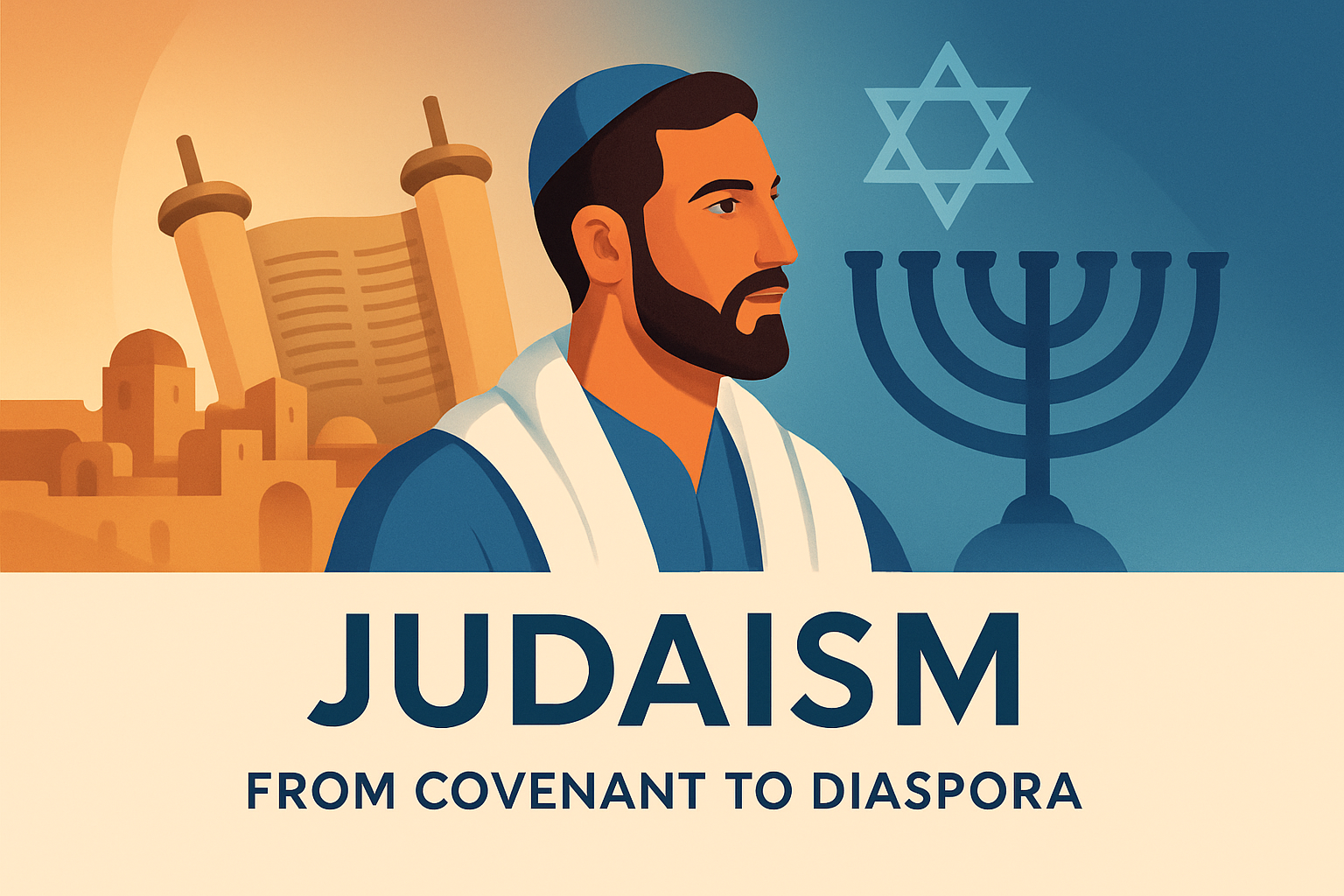
Humanity’s search for meaning and understanding of the divine has birthed various religious traditions, among which Judaism stands as one of the oldest. With its roots in the ancient Near East, Judaism is not just a religious faith but a cultural and historical journey that has played a significant role in shaping the course of human civilization. Central to Judaism is the concept of the Covenant, a unique and divine agreement between God and the Jewish people, establishing a framework for a moral and ethical life. This journey from the Covenant has led to the scattered spread of Jewish communities around the world, known as the Diaspora. Understanding Judaism’s profound influence on world history and its enduring legacy sheds light on its continual importance in contemporary society. But to grasp the depth and breadth of Judaism, one must first unravel the interwoven tales of its covenantal beginnings and diasporic expansions, illustrating its resilience and adaptability.
The Covenant: Foundation of Jewish Faith
The Covenant is the bedrock of Jewish faith and identity, representing a sacred pact with God initiated with the patriarch Abraham. As narrated in the Hebrew Bible, God promised Abraham that he would become the father of a great nation, a promise further solidified with the giving of the Ten Commandments to Moses on Mount Sinai. These divine laws became the cornerstone of Jewish ethics, delineating a path of righteousness and social justice. The Covenant was not merely a religious directive but a binding agreement that shaped the morals, societal structure, and rituals of Jewish life. It forged an unbreakable bond that ensured the Jewish people’s spiritual connection with God, even in times of persecution and adversity.
An illustrative example of the Covenant’s influence is the celebration of Passover, commemorating the liberation of the Israelites from Egyptian bondage, a pivotal event in the Jewish narrative. This festival not only sustains the memory of divine intervention and covenantal promise but also reinforces the values of freedom, resilience, and faith.
Birth of Jewish Law: The Torah
The Torah, often referred to as the Law, is a sacred text that captures the essence of the Covenant. It consists of the first five books of the Hebrew Bible and encompasses religious teachings that guide Jews in their everyday lives. The Torah’s commandments (mitzvot) range from ethical precepts, such as charity and justice, to ritualistic observances, including kosher dietary laws and the Sabbath. Through these laws, the Torah serves as a compass directing how Jews maintain their covenantal obligations to God and each other.
The importance of the Torah is manifested in Jewish educational traditions, where learners, from a young age, are taught to read, recite, and interpret its texts. This focus on study and interpretation has cultivated a scholarly and introspective dimension within Jewish culture, fostering a distinctive intellectual tradition that deeply values learning and debate.
Diaspora: Dispersion and Resilience
As centuries unfolded, Jewish communities spread far beyond their original homelands, leading to the phenomenon known as the Diaspora. This dispersion was primarily due to historical events such as the Babylonian Exile, Roman conquests, and socio-political upheavals across the world. Despite facing adversity, including forced migrations and persecution, Jewish communities remained resilient, preserving their religious practices and cultural heritage across the globe.
To illustrate the extent of the Diaspora, consider the Sephardic Jews, who were expelled from Spain during the Inquisition in 1492. Many settled in regions like North Africa, the Ottoman Empire, and later the Americas, where they established vibrant communities. This scattering led to diverse cultural expressions within Judaism, as communities adapted to their new environments while maintaining a sense of shared identity.
- Sephardic Jews in North Africa incorporated local traditions, leading to unique linguistic and culinary fusions.
- Ashkenazi Jews in Eastern Europe developed distinct customs and liturgical practices influenced by their European surroundings.
- Judeo-Spanish, a language blend that emerged from Sephardic Jewish communities, exemplifies the cultural synthesis characteristic of the Diaspora.
Modern Judaism: Identity and Continuity
In modern times, Judaism continues to evolve, encountering new challenges and opportunities in preserving traditions while engaging with contemporary societal shifts. The establishment of the State of Israel in 1948 marked a significant moment in Jewish history, signifying a return to biblical lands and offering a point of unity for Jews worldwide. Israel’s existence and its role in modern geopolitics deeply affect Jewish identity and communal dynamics globally. It acts as a source of cultural pride and connection to Jewish ancestry for many across the Diaspora.
However, Judaism does not solely hinge on its religious aspects; it has also nurtured a vibrant cultural and social presence, seen in contributions to art, science, and politics. From Nobel laureates like Albert Einstein to influential cultural figures like Barbra Streisand, Jewish individuals have left indelible marks on global advancements, showcasing the creative spirit that thrives within the Jewish community.
Challenges and the Future of Jewish Identity
Despite its historical strength, the Jewish community faces ongoing challenges, such as anti-Semitism, assimilation, and the need for interfaith dialogue. Jewish identity in the 21st century involves navigating a delicate balance between cultural preservation and integration into broader societies. For example, young Jews today often grapple with questions of identity, heritage, and how to practice their faith in an increasingly interconnected and secular world.
| Challenge | Description | Impact |
|---|---|---|
| Anti-Semitism | Prejudice against Jews | Leads to social and political tensions |
| Assimilation | Loss of distinct cultural and religious practices | Threatens cultural continuity and identity |
| Interfaith Dialogue | Engagement with other religious communities | Fosters mutual understanding and respect |
These challenges, however, also present opportunities for adaptive growth, fostering new interpretations of old traditions and inviting wider societal contributions. As Judaism continues to make its presence felt globally, its emphasis on community, moral responsibility, and intellectual pursuit remains relevant, offering time-tested wisdom to face modern dilemmas.
Conclusion: Moving Forward with Tradition
Judaism’s journey from the Covenant to the Diaspora exemplifies a profound narrative of faith, endurance, and cultural evolution. Central to this tradition is the unwavering commitment to the divine promise, guiding adherents through history’s tumultuous waters. This journey reflects resilience, as seen in how Jewish communities preserve their identity globally while contributing richly to world culture and dialogue.
The importance of studying and understanding Judaism lies in its ability to offer insights into human nature, community, and the search for meaning. By drawing lessons from its past, individuals can appreciate the value of cultural heritage and the importance of upholding one’s traditions amidst change.
For those intrigued by this rich tapestry of history and spirituality, engaging further with Jewish texts, traditions, and communities can lead to a deeper appreciation of Judaism’s timeless values. Whether through attending cultural events, exploring religious texts, or participating in interfaith dialogues, there lies an invitation to connect with a legacy that continues to enlighten and inspire.
As Judaism adapts to an ever-changing world, it invites individuals to explore their connection to tradition, enriching their lives and opening avenues for meaningful dialogue and growth across cultures.
Frequently Asked Questions
1. What is the Covenant in Judaism, and why is it so important?
At the heart of Judaism lies the concept of the Covenant, or “brit” in Hebrew, which is a deeply rooted agreement between God and the Jewish people. This unique relationship is foundational to Jewish faith and identity. The Covenant began with the patriarch Abraham, who is seen as the first to form this pivotal bond with God. According to Jewish tradition, God promised Abraham that his descendants would become a great nation, receive their own land, and be a source of blessing to the world. In return, Abraham and his descendants were to follow God’s laws and commandments.
The narrative continues with Moses, who receives the Ten Commandments at Mount Sinai, formalizing the Covenant with the entire nation of Israel. This event is a defining moment, as it sets up the rules and expectations that would guide the Israelites’ conduct and ethics. The Covenant is not only a religious commitment but also a cultural and communal one that solidified a collective identity among the Jewish people, transcending geography and time.
2. How did the Jewish Diaspora impact the development of Judaism over time?
The Jewish Diaspora, referring to the spread of Jewish people beyond their ancestral homeland, has been instrumental in shaping the evolution of Judaism. This dispersion occurred in several waves, primarily due to exile and persecution, such as the Babylonian Exile in the 6th century BCE and the destruction of the Second Temple by the Romans in 70 CE. Rather than diminishing the Jewish faith, the Diaspora led to its diversification and adaptation.
In the Diaspora, Jewish communities found themselves in varied cultural settings, which necessitated different approaches to religious practice and interpretation. As Jewish communities settled in regions as diverse as North Africa, Europe, and the Middle East, they retained core beliefs while developing local customs and traditions. Rabbinic Judaism, which developed during this period, emphasized the importance of the Torah and Talmud, creating a flexible yet enduring framework for Jewish life separated from the Temple in Jerusalem. The Diaspora also fostered a sense of unity and identity among Jews worldwide, as shared practices and faith transcended local customs and languages.
3. What role does the Torah play in the daily life and rituals of Jewish people?
The Torah, often referred to as the Five Books of Moses, is the central reference of Judaic tradition and teaching. It serves as the written law and foundation for Jewish ethics, spirituality, and law. Comprising Genesis, Exodus, Leviticus, Numbers, and Deuteronomy, it encompasses everything from the creation of the world to the laws governing everyday life and community organization.
In Jewish life, the Torah is not merely a text but an active component of religious and cultural identity. It is read regularly during prayer services in synagogues, most notably on the Sabbath and during Jewish holidays. Rituals surrounding the Torah reflect its sanctity, such as the process of taking it out from the Ark, reading from it with a special pointer called a yad, and giving it honors within the service.
The commandments and stories within the Torah guide ethical behavior and spiritual practice, influencing everything from dietary restrictions (kashrut) to principles of justice and charity. It encourages study and debate, with countless interpretations and commentaries encouraging continuous engagement and reflection on its teachings.
4. How do Jewish holidays commemorate historical and religious events?
Jewish holidays are rich in history and religious significance, serving as annual reminders of pivotal events in Jewish history and expressions of Jewish faith. These observances are deeply rooted in the Jewish calendar, which is lunar-based, resulting in holidays that shift annually in relation to the Gregorian calendar.
Passover (Pesach) is one of the most well-known Jewish holidays, commemorating the Exodus from Egypt and the liberation of the Israelites from slavery. The holiday involves a ritual meal called the Seder, where the story of the Exodus is retold, highlighting themes of freedom and divine intervention.
Yom Kippur, the Day of Atonement, is the most solemn day of the Jewish year, focusing on repentance and spiritual renewal. It follows Rosh Hashanah, the Jewish New Year, and entails a 25-hour period of fasting and prayer. This time allows for introspection, public confession of sins, and seeking of forgiveness from God.
Hanukkah, though more cultural than biblically based, celebrates the victory of the Maccabees over the Greek Syrians and the miracle of the temple’s menorah burning for eight days on a small amount of oil. This holiday is marked by lighting candles, playing dreidel games, and enjoying foods fried in oil.
5. What are some key differences between various Jewish denominations, such as Orthodox, Conservative, and Reform Judaism?
The diversity within Judaism reflects varied approaches to religious practice and interpretation of Jewish law (halacha). These denominations offer different levels of observance and adaptation to contemporary life.
Orthodox Judaism is known for its strict adherence to traditional Jewish law and practices. It believes in the immutability of the Torah’s teachings and that all commandments must be observed as interpreted by authoritative rabbinical tradition. Orthodox communities often follow specific codes of dress, dietary laws, and gender roles based on these interpretations.
Conservative Judaism seeks a middle ground, maintaining a strong commitment to Jewish law while allowing for adaptations that consider modern contexts. It emphasizes the historical development of Judaism and encourages congregational autonomy in decision-making, thus providing a more adaptable yet traditional practice.
Reform Judaism emphasizes personal choice and moral autonomy, holding that Jewish law is not binding but rather a guide. It advocates for individual interpretations of Judaism and actively engages with progressive concepts, such as gender equality and social justice, often using innovations in worship and ceremony to reflect contemporary values.