
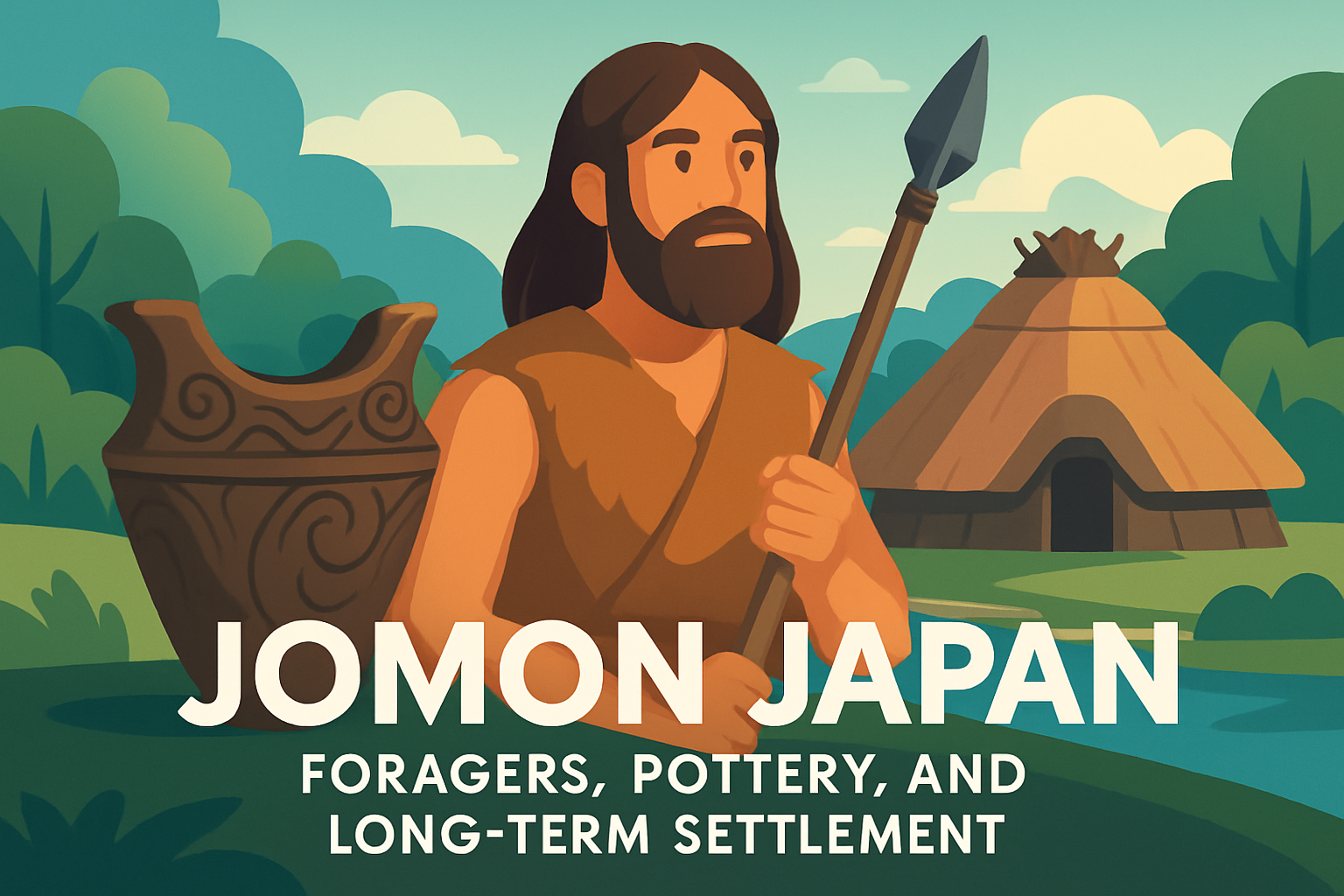
Introduction to Jomon Japan
Jomon Japan, a significant prehistoric era, extends from approximately 14,000 BCE to 300 BCE. This period, aptly named “Jomon,” translates to “cord-marked,” reflecting the unique pottery style quintessential to the culture. Jomon culture is marked by its innovative pottery, its deep connection to the natural environment, and its advancement towards sedentism through long-term settlements. Understanding this era is crucial, as it reveals the adaptation and survival strategies of hunter-gatherer communities and their early steps towards a settled lifestyle.
Key terms to define include “foragers,” “pottery,” and “long-term settlement.” Foragers are people who primarily survive by hunting, fishing, and gathering wild edibles. Pottery refers to the clay and ceramic artifacts used by Jomon people for storage, cooking, and ceremonial purposes. Long-term settlement indicates the gradual transition from nomadic living to a more stationary lifestyle, despite being classified as foragers. This phenomenon within Jomon Japan is remarkable because it shows a significant cultural shift without an immediate transition to agriculture.
Jomon Japan matters as it provides insights into human innovation, sociocultural evolution, and the unique adaptations of prehistoric societies. By examining Jomon culture, we can better understand the complex relationships between humans and their environments and how these interactions shaped early technological advances.
Early Foragers and Pottery Innovation
The Jomon period begins with early foragers utilizing sophisticated techniques to interact with their environment. The inhabitants of the time were adept hunters and gatherers who relied on the abundant natural resources provided by Japan’s rich flora and fauna. Nevertheless, what sets the Jomon people apart were their innovations in pottery, a groundbreaking technological advancement for the era.
The creation of pottery allowed Jomon foragers to store food, cook meals efficiently, and develop new methods to preserve resources. This innovation is evidenced by the discovery of the oldest pottery pieces, some dating back to around 10,000 BCE. These artifacts display intricate designs made by pressing cords into wet clay, a method that gives the Jomon culture its name.
Through this sophisticated craft, early foragers markedly increased their capability to store and manage food resources. The use of pottery also signals a significant cognitive leap, as it required planning, execution, and understanding of material properties. The pottery technology served as a foundation for more elaborate social practices and advanced the society’s continuity.
Long-Term Settlements: A Gradual Shift
Although predominantly foragers, Jomon groups began establishing longer-term settlements by taking advantage of their local ecosystems. These semi-permanent dwellings emerged as they exploited steady food sources, such as marine life in coastal areas or nut and acorn harvests in forested regions.
In the settlement of Sannai-Maruyama in modern Aomori Prefecture, archaeologists have unearthed evidence of one of the oldest known long-term settlements from the Jomon period. Around 3,900 to 2,200 BCE, this settlement housed hundreds of inhabitants living in pit dwellings, arranged in distinct clusters suggesting organized community structures.
This settlement reflects the Jomon society’s shift from purely nomadic lifestyles to more settled forms, facilitated by exploiting reliable resources. The community was able to thrive without fully transitioning to agriculture, thus providing a valuable case study in the diversity of human adaptations to the natural environment.
Societal Structures and Social Practices
Jomon society was not a monolithic entity but a collection of diverse groups spread across the Japanese archipelago. These groups developed intricate societal structures and rituals, with the complexity of their social systems often evidenced in their burial practices, ceremonial artifacts, and the varied regional designs of pottery.
Emerging from these diverse practices was a culture rich with symbolism and ritual. The prevalence of clay figurines, known as dogu, found at various sites, suggests a concept of religious or spiritual life within these communities. Despite the primitive living conditions, these artifacts signify a deep social complexity and an understanding of metaphysical concepts.
Societal structures resonated through coordinated efforts in the community such as food sharing and communal hunting, where groups would organize labor and resources for the betterment of all. Such cooperation would have strengthened social bonds and facilitated the maintenance of long-term settlements.
Jomon Culture Impact on Modern Understanding
The enduring legacy of Jomon culture provides modern scholars with valuable lessons about prehistoric human adaptation and resilience. The long-term settlements and innovations seen in the Jomon period run counter to earlier assumptions that agriculture was universally fundamental to societal development.
In contemporary times, Jomon culture is recognized as a unique and exemplary model of a foraging society that achieved sedentism and social complexity. This example illustrates the flexibility and ingenuity humans employed to thrive in diverse environments.
The Jomon period reminds us that human history is not a linear progression toward agriculture and urbanization; rather, it is a tapestry of adaptive strategies that account for diverse environmental and social circumstances. Appreciating this complexity enriches our understanding of human resilience and adaptability.
Visual Representation of Jomon Period Significance
| Aspect | Description |
|---|---|
| Pottery | Innovative cord-marked designs for storage and cooking. |
| Settlement | Semi-permanent pit dwellings indicating early sedentism. |
| Social Structure | Complex social bonds highlighted by communal activities. |
| Cultural Impact | Expands understanding of non-agricultural societal development. |
Conclusion and Reflection
In summary, Jomon Japan exemplifies a distinctive period where prehistoric foragers exhibited remarkable adaptability and innovation. This era’s hallmarks lie in its intricate pottery, long-term settlements, complex social structures, and cultural practices. These elements collectively challenge preconceived notions about human progress and developmental trajectories.
The key takeaway from the Jomon period is the affirmation that human societies can navigate diverse environmental conditions by leveraging ingenuity and cooperation. For modern readers, this illustrates the significance of maintaining and respecting the balance with nature and one another.
The study of Jomon Japan challenges us to consider alternative paths of development that offer sustainable coexistence between humans and their surroundings. Our call to action should be an investment in researching our prehistoric roots for valuable lessons applicable to enriching cultural diversity and environmental harmony today.
Frequently Asked Questions
1. What are the key features of the Jomon period in Japan?
The Jomon period is one of the most fascinating eras in Japanese prehistory, stretching from around 14,000 BCE to 300 BCE. It was a time of significant cultural development, particularly noted for its pottery. This era is aptly named “Jomon,” which means “cord-marked” in Japanese. The name comes from the distinct pottery style created by making impressions with cords on clay. This pottery is not just art; it reflects the technological and cultural evolution of the Jomon people.
Aside from pottery, the Jomon period is remarkable for its gradual shift towards sedentism, or permanent settlement, which was quite innovative for that time, considering the majority of the world’s populations were still nomadic foragers. Jomon people developed small villages and semi-permanent settlements, relying on a rich environment that provided ample wildlife and vegetation. This connection to nature allowed them to thrive without resorting to agriculture immediately, relying instead on hunting, gathering, and fishing.
The Jomon people also showed a deep spiritual and cultural connection to their environment. Archaeologists have discovered numerous figurines, stone circles, and other artifacts that suggest a complex belief system and community dynamics. This period not only gives us a glimpse into the life of early settlers in Japan but also highlights human adaptation, innovation, and cultural richness in prehistoric times.
2. How did Jomon pottery influence their society and technological development?
Jomon pottery is one of the earliest known in the world and is highly significant for several reasons. Firstly, the intricate designs and shapes of the pottery demonstrate an advanced level of artistry and craftsmanship achieved by the Jomon people. The cord-marked patterns that these pots featured are significant for more than mere aesthetics; they indicate a high degree of sophistication and a deep cultural connection to the environment.
This pottery was not just decorative; it had a profound impact on the technology and daily life of the Jomon society. The pots were used for cooking, storage, and sometimes even burial, which suggests that the Jomon people had developed a somewhat complex society where such utilities were necessary. This technological development meant that they could store food, which allowed them to have more consistent food supplies and potentially led to population growth and more sizable communities.
Additionally, the skills needed to create such pottery reflect the Jomon society’s overall technological advancement. Crafting pottery required knowledge of selecting clay, building kilns, and controlling fire, all crucial skills that contributed to other developments in their civilization. The artistic expressions seen in pottery also allowed the Jomon people to communicate cultural identity and social status within and outside their communities.
3. How did the Jomon people sustain themselves without agriculture?
While many early societies turned to agriculture to sustain growing populations, the Jomon people took a different path. They relied heavily on their surrounding environment, which was rich and diverse, providing ample food resources without needing to cultivate land intensively. The Jomon period saw people engaging in a complex foraging economy that included hunting, gathering, and fishing as its core components.
The Jomon landscapes included lush forests and coastlines, offering a bounty of resources such as nuts, seeds, tubers, fish, and game animals. Their diet was varied and abundant, which reduced the need for agriculture as an immediate option. Additionally, the efficiency and knowledge likely developed over generations allowed them to effectively harness these natural resources for their survival.
Tools and techniques for hunting and gathering were highly developed. The Jomon people used stone tools for hunting and processing food, while fishing technologies included hooks made from bone and plant fibers for nets. Through their intimate knowledge and relationship with the land, they managed sustainable resource use that supported their communities’ needs and even allowed for some level of population growth and settlement stability.
4. What evidence is there of long-term settlements in Jomon Japan?
The evidence of long-term settlements during the Jomon period is substantial and provides insights into the lives of these early residents of Japan. Archaeological sites scattered across Japan have unearthed remains of large pit dwellings, which were semi-permanent homes dug into the ground and topped with thatched roofs. These structures suggest that Jomon communities had begun to settle in fixed locations, a major shift from a purely nomadic lifestyle.
These dwellings often formed clusters, creating small village-like communities where people lived for extended periods. Alongside these housing structures, archaeologists have also found storage pits and other communal facilities that would have supported more settled lifestyles. Artifacts such as tools, pottery, and figurines often found at these sites imply a rich cultural and social life that revolved around these long-term settlements.
The construction of such settlements required intricate planning and resource management, indicating that Jomon people had developed societal structures to organize and sustain these communities. The remains of various ritual sites, like stone circles, also point toward a communal approach to life, deeply interwoven with spiritual and cultural practices that necessitated and facilitated longer-term habitation of certain areas.
5. How did Jomon society transition to the subsequent Yayoi period?
The transition from the Jomon to the Yayoi period (which began around 300 BCE) marked a fundamental shift in Japanese prehistory, characterized by the introduction of agriculture, notably rice farming, and improved metallurgy. This transition was facilitated by a combination of internal developments and likely immigration or cultural influence from the Korean Peninsula.
During the late Jomon period, communities began experiencing changes in their social and economic structures, partially driven by interactions with mainland Asia. The introduction of technological innovations such as bronze and iron tools and new agricultural practices allowed for more intensive resource management and led to the development of a settled agricultural society.
There was also a demographic shift during this time. The optimization and shift to rice agriculture likely supported larger populations and differences in social organization. The Yayoi period saw an increase in social hierarchies, as communities became more complex and organized around agricultural production centers. This population growth and transformation in production methods and social structures marked the end of the Jomon way of life, as Yayoi culture gradually became predominant.
Throughout this transition, many of the Jomon cultural elements were carried forward, blending with Yayoi innovations to create the unique tapestry of ancient Japanese culture. This transformation signifies the resilience and adaptability of human societies over millennia, responding to both internal and external factors.