
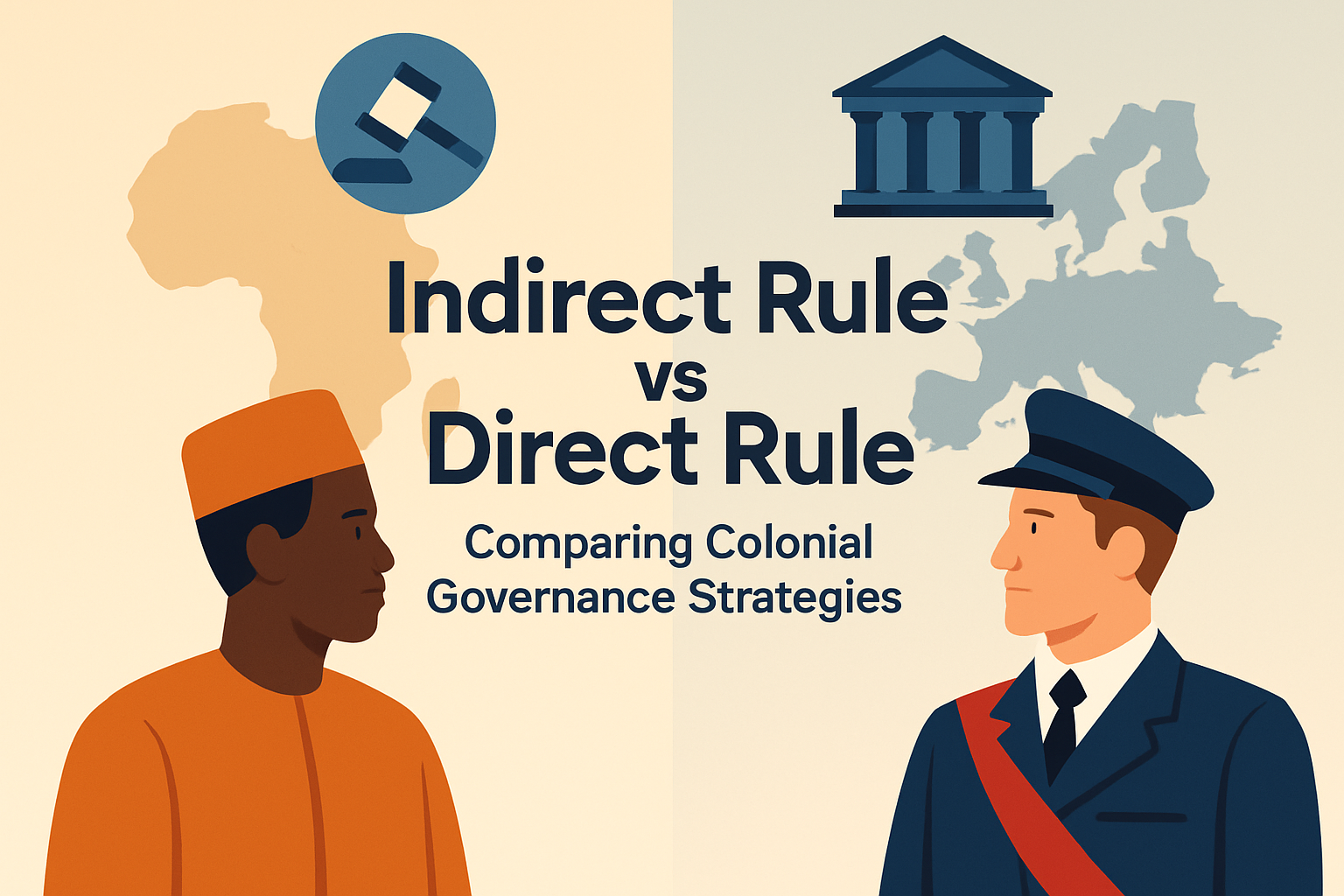
Indirect rule and direct rule were the two defining colonial governance strategies used by European empires to control vast territories, and the difference between them shaped politics, law, identity, and state capacity across Africa, Asia, and beyond. In colonial history, direct rule refers to a system in which imperial officials governed a colony through centralized institutions staffed or tightly supervised by the colonizing power. Indirect rule, by contrast, relied on existing local rulers, chiefs, emirs, sultans, or councils to administer colonial directives under imperial oversight. I have found that students and readers often reduce the distinction to “foreign officials versus local chiefs,” but that shorthand misses the deeper administrative logic. These systems differed in taxation, legal authority, language policy, education, policing, labor control, and the production of political legitimacy. Understanding indirect rule versus direct rule matters because these models did not end with formal decolonization. They left behind durable institutions, uneven state structures, and local expectations about authority that still affect elections, land disputes, ethnic politics, and public administration in many former colonies today.
European empires chose one system or blended both based on cost, military strength, local social organization, and ideological goals. The British often favored indirect rule in parts of Africa, especially where hierarchical political systems already existed, while the French were more associated with direct rule and assimilationist centralization, though practice varied widely. Belgium, Portugal, and Germany also used combinations, often harsher than textbook categories suggest. The key point is that colonial governance was never only about abstract theory; it was a practical method for extracting revenue, maintaining order, and reshaping societies. When people ask which strategy was more effective, the better question is effective for whom. For empires, both could secure compliance. For colonized populations, both could distort institutions, narrow political representation, and reorient economies toward imperial priorities.
What direct rule meant in practice
Direct rule was a centralized colonial system in which authority flowed downward from imperial capitals and their appointed governors to district officers, police, courts, and tax collectors. In practice, this meant colonies were divided into administrative units run by officials answerable to the colonial state rather than to indigenous political communities. French West Africa provides a clear example. Paris claimed sovereignty, governors-general coordinated policy, and local commandants implemented orders with limited regard for precolonial autonomy. The goal was not simply to supervise local elites but to subordinate them. Administrative law, codified procedures, census taking, standardized taxation, and official schooling were core tools. Colonial subjects could be categorized, taxed, conscripted, and judged through institutions explicitly designed by the imperial state.
One major feature of direct rule was the attempt to weaken or bypass traditional rulers. Chiefs might remain, but they functioned as state agents rather than independent authorities. Courts were increasingly reorganized, and legal pluralism was tolerated only when convenient. In French colonies, the ideology of assimilation suggested that colonized people could, in theory, become culturally French through language, education, and legal incorporation, although in reality very few received equal citizenship rights. This gap between rhetoric and practice is essential. Direct rule promised uniform administration, yet colonial governments usually preserved racial hierarchies and coercive labor systems. The supposedly rational bureaucracy was also thinly staffed, meaning violence and arbitrary discretion often filled the gap between official policy and local enforcement.
How indirect rule operated on the ground
Indirect rule used existing local authorities to govern on behalf of empire, reducing administrative cost while increasing local reach. The British system in Northern Nigeria under Frederick Lugard is the textbook case. Rather than dismantling emirate structures, British officials ruled through emirs, native courts, and customary authorities, provided these institutions recognized colonial supremacy, collected taxes, and maintained order. This arrangement allowed a small number of European officers to govern large populations. It also gave colonial regimes a language of legitimacy: officials claimed they were preserving indigenous institutions instead of imposing alien systems. In reality, indirect rule often transformed those institutions profoundly.
From experience studying district reports and native authority ordinances, the crucial point is that indirect rule did not mean noninterference. Colonial states selected which rulers counted as authentic, fixed fluid customs into rigid legal codes, and elevated some groups over others. In acephalous societies without centralized chieftaincy, colonial administrators sometimes invented chiefs to fit the model. In parts of southeastern Nigeria, warrant chiefs became notorious because they lacked recognized legitimacy yet wielded colonial-backed power. Indirect rule therefore depended on simplification. Complex local politics had to be translated into governable chains of command. The result was frequently a hybrid institution: not truly traditional, not fully modern, but powerful enough to collect taxes, recruit labor, and enforce colonial decisions.
Key differences between indirect rule and direct rule
The clearest comparison between indirect rule and direct rule is administrative distance. Direct rule concentrated authority in imperial institutions, while indirect rule delegated day-to-day governance to local intermediaries under colonial supervision. That difference affected nearly every policy area. Under direct rule, officials were more likely to standardize law, language, education, and taxation across territories. Under indirect rule, policy implementation depended on local rulers and customary institutions, creating greater regional variation. Direct rule sought visible state penetration. Indirect rule sought control without constant presence.
| Dimension | Direct Rule | Indirect Rule |
|---|---|---|
| Administrative structure | Colonial officials govern directly through centralized bureaucracy | Local rulers govern under supervision of colonial officials |
| Cost to empire | Higher staffing and administrative cost | Lower cost due to reliance on intermediaries |
| Role of traditional authorities | Reduced, absorbed, or bypassed | Retained, reshaped, or invented for governance |
| Legal system | More standardized colonial law | Greater use of customary courts and legal pluralism |
| Political effect | Can build stronger centralized institutions | Can entrench local hierarchies and fragmented authority |
Another major difference was ideology. Direct rule often came with a civilizing or assimilationist claim that justified intervention in education, language, and social norms. Indirect rule framed itself as respectful of local culture, but that claim obscured its manipulative nature. Both systems relied on coercion, including taxation, forced labor in many colonies, pass systems, policing, and punitive expeditions. The distinction was not between harsh and humane colonialism. It was between different methods of domination. Direct rule tended to create clearer chains of command, but it could provoke resistance by visibly displacing local authority. Indirect rule could appear less intrusive at first, yet it often entrenched authoritarian local structures and made colonial power harder to contest because it operated through familiar faces.
Why empires chose one strategy over another
Colonial powers selected governance strategies based on practical constraints rather than pure doctrine. Where precolonial states were centralized, indirect rule was easier to implement because empires could work through recognizable hierarchies. Northern Nigeria, Buganda, and several princely states in British India fit this pattern. Where political authority was dispersed, direct rule could appear more feasible, although colonial governments also tried to manufacture local intermediaries. Geography mattered too. Remote territories with limited infrastructure encouraged cheaper indirect administration. Fiscal capacity mattered just as much. Empires wanted revenue-producing colonies, not expensive bureaucratic burdens, so indirect rule appealed when manpower was scarce.
Imperial political culture also influenced choice. British administrators often emphasized pragmatic adaptation and devolved governance, while French republican traditions favored centralization, codification, and the language of uniform sovereignty. Yet these broad tendencies should not be treated as rigid rules. The British used direct methods when strategic interests demanded it, and the French employed chiefs and customary mechanisms when convenient. In other words, indirect rule versus direct rule was not a clean empire-by-empire divide. It was a spectrum shaped by labor needs, missionary influence, settler pressure, military resistance, and the perceived trustworthiness of local elites. When extraction was the priority, colonial authorities usually chose whichever arrangement produced taxes and order most efficiently.
Effects on law, identity, and local society
The long-term social effects of direct and indirect rule were profound because governance systems classify people as much as they administer them. Direct rule often promoted common legal categories, official languages, and centralized schooling, which could strengthen territorial identity but also deepen alienation from local institutions. In former French colonies, centralized bureaucratic habits, civil law traditions, and strong capitals often remained politically influential after independence. Indirect rule, meanwhile, frequently preserved or hardened distinctions among ethnic groups, lineages, and customary jurisdictions. By assigning power to recognized chiefs, colonial states rewarded some identities and marginalized others. Communities that had previously negotiated authority flexibly were frozen into administrative categories.
Land governance shows the difference clearly. Under indirect rule, colonial governments often treated chiefs as custodians of communal land, giving them enhanced authority over allocation and disputes. That could support continuity, but it also enabled abuse and elite capture. Under direct rule, land registration and statutory law could increase state control and market integration, yet these reforms often ignored customary tenure, creating legal conflict that persists today. Education followed a similar pattern. Direct rule more often pushed uniform curricula and official language instruction. Indirect rule frequently left schooling uneven, especially where missionary provision filled gaps. The result in many former colonies was a split between urban bureaucratic elites and rural customary authorities, a divide with lasting political consequences.
Resistance, adaptation, and colonial limits
Neither direct rule nor indirect rule produced stable control without resistance. Colonized societies adapted, negotiated, evaded, and revolted against both systems. Direct rule drew opposition because it made foreign domination unmistakable. Taxes, labor requisitions, conscription, and interference in religion or custom could trigger organized rebellions. Indirect rule generated different tensions. Subjects often challenged chiefs viewed as colonial collaborators, especially where these rulers exercised powers they had never possessed before conquest. The 1929 Women’s War in southeastern Nigeria is a classic example: protests targeted both colonial administration and the warrant chief system that had disrupted local political balances.
Colonial archives repeatedly show that both strategies suffered from information problems. Administrators misunderstood local politics, exaggerated the authority of allies, and mistook compliance for consent. Indirect rule was especially vulnerable to this because empires depended on intermediaries who filtered information. Chiefs could manipulate colonial officers, settle personal scores, or misreport revenue and labor capacity. Direct rule faced its own limits because bureaucracies were usually too thin to govern deeply without coercion. In both systems, the colonial state often appeared powerful at the center and weak at the margins. This is one reason postcolonial governments inherited institutions that looked formal on paper but operated unevenly in practice.
Colonial legacies in modern states
The debate over indirect rule vs direct rule remains important because colonial governance left measurable political legacies. Scholars such as Mahmood Mamdani have argued that indirect rule institutionalized decentralized despotism by empowering customary authorities who were accountable upward to the state rather than downward to citizens. Other researchers link indirect rule to weaker public goods provision, lower trust in local government, or persistent chieftaincy power in parts of Africa. Direct rule, meanwhile, is often associated with stronger central bureaucracies, but not necessarily more democratic ones. A centralized postcolonial state can deliver services more uniformly, yet it can also reproduce the authoritarian habits of colonial command.
In practical terms, many contemporary governance problems reflect these inherited structures. Local court dualism, disputes over customary law, center-periphery tensions, uneven taxation, and politicized ethnicity all connect to how colonial power was organized. For readers exploring related topics, this debate also intersects with broader issues such as state capacity and development and colonial legacy in Africa. The most accurate conclusion is not that one model was good and the other bad. Both were exploitative systems designed for imperial control. However, they produced different institutional pathways. Direct rule often centralized authority; indirect rule often localized coercion through selected intermediaries. Those divergent paths continue to shape how states govern and how citizens understand power.
Indirect rule and direct rule were distinct colonial governance strategies, but both served the same imperial purpose: control, extraction, and political subordination. Direct rule relied on centralized colonial bureaucracy, standardized law, and tighter institutional supervision. Indirect rule relied on local intermediaries, customary authority, and cheaper administration under imperial oversight. The difference mattered because each system reshaped law, identity, land, education, and political legitimacy in different ways. Direct rule could produce stronger central institutions, while indirect rule often entrenched local hierarchies and fragmented authority. Neither was benign, and neither can be understood apart from coercion and economic exploitation.
If you want to understand why many former colonies still struggle with divided legal systems, contested local authority, or uneven state presence, comparing indirect rule vs direct rule is one of the best starting points. These are not just historical labels for exam answers. They are institutional blueprints whose consequences still appear in governance today. Use this comparison as a framework for analyzing colonial history, postcolonial state formation, and current political conflict. The closer you look at how rule was organized, the clearer today’s institutions become.
Frequently Asked Questions
What is the main difference between indirect rule and direct rule in colonial governance?
The core difference lies in how colonial power was exercised. Under direct rule, the colonizing state governed a territory through its own officials, laws, administrative structures, and centralized institutions. Colonial governors, district commissioners, military officers, and bureaucrats were expected to impose policy from the top down, often with the goal of reshaping local society to fit imperial priorities. In this model, indigenous political authorities were frequently weakened, bypassed, or absorbed into the colonial state.
Under indirect rule, colonial powers governed through existing local rulers, chiefs, emirs, kings, or other recognized authorities. Instead of replacing local institutions completely, the empire used them as intermediaries to collect taxes, maintain order, administer customary law, and enforce colonial policy. This approach was often presented as more practical and less expensive, especially in territories where European powers lacked the manpower or resources to govern every locality directly.
In practice, the distinction was not always absolute. Many empires mixed both systems depending on local conditions, resistance, economic importance, and the strength of preexisting political structures. Still, the contrast is historically important because direct rule generally aimed at greater administrative centralization, while indirect rule depended on collaboration with local authorities and the selective preservation of local institutions.
Why did European empires choose indirect rule in some colonies and direct rule in others?
European empires usually made this choice for strategic, financial, and political reasons rather than from any fixed principle. Indirect rule was often attractive because it was cheaper. Colonial powers could govern large populations without building a massive administrative apparatus from scratch. If local rulers already commanded legitimacy or authority, imperial governments could use them to maintain order, collect revenue, and reduce the need for a large European official presence.
Indirect rule was especially useful where strong precolonial institutions already existed. In parts of Africa and Asia, emirs, sultans, chiefs, and kings had established systems of governance that colonial authorities could adapt to imperial purposes. By contrast, where colonial officials viewed local political systems as fragmented, resistant, or unsuitable for imperial goals, they were more likely to impose direct rule.
Direct rule was also more common when empires wanted tighter control over law, education, labor, land, and commerce. Colonizing powers that promoted cultural assimilation or administrative uniformity often favored direct oversight. In some cases, direct rule emerged after military conquest, rebellion, or a crisis of confidence in local rulers. In others, indirect rule was adopted simply because distance, terrain, and cost made direct administration impractical. Ultimately, the choice reflected a balancing act between control and convenience: empires wanted obedience and extraction, but they also wanted to minimize the cost of running overseas territories.
How did indirect rule and direct rule affect local societies and political institutions?
Both systems profoundly transformed colonized societies, but they did so in different ways. Direct rule tended to alter political institutions more visibly and rapidly. Colonial authorities often introduced new administrative divisions, codified laws, tax systems, courts, and police forces. This could weaken older political networks and make the state appear more centralized, but it also frequently disrupted local governance traditions and imposed foreign concepts of authority. In many colonies, direct rule contributed to the rise of a more bureaucratic political order that later influenced postcolonial state structures.
Indirect rule often seemed less disruptive on the surface because it operated through local leaders, but its effects could be equally far-reaching. Colonial governments frequently redefined who counted as a legitimate chief or ruler, sometimes elevating individuals who had not previously held such authority or hardening flexible local structures into rigid hierarchies. In this sense, indirect rule did not simply preserve tradition; it often invented, reshaped, or politicized tradition to make governance easier for the colonial state.
Social consequences were also significant. Direct rule could encourage a stronger colonial bureaucracy, wider use of the colonizer’s language, and greater institutional penetration into daily life. Indirect rule could intensify ethnic, regional, or customary distinctions by governing different groups through separate authorities and legal systems. In both cases, colonial rule affected identity, land rights, class formation, access to education, and the distribution of power. The long-term result was that colonial governance did not just administer conquered societies; it reorganized them in ways that continued to matter long after formal empire ended.
Which colonial powers are most associated with indirect rule and direct rule?
In broad historical discussions, Britain is most closely associated with indirect rule, while France is often linked with direct rule, though this shorthand should be used carefully. British colonial administration, especially in parts of Africa such as Nigeria and Uganda, became famous for ruling through local chiefs and traditional authorities. The British argued that this method was efficient and better suited to governing large territories with limited personnel. Thinkers such as Frederick Lugard helped formalize the idea of indirect rule as a deliberate imperial strategy.
France, on the other hand, is often associated with direct rule because of its emphasis on centralized administration and, at least ideologically, the assimilation of colonial subjects into French political and cultural frameworks. French officials more often sought to govern through territorial units under close imperial supervision, with authority flowing through colonial administrators rather than primarily through indigenous rulers.
That said, reality was more complicated than textbook labels suggest. The British sometimes ruled directly when local authorities were weak, uncooperative, or considered inconvenient. The French, despite their reputation for direct rule, also relied on local intermediaries in many areas. Other empires, including the Portuguese, Belgians, Dutch, and Germans, likewise used varying mixtures of both systems. So while certain powers are associated with one model more than the other, colonial governance in practice was flexible, improvised, and often contradictory.
What were the long-term consequences of indirect rule versus direct rule after independence?
The long-term consequences were major, and historians continue to debate their full impact. Direct rule often left behind stronger central bureaucratic institutions, more uniform legal systems, and a state that could reach deeper into society. However, these institutions were usually designed for control rather than democratic participation, so postcolonial governments inherited structures that could be authoritarian, extractive, or disconnected from local communities.
Indirect rule often left a different legacy. Because colonial governance relied on local chiefs or customary authorities, it could preserve or intensify decentralized power structures. In some cases, this gave communities familiar local institutions that continued to matter after independence. In other cases, it entrenched unelected intermediaries, sharpened ethnic divisions, and created tensions between customary authority and modern state institutions. Where colonial regimes selectively empowered certain groups over others, indirect rule could contribute to future political imbalance, regional inequality, or conflict.
One of the most important legacies is that these systems shaped how people understood the state itself. In areas shaped by direct rule, the state was often seen as centralized and bureaucratic, even if alien and coercive. In areas shaped by indirect rule, the state could appear more fragmented, layered, or dependent on local power brokers. These differences influenced nation-building, constitutional design, local administration, and struggles over legitimacy in the postcolonial era. In short, indirect rule and direct rule were not just temporary colonial techniques; they helped define the political foundations many newly independent states had to work with or struggle against.