
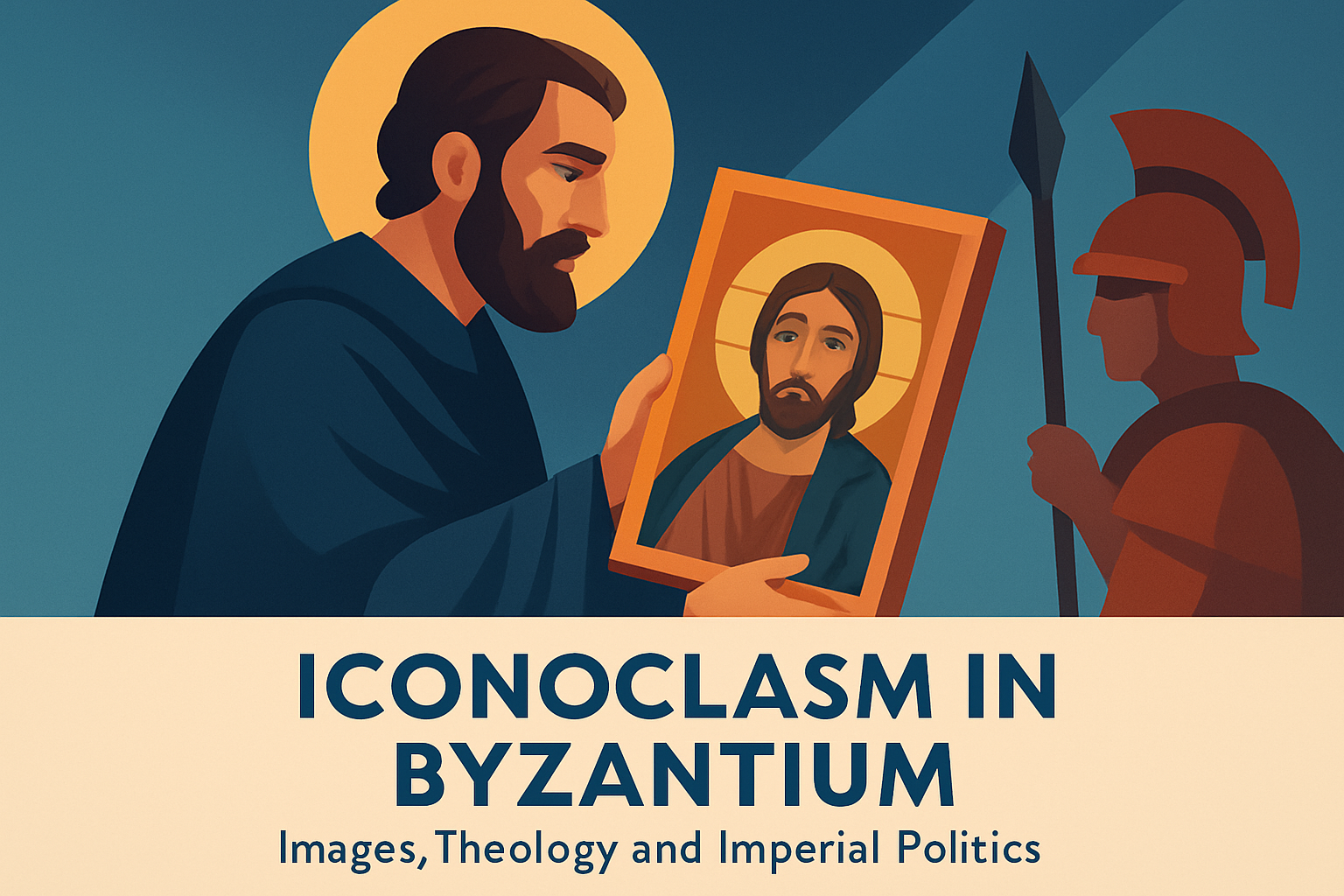
Iconoclasm in Byzantium was not a narrow dispute about church decoration. It was a prolonged crisis over the meaning of Christian images, the authority of emperors, and the boundaries between doctrine and political power. In Byzantine history, iconoclasm refers to official opposition to sacred images, especially icons of Christ, the Virgin, and the saints, during the eighth and ninth centuries. The controversy unfolded in two major phases, usually dated 726 to 787 and 815 to 843. It mattered because icons stood at the center of Byzantine worship, public identity, monastic life, and imperial legitimacy. When emperors attacked icons, they were not merely changing artistic taste. They were intervening in theology, liturgy, and social order.
An icon in Byzantium was more than a devotional picture. It was a painted panel, mosaic, or fresco that made a holy person present in a particular, disciplined sense. Icon supporters distinguished between worship due to God alone and veneration offered to images as representations. That distinction became the core of the debate. Critics argued that any bowing, kissing, censing, or lighting lamps before an image blurred the line between Christian devotion and idolatry. Defenders answered that honor shown to an image passed to its prototype, meaning the person depicted, not to wood and pigment. In practical terms, ordinary believers had long treated icons as objects of prayer, healing, procession, and protection. That lived practice gave the controversy its urgency.
Having worked through Byzantine theological texts and imperial decrees, I find that modern summaries often make the issue seem simpler than it was. Iconoclasm was not just religion versus art, nor was it reducible to a power grab by the state. It drew energy from military setbacks, scriptural interpretation, regional tensions, monastic influence, and Christological doctrine inherited from earlier councils. The central theological question was precise: if Christ truly became human in the Incarnation, could his human form be depicted without dividing or confusing his divine and human natures? For iconophiles, denying the image of Christ endangered the reality of the Incarnation itself. For iconoclasts, depicting Christ risked theological error by enclosing the uncircumscribable God in matter.
The topic still matters because it shows how visual culture can become a battleground for political authority and religious truth. Byzantium offers a classic case of images shaping public life, from palace ceremonies to parish devotion. The controversy also produced some of the most influential statements in Christian aesthetics, especially in the writings of John of Damascus, Theodore the Studite, and the bishops of the Second Council of Nicaea in 787. For readers asking what iconoclasm in Byzantium was, why it happened, and how it ended, the answer lies in the intersection of theology and imperial politics. The empire’s struggle over images was, at every stage, a struggle over who could define orthodoxy and how divine presence should be represented in Christian society.
How Byzantine Iconoclasm Began
The first phase of Byzantine iconoclasm is associated above all with Emperor Leo III, who ruled from 717 to 741. The traditional starting point is 726, when imperial policy began moving against public images. The precise early sequence is debated, and the surviving sources are often hostile to iconoclast emperors, so historians must read them carefully. Still, the broad pattern is clear. Leo III acted in a context of severe pressure: Arab expansion, military conflict, natural disasters interpreted as divine warning, and ongoing concern about religious error. In that atmosphere, reforming worship could appear not only pious but politically necessary.
One common question is whether Byzantine iconoclasm was influenced by Islam or Judaism, both of which maintained stronger aniconic traditions. Influence is plausible, especially because the empire’s eastern provinces were in close contact with Muslim rule and polemic. But iconoclasm was not simply borrowed from outside. It emerged from internal Christian arguments about the Second Commandment, the danger of idolatry, and the proper relation between matter and holiness. Byzantine emperors also had their own tradition of intervening in church affairs. Leo III and his successors did not need foreign models to believe they had responsibility for the religious health of the empire.
Constantine V, Leo’s son, turned policy into doctrine. His reign from 741 to 775 marks the most systematic iconoclast program. In 754 he convened the Council of Hieria, which rejected icons and claimed ecumenical authority, though it lacked the participation of Rome and the eastern patriarchates beyond imperial reach. The council condemned the making and veneration of images, especially of Christ. Its argument was sharply Christological. If an image depicts only Christ’s humanity, it separates that humanity from divinity and falls into Nestorian division. If it tries to depict the united person, it attempts the impossible by representing divinity. Therefore, the only valid image of Christ, according to iconoclast reasoning, was the Eucharist, instituted by Christ himself.
Iconoclasm also had a social edge. In practice, policy often targeted monks, who were among the strongest defenders of icons and whose houses held wealth, land, and local influence. Not every period of iconoclast rule was equally violent, but persecution did occur, especially under Constantine V. Monastic communities became centers of resistance because icons were woven into liturgical life and ascetic devotion. I have always found this point crucial: the controversy persisted not because theologians enjoyed abstraction, but because ordinary structures of Byzantine life were implicated. To remove icons from churches was to reorder sacred space, public ritual, and networks of patronage.
The Theology of Images and the Case for Icons
The most important defense of icons rested on the Incarnation. John of Damascus, writing from the monastery of Mar Saba outside imperial territory, argued that Christians do not depict the invisible God in his divine essence. They depict God made visible in Jesus Christ, who truly assumed human nature. His formulation remains foundational: when the invisible One became visible in flesh, depiction became theologically possible. In other words, the image of Christ witnesses to the reality that the Word took a body. For iconophiles, to ban Christ’s image was to imply that his humanity was unreal, inaccessible, or religiously irrelevant.
Icon defenders also clarified the difference between adoration and veneration. The Greek terms matter here: latreia, worship owed to God alone, was sharply distinguished from proskynesis, reverential honor. The distinction was not an evasion. It was a technical and liturgical claim about intention and object. Christians bowed before the cross, the Gospel book, and imperial insignia without treating wood, parchment, or cloth as gods. Likewise, honoring an icon meant honoring the prototype. Basil of Caesarea’s maxim, frequently cited by iconophiles, stated that the honor paid to the image passes to the prototype. This principle became a doctrinal cornerstone at Nicaea II.
The theology of matter was equally important. Iconophiles argued that Christianity is not a religion of pure inwardness. Water baptizes, bread and wine convey grace sacramentally, relics mediate sanctity, and churches set apart holy space. Matter is not discarded by salvation; it is transfigured. That is why iconophile writers repeatedly accused iconoclasts of sounding too spiritualizing, too suspicious of the material world. From my reading of the sources, this is where the emotional force of the debate becomes visible. For icon supporters, iconoclasm felt like an assault on the sacramental texture of Christian life, not merely on painted boards.
Theodore the Studite later sharpened these arguments. He insisted that the icon represents the person, not the nature, of Christ. Because depiction concerns hypostasis or personhood, not the invisible divine essence, Christ can be imaged without confusion. Theodore also extended icon theology into a broader defense of ecclesial order. If the emperor dictated doctrine against the received tradition of the church, he overstepped his role. This line of thought connected image theology directly to resistance against imperial overreach and became decisive in the second phase of the controversy.
Imperial Politics, Councils, and Control of Orthodoxy
Why did emperors care so much about icons? The direct answer is that Byzantine emperors understood themselves as guardians of Christian order. They did not see religion as a private sphere insulated from government. Victory in war, stability in cities, and divine favor were linked. If God seemed to judge the empire through defeat or disaster, reforming worship could appear an imperial duty. This logic helps explain why icon policy came from the palace as well as from bishops. It also explains why councils became contested instruments of power. Councils did not simply deliberate theology; they publicly ratified the religious direction of the state.
The following table shows the core sequence of the controversy and why each turning point mattered.
| Year | Event | Why it mattered |
|---|---|---|
| 726 | Leo III begins anti-image policy | Marks the imperial move against icons and starts the first phase |
| 754 | Council of Hieria | Gave iconoclasm formal doctrinal expression under Constantine V |
| 787 | Second Council of Nicaea | Restored icons and defined their veneration as orthodox |
| 815 | Leo V revives iconoclasm | Begins the second phase after renewed military and political anxiety |
| 843 | Triumph of Orthodoxy | Final restoration of icons under Empress Theodora |
The Council of Hieria in 754 illustrates how theology and politics reinforced one another. Convened by Constantine V, it condemned icons while presenting itself as the authentic voice of the church. Yet its authority was compromised by absence: Rome rejected it, and other patriarchates were not freely represented. That mattered in Byzantine terms because ecumenical legitimacy required reception across the wider church. Later, the Second Council of Nicaea in 787, supported by Empress Irene, reversed Hieria and restored icons. Nicaea II declared that icons of Christ, Mary, angels, and saints were to be displayed in churches and homes and honored with veneration, not adoration. Its decrees became the orthodox standard for Eastern Christianity and, in a more complex way, for the medieval West.
The second phase of iconoclasm began in 815 under Leo V. The pattern resembles the first phase in one important respect: military insecurity again framed the policy shift. Yet the second phase also shows how durable iconophile resistance had become. Figures such as Theodore the Studite and networks of monks, clergy, and lay patrons kept the defense of images intellectually coherent and socially rooted. Final restoration came in 843 under Empress Theodora and Patriarch Methodios. The event is remembered in Eastern Orthodoxy as the Triumph of Orthodoxy, celebrated on the first Sunday of Lent. That annual liturgical memory turned the defeat of iconoclasm into a permanent statement about right belief.
Art, Society, and the Lasting Legacy of the Controversy
Byzantine iconoclasm changed art, but its deeper legacy lies in how Byzantines defined sacred presence and institutional authority. During iconoclast periods, some figural art was destroyed, removed, or replaced, though the scale varied by region and building. Crosses and nonfigural decoration often took the place of human images in churches. After restoration, however, figural art returned with renewed theological confidence. Post-iconoclast Byzantine art was not simply a revival. It was a mature visual language shaped by controversy. Programs in domes, apses, and icon screens increasingly expressed doctrinal hierarchy, linking Christ Pantokrator, the Theotokos, saints, and liturgical space in a more self-conscious way.
The social consequences were equally significant. The victory of icon veneration strengthened monastic authority, confirmed the church’s role in testing imperial initiatives, and gave Byzantium a durable theology of images that still structures Orthodox practice. In parish life, icons became even more central to prayer, feast days, processions, and domestic devotion. The controversy also sharpened Byzantine distinctions between emperor and patriarch, even though those boundaries were never modern separations of church and state. Emperors remained powerful in ecclesiastical affairs, but iconoclasm demonstrated limits. An emperor could sponsor doctrine, yet lasting orthodoxy required reception by bishops, monks, clergy, and worshiping communities.
For modern readers, the clearest takeaway is that iconoclasm in Byzantium was about representation, authority, and the meaning of matter in religion. It asked who may define legitimate worship, whether divine truth can be mediated visually, and how states use religious reform to consolidate power. Those questions did not disappear with Byzantium. They reappear whenever governments regulate symbols, whenever communities argue about public images, and whenever religious traditions debate what can be shown. Byzantine sources remain valuable because they answer these issues with unusual precision. They insist that images are never merely images. They carry assumptions about embodiment, memory, and power.
The controversy ended formally in 843, but its intellectual and devotional consequences endured for centuries. Orthodox Christians today still inherit the settlement achieved by Nicaea II and confirmed in the Triumph of Orthodoxy. Scholars continue to debate motives, regional variation, and the exact severity of iconoclast enforcement, yet the main arc is settled. Icons survived because their defenders made a compelling claim: the Christian gospel is inseparable from the Word made flesh, and a faith centered on the Incarnation cannot treat material representation as spiritually trivial. If you want to understand Byzantium at its core, study iconoclasm closely. It reveals how theology, art, and imperial politics shaped one another at the highest stakes.
Frequently Asked Questions
What was Byzantine iconoclasm, and why was it such an important crisis?
Byzantine iconoclasm was the official rejection or suppression of sacred images, especially icons of Christ, the Virgin Mary, and the saints, during two major periods in the eighth and ninth centuries. It is usually divided into a first phase from 726 to 787 and a second phase from 815 to 843. At first glance, the conflict can seem like a dispute over religious art or church decoration, but in reality it was far broader and far more consequential. It raised fundamental questions about how Christians understood the incarnation of Christ, how the faithful should worship, who had the authority to define orthodoxy, and how emperors could intervene in the life of the Church.
The crisis mattered because icons in Byzantium were not viewed as mere decorations. They played a central role in devotion, public ritual, teaching, and the shared religious life of the empire. For many believers, icons made visible the reality of Christ’s becoming human and affirmed that matter itself could be sanctified. To attack icons, then, was not simply to remove images from churches. It was to challenge a whole way of thinking about the relationship between the divine and the material world.
Iconoclasm also became politically explosive because Byzantine emperors were deeply involved in religious affairs. When emperors promoted iconoclast policies, they were not only regulating worship but also asserting imperial authority over doctrine and ecclesiastical practice. That meant the issue touched bishops, monks, lay believers, and imperial officials alike. The controversy endured for more than a century because it sat at the crossroads of theology, devotion, and state power, making it one of the defining crises of Byzantine civilization.
Why did some Byzantine emperors and church leaders oppose icons?
Those who opposed icons did so for a mix of theological, political, and cultural reasons. Theologically, iconoclasts worried that the veneration of images could slide into idolatry. They drew on the biblical prohibition against graven images and argued that no painted or sculpted object could adequately represent the divine. In their view, attempts to depict Christ risked either confusing his human and divine natures or reducing him to a merely earthly form. Some iconoclast thinkers insisted that the only proper “image” of Christ was the Eucharist or the life of the Christian community, not a painted panel.
There were also concerns about popular religious practice. Critics of icons saw some forms of devotion as excessive or superstitious. Reports of people bowing before images, kissing them, lighting lamps before them, or attributing miraculous power to them may have convinced iconoclasts that the line between veneration and worship had become dangerously blurred. From that perspective, opposition to icons could be presented as a reform movement aimed at purifying Christian practice.
Political considerations were just as important. Byzantine emperors often sought unity in a period marked by military pressure, internal instability, and territorial losses. By intervening against icons, emperors could claim to be restoring divine favor, disciplining the Church, and strengthening imperial control. Some historians also note the wider religious environment of the eastern Mediterranean, where both Judaism and Islam rejected sacred images in worship. While Byzantine iconoclasm cannot be reduced to outside influence, these neighboring traditions formed part of the background against which imperial policy developed. In short, opposition to icons was driven by a genuine theological program, but it was amplified by imperial ambition and the pressures of a changing world.
How did defenders of icons justify their use in Christian worship?
Defenders of icons, often called iconodules or iconophiles, argued that Christian images were not idols and did not compete with God. Their central claim rested on the doctrine of the incarnation. Because the Son of God truly became human in Jesus Christ, they argued, he could be depicted in visible form. To deny that Christ could be represented in an image was, in their eyes, to weaken the reality of his humanity. The defense of icons was therefore not just about art; it was about protecting orthodox Christology.
One of the most influential arguments came from John of Damascus, who explained that honor shown to an icon passes to its prototype, meaning the person represented. In other words, Christians did not worship wood and paint. They venerated the image because it referred them to Christ, Mary, or the saints. This distinction between worship due to God alone and veneration offered to holy images became essential to the iconophile case. It allowed defenders to say that icons were legitimate aids to devotion without equating them with God himself.
Supporters of icons also emphasized their pastoral and liturgical value. Icons taught the faith visually, reinforced the memory of biblical events and holy persons, and helped shape the devotional life of the faithful. In Byzantine spirituality, sight, gesture, incense, chant, and sacred space worked together. Icons were part of that total religious world. Their defenders believed that removing them would impoverish worship and undermine the Church’s witness to the sanctification of material creation. This position was formally affirmed at the Second Council of Nicaea in 787, which restored the veneration of icons and gave lasting doctrinal expression to the iconophile view.
What role did emperors, monks, and church councils play in the iconoclast controversy?
The iconoclast controversy cannot be understood without recognizing the competing roles of emperors, monks, bishops, and councils. Byzantine emperors were central because they possessed immense influence over public religion. Emperors such as Leo III and Constantine V promoted iconoclast policies, convened assemblies, and used state authority to reshape religious practice. Their involvement shows how closely linked the empire and the Church were in Byzantium. Imperial policy could set the terms of the debate, but it could not settle the issue permanently without broader acceptance.
Monks often emerged as some of the strongest defenders of icons. Monastic communities were deeply attached to the devotional use of sacred images and often resisted imperial interference in matters of doctrine and worship. Because monasteries were centers of spiritual authority, learning, and popular piety, their opposition gave iconophile resistance a powerful social base. Many monks suffered exile, punishment, or persecution for refusing to accept iconoclast decrees, and their witness helped shape later Orthodox memory of the conflict.
Church councils played a decisive role in defining orthodoxy, though not every gathering was later accepted as legitimate. The iconoclast Council of Hieria in 754 condemned icons, but it was later rejected by the Church. The Second Council of Nicaea in 787, by contrast, restored the veneration of icons and became recognized as the seventh ecumenical council in Eastern Orthodox and Roman Catholic tradition. Yet the dispute returned in the ninth century, proving that conciliar decisions still depended on political support and ecclesiastical enforcement. The final restoration of icons in 843, traditionally celebrated as the “Triumph of Orthodoxy,” marked not only a theological victory but also the end of a long struggle over whether emperors could determine the limits of Christian doctrine on their own.
How did iconoclasm shape Byzantine religion, politics, and later Christian tradition?
Iconoclasm left a lasting mark on Byzantium because it clarified the place of images in Christian theology while also exposing the tensions built into the Byzantine model of imperial rule. Religiously, the controversy forced theologians to articulate with much greater precision why icons mattered, how they related to the incarnation, and what distinguished proper veneration from idolatry. That doctrinal work had enduring consequences, especially for Eastern Orthodox Christianity, where icons remain central to worship, devotion, and the visual expression of the faith.
Politically, the crisis revealed both the reach and the limits of imperial authority. Byzantine emperors could influence doctrine, appoint bishops, and direct policy, but they could not easily impose a religious settlement that large parts of the Church rejected. The long resistance of monks, clergy, and lay believers showed that spiritual authority in Byzantium was distributed across more than just the palace. In that sense, iconoclasm became a test case for the relationship between sacred tradition and political power.
The controversy also shaped Byzantine identity in relation to other Christian traditions and neighboring religions. The defense of icons helped define what was distinctively Byzantine and Orthodox about the sanctification of matter, the role of visual theology, and the public culture of worship. Later generations remembered the end of iconoclasm in 843 as a foundational victory for orthodoxy itself, not merely as the return of church art. Even beyond Byzantium, the debates influenced wider Christian reflection on religious images, representation, and the authority of tradition. That is why iconoclasm remains a major subject of historical and theological study: it was a struggle over what Christians believe can be seen, represented, and defended when doctrine and power collide.