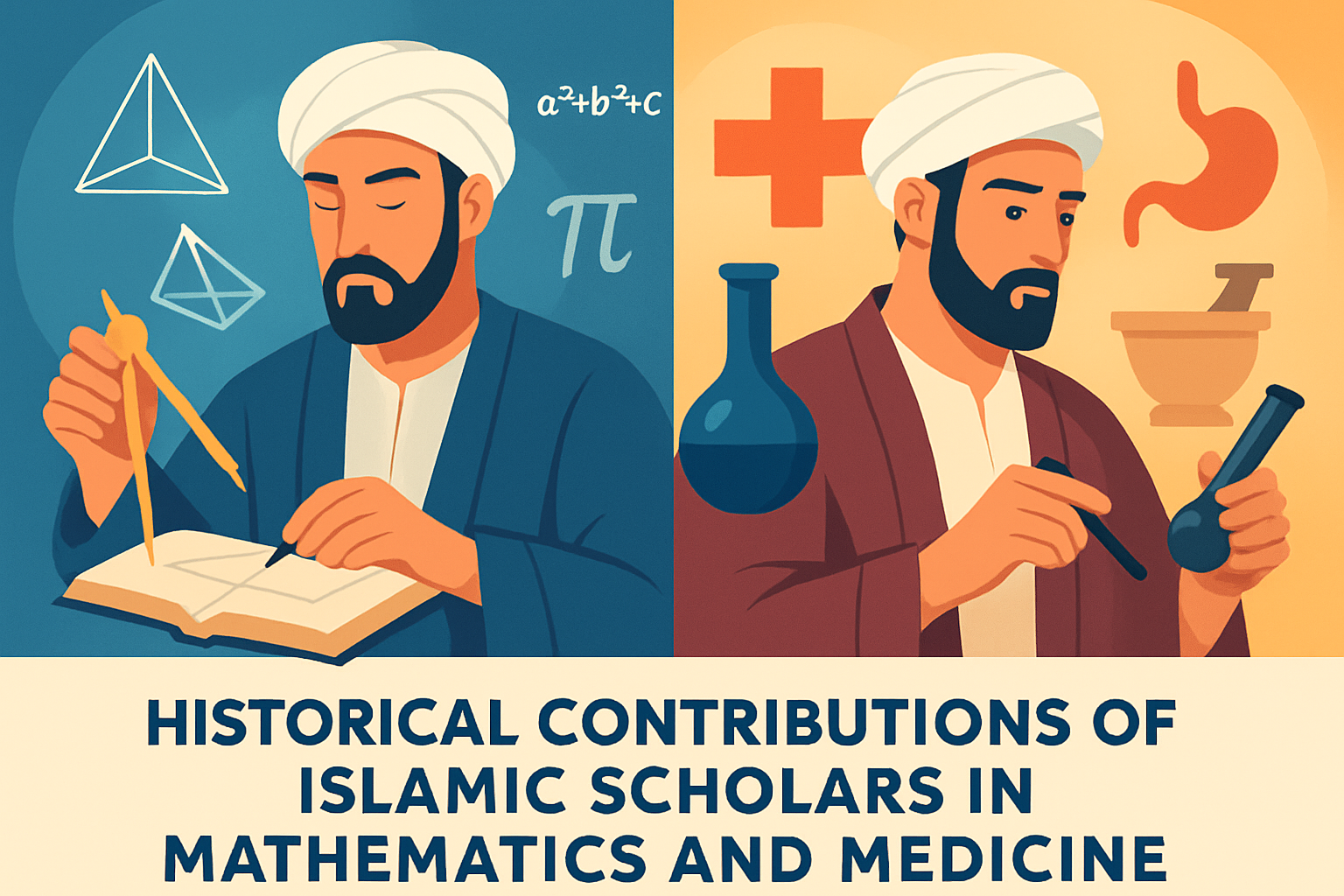
The Islamic Golden Age, which spanned from the 8th to the 14th centuries, was a period of remarkable intellectual and cultural achievements. During this era, Islamic scholars made significant contributions to various fields of knowledge, particularly in mathematics and medicine. This article explores these groundbreaking contributions, highlighting their importance and enduring impact on modern science and society.
Key terms such as “Islamic Golden Age,” “mathematics,” and “medicine” are crucial to understanding this topic. The Islamic Golden Age refers to a period where scholars across the Islamic world engaged in rigorous scientific, intellectual, and cultural endeavors. Mathematics and medicine were two disciplines that flourished during this time, thanks to the scholars’ commitment to learning, translating, and expanding on existing knowledge.
The contributions of Islamic scholars in mathematics and medicine have had a lasting influence on the modern world. Their work laid the foundation for significant advancements in these fields. Understanding the historical significance of these contributions not only provides valuable insights into the development of scientific thought but also emphasizes the multicultural and diverse roots of modern science.
Contributions to Mathematics
One of the most significant contributions of Islamic scholars in mathematics was the development of algebra. The term “algebra” itself is derived from the Arabic word “al-jabr,” meaning “reunification of broken parts,” from the title of the book “Kitab al-Jabr wa al-Muqabala” by the Persian mathematician Al-Khwarizmi. Al-Khwarizmi’s work in the 9th century laid the groundwork for algebra as a mathematical discipline.
Al-Khwarizmi’s contributions went beyond algebra; he also introduced the Hindu-Arabic numeral system to the Islamic world, which eventually spread to Europe. This numeral system simplified calculations and led to significant advancements in arithmetic and commerce. The impact of this work is evident today, as the numeral system is used globally and considered one of the most significant developments in mathematics.
Advancements in Geometry
Islamic scholars made notable advancements in geometry, building on the works of ancient Greek mathematicians like Euclid. One such scholar was Thabit ibn Qurra, who furthered the study of geometry and developed theorems related to the properties of numbers, such as amicable numbers. These contributions played a crucial role in the development of geometric theories and applications.
Their work in geometry also had practical applications, such as in the design and construction of Islamic architecture. The intricate geometric patterns found in Islamic art and architecture, including mosaics and tilings, reflect the advanced understanding of mathematical principles developed during this period.
The Role of Islamic Scholars in Trigonometry
Trigonometry, the study of the relationships between the angles and sides of triangles, was another area where Islamic scholars made significant contributions. Scholars like Al-Battani and Abu al-Wafa’ played a key role in developing trigonometric functions and compiling trigonometric tables that were more precise than those of their predecessors.
Al-Battani, known for his astronomical observations, corrected some of the errors in Ptolemy’s “Almagest” and introduced new trigonometric concepts, such as the use of sines and cosines, that are still in use today.
Innovations in Medicine
Islamic scholars were also instrumental in advancing the field of medicine. One of the most prominent figures in this area was the Persian scholar Avicenna (Ibn Sina), whose seminal work “The Canon of Medicine” served as a medical reference in both the Islamic world and Europe for centuries. This comprehensive text covered topics ranging from pharmacology to surgery and provided detailed explanations of various diseases and their treatments.
Avicenna’s influence extended beyond medicine to philosophy and science, earning him a prominent place in the canon of medieval scholarship. His contributions to the classification and treatment of diseases laid the groundwork for modern medical practices and education.
Establishment of Hospitals and Medical Education
During the Islamic Golden Age, the establishment of hospitals and formal medical education institutions marked significant advancements in healthcare. The Bimaristan, or hospital system, flourished in major cities like Baghdad, Damascus, and Cairo, offering free medical care and serving as centers for medical research and teaching.
The Islamic hospitals introduced innovative practices such as the use of antiseptics, mental health care, and organized medical records, which influenced the development of hospitals in Europe. These institutions underscored the importance of accessible healthcare and the need for continuous medical education, concepts that remain highly relevant today.
Contribution to Pharmacology
The field of pharmacology also saw significant advancements thanks to Islamic scholars. Al-Razi (Rhazes) and Al-Biruni were notable figures in this domain. Al-Razi wrote extensively on various medical topics, including pharmacology, where he emphasized the importance of empirical testing for drugs. His work “Al-Hawi” was a comprehensive medical encyclopedia that informed future generations of physicians.
Al-Biruni’s contributions to pharmacology included the compilation of a “Pharmacopoeia,” a text detailing the properties and uses of various drugs. His holistic approach to medicine integrated knowledge from other disciplines, including chemistry and botany, to create effective treatments. The work of these scholars laid the foundation for modern pharmacology, emphasizing the role of scientific inquiry and experimentation in developing new therapies.
Influence of the Translation Movement
The Translation Movement during the Islamic Golden Age was a critical factor in preserving and enhancing the knowledge inherited from ancient civilizations. Scholars like Hunayn ibn Ishaq translated numerous works from Greek, Persian, and Indian sources into Arabic, making this knowledge accessible to the Islamic world. This movement facilitated the integration of diverse scientific and medical traditions, fostering an environment of intellectual exchange and innovation.
The Translation Movement’s impact extended to Europe through the transmission of Arabic texts, which, once translated into Latin, influenced the European Renaissance. It highlights the significance of cross-cultural collaboration in advancing human understanding, a practice that continues to benefit scientific progress today.
Visual Representation of Contributions
| Field | Scholar | Major Contribution |
|---|---|---|
| Algebra | Al-Khwarizmi | Introduction of Algebra and Hindu-Arabic numerals |
| Geometry | Thabit ibn Qurra | Advancements in geometry and number theory |
| Trigonometry | Al-Battani | Development of trigonometric functions |
| Medicine | Avicenna | “The Canon of Medicine” – comprehensive medical reference |
| Pharmacology | Al-Razi | Empirical testing for drugs |
Legacy and Modern Implications
The contributions of Islamic scholars in mathematics and medicine during the Islamic Golden Age have left a lasting legacy that continues to influence these fields today. Their work laid the foundational principles for numerous scientific advancements and set a precedent for rigorous scholarship and inquiry.
Their commitment to knowledge exchange and cross-cultural collaboration underscores the importance of diverse perspectives in advancing human understanding. Modern science continues to build on the rich legacy of these scholars, with their contributions forming an integral part of our shared intellectual heritage.
Conclusion and Call to Action
The historical contributions of Islamic scholars in mathematics and medicine during the Islamic Golden Age demonstrate the profound impact of cultural and intellectual exchange on the advancement of human knowledge. By exploring their achievements, we gain a deeper appreciation for the collaborative nature of science and the importance of fostering environments that promote diverse perspectives and innovative thinking.
As we continue to benefit from the legacy of these scholars, it is crucial to acknowledge their contributions and integrate their insights into modern scientific endeavors. Encouraging further research and education in these historical achievements can inspire future generations to build on this foundation and contribute to the continued progress of mathematics and medicine.
Readers are encouraged to further explore the rich history of the Islamic Golden Age and its contributions to mathematics and medicine. By doing so, we can celebrate the diverse roots of modern science and honor the enduring legacy of Islamic scholars.
Embracing this history not only enriches our understanding of science but also reinforces the idea that progress is rooted in collaboration, diversity, and the relentless pursuit of knowledge.
Frequently Asked Questions
1. What were the major contributions of Islamic scholars in the field of mathematics during the Islamic Golden Age?
Islamic scholars made numerous groundbreaking contributions to the field of mathematics during the Islamic Golden Age. One of the most notable contributions was the development and refinement of algebra by the Persian mathematician Al-Khwarizmi, whose seminal work, “The Compendious Book on Calculation by Completion and Balancing,” laid the foundations for modern algebra. His works introduced the term “algebra” itself, derived from “al-jabr,” which refers to the operation of moving a term from one side of an equation to the other. Al-Khwarizmi’s work was translated into Latin in the 12th century and became the standard mathematical reference in European universities.
Another critical contribution was the development of the decimal place value system, including the introduction of the concept of zero, which revolutionized mathematical calculations. This system, along with algorithms for arithmetic operations, was instrumental in advancing mathematics as a discipline and remains in use globally today.
In addition, Islamic mathematicians like Omar Khayyam made substantial strides in geometry and algebraic geometry. Khayyam developed a geometric method for solving cubic equations by intersecting a parabola with a circle. The works of Islamic scholars in trigonometry, particularly by Al-Battani, who refined and corrected Ptolemy’s astronomical data, further expanded the mathematical understanding of angles and their functions, paving the way for advancements in astronomy and navigation.
2. How did Islamic scholars contribute to the field of medicine during this period?
Islamic scholars during the Islamic Golden Age played a pivotal role in advancing the field of medicine. They synthesized knowledge from Greek, Roman, Persian, and Indian sources, which allowed for more comprehensive understanding and innovation in medical practices.
One of the most influential figures was Avicenna (Ibn Sina), whose medical encyclopedia, “The Canon of Medicine,” became a cornerstone in both Islamic and European medical education for several centuries. This extensive work systematically organized medical knowledge available at that time and featured insights into the treatment of diseases, medical ethics, and pharmacology. Avicenna’s emphasis on clinical observation and experimentation anticipated the principles used in modern medical practice.
Another scholar, Al-Razi (Rhazes), made significant contributions to medicine by emphasizing the importance of clinical research and the ethics of medical practice. He wrote extensively on smallpox and measles and developed methods for differentiating between different diseases, which was groundbreaking at the time. His comprehensive medical guides were utilized across the Islamic world and later in Europe.
Additionally, Islamic physicians were pioneers in surgery. Scholars like Al-Zahrawi, known as the “father of surgery,” developed surgical instruments and techniques that were used for centuries. His writings described various surgical treatments and cauterization methods, and he documented the importance of cleanliness and infection prevention during surgery.
3. What was the impact of the mathematical advancements made by Islamic scholars on European mathematics?
The mathematical advancements made by Islamic scholars had a profound impact on European mathematics and played a crucial role in the Renaissance and the development of modern mathematics. The works of Al-Khwarizmi, Al-Battani, and Khayyam, among others, were translated into Latin, facilitating their introduction to European scholars who were seeking knowledge beyond the traditional Greco-Roman sources.
The introduction of the Arabic numeral system, including the concept of zero, transformed European mathematics by simplifying arithmetic operations and calculations. This enabled more complex mathematical exploration and commercial practices, as methods based on Roman numerals were cumbersome and inefficient.
Additionally, the algebraic methods introduced by Islamic scholars allowed European mathematicians to solve equations that were previously intractable. This new algebraic approach to mathematics laid the groundwork for further developments during the Scientific Revolution.
The access to Islamic mathematical knowledge enabled European mathematicians such as Fibonacci, who learned about these innovations and introduced them to the West through works like “Liber Abaci.” This book popularized the Arabic numeral system and the mathematical techniques developed by Islamic scholars, which were integral to the progress of mathematics in Europe.
4. In what ways did Islamic medicine influence European medical practices during the Middle Ages?
Islamic medicine significantly influenced European medical practices during the Middle Ages by serving as a critical link between ancient knowledge and emerging medical theories of that era. The comprehensive medical texts produced by Islamic scholars—most notably Avicenna’s “Canon of Medicine” and Al-Razi’s works—became crucial resources in European medical schools.
These texts provided one of the most systematic and organized approaches to diagnosis and treatment, offering a deep understanding of various diseases and their remedies. The emphasis on empirical observation and experimentation highlighted in these works prompted a shift from superstitions and traditional practices to more structured medical approaches.
European scholars translated these pivotal texts into Latin, and they were used as authoritative references for centuries. This integration of Islamic medical knowledge enabled the advancement of surgical techniques, pharmacology, and hospital management, leading to improved healthcare practices in medieval Europe.
Furthermore, Islamic scholars introduced medical ethics principles and various medical procedures that laid the groundwork for modern techniques. Al-Zahrawi’s surgical innovations, along with illustrated guides for surgical instruments, were particularly influential in furthering European surgical knowledge.
5. Can you provide examples of specific Islamic scholars and how their work shaped the landscape of mathematics and medicine?
Several Islamic scholars made seminal contributions that shaped both the mathematical and medical landscapes during the Islamic Golden Age. For instance, Muhammad ibn Musa al-Khwarizmi, often known as the father of algebra, produced works that transformed Arab and later European mathematical practices. His methods of systematic solving of linear and quadratic equations form the foundation of modern algebra.
In medicine, the work of Avicenna stands out due to his “Canon of Medicine,” which consolidated previous medical knowledge and introduced new concepts such as the contagious nature of infectious diseases, systematic experimentation, and clinical trials—principles that predate modern medical research methodologies.
Al-Razi, another towering figure in medicine, wrote extensively on medical subjects. His emphasis on case histories and the differentiation of smallpox from measles in his detailed clinical descriptions was revolutionary. He also contributed significantly to psychology and psychotherapy, and he underscored the holistic approach to patient care.
In the realm of astronomy and trigonometry, Al-Battani’s adjustments to astronomical tables and introduction of the sine function had a profound impact on navigation and astronomical calculations in Europe.
Lastly, Al-Zahrawi’s surgical guide, which was painstakingly detailed with illustrations, was used as a reference work for centuries in both the Islamic world and Europe, introducing new surgical techniques and emphasizing the importance of post-operative care.