
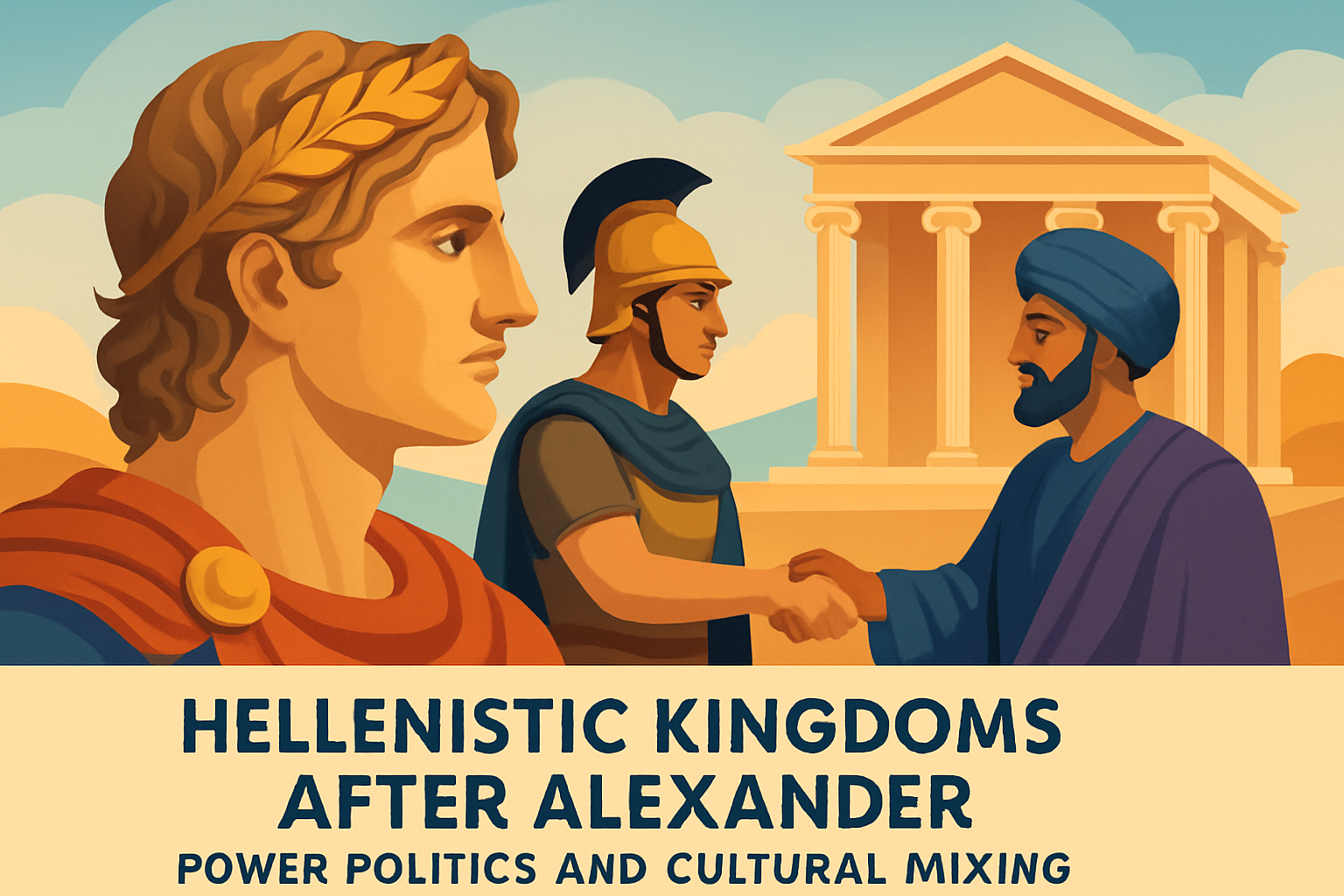
The Hellenistic period marks a fascinating chapter in ancient history, following the death of Alexander the Great in 323 BCE. This era was characterized by the expansive territories that emerged from the former Empire of Alexander, often referred to as the Hellenistic kingdoms. Spanning from the eastern Mediterranean to parts of Asia, these kingdoms offer a rich tapestry of power dynamics and cultural interplay that have continued to intrigue historians and scholars. In this article, we will delve into what defines the Hellenistic kingdoms, exploring the power politics that shaped them, and the cultural melting pots created in their wake. Understanding this era is essential, as it laid foundational stones for the cultural diffusion and geopolitical traditions that have resonated through history up to the present day.
The Fragmentation of Alexander’s Empire
Upon Alexander the Great’s untimely death, his empire lacked a clear successor, leading to a fractious division among his top generals, known as the Diadochi. Each sought control over different expanses of his vast conquest, giving birth to distinct Hellenistic kingdoms. The Seleucid Empire, Ptolemaic Egypt, and the Antigonid dynasty in Macedonia were just a few of the powerful entities that emerged from this fragmentation. The Seleucids governed over a wide swath of territories that extended across the modern-day Middle East and into parts of Asia, while Ptolemaic Egypt, centered in Alexandria, became a beacon of Hellenistic learning and culture. The division was not merely political but deeply entwined with military prowess, as these generals-turned-rulers relied heavily on their armies to maintain control and suppress uprisings.
For example, the Battle of Ipsus in 301 BCE marked a significant turning point, as it saw the defeat of Antigonus I Monophthalmus, illustrating the brutally competitive nature of these emergent kingdoms. Alliances, betrayals, and strategic marriages were all integral elements, underpinning the power struggles that were as much about territorial dominion as they were about prestige and legacy. This intricately woven tapestry of conflicting ambitions provided the backdrop for the ensuing power politics that dominated the Hellenistic period.
Cultural Synthesis and Exchange
One of the most enduring legacies of the Hellenistic kingdoms is the profound cultural exchange that took place across their territories. As Greek settlers moved into these new realms, they mingled with local populations, resulting in a unique blend of art, architecture, language, and religion. The concept of “Hellenization” refers to this process where Greek culture permeated local traditions, but it also worked in reverse, with eastern customs influencing Greek practices.
Take, for instance, the city of Alexandria in Egypt, which became a hub of cultural convergence, boasting the famed Library of Alexandria and the lighthouse, one of the Seven Wonders of the Ancient World. In Alexandria, Greek, Egyptian, Persian, and Jewish cultures intermingled, giving rise to innovations in science, philosophy, and the arts. The Graeco-Bactrian Kingdom in Central Asia serves as another prime example, where Greek and Indian cultures merged, creating hybrid forms of governance, art, and religion, most evidently seen in the Greco-Buddhist art and coinage.
| Kingdom | Capital | Notable Cultural Contributions |
|---|---|---|
| Ptolemaic Egypt | Alexandria | Library of Alexandria, Syncretism in Religion |
| Seleucid Empire | Antioch | Architectural Fusion, Spread of Greek Coinage |
| Antigonid Kingdom | Pella | Military Innovations, Patronage of the Arts |
Economic Transformations and Trade
The Hellenistic period also witnessed considerable economic transformations as trade networks expanded dramatically across the known world. The opening of new trade routes facilitated the flow of goods, ideas, and culture between Greece, Egypt, the Middle East, and beyond. Exchange was not limited to luxury items but included essential commodities that fueled the economies of these kingdoms.
- Silk Road Connections: Greek products, such as olive oil and wine, found markets in Asia, while silk and spices traveled westward, enriching both ends of the trade spectrum.
- Maritime Trade: The Mediterranean Sea served as a critical artery for trade, fostering connections between various Hellenistic states. Notable trade centers included the island of Rhodes and the bustling port of Piraeus.
- Economic Policies: Hellenistic rulers established monetary systems that facilitated easier trade across borders, with coinage often depicting Greek gods or rulers, signifying both wealth and cultural pride.
Recent archaeological findings, such as ancient shipwrecks discovered off the coast of Egypt, have unveiled the extent of maritime commerce, revealing amphorae that once transported wine and oil. These economic interactions were not merely for wealth accumulation but served as powerful instruments for the integration of disparate cultures and societies within the Hellenistic sphere.
Influence on Art and Science
The Hellenistic period saw a golden age of artistic and scientific advancements, with lasting impacts that seeped into the fabric of later civilizations. Art took on a more emotional and realistic form compared to the classical Greek art’s stoic and idealized depictions. Statues such as the “Laocoön and His Sons” and the “Venus de Milo” exemplify the dramatic and intricate human expressions that defined Hellenistic sculpture.
In science, figures such as Archimedes and Euclid made groundbreaking contributions. The invention of devices like the ship-screw and advancements in mathematics, particularly in geometry, are attributed to this vibrant period. The fusion of empirical study and philosophical inquiry established during the Hellenistic era underpinned the later scientific revolutionary shifts of the Renaissance. This flourishing of scholarly activity was primarily supported by royal patronage, underlining the role of Hellenistic kings as cultural vanguards who valued, funded, and protected intellectual pursuits.
Conclusion: The Enduring Legacy of Hellenistic Kingdoms
The Hellenistic kingdoms, emerging from the fragments of Alexander the Great’s empire, developed into complex and influential entities that redefined the ancient world. Through power politics, remarkable cultural exchanges, economic innovations, and artistic flourish, these kingdoms set the stage for subsequent generations. The remnants of their influence are etched into the cultural, political, and scientific domains of later civilizations.
The Hellenistic period teaches us about the importance of cultural synthesis and the benefits that arise from multi-ethnic cooperation and understanding. This era’s vibrant history reminds us that when diverse ideas and peoples converge, they can foster innovation, progress, and resilience against the backdrop of power struggles and geopolitical transformations. As modern society navigates through similarly complex and multicultural landscapes, these lessons from history become increasingly vital.
As we move forward, the call to action is to appreciate this rich historical legacy, to understand the complexities of cultural interplay, and to apply these lessons in a contemporary setting. Read more about archaeological discoveries of the Hellenistic period and explore virtual museums that showcase the art and intellectual advancements of this incredible era.
Frequently Asked Questions
1. What were the major Hellenistic kingdoms that emerged after Alexander the Great’s death?
Following the death of Alexander the Great in 323 BCE, his vast empire was divided among his generals, leading to the establishment of several key Hellenistic kingdoms. The most prominent among these were the Ptolemaic Kingdom in Egypt, the Seleucid Empire in the Near East, and the Antigonid Kingdom in Macedonia and parts of Greece. These political entities were formed through a series of power struggles and treaties among Alexander’s former generals, known as the Diadochi.
The Ptolemaic Kingdom, founded by Ptolemy I Soter, was centered in Egypt and is renowned for the cultural and economic prominence of its capital, Alexandria. This kingdom was known for its significant contributions to arts and science, evidenced by the famed Library of Alexandria and the Lighthouse of Pharos. The Seleucid Empire, founded by Seleucus I Nicator, extended from the easternmost parts of Asia Minor to the Indus Valley. It was a melting pot of cultures, bringing together local traditions with Greek influences.
The Antigonid Kingdom, based mainly in Macedonia and parts of Greece, although lesser in territorial expanse, played a crucial role politically and militarily throughout the Hellenistic period. Each of these kingdoms faced their challenges and opportunities, shaping the cultural and geopolitical landscape of the era.
2. How did the cultural mixing in the Hellenistic kingdoms impact society?
The cultural blending during the Hellenistic period was profound and far-reaching. As Greek settlers and cultures spread across the newly established kingdoms, they interacted with local traditions, resulting in a vibrant cultural amalgamation. In cities like Alexandria and Antioch, this cross-pollination was most visible, where Persian, Egyptian, Babylonian, and Indian influences mingled with Greek art, philosophy, and science.
One of the most significant impacts of this cultural exchange was the spread of Hellenism itself — the adoption of Greek language, thought, customs, and arts by diverse populations. This fusion can be seen in various facets like architecture, where Greek styles blended with local building techniques, and in religious practices where syncretism became common. Deities from different cultures were merged, with gods like Zeus-Amun becoming symbols of this cultural symbiosis.
Education and philosophical discourse flourished as well, with ideas from different traditions being debated in the great libraries and schools of the time. This period also saw the expansion of trade networks, facilitating not just economic prosperity, but also the exchange of ideologies, crafts, and technologies which shaped the further development of both western and eastern civilizations.
3. How did power politics play out among the Diadochi and their successors?
The death of Alexander the Great precipitated a tumultuous period of warfare and strategic alliances as his former generals — referred to as the Diadochi — vied for control over portions of his empire. Initially united, these leaders soon fractured into contenders for power, resulting in a prolonged series of conflicts known as the Wars of the Diadochi.
Central to these power struggles were attempts to assert dominance through military campaigns and political marriages. The Diadochi each sought to carve out their territories and establish legitimacy. This led to shifting alliances and betrayals, as leaders like Ptolemy, Seleucus, Antigonus, and Lysimachus fought for dominance. Key engagements like the Battle of Ipsus in 301 BCE and the Battle of Corupedium in 281 BCE were decisive in determining territorial boundaries.
Over time, these conflict-fueled negotiations resulted in relatively stable kingdoms. Still, the threat of rebellion or invasion remained a constant aspect of Hellenistic rule. Political intrigue, assassinations, and familial power struggles continued to shape the political landscape, influencing both the internal governance of these kingdoms and their external relations with neighboring powers.
4. What role did cities play in the Hellenistic kingdoms?
Cities were the heart of Hellenistic cultural and political life, serving as centers of commerce, governance, and cultural exchange. Cities like Alexandria, Antioch, and Pergamon not only became the administrative capitals of their respective kingdoms but also the focal points for artistic and intellectual activity. They were the epicenters of this era’s cultural dynamism, attracting scholars, artisans, and traders from across the known world.
These urban centers were characterized by extensive urban planning and adorned with impressive architecture that showcased the era’s rich cultural synthesis. Public spaces such as gymnasiums, libraries, temples, and theaters reflected both Greek influences and local traditions. The establishment of the Library of Alexandria, for example, represented a monumental hub of knowledge, attracting scholars from various disciplines to contribute and exchange ideas.
The cities of the Hellenistic kingdoms also played strategic economic roles. Situated along key trade routes, they facilitated the movement of goods, peoples, and ideas between different cultural zones. This increased interaction promoted economic prosperity, but also aided in the dissemination of Hellenistic culture and Greek language as a lingua franca across these vast territories.
5. What lasting impacts did the Hellenistic kingdoms have on subsequent civilizations?
The Hellenistic kingdoms left a lasting legacy that influenced both Western and Eastern civilizations long after their decline. They played a crucial role in the transmission and transformation of Greek culture, philosophy, science, and art across Asia, North Africa, and parts of Europe. This period saw significant advancements in a wide array of fields: from the expanded understanding of astronomy and mathematics to innovations in art and literature.
Through the Hellenistic spread of Greek language and culture, these kingdoms laid the groundwork for the later Roman Empire, which heavily drew upon Hellenistic styles and ideas. The concept of cities as cultural and administrative centers was further developed by the Romans, who embraced Hellenistic architectural styles and cultural norms. Philosophies such as Stoicism and Epicureanism, born during the Hellenistic period, continued to shape ethical and political thought for centuries.
Furthermore, the blending of traditions during this time influenced religious developments, contributing to the formation of syncretic belief systems. This paved the way for cultural and religious transitions that would occur in the Greco-Roman world and beyond. Elements of Hellenistic culture, such as the emphasis on knowledge, rationality, and artistic expression, continue to echo in modern societal values and traditions, underscoring the enduring influence of the Hellenistic kingdoms.