
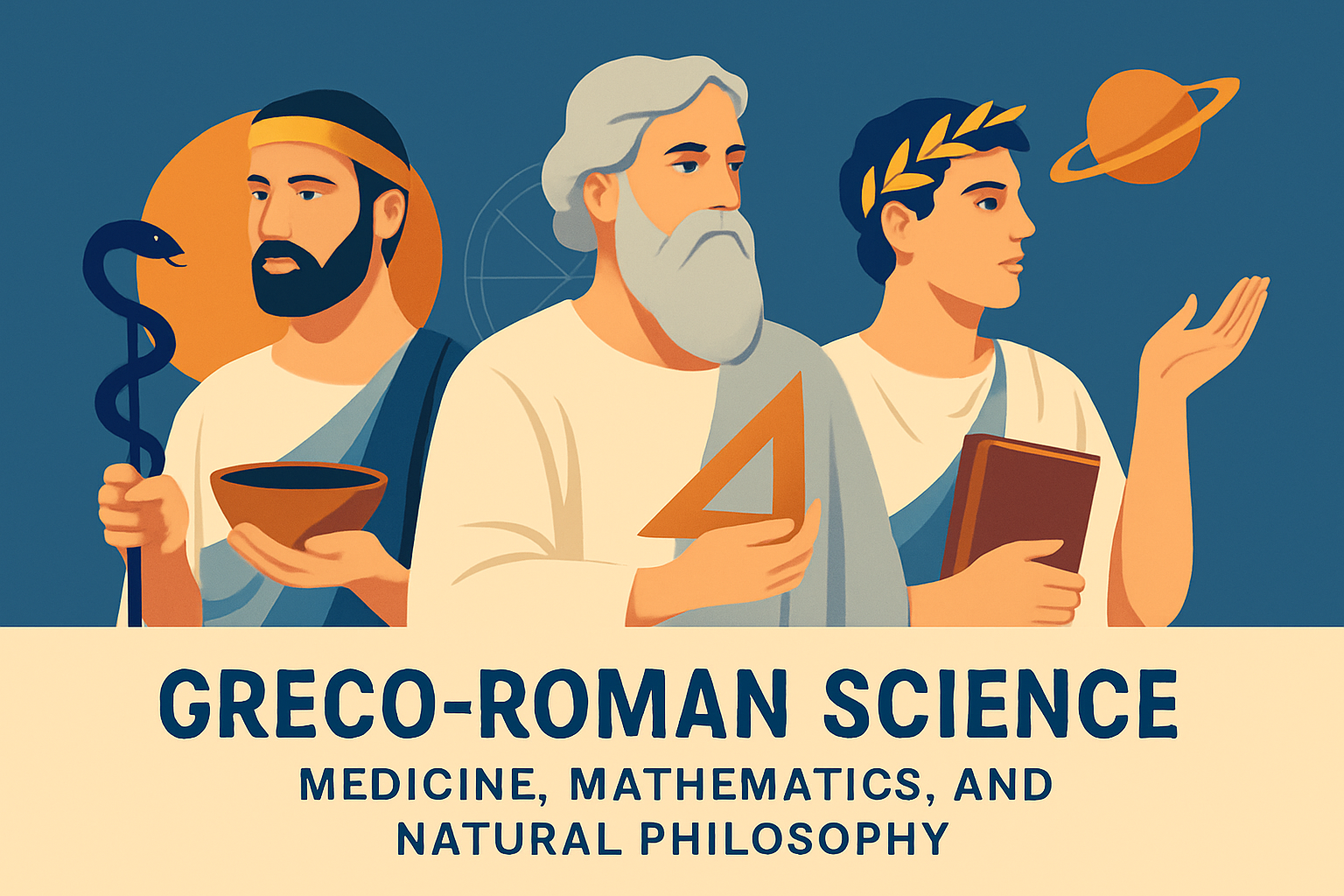
The blending of Greek and Roman intellectual traditions during antiquity laid the foundation for major advancements in science that continue to impact modern concepts of medicine, mathematics, and natural philosophy. These areas not only signify the brilliance of ancient civilizations but continue to influence modern scientific thought and practice. Ancient Greco-Roman science represents a crucial intersection of observational precision, mathematical innovation, and philosophical inquiry, which collectively shaped humanity’s understanding of the natural world. Understanding this history is critical for appreciating how past knowledge informs current scientific paradigms and technological advances.
The concept of science in the ancient Greco-Roman world encompassed various disciplines emerging primarily from early philosophical queries. Medicine referred not only to the healing of the body but also embraced broader considerations of wellness and balance. Mathematics was not only the quantification of the tangible but also a metaphysical exploration of numbers and their harmonies. Lastly, what we today might categorize as ‘science’ was deeply intertwined with natural philosophy—the pursuit of understanding the universe’s fundamental laws. By unraveling these interconnected threads, we can better comprehend how philosophical methodologies influenced scientific models and evidence-based reasoning.
The Art of Ancient Medicine
Ancient Greco-Roman medicine was a sophisticated interplay of empirical practices and philosophical ideas. Hippocrates, often considered the “Father of Medicine,” revolutionized the field by attributing diseases to natural causes rather than divine intervention. His adherence to systematic observation and clinical documentation established a foundation for medical diagnostics that prioritized the physician-patient relationship.
Roman contributions furthered medical practices through an emphasis on public health. The Romans built extensive aqueduct systems and public baths, demonstrating an understanding of hygiene’s role in disease prevention. Galen, a notable Roman physician, extended the knowledge of anatomy and physiology through dissections and writings that would dominate medical thought for centuries.
For example, the understanding and surgical treatment of cataracts were significantly advanced during this period. Roman physicians utilized a procedure known as couching, wherein a needle was used to displace the cloudy lens from the pupil, restoring partial vision. Such practices underscore a practical approach rooted in observational technique and evolving technology.
Mathematics and Its Many Dimensions
In the world of mathematics, the Greeks established numerous axioms and theories, many of which form the core of what is known today as Euclidean geometry. Euclid’s “Elements” compiled geometric knowledge into a cohesive framework that continues to be the basis of modern mathematical education.
Pythagoras introduced the concept of numerical harmony and its implications beyond mere arithmetic. The Pythagorean theorem is perhaps the most famous legacy of this school of thought, describing the relation between the sides of a right triangle in a way that highlights the universality of mathematical truth.
Additionally, Archimedes, a pioneer in the study of calculus, formulated approximations of pi and theories regarding volumes and areas, influencing mathematical thought deeply. His method of exhaustion contributed to the later development of integral calculus.
| Scientist | Contribution | Legacy |
|---|---|---|
| Euclid | Elements | Foundation of geometry |
| Pythagoras | Pythagorean theorem | Number theory |
| Archimedes | Exhaustion method | Calculus precursor |
These individuals and their works illustrate how mathematics served not only as an empirical tool but a framework for rationality and philosophical inquiry, shaping both practical applications and theoretical explorations.
Natural Philosophy: The Quest for Understanding
Natural philosophy in the Greco-Roman era was a precursor to modern science, where philosophers sought to understand the fundamental principles governing the universe. Thales, one of the earliest pre-Socratic philosophers, posited that water was the fundamental substance of all matter, hinting at an early material monism.
Perhaps more influential was Aristotle, whose writings covered a broad spectrum of subjects, including metaphysics, ethics, and politics. In natural philosophy, he endeavored to categorize all phenomena and introduced the concept of cause and effect, which laid the groundwork for scientific exploration and classification.
Later, during the Roman period, thinkers like Lucretius embraced Epicurean philosophy to explain the natural world. His poem “De Rerum Natura” elucidates atomic theory in poetic form, foreshadowing modern molecular science with remarkable accuracy.
- Thales: Water as the foundational element
- Aristotle: Causes and categorization
- Lucretius: Atomic theory and materialist philosophy
This formative era testified to the power of logical reasoning and empirical observation, fostering an intellectual tradition that emphasized systematic inquiry despite limited technological resources.
Interconnection and Influence on Future Science
Despite the temporal distance, Greco-Roman scientific endeavors directly influence contemporary scientific methodologies and understanding. For example, Hippocratic concepts like ethical medical practice and meticulous patient observation are cornerstones of modern medicine.
The mathematical advancements of Euclidean geometry and Pythagorean exploration paved the way for the subsequent development of algebra and calculus, instrumental to modern engineering and physics. The interfacing of these mathematical principles with early natural philosophy encourages a holistic understanding of complex systems.
Moreover, the dynamic inquiry models established by philosophers like Aristotle inspired Renaissance thinkers such as Galileo and Newton. Their continued pursuit of uncovering universal principles defined the scientific revolution, which established the interconnected fields of physics, astronomy, and various other natural sciences.
Through these varied influences, it becomes clear how the ancient civilizations’ dedication to knowledge, truth, and empirical study not only preserved human advancements but propelled future innovations. Their synthesis of observational rigor with expansive inquiry forms a legacy that continues to inform today’s scientific pursuits.
Conclusion
The consolidation of Greek and Roman intellectual traditions provided a unique platform for the development of medicine, mathematics, and natural philosophy, each interwoven with the other, leading to advancements that are echoed across centuries. Their methods and findings, from Hippocratic clinical practices to Pythagorean harmony, continue to serve as vital cornerstones to our scientific foundations. The contributions of key figures, the methodologies they employed, and the rich legacies they left shape the study and application of modern science.
The integration of empirical observation, rational argumentation, and a quest for universal truths—from the treatment of disease to the calculations of geometry—highlighted the profound comprehension of natural phenomena sought by the ancients. Not only do these efforts underscore a scientific revolution that took hold through curiosity and analytical vigor, but they also emphasize the value of interdisciplinary unity and cooperation that transcends empirical boundaries.
For the modern reader, learning from these paradigms provides insights into our cultural and scientific ancestry and directs us to approach contemporary challenges with the same ingenuity, resolve, and philosophical inquiry. By understanding our shared history in science, we empower ourselves to innovate while grounded in a profound, enduring legacy of human inquiry—inviting both reflection and inspiration to chart new intellectual territories.
Frequently Asked Questions
1. What were some of the significant contributions of Greco-Roman science to the field of medicine?
Greco-Roman science made several remarkable contributions to medicine, which laid the groundwork for modern medical practices. Hippocrates, often referred to as the “Father of Medicine,” introduced methodologies that emphasized observation and diagnosis. His most influential work, the Hippocratic Corpus, set forth the ethical standards for the practice of medicine, stressing the importance of environmental factors, diet, and lifestyle in health. Furthermore, Galen, a prominent Roman physician, expanded upon these ideas and introduced new concepts around anatomy and physiology. Galen’s extensive writings on dissection and experimentation provided a detailed understanding of human anatomy, though some of his texts were more philosophical than strictly scientific. Nevertheless, these texts were utilized widely in medical education for centuries, even well into the Middle Ages. The systematic approach of using critical observation and empirical evidence in medical practice, introduced by Greco-Roman intellectuals, remains a cornerstone of medical science today.
2. How did Greco-Roman thinkers influence the development of mathematics?
The intellectual efforts of Greco-Roman thinkers in mathematics have had profound and lasting effects on the discipline as we know it. Greek mathematicians like Euclid and Pythagoras were pioneers in the field. Euclid’s “Elements” served as a comprehensive compendium of knowledge in geometry, summarizing and systematizing previous work and adding new findings that were taught for over two millennia. The Pythagorean Theorem stands as a testament to the influence of this era on mathematical study, encapsulating a simple yet powerful relationship within a right-angled triangle that is foundational to geometry today. Additionally, Archimedes made significant contributions to the understanding of calculus concepts, though calculus itself was not formally recognized until much later. His methods for determining areas and volumes of shapes anticipated the techniques of integral calculus. Romans were also known for their engineering prowess, relying on practical applications of mathematics in constructing roads, aqueducts, and monumental architecture like the Colosseum, demonstrating the applied nature of mathematical thought during this era.
3. What role did natural philosophy play in Greco-Roman scientific development?
Natural philosophy, as a precursor to modern science, played a central role in Greco-Roman intellectual pursuits. Philosophers sought to understand the world through a rational framework, using observation and logic to explore the underlying principles of nature. Figures such as Aristotle were seminal in establishing a systematic approach to studying natural phenomena. Aristotle’s works on physics, biology, and metaphysics laid the groundwork for comprehensive scientific inquiry, greatly influencing subsequent philosophical and scientific thought. The Roman philosopher Lucretius built upon Greek atomism and presented natural phenomena in his poem “De Rerum Natura,” highlighting a materialistic view of the universe. These pursuits fostered an environment that valued empirical evidence and reasoned debate, setting the stage for scientific discoveries that bridged diverse fields. The Greco-Roman blend of philosophical reasoning with empirical inquiry cultivated an intellectual tradition that spurred further advancement and innovation, ultimately influencing the Age of Enlightenment and modern scientific thought.
4. In what ways did Greco-Roman investigations into the natural world influence scientific methods?
Greco-Roman investigations into the natural world were instrumental in shaping the trajectory of scientific methods. Ancient scientists placed significant emphasis on empirical observation, logical deduction, and the testing of hypotheses, which are all cornerstones of the scientific method today. Thinkers like Aristotle were pioneers in methodical observation, collecting data to form general concepts and theories about the physical world. His emphasis on categorizing and classifying natural phenomena introduced a systematic approach to scientific study. Similarly, Archimedes’ devotion to rigorous proof and mathematical solution to physical problems exemplified the application of precise reasoning to extract explanations about the natural world. The integration of philosophy with science promoted a culture of questioning, debate, and exploration, encouraging discoveries that surpassed geographical and chronological boundaries. The foundational concepts and methodologies from the Greco-Roman era have been refined and enhanced, having a direct impact on the experimental and analytical techniques we employ in contemporary scientific research.
5. How did the blend of Greek and Roman traditions contribute to scientific progress during antiquity?
The convergence of Greek and Roman intellectual traditions during antiquity created a fertile ground for scientific progress by merging distinct cultural perspectives and priorities. Greeks were renowned for their deep philosophical inquiries and advancements in theoretical sciences such as mathematics, chemistry, and physics. The Romans, on the other hand, were more focused on practical application, as seen in their architectural innovations, engineering triumphs, and their robust health and sanitation systems. This blend of theory and practice enhanced scientific methods and facilitated the transition from purely speculative philosophy to a more experimental and practical science. Roman organizational might supported large-scale dissemination and standardization of Greek knowledge, including massive libraries and a shared lingua franca in the form of Latin and Greek dialects. This environment of intellectual and technological exchange fostered scholarly activity, leading to breakthroughs that served immediate civil and military needs while also extending humanity’s inquiry into the natural world. These combined Greek and Roman efforts paved the way for the expansion of scientific knowledge that has informed countless technological and medical advancements across history.