
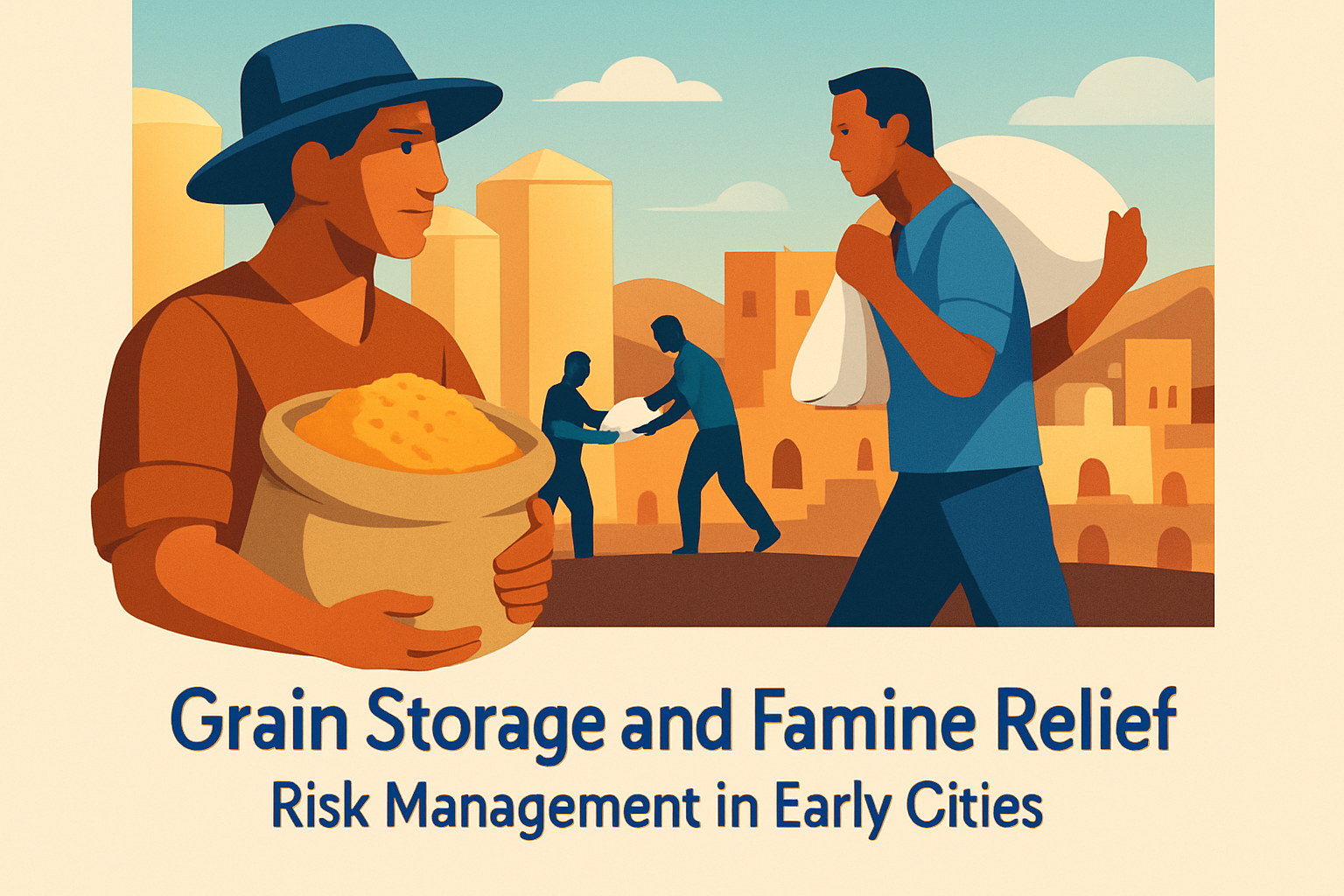
Introduction to Grain Storage and Famine Relief
Throughout history, the survival and flourishing of civilizations have depended on efficient resource management. One of the critical components of this management is the storage of essential commodities, primarily grains. Grain storage refers to the methods and facilities used to conserve crops such as wheat, rice, barley, and corn. The term “famine relief” describes the measures implemented to provide food to the population during shortages or scarcity. These two concepts, though seemingly straightforward, played a pivotal role in the rise and sustainability of early cities.
The significance of managing grain storage effectively cannot be understated. Beyond merely feeding populations, these practices heralded the transition of human societies from nomadic lifestyles to permanent settlements—what we now refer to as early urbanization. They equipped early cities to cope with unpredictable climatic conditions, crop failures, and adversities, which were rampant in ancient times. Hence, understanding this aspect of historical risk management is both fascinating and enlightening, unveiling the pragmatism embedded within ancient societies.
Why does understanding grain storage and famine relief matter today? The echoes of past strategies continue to inform the present and future food security initiatives. Comprehending these ancient techniques equips modern society with insights into sustainable practices and resilience in the face of changing environmental patterns. Through this exploration, one can glean how stored knowledge from bygone ages can address contemporary challenges in food security, policy making, and urban planning. Let’s delve deeper into how early cities tackled these challenges.
Grain Storage Techniques: An Ancient Necessity
Grain storage systems in ancient cities were integral to their survival and prosperity. The design and implementation of these facilities varied geographically, influenced by the local environment and cultural practices. In Mesopotamia, one of the earliest cradles of civilization, public granaries were large, centralized repositories essential for sustaining city populations and preventing famines.
Egypt, renowned for its monumental architecture, also devised intricate grain storage solutions. The granaries in Egypt could store vast amounts of grain, facilitated by the predictability of the Nile’s flooding and subsequent fertile conditions. Regions like Rome developed impressive storage mechanisms to stabilize their city-based economies. The granaries within the Roman Empire were publicly owned, indicating a level of state control over food resources unparalleled in other regions of that era.
- Mesopotamia: Public centralized granaries.
- Ancient Egypt: Granaries influenced by Nile’s flood cycles.
- Rome: State-controlled granaries with large capacity.
These storage systems didn’t just preserve food; they buttressed political power. Leaders who assured the food supply through storage measures could secure loyalty and stability among their populace, placating urban and rural anxieties over potential famines. Thus, we see that grain storage was not just a logistical concern but a strategic state endeavor. Understanding these systems illuminates how contemporary food banks and grain reserves still draw from these age-old principles, harmonizing safety nets with modern advances in food preservation.
The Role of Famine Relief in Urban Resilience
While grain storage dealt with the problem of food preservation, famine relief strategies addressed the dire consequences when shortages occurred. Early cities devised diverse ways to tackle periods of scarcity, ensuring urban resilience and stability.
An insightful example stems from ancient China. During the Tang Dynasty, a sophisticated system, known as the “ever-normal granaries,” was established. These were state-organized rural granaries intended to prevent famines by stabilizing grain prices and supplies. They acted as food reserves during bad harvests, effectively demonstrating a government-provided safety net.
Similarly, in India, the Chola dynasty introduced a unique approach by assigning arable land specifically for famine relief activities, known as the temple-based system. Temples acted as repositories for supplies, and their central role in community life made them ideal for disseminating aid during crises.
The Roman Empire also had its measures. The “annona” policy ensured that grain was distributed to citizens at fixed prices, which prevented market exploitation during shortages and supported the vast population that Rome needed to feed. These ancient relief systems show parallels to today’s global relief efforts facilitated by international bodies such as the World Food Programme, emphasizing the persistence of cooperative strategies to tackle food shortages.
Grain Storage Structures: From Silos to Storehouses
The physical structures used for grain storage have evolved tremendously. Archaeological studies have documented a variety of storage techniques ranging from underground silos to above-ground barns.
In the Fertile Crescent, where agriculture famously began, archaeologists uncovered silos that were dug below ground level, often lined with mudbrick or stone to prevent spoilage from moisture and pests. These designs were primitive but remarkably effective, showcasing an understanding of environmental adaptation and materials.
| Region | Primary Storage Type | Structural Adaptation |
|---|---|---|
| Fertile Crescent | Underground Silos | Mudbrick linings |
| Ancient Egypt | Granaries | Elevated above floodplain |
| Rome | Storehouses | Public ownership for distribution |
Above ground, granaries in ancient Egypt were elevated to protect against inundation from the Nile’s floodwaters, demonstrating an understanding of risk mitigation. These structures were strategically placed in proximity to the fields, ensuring efficient harvesting and storage processes.
The Romans adopted large-scale warehouse approaches, known as horrea, which were an architectural marvel for their time. Secure and large enough to hold substantial quantities of grain, these storehouses represented some of the earliest mass storage facilities. The evolution from simple silos to complex warehouses reflects the advancements in engineering and the increasing importance placed on the secure storage of essential goods, laying the groundwork for today’s agribusiness storage solutions.
Political and Social Implications of Grain Control
Grain storage and the distribution of food surplus were not solely logistical challenges but were imbued with political significance. The control over food resources often translated into social influence and power.
Throughout history, leaders who successfully managed grain supplies were able to promote social stability and quell public unrest. During the reign of Pharaohs in Egypt, the state-controlled granaries had dual purposes: supporting the population and demonstrating the pharaoh’s divine ability to provide. This divine symbolism bolstered the political stature of rulers.
The Roman system institutionalized the grain dole or “Cura Annonae”, a grain distribution initiative that solidified the emperors’ popularity among the masses and prevented civil disorder. Providing subsidized or free grain proved to be a powerful method to engender political loyalty and deter deposal through hunger-induced riots.
In China, the concept of granaries not only served economic functions but also expressed imperial power and benevolence. By stabilizing grain supply through effective storage, empires could secure loyalty from the populace as well as cooperation from local administrators. Such strategies are still impinging on modern governance; food security remains a national policy tool used to ensure economic stability and fortify government legitimacy worldwide.
Lessons from the Past for Contemporary Risk Management
The study of ancient grain storage and famine relief offers vital lessons for modern-day risk management and food security policy. Key among these insights is the understanding that diverse and adaptive strategies in food storage and dissemination can bolster societal resilience against disruptions.
Modern societies can draw upon the understanding that coordinated, well-planned food reserves not only alleviate immediate hunger during crises but also buttress long-term economic stability. Global supply chains, while efficient, remain vulnerable to interruptions—a reality that was cast into the spotlight by recent global events.
Emphasizing resilience over mere efficiency, contemporary policy-makers can look to historical precedents for guidance on building robust food logistics architectures. In sectors such as public health, education—that previously neglected the interconnectedness with food security—there is a window to adopt a holistic view guiding more sustainable urban planning and socio-economic interventions.
Thus, adapting ancient insights about grain storage and famine relief is an imperative step forward in achieving comprehensive global food security. By leveraging historical insights, today’s societies are better equipped to manage risks with foresight, laying the groundwork for secure futures. Recognizing these patterns is not just about honoring history but ensuring that humanity progresses in addressing fundamental human needs.
Conclusion
In summation, grain storage and famine relief efforts in early urban societies showcase an enduring legacy of pragmatic risk management and resource allocation strategies that modern cities continue to rely upon. By delving into the technical advancements and socio-political implications of grain management, one can appreciate the profound impact these systems had on urban resilience and societal development.
The lessons gleaned from these ancient practices emphasize the principle that forward-thinking, adaptable strategies are crucial for mitigating the impact of unforeseen challenges. As current and future generations face climate uncertainties and evolving global dynamics, the adaptability lessons entwined within the history of early grain management provide a bedrock of wisdom for tackling similar issues.
For those looking to apply these learnings, consider advocating for better preservation methods, investing in sustainable farming practices, or supporting local governance initiatives focused on building better food reserves. Engaging in these actions represents a step toward a balanced relationship between historical wisdom and modern innovation to ensure sustained prosperity and resilience globally.
Let us, therefore, remember the harmony of taking historic lessons into our stride as we stride forward.
Frequently Asked Questions
1. What was the role of grain storage in early cities and how did it impact risk management?
Grain storage played a pivotal role in the development and sustenance of early cities because it directly influenced the survival of people during periods of scarcity. Early civilizations, such as those in Mesopotamia, Egypt, and the Indus Valley, understood the importance of having a grain reserve as a contingency against poor harvests, natural disasters, or conflicts that disrupted regular food supply. Efficient grain storage systems allowed these societies to thrive by providing a safety net against potential threats. These storage systems helped to manage risk by leveling out the fluctuations between times of abundance and times of shortage, ensuring that there was always a buffer supply available to the city population. Proper grain storage involved meticulous planning and the application of technology to preserve grain against rot, pests, and environmental damage. It showcased an early form of risk management whereby cities could mitigate the impacts of potential famines, providing stability and sustaining growth even in adverse conditions.
2. How did early civilizations implement grain storage techniques to ensure longevity and efficiency?
Early civilizations developed a range of techniques and structures to ensure effective grain storage. These techniques were often sophisticated and incorporated natural climate adaptations and technological enhancements. For instance, the Egyptians used silos – a type of storage facility where grains were protected from moisture and pests. Similarly, Mesopotamians adopted granaries with thick walls and elevated floors to preserve and protect their grains. In some regions, underground pits were utilized when above-ground storage systems were threatened by invading forces. Additionally, air-conditioning techniques, such as cross-ventilation, were implemented to keep grains cool and dry, minimizing spoilage. Early societies also used natural substances like ash, sand, clay, and salt as preservatives. These combined efforts not only ensured the longevity of grain supplies but also indicated a deep understanding of science and engineering that surpassed mere trial and error, reflecting a strategic approach to sustainability and risk reduction.
3. How did the concept of famine relief evolve in these early cities, and what measures were taken?
The concept of famine relief in early cities evolved as societies increasingly understood the collective responsibility of ensuring consistent food supply to every member. In ancient times, ensuring a resilient food supply was seen as a communal or state responsibility. Measures included ration distribution from reserved supplies, regulating grain prices to avoid inflation, and sometimes even undertaking military campaigns to acquire more food resources. National food stocks were regularly monitored to anticipate shortages and act preemptively. Reducing taxes on grain during poor harvest years and implementing food-for-work programs during times of famine also helped alleviate hunger. Notably, religious and ceremonial contexts often intertwined with food relief efforts, as offerings and redistributions became important mechanisms of social and spiritual assurance. Over time, certain cities established state-controlled granaries, ensuring that when famine struck, these reserves could be opened to maintain public order and health, highlighting a pivotal evolution in communal risk-sharing strategies.
4. What were some of the challenges faced by early cities with grain storage and famine relief efforts?
Early cities faced numerous challenges with grain storage and famine relief, largely due to technological constraints and unpredictable environmental factors. Firstly, the lack of advanced preservation technology meant that grains were highly susceptible to spoilage due to mold, vermin, or excessive moisture. The infrastructure, although innovative for the time, was often insufficient in dealing with long-term preservation needs, resulting in significant losses. Moreover, fluctuating yields and unexpected disasters like floods or droughts posed challenges for even the most well-prepared societies, leading to inconsistent supply levels. Another significant obstacle was the political and economic disparities that emerged when controlling food supplies. Hoarding, corruption, and misallocation of resources often undermined famine relief efforts, as those in power might prioritize personal wealth or political leverage over collective well-being. As a result, ensuring fair and consistent access to these critical reserves remained a complex challenge for many early civilizations.
5. How does the study of grain storage and famine relief in early societies influence modern practices in resource management?
The study of grain storage and famine relief in early societies provides invaluable insights for modern resource management practices. One significant lesson is the importance of forward-thinking and preparation; early cities exemplified how strategic reserves could cushion the impact of unexpected food crises. In today’s context, this translates to establishing robust food security measures and emergency reserves that are part of national and global strategies to combat such shortages. Furthermore, historical analyses emphasize the interconnectivity between agricultural practices, social stability, and economic policies, suggesting the necessity of integrated approaches to resource management. Modern practices also benefit from historical failures and successes, understanding the role of resilience and adaptability. Finally, early societies’ cooperative initiatives for famine relief underscore the importance of communal support systems, which remain relevant today. Concepts such as community-based response plans and public-private partnerships are reflective of this enduring legacy, where the collective welfare takes precedence over individual gain.