
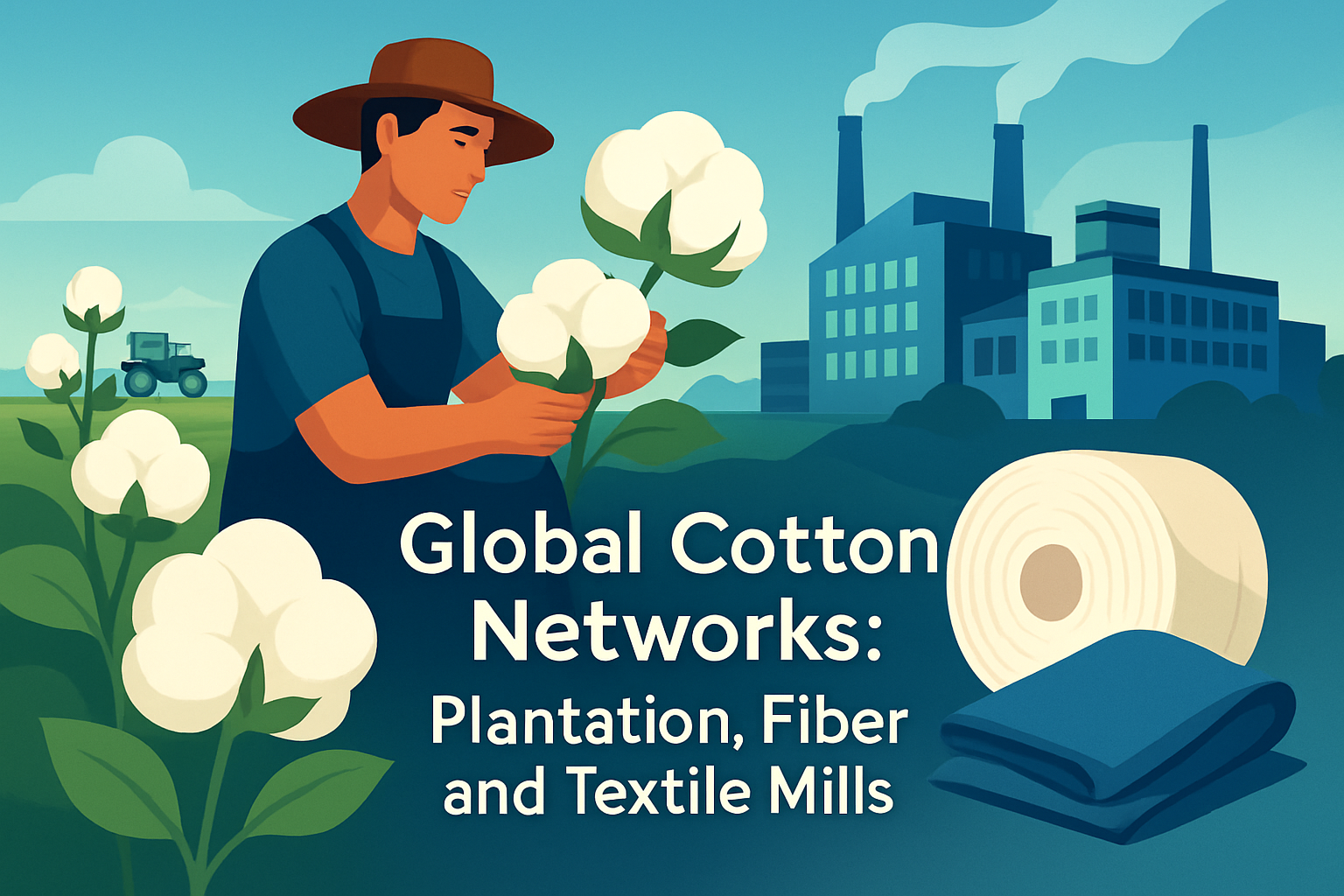
Global cotton networks connect farms, traders, ports, spinning factories, weaving units, brands, and retailers into one of the most influential supply chains in economic history. Cotton is the soft cellulose fiber that grows around the seeds of plants in the genus Gossypium, while textile mills are industrial facilities that clean, spin, weave, knit, dye, and finish that fiber into fabrics and finished goods. The phrase plantation fiber refers to cotton produced at scale on large estates or highly commercial farms, often linked to export markets, credit systems, and labor regimes that shape entire regions. This topic matters because cotton still supports millions of farmers and factory workers, consumes significant land and water resources, and remains central to trade flows from the United States, Brazil, India, and West Africa to mills in China, Bangladesh, Vietnam, Pakistan, and Turkey.
I have worked on supply chain content and manufacturing analyses long enough to see the same pattern repeatedly: people treat cotton farming and textile production as separate subjects, when they are actually inseparable parts of one networked system. A bale grown in Texas or Gujarat does not become economic value simply because it is harvested. Its value emerges through classification, ginning, warehousing, merchanting, shipping, spinning, weaving, garment manufacturing, branding, and distribution. When any link fails, prices move, lead times stretch, and quality claims collapse. That is why understanding global cotton networks requires more than a basic history of plantations or a generic description of mills. It requires tracing how fiber quality, labor systems, technology, logistics, and regulation interact in real commercial settings.
Cotton networks also sit at the intersection of industrialization, colonial expansion, and modern sustainability debates. In the nineteenth century, plantation cotton from the American South fed British mills in Lancashire and helped build industrial capitalism. In the twentieth century, mechanization, synthetic blends, and trade liberalization changed where cotton was grown and processed. Today, procurement teams care about staple length, micronaire, contamination rates, Better Cotton traceability claims, and compliance with forced labor laws as much as they care about price. Searchers usually want direct answers to practical questions: where is cotton grown, how does raw fiber move to mills, why do certain countries dominate textile production, and what risks shape the market. The clearest answer is that global cotton networks are coordinated through quality standards, logistics infrastructure, and purchasing relationships that move plantation fiber toward the mills best equipped to turn specific grades into specific products.
How plantation cotton enters the global market
Plantation cotton becomes tradable only after a sequence of tightly managed post-harvest steps. Farmers harvest seed cotton, which is then sent to gins that separate lint from seed, remove field trash, and press fiber into standardized bales. In most export-oriented systems, classing offices or accredited labs assess staple length, strength, color grade, leaf content, and micronaire, a measure related to fineness and maturity. These attributes are not technical trivia. They determine whether a spinner can run the cotton efficiently on ring frames or open-end equipment, what yarn count is possible, and how much waste the mill will incur. In practice, merchants and mills pay for predictability as much as for fiber itself.
The United States offers a clear example of a mature cotton network. Growers in states such as Texas, Georgia, Mississippi, and Arkansas sell through merchants, cooperatives, or direct contracts. The USDA classing system gives buyers a common language for quality, and bales move through warehouses to ports such as Houston, Savannah, and Memphis-linked inland routes. Brazil has become another major exporter, especially from Mato Grosso, where large-scale farms use advanced agronomy and logistics corridors to move cotton to Asian buyers. India is both a major grower and processor, but domestic demand absorbs much of its output. West African countries including Benin, Burkina Faso, and Mali produce export-oriented cotton that often travels to mills in Asia because local spinning capacity remains limited.
Price formation follows recognizable benchmarks. The ICE cotton futures contract influences international pricing, while merchants negotiate premiums and discounts based on grade, origin, shipment timing, and contamination risk. In my experience reviewing mill procurement strategies, contamination is one of the most underestimated issues in cotton trading. A bale tainted with polypropylene from harvesting materials can create visible defects in dyed fabric and lead to rejected orders downstream. That is why mills often pay more for origins known for cleaner picking, better ginning discipline, or stronger bale management. Cotton may look interchangeable from a distance, but in commercial reality, origin reputation matters.
Why textile mills cluster in specific countries
Textile mills do not simply appear near cotton fields. They cluster where energy, labor, machinery support, trade policy, and export infrastructure align. China built enormous spinning and weaving capacity through industrial policy, scale, and integrated supplier ecosystems. Although labor costs have risen, Chinese mills still benefit from deep technical expertise, chemical supply chains, machine maintenance networks, and port efficiency. Bangladesh dominates garment exports, but it relies heavily on imported cotton and yarn because its strength lies in cut-and-sew manufacturing linked to global apparel brands. Vietnam has expanded spinning and fabric production through trade agreements and foreign direct investment. Pakistan and India remain important because they combine domestic cotton production with longstanding textile capabilities.
A mill location decision usually comes down to conversion economics. Spinners ask whether imported cotton can be landed efficiently, whether power supply is stable enough to avoid damaging stoppages, whether technicians can maintain carding machines and combers, and whether nearby customers will buy yarn or fabric at viable margins. Turkey illustrates the value of geographic position. Its mills source cotton domestically and internationally, process it with relatively advanced equipment, and supply European brands that need shorter lead times than many Asian routes provide. This is why proximity to consumer markets can sometimes outweigh lower labor costs elsewhere.
Industrial specialization matters too. Not every mill is designed for the same outcome. A spinner focused on coarse rotor yarn for denim has different machinery, raw material tolerances, and purchasing behavior than a mill making fine combed yarn for shirting or knitwear. Weaving mills need consistent yarn strength and low hairiness. Knitting mills care about evenness and recovery in ways that differ from woven fabric producers. Dye houses need fabric structures that take color uniformly. When brands select suppliers, they are indirectly selecting the cotton network behind them. The best mills know which origins and grades fit which end use, and they build sourcing programs around that knowledge rather than chasing the cheapest bale on paper.
| Country | Role in the cotton network | Key advantage | Main constraint |
|---|---|---|---|
| United States | Major exporter of raw cotton | Standardized classing and logistics | Weather volatility in producing regions |
| Brazil | Large-scale exporter | High-productivity commercial farming | Long inland transport distances |
| India | Major grower and processor | Large domestic textile base | Variable quality and policy shifts |
| China | Massive spinner and fabric producer | Integrated manufacturing ecosystem | Higher labor and compliance costs |
| Bangladesh | Garment manufacturing hub | Export-oriented apparel scale | Heavy reliance on imported fiber |
| Turkey | Regional textile and apparel supplier | Fast access to European markets | Currency and energy cost pressure |
From bale to fabric: what mills actually do
The path from bale to fabric is mechanical, technical, and unforgiving. First, mills open and blend bales to create a consistent feedstock. Blending is essential because no two bales are identical, and yarn uniformity depends on averaging fiber properties across many lots. The cotton then passes through blowroom equipment and carding machines, which clean and align fibers into a sliver. For higher-quality yarns, combing removes short fibers and neps, improving smoothness and strength. Drawing and roving prepare the material for spinning, where ring, rotor, or air-jet systems twist fibers into yarn. That yarn may then be warped and woven or fed into knitting machines before dyeing, finishing, and inspection.
Each stage introduces both value and risk. If humidity control is poor, fiber handling becomes unstable and end breakage rises. If card settings are too aggressive, mills damage fibers and reduce yarn performance. If bale laydown planning is weak, shade variation and fabric barré become more likely. In factories I have studied, the best operators treat raw cotton selection and process engineering as one discipline, not two. They monitor Uster statistics, waste percentages, machine efficiency, and quality claims from customers at the same time. A spinner producing compact yarn for premium T-shirts cannot rely on average raw material decisions. It needs disciplined contamination control, fiber testing, and machine calibration every day.
Technology has changed mills profoundly, but not evenly. Modern facilities use automated bale pluckers, online contamination sorters, autoconers, laboratory HVI testing, and enterprise planning systems that link procurement to production. Yet many competitive mills still operate with mixed generations of equipment, upgrading selectively where return on investment is clearest. The smartest investments are often not the flashiest ones. Better humidification, spindle maintenance, and operator training can improve quality faster than a headline-grabbing machine purchase. That is a practical reality often missed in simplistic discussions of textile modernization.
Labor, power, and the politics of cotton networks
No serious article about plantation fiber and textile mills can ignore labor systems. Cotton’s historical expansion depended on coercion, especially enslaved labor in the Atlantic economy. The wealth generated by plantation cotton fed industrial growth in Britain and beyond, while the human cost was catastrophic. That legacy still matters because present-day supply chain governance is shaped by concerns about forced labor, debt bondage, unsafe factories, and unequal bargaining power. Laws such as the United States Uyghur Forced Labor Prevention Act have made traceability a commercial necessity, not a public relations option.
Modern mills face their own labor questions. Textile production is labor-intensive even when machinery is advanced, and worker skill affects output in measurable ways. Ring spinning requires attentive supervision. Knitting and weaving departments depend on quick fault response. Garment factories operate under shipment pressure that can drive excessive overtime when planning is poor. After the Rana Plaza disaster in 2013, global scrutiny of Bangladesh’s apparel sector led to stronger building safety systems through initiatives such as the Accord and Alliance frameworks. The lesson was simple and permanent: low-cost production without credible governance creates unacceptable risk for workers and brands alike.
Power and water are equally political. Cotton farming can be water-intensive, especially in arid regions dependent on irrigation. Textile wet processing uses substantial water, chemicals, and heat. Mills in places with unreliable electricity often depend on captive power generation, which raises costs and complicates carbon reduction efforts. Energy price spikes can erase spinning margins in weeks. For that reason, procurement managers now evaluate utility stability alongside labor rates and raw material costs. Sustainability in cotton networks is not just about farm practices. It is also about whether mills can produce fabric with controlled emissions, wastewater treatment, and auditable inputs.
Sustainability, traceability, and the future of cotton trade
The future of global cotton networks will be shaped by three forces: climate pressure, digital traceability, and shifting sourcing strategy. Climate risk is already visible through drought, flooding, heat stress, and pest disruption in major growing regions. These events affect both yield and fiber quality. Merchants and mills increasingly diversify origins to reduce weather concentration risk, and brands ask suppliers to explain not just price changes but resilience plans. Cotton will remain important because it is natural, breathable, and widely accepted by consumers, but the network around it must become more adaptive.
Traceability is moving from document-based claims to data-linked verification. Programs such as Better Cotton, Organic Content Standard, and Global Organic Textile Standard address different parts of the claim landscape, though none eliminates the need for due diligence. Physical traceability remains difficult in a commodity system where fibers are blended, but tools such as bale-level records, transaction certificates, isotopic testing, and DNA marker technologies are improving accountability. In procurement meetings, I have seen how quickly a brand’s sourcing posture changes once customs enforcement or NGO scrutiny enters the picture. Mills that can document inputs clearly gain trust and often win better business.
Nearshoring and regionalization are also reshaping trade routes. European brands are increasing interest in Turkey, North Africa, and parts of Eastern Europe for speed-to-market programs. US brands continue to source from Asia at scale, but there is renewed attention on Western Hemisphere options for selected categories. Even so, no single country will replace Asia’s textile depth soon. The likely outcome is a more diversified network in which raw cotton still travels globally, while fabric and garment production balance cost, compliance, and lead time more carefully than in the past.
Global cotton networks are best understood as living systems that tie plantation fiber to textile mills through quality standards, infrastructure, labor, finance, and technology. Cotton moves from fields to gins, from classing systems to merchants, from ports to mills, and from yarn to fabric and apparel because every participant translates raw fiber into a more specific form of value. The most important takeaway is that cotton is never just an agricultural commodity and mills are never just factories. Together they form a coordinated industrial chain shaped by geography, history, and constant negotiation over cost, quality, and ethics.
For businesses, researchers, and students, the practical benefit of understanding this chain is better judgment. You can evaluate sourcing risk more accurately, read trade news with greater clarity, and recognize why one disruption in farming, shipping, regulation, or energy can ripple across the entire textile market. The strongest cotton networks are not the cheapest at every moment. They are the ones that deliver consistent fiber, efficient conversion, transparent documentation, and credible labor and environmental performance. That combination is what keeps mills running, brands supplied, and customers confident in what they buy.
If you want to go deeper, map one cotton product you use every week back through its likely network: the farm origin, the ginning and export stage, the spinning region, the fabric mill, and the final brand. That simple exercise turns an abstract global system into a visible commercial reality, and it is the fastest way to understand how plantation fiber and textile mills continue to shape world trade today.
Frequently Asked Questions
What does the term “global cotton networks” mean?
Global cotton networks refer to the interconnected system that moves cotton from agricultural production to finished consumer goods. In practical terms, this network begins in cotton-growing regions where the fiber is cultivated, harvested, and prepared for market. From there, it passes through ginners, merchants, commodity traders, shipping firms, ports, warehouses, spinning mills, weaving and knitting units, dye houses, garment manufacturers, brands, and retailers. Each stage adds value and also depends on timing, quality standards, labor, infrastructure, and international trade rules.
What makes these networks especially significant is their global reach and historical depth. Cotton has linked plantations, industrial textile centers, and international trade routes for centuries, shaping labor systems, manufacturing growth, and consumer markets across multiple continents. Today, the same basic network still exists, but it operates with far greater speed, specialization, and technological coordination. A bale of cotton grown in one country may be spun into yarn in another, woven into fabric somewhere else, stitched into apparel in a fourth location, and finally sold worldwide through physical stores and e-commerce channels. That broad chain of movement is what the phrase “global cotton networks” is designed to capture.
What is meant by “plantation fiber” in the cotton industry?
The phrase “plantation fiber” generally describes cotton produced at scale on large estates, extensive commercial farms, or highly organized agricultural operations designed for bulk output. In historical discussions, the term often points to plantation-based cotton production systems that relied on concentrated land ownership and labor-intensive cultivation. In modern usage, it can also refer more broadly to cotton grown within large, export-oriented farming structures that emphasize volume, efficiency, and integration with global supply chains.
This distinction matters because scale affects almost everything in the cotton economy. Large-scale production can influence harvesting methods, fiber consistency, logistics planning, storage systems, and downstream contracts with ginners and mills. Plantation or estate-grown cotton is often associated with standardized production and easier aggregation for international trade, although quality still varies depending on seed type, soil conditions, water availability, pest management, and harvesting practices. The term also carries historical weight, since plantation cotton was central to the rise of industrial textile manufacturing and to major economic transformations in the Atlantic world and beyond. For that reason, “plantation fiber” is not just an agricultural label; it is also a concept tied to labor history, trade expansion, and the industrial development of textiles.
What role do textile mills play in the cotton supply chain?
Textile mills are the industrial link that transforms raw cotton fiber into usable textile materials. After cotton is harvested and ginned to separate lint from seeds and debris, mills begin the process of converting that fiber into yarn and fabric. Spinning mills open, clean, blend, card, and draw the cotton before twisting it into yarns of different counts and strengths. From there, weaving mills interlace yarn into woven cloth, while knitting units produce flexible knitted fabrics used in everything from T-shirts to sportswear. Additional finishing facilities dye, print, bleach, soften, shrink-control, and otherwise treat the material to meet technical and commercial requirements.
Because of this, mills are far more than simple processing sites. They are quality-control centers, technology hubs, and economic engines within the cotton network. Mill decisions determine fabric performance, appearance, and cost, and they influence whether cotton ends up in premium shirting, denim, home textiles, industrial fabrics, or mass-market apparel. Textile mills also connect agriculture to manufacturing demand by specifying fiber length, strength, cleanliness, and consistency. If the raw cotton does not match mill requirements, the final product may suffer. In global trade, competitive mills often succeed through a combination of machinery, labor skills, sourcing strategy, energy access, compliance standards, and production speed. In short, textile mills are where cotton becomes commercially useful at scale.
Why has cotton become one of the most influential supply chains in economic history?
Cotton became one of the world’s most influential supply chains because it sits at the intersection of agriculture, industry, trade, labor, and consumer demand. Historically, cotton was a crucial raw material for the expansion of mechanized textile production, particularly during the Industrial Revolution. Its suitability for spinning, weaving, dyeing, and mass consumption made it ideal for industrial manufacturing. As demand for cotton cloth rose, so did the need for larger supplies of raw fiber, more efficient transport systems, bigger ports, stronger merchant networks, and increasingly sophisticated factory organization.
The impact went far beyond clothing. Cotton stimulated banking, insurance, shipping, warehousing, rail development, machinery innovation, and international commerce. It also deeply influenced land use, colonial expansion, labor systems, and the growth of manufacturing cities. Even in the modern era, cotton remains economically powerful because it supports extensive upstream and downstream industries, from seed technology and farm equipment to fashion retail and global logistics. Its influence persists not simply because it is a common fiber, but because it has long connected rural producers to industrial processors and worldwide markets in a highly structured, scalable, and commercially valuable system.
How do farms, traders, ports, mills, brands, and retailers stay connected in modern cotton networks?
Modern cotton networks stay connected through a combination of physical logistics, contractual relationships, quality verification, and digital information systems. Farmers and large producers sell seed cotton or ginned lint into local and international channels, often through cooperatives, merchants, brokers, or trading firms. Traders aggregate supply, manage risk, arrange financing, and match cotton qualities with the needs of spinning mills. Ports then serve as critical transfer points, linking producing regions to overseas manufacturing centers through container shipping and bulk logistics. Once cotton reaches mills, manufacturers process it according to yarn, fabric, and product specifications provided by buyers further down the chain.
Brands and retailers influence the network by setting standards for price, lead times, quality, sustainability, and traceability. Their sourcing teams may require particular fiber grades, certifications, testing protocols, and social compliance measures from suppliers. To keep everything moving, participants rely on shipping schedules, commodity market data, warehouse documentation, mill planning systems, and increasingly detailed supply chain tracking tools. Communication across the network is essential because disruption at any stage, whether from weather, port congestion, labor shortages, trade policy changes, or fluctuating demand, can affect every participant. That is why global cotton networks function best when agricultural output, transport capacity, industrial processing, and market intelligence are all aligned. The system is vast, but it remains tightly interconnected from field to finished product.