
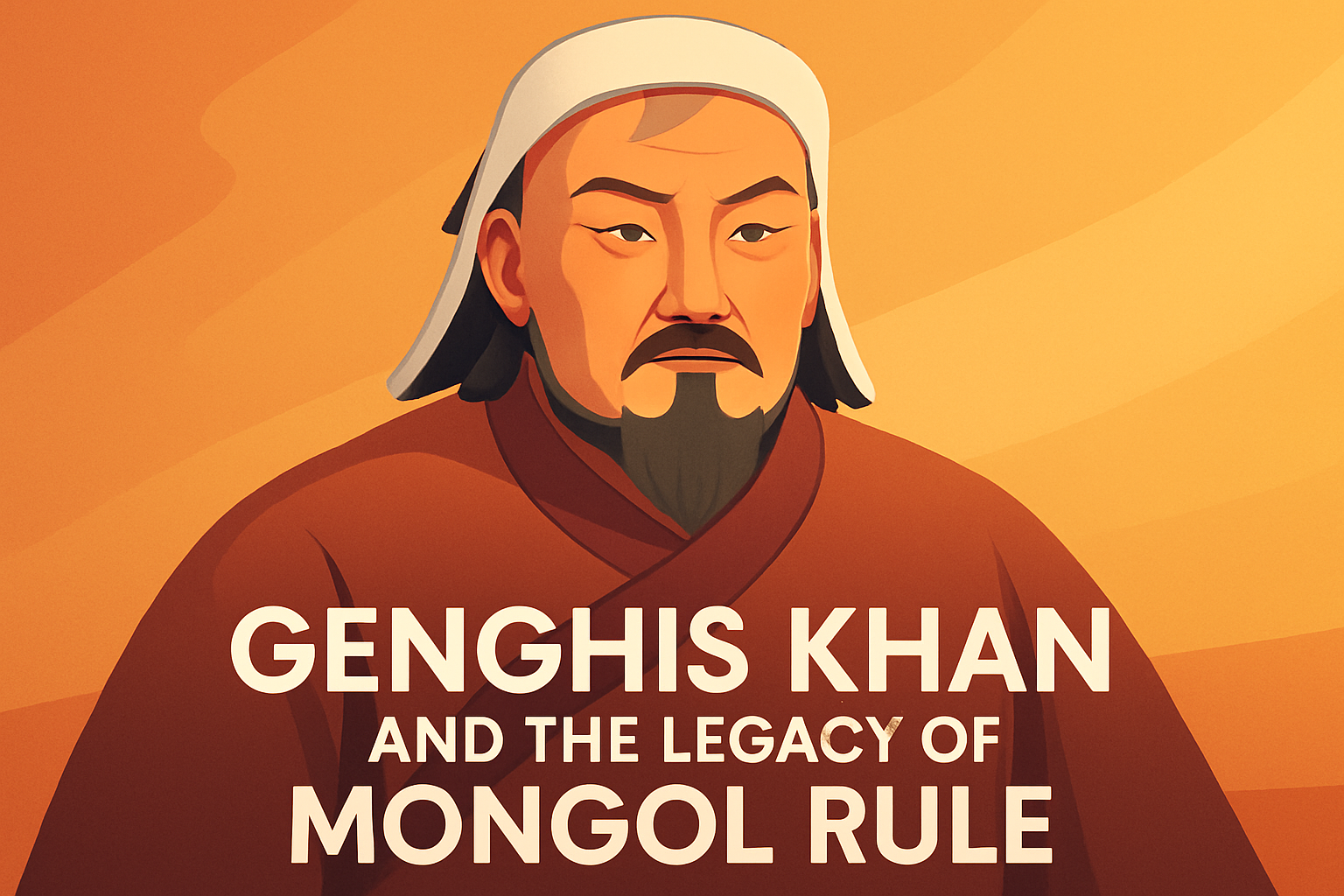
Introduction to Genghis Khan and Mongol Rule
Genghis Khan, born as Temüjin in 1162, emerged from the stark plains of Mongolia to become one of history’s most infamous conquerors. By unifying the Mongol tribes, he set the stage for an unprecedented era of empire-building and global transformation. His life’s work led to the Mongol Empire, which at its height stretched from Eastern Europe to the Sea of Japan, making it the largest contiguous land empire in history. Understanding Genghis Khan’s legacy is crucial because it reshaped the world’s geopolitics and influenced cultures, economies, and societies across continents. This exploration of Genghis Khan and Mongol rule will delve into the strategies, impacts, and lasting legacies of this formidable empire.
Unification of the Mongol Tribes
Genghis Khan’s first significant achievement was the unification of the diverse and warring Mongol tribes. Through strategic alliances and conquests, he brought together tribes that were traditionally antagonistic. This unification was not merely political; it involved creating a common legal code, known as the Yassa, which established laws and penalties that were uniformly applied across his domain.
One example of how Genghis Khan ensured unity was his promotion based on merit rather than nobility, which bolstered loyalty and efficiency. His strategic brilliance was evident in his use of sophisticated military tactics, such as the feigned retreat, which tricked the enemy into pursuing a seemingly retreating Mongol force, only to be ambushed when they were most vulnerable.
The unification of these tribes under Genghis Khan was essential as it transformed a collection of nomadic tribes into a disciplined and formidable fighting force. This unification had lasting impacts, laying the foundations for the rapid expansion that followed.
The Military Strategy and Conquests
Genghis Khan’s military strategies were innovative and ruthless, laying the groundwork for his empire’s expansion. His army was structured around a decimal system with units of 10, 100, 1,000, and 10,000 soldiers, allowing for flexibility and efficiency. Commanders were chosen based on skill rather than kinship, ensuring competence and loyalty.
The Mongol conquests were marked by the speed and mobility of their cavalry, which could cover vast stretches of land rapidly. The adept use of psychological warfare, including the spread of fear through tales of Mongol brutality, often led to cities surrendering without a fight. A noteworthy example is the Siege of Bukhara in 1220, where Mongol forces razed the city after it attempted resistance, reinforcing the fearsome reputation that preceded Mongol armies.
This military prowess was a key element in the rapid expansion of the empire, leading to domination over vast territories across Asia and Europe, and leaving a mark on military strategy that is studied to this day.
Administration and Governance of the Empire
Genghis Khan displayed not only military acumen but also administrative brilliance. The vast Mongol Empire required a sophisticated system of governance to maintain control over diverse and geographically distant regions. To manage such an expansive territory, he implemented a decentralized administrative system that allowed local leaders some autonomy while ensuring loyalty to the Mongol supreme leadership.
One of the significant administrative innovations was the establishment of a relay station system known as the Yam. It facilitated rapid communication across the empire, significantly enhancing administrative efficiency and coordination. This system allowed for the swift delivery of messages and goods, thus integrating the empire economically and politically.
The Mongol governance model allowed them to adapt and administer across different cultures and regions. It was a crucial aspect of maintaining control and leveraging the empire’s vast resources, contributing to the Mongols’ enduring legacy in terms of empire management.
Mongol Impact on Trade and Culture
The Mongol Empire played a pivotal role in the development of global trade and cultural exchange. By unifying such a vast expanse, the Mongols effectively reopened and secured the Silk Road, which had been under threat from various military conflicts. The peace and stability established by Mongol rule, known as the Pax Mongolica, facilitated unprecedented trade between the East and West.
Real-world examples of this impact include the increased trade of silk, spices, and precious metals, which flowed across the continent. The Mongols’ open attitude towards merchants and diplomats from different cultures further stimulated the exchange of goods and ideas. Notably, Marco Polo’s travels to the Mongol courts are a testament to the cultural exchanges occurring at the time, leading to a greater understanding and interaction between Europe and Asia.
This increased trade and cultural interaction had long-term effects, introducing diverse goods and knowledge across continents and laying the groundwork for future global exchanges.
Mongolian Influence on Modern Geopolitics
The Mongol Empire’s influence extends beyond historical expansion; it has left a significant imprint on the modern world. The territorial expansions and political repercussions shaped borders and national identities that exist to this day. The integration of diverse cultures under Mongol rule fostered a period of relative peace and stability across Asia, influencing the development of national systems in these regions.
To contextualize, consider countries like Russia and China. The Mongol rule directly shaped Russia’s historical trajectory, influencing its centralization of power and expansionist policies. In China, the Mongols established the Yuan dynasty, integrating various administrative practices and cultural exchanges that would influence Chinese society profoundly.
The legacy of the Mongol Empire is thus foundational in understanding the current geopolitical landscape. It highlights how historical conquests and cultural integrations can echo through centuries, shaping contemporary nations and cultures.
| Aspect | Impact | Example |
|---|---|---|
| Military Strategy | Innovative tactics and organization | Decimal system in army structure |
| Governance | Decentralized administration | Yam relay system |
| Trade and Culture | Reopening of the Silk Road | Marco Polo’s travels |
| Geopolitics | Formation of modern borders | Impact on Russian and Chinese history |
Enduring Lessons and Conclusion
The story of Genghis Khan and the Mongol Empire offers a trove of lessons and insights relevant to various fields of study today. The empire’s legacy in military tactics, governance, trade, and culture illustrates the profound effect leadership and policy can have across centuries. It underscores the importance of adaptability, strategic thinking, and integration in managing large-scale organizations and nations.
For modern readers, understanding this historical context provides valuable perspectives on global trade practices, cultural integration, and geopolitical strategies. The Mongol Empire exemplifies how management of diversity and centralized policies can either bind regions together or implode under inefficiencies, a lesson that holds true across eras.
We invite you to further explore the rich tapestry of history woven by Genghis Khan and the Mongol Empire. Delve into how these historical narratives continue to influence world affairs today. Whether you’re interested in history, strategy, or cultural studies, there’s a wealth of knowledge waiting to be unearthed from this formidable empire’s past.
Frequently Asked Questions
1. Who was Genghis Khan and what was his significance in history?
Genghis Khan, originally named Temüjin, is one of history’s most renowned conquerors, credited with the creation of the largest contiguous land empire the world has ever seen. Born in 1162 on the harsh plains of Mongolia, he rose from obscurity to unite the Mongol tribes, a feat accomplished through strategic alliances and military conquests. His leadership and vision laid the groundwork for the Mongol Empire, stretching from Eastern Europe to the Sea of Japan. Nicknamed the “Universal Ruler,” Genghis Khan’s significance lies in his role in changing the course of history by introducing unprecedented levels of connectivity across cultures and nations, facilitating trade, exchange, and cultural diffusion on a global scale.
2. How did Genghis Khan manage to unify the Mongol tribes?
Unifying the Mongol tribes was a monumental challenge that Genghis Khan achieved through a combination of diplomacy, innovative military tactics, and a robust legal system. He built alliances with powerful warlords through marriages and pacts, which helped him consolidate power. His military genius lay in his ability to break away from traditional Mongol warfare, employing highly mobile army units and modern siege technologies adapted from conquered regions. Additionally, the introduction of the Yassa, a set of laws promoting meritocracy and discipline, incentivized loyalty among his followers. His charisma and vision attracted many to his cause, transforming a collection of fractious tribes into a unified, formidable force.
3. What was the extent of the Mongol Empire at its peak?
At its zenith, the Mongol Empire was unprecedented in scope, stretching from the shores of Eastern Europe across Asia to the Sea of Japan. It encompassed vast territories including modern-day China, Mongolia, Korea, portions of Central Asia, Russia, and even parts of the Middle East and Eastern Europe. This tremendous expanse spanned a variety of climates and cultures, linking disparate regions into a single economic and political framework. The empire facilitated the movement of goods, ideas, and technologies between West and East, contributing to significant cultural and intellectual exchanges during the period.
4. What is Genghis Khan’s legacy on modern civilization?
Genghis Khan’s legacy is profound and multifaceted, touching various aspects of modern civilization. He established principles of religious tolerance and laid the early foundations for global trade by securing safe passage along what would become the Silk Road. Under Mongol rule, the exchange of goods, ideas, and innovations between East and West was unprecedented, leading to advancements in technology and culture. Moreover, his meritocratic approach to governance and the influence of the Mongol legal code (Yassa) resonated in many areas, paving the way for modern concepts like cultural exchange, international law, and centralized administration. Despite the typical portrayal as a ruthless conqueror, his contributions to spreading cultural diversity and knowledge are undeniable.
5. How did the Mongol Empire impact trade and cultural exchange?
The Mongol Empire significantly revolutionized trade and cultural exchange, primarily through the safety and stability it brought to the vast territories under its control. The Pax Mongolica, akin to the Roman Peace, ensured secure routes for merchants and travelers along the Silk Road. This unprecedented era of safety promoted robust exchanges of goods, such as silk, spices, and precious metals, facilitating wealth accumulation and economic development across continents. Furthermore, Mongol rule catalyzed cultural interactions, allowing travelers like Marco Polo to explore and document diverse societies. Innovations and ideas in science, technology, and arts also flourished under Mongol influence, with scholars and artisans sharing their expertise across the vast reaches of the empire, effectively knitting regions together in a tapestry of cultural enrichment and understanding.