
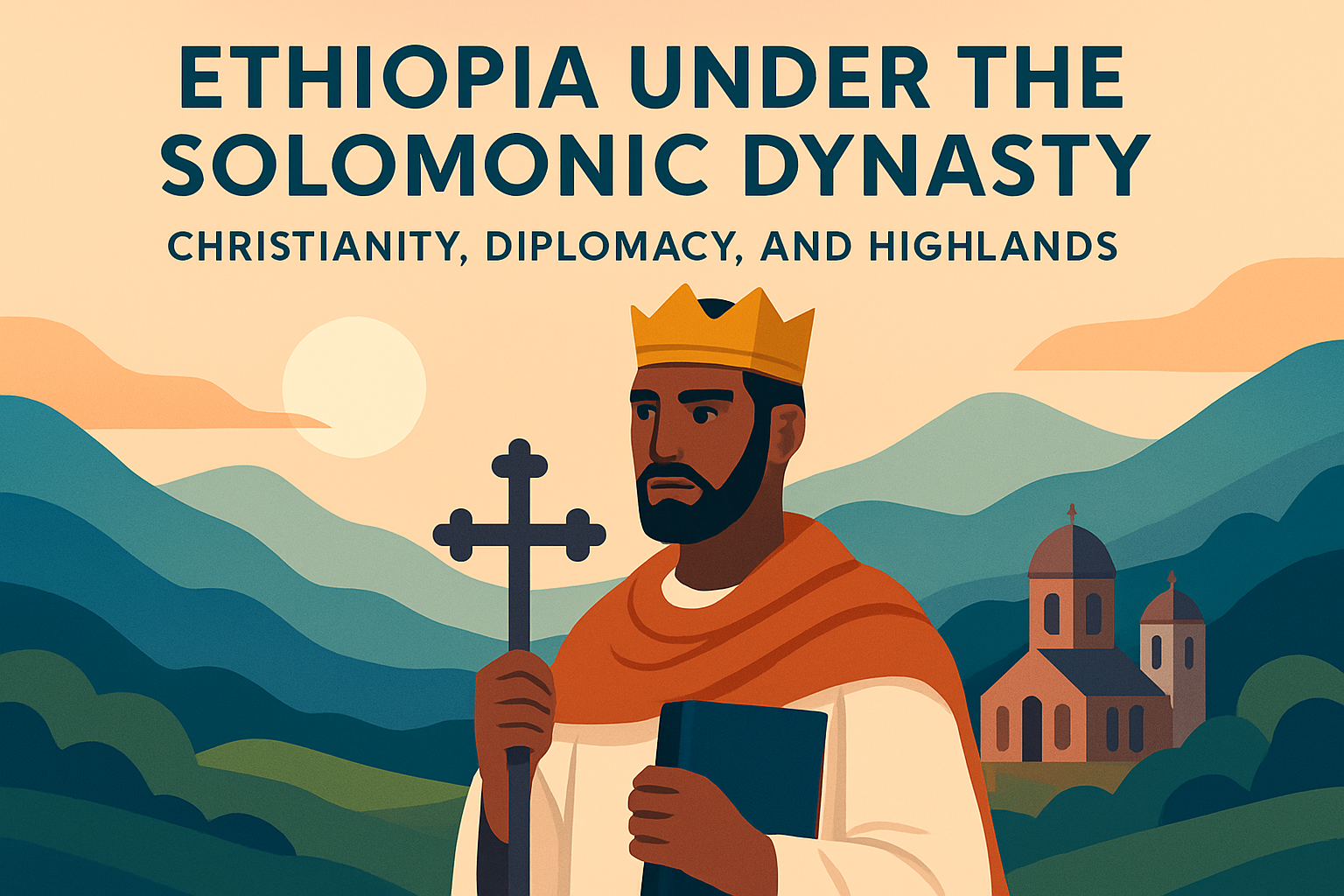
Ethiopia under the Solomonic Dynasty was a highland Christian kingdom that combined sacred kingship, military resilience, and skillful diplomacy to shape one of the longest continuous monarchic traditions in world history. Historians usually date the dynasty from 1270, when Yekuno Amlak overthrew the Zagwe rulers and claimed restoration of the ancient royal line, to 1974, when the monarchy ended under Haile Selassie. In practice, the medieval and early modern Solomonic centuries are the most important for understanding how Christianity, diplomacy, and geography worked together. The Ethiopian highlands were not just a backdrop. They were the ecological core of the state, the source of food surplus, defensive strength, monastic learning, and political legitimacy.
The term Solomonic refers to the dynasty’s claim of descent from King Solomon of Israel and the Queen of Sheba, known in Ethiopian tradition as Makeda. That genealogy was not a minor legend. It formed the ideological spine of the monarchy, especially through the Kebra Nagast, a foundational text that linked Ethiopian kingship to biblical history and the Ark of the Covenant. Christianity, adopted centuries earlier in the Aksumite world, gave the Solomonic rulers a shared language of law, ritual, and authority. Diplomacy connected that highland kingdom to Muslim sultanates, Coptic Egypt, the wider Red Sea, and eventually Portugal, Rome, and the Ottoman frontier. Together, these forces explain how Ethiopia remained independent for so long despite repeated regional pressures.
I have found that readers often picture Ethiopian history through isolated events such as the battle of Adwa or the reign of Haile Selassie, but the Solomonic period makes those later developments intelligible. The dynasty created durable institutions: royal itinerancy, regional lordship, monastic networks, land grants to churches, and a political theology that made the king both military commander and defender of the faith. It also produced a cultural world expressed in Ge’ez liturgy, illuminated manuscripts, rock-hewn and later masonry churches, sacred music, and court chronicles. If you want to understand Ethiopia’s state formation, religious identity, and foreign relations, the Solomonic age is the essential starting point.
Why do Christianity, diplomacy, and the highlands belong in the same frame? Because each depended on the others. Christianity legitimized the dynasty and helped unify elites across difficult terrain. Highland ecology sustained armies and monasteries, while mountain barriers made conquest costly for rivals. Diplomacy managed the kingdom’s place among stronger maritime powers and neighboring Muslim states, securing trade access and occasional military alliances. Ethiopia was neither isolated nor fully integrated into surrounding empires. It survived by controlling passes, mobilizing regional loyalties, and using religious prestige as a political asset. That combination is what made Solomonic Ethiopia distinctive.
Restoration of the Solomonic line and the making of sacred monarchy
When Yekuno Amlak seized power in 1270, he did more than found a new ruling house. He reframed Ethiopian kingship as a restoration. The Zagwe dynasty had built impressive monuments, especially at Lalibela, but Solomonic court ideology cast them as interlopers who had interrupted the legitimate biblical line. This was politically effective because it allowed the new dynasty to present rebellion as rightful renewal. In the chronicles and later traditions, the king was not merely a successful warlord. He was the guardian of a covenantal kingdom. That mattered in a landscape where local nobles, military chiefs, and church leaders all held real power.
The Solomonic monarchy governed through a blend of charisma, ritual, and negotiation. Unlike centralized bureaucratic states with fixed capitals, medieval Ethiopia often relied on a mobile court. The king traveled with retainers, clergy, and troops, collecting tribute, rewarding loyalty, and demonstrating presence across the highlands. This itinerant system was practical because terrain made communication slow and local autonomy hard to eliminate. It was also political theater. Royal movement displayed power, tied distant regions to the crown, and enabled the monarch to mediate among competing elites. In my experience analyzing premodern states, this kind of mobility is often mistaken for weakness. In Ethiopia it was a deliberate method of rule adapted to geography.
Texts and ritual deepened that authority. The Kebra Nagast linked the monarchy to sacred history, while coronation ceremonies and church patronage turned dynastic claims into lived public memory. Kings endowed monasteries, commissioned manuscripts, and sponsored church building not only from devotion but because these acts anchored legitimacy in institutions that reached into provincial society. Monks and clergy could challenge rulers, yet they also helped define the realm as a Christian commonwealth. The result was a monarchy stronger in symbolic authority than many of its material resources might suggest.
Christianity as state framework, social bond, and source of contest
Ethiopian Christianity under the Solomonic Dynasty was not simply personal belief. It was a governing framework, a cultural system, and a diplomatic identity. The Ethiopian Orthodox Tewahedo tradition preserved ancient liturgy in Ge’ez, followed a miaphysite Christology linked historically to the Coptic Church of Alexandria, and organized sacred time through fasts, feasts, saints’ days, and processions that structured daily life. The metropolitan bishop, or abuna, was traditionally appointed from Egypt, which created a lasting connection between Ethiopian rulers and the Coptic patriarchate. That dependence gave Egypt indirect leverage, but it also tied Ethiopia to one of the oldest Christian traditions in the world.
Church institutions shaped landholding and learning. Royal grants known broadly as church lands supported monasteries, clergy, and liturgical life. Monastic centers became hubs of manuscript copying, theological debate, education, and regional influence. Important communities such as Debre Libanos could bless rulers, criticize policy, and preserve historical memory. Christian identity also influenced law and kingship. The ideal ruler defended orthodoxy, protected churches, and punished enemies of the faith, but reality was more complex. Court politics, succession struggles, and regional rebellions constantly tested that ideal.
Religious unity was never complete. The Solomonic world included Muslims, Jews known historically as Beta Israel, practitioners of local traditions, and Christians divided by theological and monastic disputes. In the seventeenth century, for example, the Catholic mission and the conversion of Emperor Susenyos created a severe crisis. Jesuits, backed by Portuguese connections and Roman universal claims, sought doctrinal and liturgical change. The backlash was immediate and violent because many Ethiopian clergy and nobles viewed Catholicism as an attack on inherited practice and political autonomy. Fasilides reversed the policy in 1632, expelled missionaries, and restored Orthodox primacy. The episode shows that Christianity unified the kingdom, but only when rooted in Ethiopian forms rather than imported control.
Highlands geography: why the Ethiopian plateau made the dynasty durable
The Ethiopian highlands were the strategic engine of the Solomonic state. Elevation moderated climate, reduced some tropical disease burdens, and created more favorable conditions for grain cultivation and cattle raising than many surrounding lowlands. Highlands agriculture, especially in provinces such as Amhara and Shewa, could sustain dense populations relative to nearby regions. Those populations furnished soldiers, labor, taxes in kind, and church endowments. Terrain also shaped defense. Steep escarpments, narrow approaches, and elevated strongholds made invasion difficult and gave local rulers time to mobilize. This was not invulnerability, but it raised the cost of conquest dramatically.
The relationship between landscape and politics can be stated clearly: the highlands enabled state survival by supporting food production, fragmenting enemy advances, and preserving autonomous centers of resistance. Even powerful outsiders struggled to hold mountain territory for long. Armies entering from the Red Sea corridor, the Sudanese frontier, or the southeastern plains faced supply problems, seasonal constraints, and unfamiliar topography. Solomonic rulers used these conditions effectively, retreating, regrouping, and counterattacking when necessary. The dynasty’s resilience during the wars of the sixteenth century makes no sense without this highland advantage.
| Highland factor | Political effect | Historical example |
|---|---|---|
| Elevated climate | Supported stable farming and population concentration | Core provinces supplied armies and court retinues |
| Mountain barriers | Slowed invasions and favored defenders | Regional resistance persisted even after major defeats |
| Plateau networks | Linked monasteries, nobles, and royal camps | Mobile courts governed without a permanent fixed capital |
| Escarpments and passes | Created defensible choke points | Campaigns depended on controlling routes rather than open plains |
Geography also shaped culture. Monasteries flourished in remote highland settings where isolation encouraged scholarship and ascetic life. Church architecture adapted to local materials, from excavated sanctuaries to circular and rectangular structures in later periods. Regional identities remained strong because valleys and plateaus could sustain communities with distinctive political traditions. That localism limited centralization, yet it also gave the kingdom depth. When one center fell, another could become the seat of recovery.
Diplomacy across the Red Sea, Nile world, and Horn of Africa
Solomonic Ethiopia practiced diplomacy because geography demanded it. The kingdom had no easy, secure outlet to the sea for most of its history, yet it needed access to trade goods, ecclesiastical ties, and foreign intelligence. Relations with Egypt were especially sensitive. Since the Coptic patriarch appointed the abuna, Ethiopian rulers sought good relations with Cairo, while also understanding that Muslim governments in Egypt might pressure the church hierarchy. Nile politics became a recurring theme in diplomatic language, with Ethiopian rulers sometimes invoking the Blue Nile headwaters as a symbolic counterweight to Egyptian influence, even when their practical ability to act was limited.
To the east and southeast, Ethiopia interacted with Muslim polities such as Ifat and Adal through war, trade, tribute, and border negotiation. It is a mistake to describe these contacts as a simple religious clash. Competition often centered on trade routes, pasture, taxation, and regional supremacy. Muslim merchants connected the interior to the Red Sea and Indian Ocean systems, while Christian rulers aimed to control corridors that generated wealth. Diplomatic marriages, truces, prisoner exchanges, and tribute arrangements all appeared alongside raids and campaigns. The frontier was politically active, not a fixed civilizational wall.
European diplomacy intensified in the fifteenth and sixteenth centuries. Portuguese interest in Ethiopia grew from crusading strategy, commerce, and the search for the legendary Prester John. By the time of Emperor Lebna Dengel and especially during the wars against Ahmad ibn Ibrahim al-Ghazi, known in Ethiopian sources as Ahmad Gragn, Portuguese military aid became decisive. A small contingent under Cristovao da Gama brought firearms and tactical support in the 1540s. Their intervention did not save Ethiopia alone, but it altered the balance at a critical moment. This is a useful diplomatic lesson: symbolic alliances matter most when they align with local capacity and timing.
War, recovery, and the limits of alliance in the sixteenth and seventeenth centuries
The greatest crisis of the Solomonic era came with the campaigns of Ahmad Gragn, leader of the Adal Sultanate, between 1529 and 1543. Using firearms, cavalry, and a coalition built across the Muslim frontier, Ahmad devastated much of the Christian kingdom. Churches were burned, provinces were overrun, and the old political order nearly collapsed. Contemporary chronicles convey a world in which royal authority shrank to survival. Yet the kingdom endured. Highland refuges, local resistance, and eventual Portuguese support allowed the Solomonic state to regroup. Ahmad’s death in 1543 changed the military picture, but recovery remained slow and incomplete.
Another major transformation followed soon after: the Oromo expansions into central and northern regions during the later sixteenth century. These movements were not a single invasion but a broad, dynamic process of migration, settlement, conflict, and assimilation. They reshaped demographics, military organization, and regional politics across the highlands and adjacent zones. Solomonic rulers responded with war, incorporation, and negotiated accommodation. Over time, Oromo groups became central participants in Ethiopian political life. This is one of the clearest examples of why simplistic narratives fail. The dynasty survived not by freezing identity but by absorbing change.
The seventeenth century brought partial stabilization under emperors such as Fasilides, who founded Gondar as a royal capital in 1636. Gondar did not create a modern centralized state, but it marked a new courtly phase with more permanent architecture, ceremonial life, and administrative clustering. Castles, churches, and urban institutions gave the monarchy a visible center, while the expulsion of Jesuits reaffirmed religious sovereignty. Still, alliances had limits. Portuguese aid had come with missionary pressure. Catholic diplomacy promised connection to wider Christendom but threatened ecclesiastical independence. Solomonic rulers learned that foreign help could solve immediate military problems while creating long-term internal fractures.
Culture, economy, and the long legacy of the Solomonic highland kingdom
The Solomonic Dynasty left a legacy far beyond dynastic chronology. It shaped Ethiopia’s historical memory, visual culture, and political vocabulary. Court chronicles established models for recording reigns and campaigns. Church painting developed a recognizable style with large expressive eyes, vivid biblical scenes, and local saintly traditions. Liturgical music associated with Saint Yared remained central to worship, while Ge’ez endured as a sacred and scholarly language even after spoken court languages changed. These are not decorative details. They explain how a kingdom reproduced identity across centuries of war and regional diversity.
Economically, the dynasty relied on agriculture, tribute, long-distance trade, and control over people more than on uniform cash taxation. Salt bars, livestock, grain, slaves, and imported luxury goods moved through regional markets. Trade linked the highlands to Zeila, Massawa, Suakin, and inland caravan routes. Because routes could shift with war and politics, rulers tried to dominate chokepoints rather than every exchange directly. Land tenure remained layered and contested, with rights divided among crown, church, nobles, and local communities. That complexity often reduced efficiency, but it also distributed power in ways that kept provincial elites invested in the system.
The long-term significance of Solomonic Ethiopia lies in endurance with adaptation. The dynasty preserved Christian statehood in Africa outside European colonial frameworks, negotiated with Islamic powers without disappearing into them, and used highland ecology to survive repeated military shocks. Its institutions were not modern, egalitarian, or fully centralized. Succession struggles, regional fragmentation, and religious coercion were real weaknesses. Yet judged in historical context, the achievement is substantial. For anyone studying African state formation, comparative monarchy, or religion and politics, Ethiopia under the Solomonic Dynasty offers a precise lesson: durable states are built when ideology, landscape, and diplomacy reinforce each other.
Ethiopia under the Solomonic Dynasty mattered because it fused sacred kingship, Orthodox Christianity, and highland strategy into a political system that lasted for centuries. The dynasty’s rulers claimed biblical legitimacy, but they survived through practical governance: mobile courts, church alliances, regional bargaining, and careful diplomacy with Egypt, Muslim neighbors, and European powers. Christianity gave the kingdom coherence and identity. The highlands provided food, refuge, and defensive depth. Diplomacy connected Ethiopia to the Red Sea, the Nile world, and global Christianity while helping leaders manage threats they could not defeat alone.
The central takeaway is straightforward. Solomonic Ethiopia was neither an isolated mountain kingdom nor a passive relic of antiquity. It was an adaptive state that used religion, geography, and foreign relations as working tools of survival. Its history explains later Ethiopian resilience and helps correct shallow narratives about Africa’s past. If you are exploring Ethiopian history further, continue with the Kebra Nagast, the chronicles of Amda Seyon and Zara Yaqob, and the sixteenth-century wars, because those sources reveal how ideology and strategy operated together on the ground.
Frequently Asked Questions
What was the Solomonic Dynasty, and why is it so important in Ethiopian history?
The Solomonic Dynasty was the ruling royal house that dominated Ethiopia from 1270 until the end of the monarchy in 1974, though historians are especially interested in its medieval and early modern centuries. Its founder, Yekuno Amlak, overthrew the Zagwe rulers and presented his victory as a restoration of an older and more sacred royal line. According to dynastic tradition, the Solomonic kings claimed descent from King Solomon of Israel and the Queen of Sheba, a genealogy that gave Ethiopian monarchy an unusually powerful religious legitimacy. This idea of sacred kingship became central to how rulers justified authority, organized the state, and presented Ethiopia to both subjects and foreign powers.
The dynasty matters because it helped create one of the world’s longest continuous monarchic traditions while preserving a distinct Christian civilization in the Ethiopian highlands. Under Solomonic rule, Ethiopia developed durable political institutions, a rich court culture, a strong monastic tradition, and an enduring written historical record in Ge’ez and other languages. The dynasty also became known for balancing warfare and diplomacy. Its rulers defended the kingdom against regional rivals, negotiated with Muslim states and later European powers, and maintained a political identity that was both African and deeply tied to wider Christian networks. In that sense, the Solomonic Dynasty was not just a sequence of kings; it was the framework through which Ethiopia’s religion, politics, military life, and international image evolved over many centuries.
How did Christianity shape the Solomonic state and its rulers?
Christianity was at the heart of Solomonic Ethiopia. The Ethiopian Orthodox Tewahedo Church did not simply coexist with the monarchy; it helped define the monarchy’s meaning. Solomonic rulers claimed that their authority was more than political. They were guardians of a Christian kingdom with a sacred historical mission. This gave royal rule a spiritual dimension that was reinforced through coronation rituals, church patronage, manuscript production, and the construction of monasteries and churches across the highlands. The dynasty’s legitimacy rested heavily on its image as defender of the faith, especially in periods of war or dynastic instability.
Christianity also shaped administration, education, and culture. Clergy and monastic scholars preserved texts, trained elites, and played a major role in recording royal genealogies, religious traditions, and historical chronicles. The church calendar structured public life, while theology influenced law, art, music, and architecture. Yet this close relationship between crown and church also brought tension. Different monasteries and clerical factions sometimes disagreed over theology and royal policy, and kings often had to manage disputes within the church as carefully as conflicts on the battlefield. Even so, the Christian identity of the Solomonic state remained one of its defining features, helping Ethiopia maintain a sense of continuity and exceptionalism in a region marked by changing political and religious frontiers.
Why were the Ethiopian highlands so important to the strength of the Solomonic Dynasty?
The highlands were the geographical foundation of Solomonic power. Ethiopia’s elevated terrain provided natural defenses that made invasion difficult and allowed rulers to build political authority in a comparatively secure environment. Mountain chains, escarpments, and rugged plateaus created strongholds where royal courts, monasteries, and local elites could survive external pressure and internal unrest. This landscape did not make the kingdom invulnerable, but it gave Solomonic rulers strategic advantages that many neighboring states lacked. Armies familiar with the terrain could move effectively through difficult country, while enemies often struggled with distance, climate, and supply lines.
The highlands were also essential economically and culturally. Their agricultural base supported dense populations, sustained royal armies, and financed both courtly and religious institutions. Highland communities became centers of Christian learning, manuscript culture, and artistic production, reinforcing the dynasty’s ideological core. At the same time, the highlands shaped the limits of the state. Solomonic kings often exercised strongest control in core upland areas, while influence over lowland and frontier regions depended on negotiation, tribute, military campaigns, and alliances with regional elites. So when historians describe the Solomonic kingdom as a “highland Christian monarchy,” they are pointing to more than geography. They are describing the environmental setting that made its politics, faith, military resilience, and cultural continuity possible.
How did Solomonic Ethiopia manage diplomacy with Muslim neighbors and foreign Christian powers?
Solomonic Ethiopia survived for so long in part because its rulers were skilled diplomats. The kingdom existed in a complex regional world that included Muslim sultanates in the Horn of Africa, Red Sea trade networks, and eventually expanding European maritime powers. Relations with Muslim neighbors were not defined only by warfare, even though major conflicts certainly occurred. There were also periods of coexistence, trade, negotiation, and shifting alliances. Ethiopian kings had to be pragmatic. They defended the kingdom when necessary, but they also understood that diplomacy could stabilize frontiers, secure commerce, and prevent the state from becoming isolated.
Foreign Christian relations were equally important, especially from the late medieval period onward. Solomonic rulers cultivated ties with other Christian communities and later with European states, partly out of religious solidarity and partly for strategic reasons. They sought military support, diplomatic recognition, artisans, and access to wider political networks. The Portuguese alliance in the 16th century is a famous example, especially during the wars against Ahmad ibn Ibrahim al-Ghazi, when foreign military assistance played a major role. Yet diplomacy with Christian Europe was never simple. Religious differences, especially over doctrine and church authority, created friction, and Ethiopian rulers were careful not to surrender their ecclesiastical independence or political autonomy. The result was a diplomatic tradition that was flexible, selective, and deeply rooted in the dynasty’s effort to preserve sovereignty while engaging with a wider world.
What challenges did the Solomonic Dynasty face, and how did it endure for so many centuries?
The Solomonic Dynasty faced repeated and serious challenges, which makes its longevity especially remarkable. Internally, kings had to manage rival nobles, regional power centers, succession disputes, and shifting military loyalties. Ethiopia was not a centralized modern state, and royal authority often depended on personal leadership, military success, and the ability to maintain alliances with provincial elites and church institutions. There were also periods when emperors were strong and commanding, and other times when power fragmented or became contested. Religious debates within the Ethiopian Church could further complicate governance, since theological disputes often had political consequences.
Externally, the dynasty confronted invasions, border wars, and competition over trade and influence. The 16th-century wars associated with Ahmad ibn Ibrahim al-Ghazi were among the most destructive crises in Ethiopian history, threatening the very survival of the Christian kingdom. Later centuries brought new pressures from Oromo migrations, changing regional political balances, and eventually the growing presence of European imperial powers. The dynasty endured because it was adaptable. It drew legitimacy from sacred kingship, but it also relied on practical tools: mobile courts, military organization, strategic marriages, church alliances, regional negotiations, and diplomatic outreach. Its rulers could invoke ancient lineage while making realistic decisions about war, alliance, and administration. That combination of mythic legitimacy and political flexibility helps explain why the Solomonic monarchy remained such a durable force in Ethiopian history for hundreds of years.