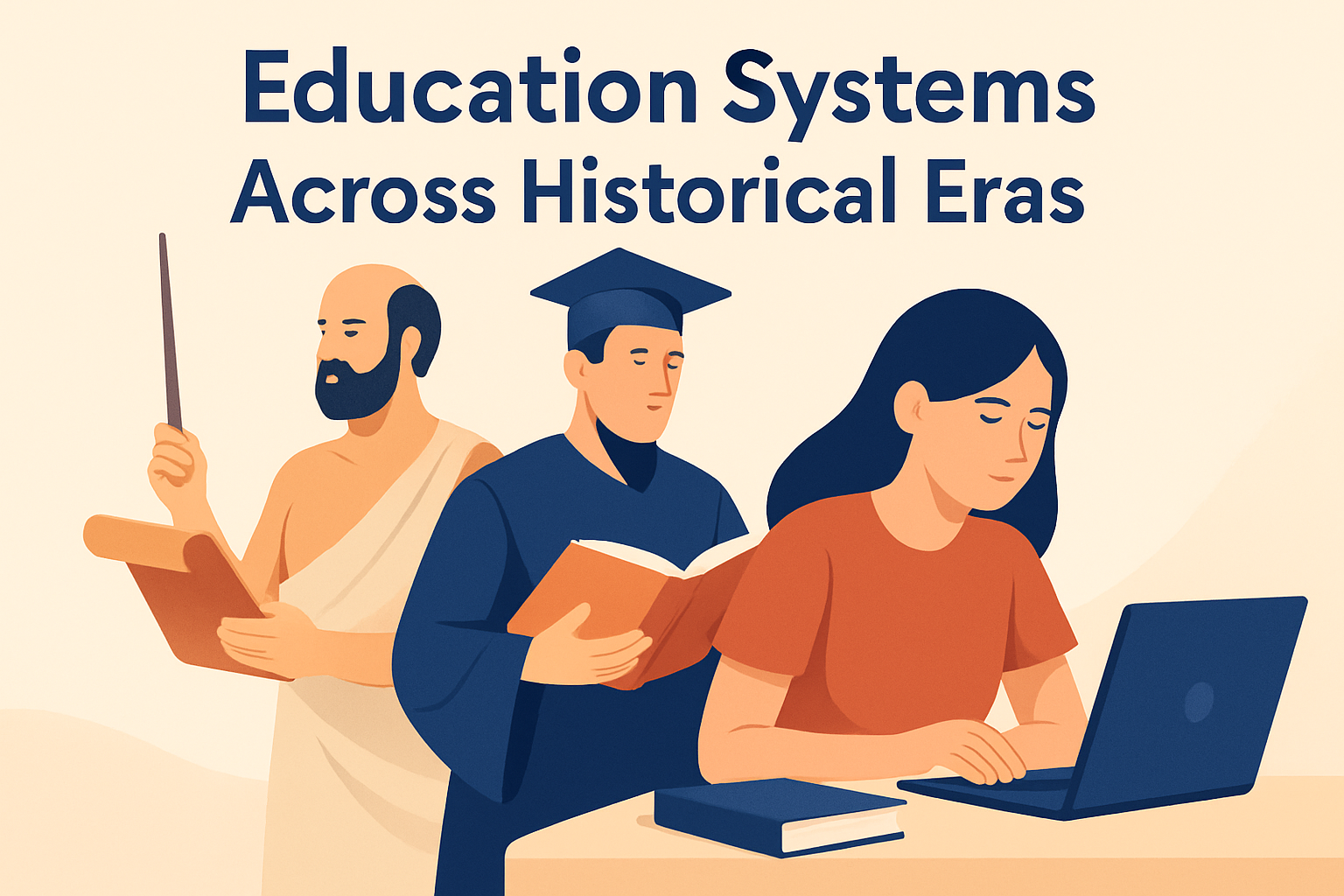
Education systems have been the backbone of knowledge dissemination and cultural propagation throughout history. From ancient civilizations to modern digital classrooms, the development of education has been crucial in shaping societies and advancing human progress. Understanding how education systems have evolved over time offers insight into the varied ways people have learned, taught, and applied knowledge to both communal and individual growth. This exploration matters because it provides a window into understanding how past educational practices influence contemporary approaches and can guide future innovations. By examining education systems across different historical eras, we can recognize the bedrock principles of learning and discern enduring lessons amidst the changes. These insights are invaluable not just for educators and policy makers, but for anyone interested in the evolution of human thought and society.
Ancient Education Systems
The earliest educational systems emerged from the necessity of passing down cultural knowledge and skills essential for survival. In ancient Mesopotamia, around 3500 BCE, education was primarily conducted in scribal schools where young boys learned cuneiform writing, the cornerstone of administration and record-keeping in civilization. These schools, known as ‘edubbas’, taught students mathematics, astronomy, and religious hymns, reflecting the society’s priorities in administration, agriculture, and spirituality.
In ancient Egypt, education was also formalized for the elite. Egyptian schools, attached to temples, prepared boys for careers in priesthood or government positions. Education was hierarchical and exclusive, signifying not just a transfer of knowledge, but a means of maintaining social stratification. Similarly, in ancient India, the Gurukul system emphasized oral learning, where students lived with a guru to learn religious texts, philosophy, and the arts. This system highlights the importance of one-on-one mentorship and holistic development.
Classical Education in Greece and Rome
Classical education systems in Greece and Rome introduced more structured approaches, focusing on rhetoric, philosophy, and the sciences. In Greece, education was seen as a tool for fostering civic duty and personal development. The famous philosopher Plato founded the Academy, emphasizing the dialectical method, where dialogue was used to explore ideas and truths. Meanwhile, Aristotle’s Lyceum placed importance on empiricism and the classification of knowledge.
Roman education borrowed heavily from Greek practices but emphasized more practical skills necessary for public life. The Roman schooling system comprised primary education for basic literacy and secondary schooling focused on rhetoric and law. Quintilian, a notable Roman educator, advocated for the moral and practical development of orators, stressing the need for well-rounded education.
Medieval Education Systems
During the medieval period, education became more closely tied to religious institutions. Monastic schools preserved and transmitted knowledge through the Dark Ages. Monks meticulously copied texts, thereby safeguarding the intellectual heritage of classical antiquity. Education was primarily religious, aimed at training clergy, but it laid the groundwork for later humanistic revival.
The establishment of medieval universities like the University of Bologna and the University of Paris marked a shift towards secular education, advancing studies in law, medicine, and theology. The rise of Scholasticism, characterized by figures like Thomas Aquinas, sought to reconcile faith with reason, using detailed analysis and the Latin language. These institutions were instrumental in cultivating a broader, secular perspective on education.
Renaissance and Enlightenment Transitions
The Renaissance heralded a renewed interest in classical knowledge, humanism, and empirical observation. Education became more inclusive and broad, emphasizing arts and sciences. The creation of the printing press by Johannes Gutenberg revolutionized education by making books more accessible, leading to higher literacy rates.
During the Enlightenment, education systems underwent further transformation. Thinkers like John Locke and Jean-Jacques Rousseau espoused educational philosophies that focused on reason and individual development. Locke’s ideas on experiential learning laid the groundwork for modern educational psychology, while Rousseau’s vision in “Emile” advocated for education tailored to the developmental stages of children.
Industrial Age and Mass Education
The Industrial Revolution necessitated mass education systems to develop a disciplined, skilled workforce. Compulsory education laws were enacted in many countries, marking the transition from elite to universal education. This period saw the rise of public schooling systems with standardized curricula designed to meet the demands of industrial economies.
| Country | Year of Compulsory Education Law | Compulsory Attendance Age Range |
|---|---|---|
| United Kingdom | 1870 | 5-10 years |
| United States | 1852 | 8-14 years |
| Germany | 1871 | 6-14 years |
Public education systems during this era were characterized by regimented, hierarchical structures designed to instill punctuality, obedience, and literacy. The model of one teacher per classroom of students learning through rote memorization prevailed, but also facilitated incredible expansion of educational access that set the precedent for modern systems.
Contemporary Education Systems
In the current digital age, education systems are increasingly embracing technology to deliver more personalized and flexible learning experiences. With the advent of the internet and digital platforms, there is a significant shift towards blended learning environments that combine traditional classroom settings with online education.
Contemporary education also emphasizes critical thinking, creativity, and lifelong learning beyond mere memorization. Educational reforms champion inclusive curricula that accommodate diverse learning needs and cross-cultural competencies. For instance, Finland’s education system is lauded for its lack of standardized tests and focus on collaborative learning, equity, and trust between teachers and students.
Today, the integration of artificial intelligence and data analytics in education provides insights into students’ learning patterns, enabling educators to tailor instructions and interventions accordingly. This technological integration present challenges, such as ensuring equal access and privacy concerns, but it undeniably offers powerful tools for sustaining education’s evolution.
Conclusion
In summary, education systems have transitioned through remarkable changes, from ancient scribal schools to advanced digital platforms, reflecting societies’ shifting priorities and technological advancements. These transformations underscore the persistent quest for knowledge and equitable access to learning. Understanding historical contexts enriches our perspectives on current practices and informs future educational policies and innovations.
For educators, students, and policymakers, acknowledging these lessons can help craft educational environments that not only disseminate information but also cultivate critical, creative, and ethical thinkers. As we navigate the complexities of the 21st century, continuing to innovate and adapt education systems remains imperative. Next steps could include encouraging dialogue between educators, investing in technology, and constantly revisiting educational philosophies to ensure they meet the needs of future generations.
By appreciating the evolution of education systems, we sustain the momentum of progress, committed to empowering learners worldwide. Let’s continue to look back and forward, using education as a transformative force for personal and societal advancement.
Frequently Asked Questions
1. How did education systems function in ancient civilizations, and what was their primary purpose?
In ancient civilizations, education systems were deeply intertwined with religion, culture, and the needs of the state. For instance, in ancient Egypt, education was primarily accessible to the elite, where scribes were trained extensively in reading, writing, and arithmetic because these skills were essential for administrative roles. Temples served as primary centers for education, and priests played a key role in teaching as they were custodians of knowledge. Similarly, in ancient Mesopotamia, education was geared towards preserving cultural continuity and ensuring governance. Schools, known as ‘edubbas,’ focused on imparting skills needed for administrative tasks performed by scribes. In ancient Greece, particularly in Athens, education focused more on the holistic development of individuals, teaching philosophy, arts, and sciences alongside physical training in the gymnasium. Education systems of this era were geared towards creating an informed citizenry and protecting cultural heritage, prioritizing elite access and service to state functions.
2. How did the concept of education evolve during the Middle Ages in Europe?
During the Middle Ages in Europe, education underwent significant transformation amid societal and political changes. The Church played an influential role as the custodian of knowledge, with monasteries and cathedral schools as primary educational centers. Here, education was largely religious, aiming to nurture a Christian identity; however, it also included the ‘trivium’ and ‘quadrivium’ curricula, which are precursors to modern liberal arts education. Education was often conducted in Latin, a unifying language across disparate regions. The establishment of universities in the twelfth century marked a pivotal moment, with institutions like the University of Bologna and the University of Paris becoming hubs for academic discourse and intellectual pursuit. These universities promoted a broad curriculum, including theology, law, medicine, and the arts, creating educated individuals who could serve both ecclesiastical and secular roles. The Middle Ages set the foundation for Renaissance learning, emphasizing scholasticism and the interpretation of classical texts.
3. What impact did the Renaissance have on education and knowledge dissemination?
The Renaissance was a period of significant educational reform, driven by a renewed interest in classical antiquity and humanistic principles. This era marked a transition from medieval scholasticism to a new focus on human-centered education. Education was more widely accessible beyond the clergy and nobility, as schools and universities expanded their curricula to include classical literature, art, history, and new scientific ideas. The invention of the printing press by Johannes Gutenberg around 1440 revolutionized knowledge dissemination by making books more accessible and affordable. This accessibility to printed material allowed for the spread of new ideas and knowledge faster than ever before, aiding the educational mission of the Renaissance. Humanist educators like Desiderius Erasmus promoted learning to cultivate virtuous individuals capable of critical thinking and civic involvement. This period laid the groundwork for modern educational practices by valuing individual potential and fostering a spirit of inquiry and exploration.
4. How did industrialization influence education systems in the 19th century?
The rise of industrialization in the 19th century had a profound impact on education systems. As factories became the backbone of the economy, there was a growing need for a literate and numerate workforce. This led to the establishment of mass education systems designed to equip children with basic skills necessary for work in an industrialized society. Universal education became a social policy goal in many Western countries, fueled by both economic imperatives and social reform movements. The period saw the introduction of compulsory education laws, which drastically increased school attendance and formalized schooling procedures. Curricula became increasingly standardized, and public education systems were structured to reinforce punctuality, discipline, and a sense of order—qualities valued in the industrial work environment. This era also saw the development of secondary and technical education, preparing individuals for specialized roles in industry and commerce, reflecting the diversifying economic landscape.
5. How have digital technologies transformed modern education systems?
The advent of digital technologies has revolutionized modern education, introducing unprecedented changes to how education is delivered and accessed. Digital classrooms and e-learning platforms have broken traditional barriers of distance and time, providing students with flexible learning environments that can be tailored to individual needs and learning styles. With online resources, multimedia content, and interactive tools, students can engage with the material in dynamic and varied ways, enhancing understanding and retention. Educators now have access to vast repositories of information and innovative teaching aids, allowing for more interactive and engaging lesson delivery. Moreover, data analytics and artificial intelligence enable personalized learning experiences, tracking student progress, and identifying areas for improvement. The global spread of digital technology has also democratized education by providing access to quality educational content, transcending geographical and socio-economic divides. Modern education, enriched by technology, fosters a collaborative and inclusive learning environment, preparing students for a technology-driven world.