
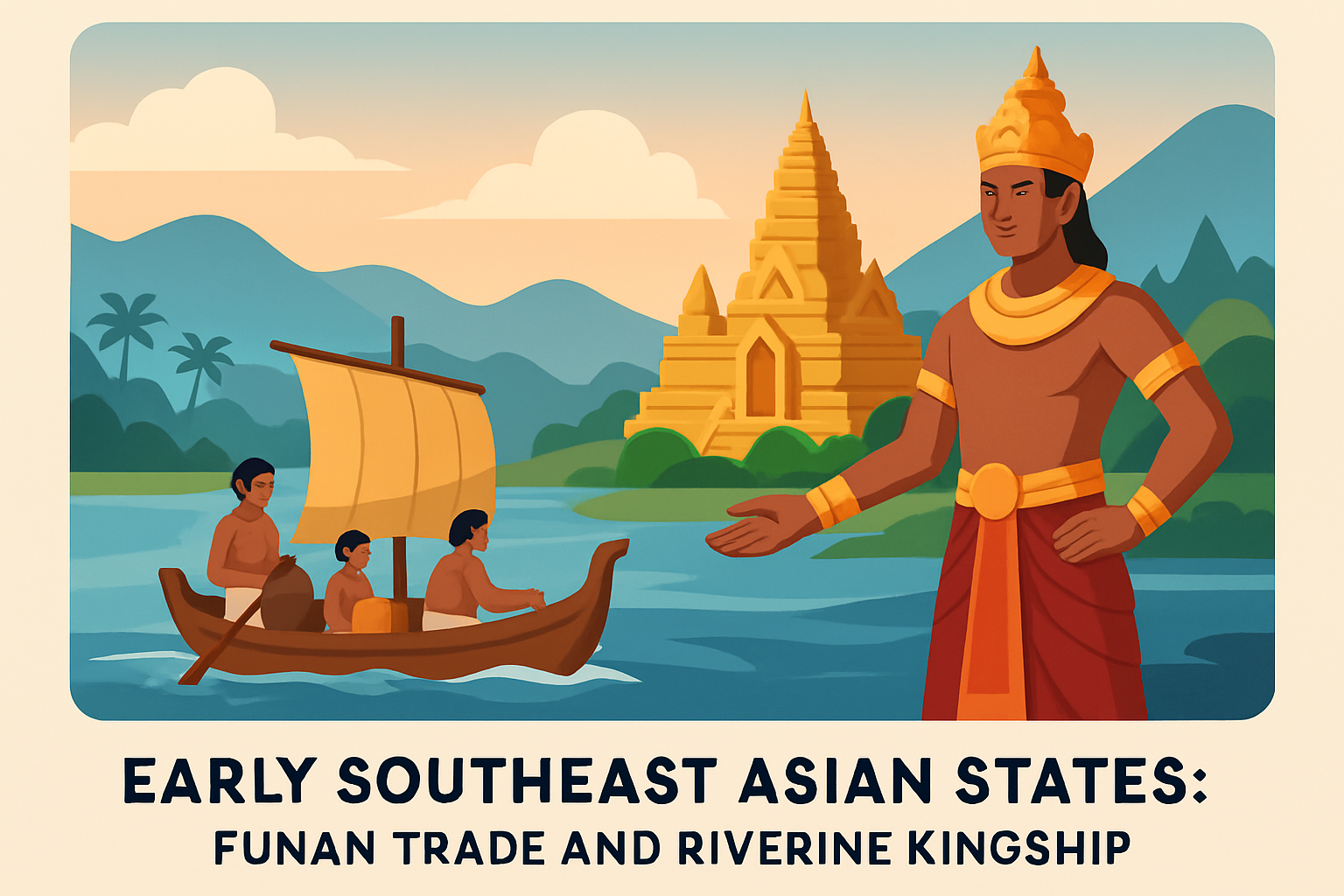
Introduction to Early Southeast Asian States
The early Southeast Asian states played a crucial role in the historical development of trade, politics, and cultural exchange in the region. Among these states, Funan stands out for its sophisticated trade networks and unique concept of riverine kingship. It existed from around the 1st to the 6th century CE in what is now southern Vietnam and Cambodia. Understanding these historical frameworks provides key insights into the evolution of Southeast Asian societies and their interactions with neighboring regions.
Funan was characterized by a well-developed network of trading routes, which facilitated the exchange of goods, culture, and ideas between distant lands. The idea of riverine kingship, where rulers governed directly by harnessing the power of rivers as avenues for trade and communication, was another crucial aspect of Funan’s governance. Studying these elements is important because they reveal how early states like Funan set the groundwork for future empires, economic systems, and cultural traditions in Southeast Asia. Moreover, they highlight the adaptive strategies employed by early civilizations in response to their geographical and environmental contexts.
Examining Funan’s trade routes and governance illuminates the resourcefulness of early Southeast Asian societies in establishing political authority and economic prosperity. These elements highlight Funan as a pioneering force in the early history of Southeast Asia, whose legacy influenced successive kingdoms and continues to hold relevance in the study of the region’s past.
Trade Networks of Funan
Funan was a thriving hub of trade and commerce, strategically situated to control major maritime routes connecting China to India and beyond. The state’s location made it an ideal intermediary for international trade, allowing the exchange of goods such as silk, spices, metals, and exotic items. This trade not only facilitated economic wealth but also attracted a diverse range of people, fostering a melting pot of cultures and ideas.
A key example of Funan’s trade prowess can be seen in the archeological findings of Roman coins and Persian ceramics in the region, which suggest extensive trade networks stretching as far as the Mediterranean. These artifacts underline Funan’s importance in global commerce and its ability to engage with far-flung civilizations, thereby enriching its own society with external influences and innovations.
Funan’s success as a trade center was largely due to its strategic location and innovative use of natural waterways. As a result, it laid a foundation for subsequent Southeast Asian states to flourish in trade, expanding their economic and cultural reach over time.
Riverine Kingship in Funan
Funan was notable for its unique system of governance known as riverine kingship, where the authority of the king was closely tied to the control and management of river systems. The Mekong River and its tributaries served as the lifeblood of Funan, providing vital communication and transportation routes that were integral to the state’s economy and governance. This system allowed rulers to administer vast territories effectively, linking remote areas through aquatic passages while facilitating trade and the movement of armies.
The concept of riverine kingship involved harnessing the power of rivers not just for practical governance but also as a means of legitimizing political power. The ability of the king to command the river and manage its resources was seen as an embodiment of divine authority, reinforcing his status as a ruler. This system can be observed in ancient inscriptions and records that highlight the king’s role in building and maintaining canals, ports, and infrastructure, demonstrating a blend of both practical governance and symbolic representation of power.
This blend of infrastructure and authority underpinned Funan’s stability and growth, enabling it to become a dominant force in the region and set a precedent for subsequent Southeast Asian polities.
The Cultural and Economic Influence of Funan
Funan’s establishment as a center of trade brought about significant cultural and economic transformations, drawing on influences from different parts of Asia. The presence of merchants, artisans, and religious figures from India and China led to the exchange of knowledge, customs, and technologies, creating a vibrant multicultural environment.
One real-world impact of this cultural amalgamation was the introduction of Indian religious practices and art styles into Funan. Temples dedicated to Hindu and Buddhist deities were constructed, and Indian epic literature gained popularity, reflecting a deep cultural synthesis that would lay the groundwork for the spread of these religions throughout Southeast Asia. Economically, Funan became a model of early economic globalization, demonstrated through its role as a key node in a vast network of trade across different continents.
The historical records from Chinese travelers, along with archaeological evidence, illustrate Funan’s impact on regional development, showcasing how trade led to cultural and technological exchanges that enriched the society. Thus, Funan laid the foundation for subsequent kingdoms like Chenla and Angkor, who continued to build on its economic and cultural innovations.
Infrastructure: The Backbone of Funan’s Prosperity
The infrastructure developed by the Funan kingdom was pivotal in maintaining its economic and political power. Roads and river routes were meticulously planned and constructed to facilitate the movement of goods and people, thus enabling efficient trade and military mobilization across its territories.
An impressive example of Funan’s infrastructural prowess is the network of canals that crisscrossed the kingdom, enhancing agricultural productivity and trade capabilities. The construction of these water canals allowed for the irrigation of extensive rice fields, which became a staple crop for both sustenance and trade, ensuring food security and stability.
This infrastructure not only supported economic activities but also reinforced the control of the central authority over its realm, allowing the king to project power and maintain connectivity across the diverse landscapes of Funan.
Funan’s Decline and Legacy
Despite its contributions and success, Funan eventually declined, giving way to the rise of the Chenla kingdom. The fall of Funan is attributed to numerous factors, including internal conflicts, changes in trade routes, and pressures from neighboring entities. However, its legacy continued to influence later Southeast Asian states, particularly in terms of trade practices and governance models.
- Trade-oriented Statecraft: Funan’s emphasis on trade as a means of state power persisted in subsequent regional powers, prompting them to also establish and protect trade networks.
- Cultural Syncretism: The tradition of cultural exchange and adaptation in Funan inspired later states to embrace foreign influences, resulting in a rich tapestry of regional culture.
- Hydraulic Engineering: Funan’s innovations in using waterways set precedents for future empires to integrate infrastructure with governance.
The concept of riverine kingship, along with Funan’s adeptness at leveraging geographical advantages, imbued subsequent kingdoms with strategies to harness their environments effectively, enabling them to fortify their political dominance.
Conclusion: Lessons from Funan’s Trade and Riverine Kingship
In summarizing the study of Funan’s trade and riverine kingship, it becomes clear that the early state laid critical foundations for the political and economic dynamics of Southeast Asia. Funan thrived as a trade nexus, bridging diverse cultures and creating a cosmopolitan society. Simultaneously, its river-based governance model demonstrated the effective use of natural resources to build and sustain authority. These twin pillars of trade and governance cultivated prosperity and cultural exchange.
The primary benefit for modern readers from examining Funan’s history is recognizing the importance of strategic geographical positioning and innovative governance in state development. Funan’s model offers lessons on how to leverage natural resources ingeniously for economic and political advantage. As we attempt to understand the complexities of global trade and leadership today, Funan serves as an early example of how aligning natural and economic strategies can yield significant benefits.
To deepen this understanding, readers can explore historical materials and contemporary interpretations of the region’s archaeological evidence. Engaging with the past can provide strategic insights for businesses, policymakers, and scholars on the intersection of geography, economy, and governance.
Next Step: Delve into the rich history of Southeast Asia by exploring other formative states and their contributions to regional development. This further exploration can enhance our appreciation of Southeast Asia’s intricate past and its influence on present-day cultural and economic landscapes.
Frequently Asked Questions
1. What was the significance of Funan in early Southeast Asian history?
Funan was one of the earliest Southeast Asian states, and it played a pivotal role in shaping the region’s history. Flourishing from around the 1st to the 6th century CE, Funan’s strategic location at the delta of the great Mekong River enabled it to become a vibrant nexus of trade. This ancient polity was a melting pot of cultures, owing to the influx of merchants and goods from India, China, and beyond. The exchange wasn’t limited to commodities; Funan also facilitated the spread of religious and cultural practices. Indian influences brought Hinduism and Buddhism, whose art, architecture, and rituals started embedding into local traditions. The complex trade networks and cultural exchanges laid the foundational systems that future Southeast Asian empires, like the Khmer Empire, would later build upon.
2. How did Funan’s trade networks function and what goods were involved?
Funan had an extensive and sophisticated trade network that stretched across maritime and overland routes, connecting it to other powerful regions like India, China, and the Roman Empire. The state’s maritime trade likely extended to the coasts of the Indian Ocean, facilitating the export and import of various goods. Key exports included rice, fish, precious metals, and exotic jungle products such as spices. In return, Funan imported luxuries such as silk, jade, spices, and ceramics from China, and ivory, gold, and developed religious texts and technologies from India. The Mekong River’s delta, serving as a key internal trade artery, allowed for the movement of goods to inland areas, enhancing the kingdom’s economic prosperity. This trade not only brought wealth but also introduced diverse cultural and technological advancements to Funan.
3. What is meant by “riverine kingship” in the context of Funan?
Riverine kingship refers to a form of governance where the ruler’s power is centralized around strategic river systems, which are used as conduits for trade, transportation, and control. In Funan, the Mekong River and its tributaries were critical to both economic and political power. The concept implies that the ruler’s legitimacy was tied not just to military or territorial influence but also to their ability to control and benefit from river-based trade. This mode of kingship was somewhat unique, as it leveraged the natural geographical features to extend control and influence. It emphasized the strategic importance of the rivers for nurturing not only economic growth but also maintaining connections with other riverine societies, fortifying the ruler’s status and influence within and beyond their immediate borders.
4. How did Funan influence cultural exchanges in Southeast Asia?
The Funan civilization was a crucial conduit for cultural exchange in Southeast Asia, primarily facilitated through its thriving trade networks. The intermingling of diverse peoples through trade led to the exchange of ideas, beliefs, and practices. Indian cultural elements, particularly from Hindu and Buddhist traditions, began to permeate local traditions through merchant interactions, leading to the adoption of Indian scripts, religious practices, and architectural styles. Funan’s openness and adaptability to foreign influences paved the way for a syncretic culture, which blended indigenous customs with Indian traditions. This cultural synthesis contributed significantly to the region’s social evolution, influencing art, government, and religion in subsequent Southeast Asian civilizations.
5. What archaeological evidence supports the existence of Funan?
Archaeological findings have significantly corroborated the historical accounts of Funan. Excavations have unearthed remnants of cities, including Oc Eo, believed to be one of Funan’s major urban centers. Here, archaeologists have discovered extensive networks of canals, indicative of sophisticated urban planning and hydraulic management techniques reflecting the importance of riverine life. Artifacts such as pottery, jewelry, and inscribed tablets show close ties with cultures from across Asia, especially those in China and India. These findings illustrate Funan’s cosmopolitan nature and its role as a major player in ancient commerce. Additionally, Chinese historical accounts, including travelogues by emissaries and traders who visited Funan, provide textual evidence supporting the archaeological discoveries, detailing administrative setup, social life, and the richness of the culture that existed in Funan.