
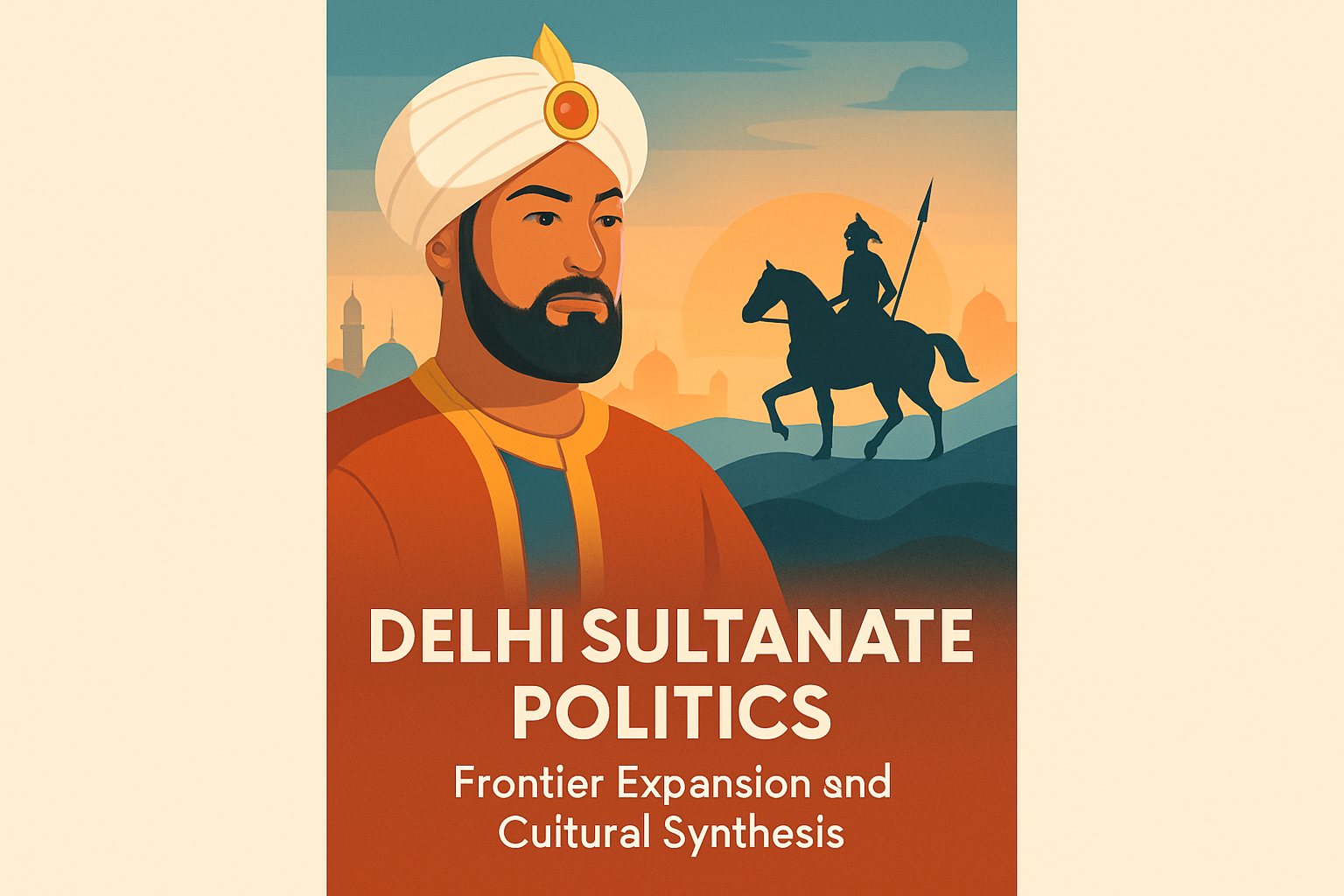
The Delhi Sultanate shaped medieval northern India through ambitious frontier expansion, hard political bargaining, and a durable process of cultural synthesis. In practical terms, the Delhi Sultanate refers to the succession of Turkic and Afghan dynasties that ruled large parts of the subcontinent from 1206 to 1526, beginning with the Mamluks and followed by the Khaljis, Tughlaqs, Sayyids, and Lodis. When historians discuss frontier expansion, they mean the movement of state power into new ecological and political zones, especially Punjab, Rajasthan, the Gangetic plain, Malwa, Gujarat, Bengal, and the Deccan. Cultural synthesis describes the blending of Persianate court culture, Islamic institutions, Turkic military practice, and deeply rooted Indian social, linguistic, and artistic traditions.
This topic matters because the Sultanate was not simply a chain of conquests. It built administrative systems, reworked revenue collection, sponsored urban growth, and linked India more closely to Central Asia and the wider Indian Ocean world. In my own reading of chronicles such as Ziauddin Barani and Isami, and while comparing them with inscriptions, architecture, and regional literature, the clearest lesson is that power on the frontier depended as much on negotiation as on force. The Sultanate could win a battlefield and still lose a province if it failed to co-opt landed elites, secure roads, or sustain grain supply for cavalry garrisons.
The politics of the Delhi Sultanate therefore must be understood as a balance between central authority and regional autonomy. Sultans claimed universal kingship, yet their rule was constantly tested by distance, climate, rival dynasts, and the ambitions of military slaves, nobles, governors, and local chiefs. At the same time, the court generated new forms of identity and patronage. Persian became a major language of administration; Sufi hospices connected rulers and commoners; temple spolia appeared in early mosques; and regional styles in music, architecture, and language evolved through sustained contact. Studying frontier expansion and cultural synthesis together reveals how the Sultanate governed, why it fractured, and what long-term legacies it left for South Asian statecraft and society.
Frontier Expansion as a Political Strategy
Frontier expansion was the core political strategy of many Delhi Sultans because it generated revenue, prestige, manpower, and strategic depth. The early Mamluk rulers consolidated control in the Indo-Gangetic heartland after the Ghurid conquests, but their position remained fragile. Rajput strongholds, Mongol pressure from the northwest, and the semi-autonomous behavior of iqta holders made constant campaigning necessary. The iqta system, in which officers received assignments to collect revenue in return for military service, helped the state mobilize cavalry without paying every soldier directly from the central treasury. Yet the same system also produced centrifugal tendencies, because governors with local military bases could turn rebellious.
Expansion under Alauddin Khalji marked a decisive turn. After securing the north and defending against repeated Mongol attacks, his regime pushed into Gujarat, Ranthambore, Chittor, Malwa, and eventually the Deccan through Malik Kafur’s campaigns. These were not random raids. Gujarat brought ports, merchant wealth, and access to horses and overseas trade. Rajasthan offered strategic forts controlling routes between the plains and western India. Deccan expeditions extracted tribute from Yadavas, Kakatiyas, Hoysalas, and Pandyas, allowing the Sultanate to tap rich agrarian and commercial resources without immediate full annexation. In administrative terms, tribute was often more practical than direct rule over distant territories.
Under Muhammad bin Tughlaq, expansion and overreach became inseparable. He aimed to hold an immense empire stretching from the Punjab to much of peninsular India. His experiments, including the transfer of the capital to Daulatabad and attempts to tighten fiscal extraction in the Doab, reflected strategic logic but faltered in execution. Distance, communication delays, ecological variation, and local resistance undermined centralized control. From experience studying medieval states, I would stress that empires usually fail first in logistics, not ideology. The Sultanate’s cavalry armies required fodder, coin, and reliable roads. Once revolts multiplied in Bengal, the Deccan, and the south, imperial ambitions became unsustainable.
Military Power, Revenue, and the Limits of Control
The political engine of frontier expansion was military-fiscal organization. Delhi’s rulers depended on mounted warfare, fortified towns, intelligence networks, and a revenue regime able to sustain campaigns over long distances. Alauddin Khalji’s market regulations, however debated in detail, were closely tied to military needs. By controlling prices of grain, cloth, and horses in Delhi, the regime sought to maintain a large standing army at lower cost. Barani’s account suggests that this was a deliberate effort to prevent noble accumulation and keep soldiers provisioned. Even if chroniclers exaggerated administrative precision, the principle is clear: frontier politics rested on stable supply.
Revenue collection also became sharper in the countryside. In the fertile Doab between the Ganga and Yamuna, assessments were increased and intermediaries were monitored more aggressively. This reduced the autonomy of local chiefs but could also provoke flight, resistance, or agrarian distress when assessments outran production. The state wanted a direct claim on agrarian surplus, yet medieval information systems were limited. Surveying, auditing, and enforcement varied widely from one district to another. That unevenness explains why some provinces remained loosely attached despite formal conquest.
| Ruler | Frontier Focus | Political Objective | Main Limitation |
|---|---|---|---|
| Iltutmish | Punjab and Gangetic consolidation | Secure succession and suppress rivals | Fragile elite loyalty |
| Alauddin Khalji | Gujarat, Rajasthan, Deccan | Revenue expansion and strategic control | Dependence on coercive centralization |
| Muhammad bin Tughlaq | All-India imperial reach | Direct centralized sovereignty | Logistical overstretch and rebellion |
| Firuz Shah Tughlaq | Selective consolidation | Administrative repair and elite accommodation | Weaker military discipline |
Mongol invasions underscored the limits of control. Repeated attacks in the late thirteenth and early fourteenth centuries forced the Sultanate to fortify the northwest and maintain high military readiness. This external threat pushed rulers toward stronger centralization, but it also consumed resources that might otherwise have stabilized newly conquered territories. Frontier expansion was therefore never a linear story of growth. It was a cycle of conquest, accommodation, resistance, and reconquest, shaped by the realities of war finance and regional ecology.
Nobles, Provincial Elites, and the Politics of Negotiation
Delhi Sultanate politics cannot be explained through royal will alone. Nobles, governors, village headmen, zamindars, and defeated dynasties all shaped the frontier. The ruling class was ethnically and politically mixed: Turks, Tajiks, Afghans, converted Indians, and others competed for office and proximity to the throne. Court factions often formed around kinship, patronage, and military networks rather than fixed ideology. Iltutmish faced the challenge of disciplining powerful slave officers; Balban responded to elite disorder with a stern doctrine of kingship, ceremonial hierarchy, and harsh punishment. His measures show that political theater mattered as much as battlefield success.
On the frontier, incorporation usually required compromise. Rajput lineages might be defeated militarily yet continue to govern locally as tributaries. In Bengal, governors frequently tested autonomy because the delta’s distance and wealth made separation feasible. In the Deccan, Khalji and Tughlaq interventions relied on extracting submission from existing rulers before attempting fuller control. These arrangements were not signs of weakness alone. They were standard imperial practice. A medieval state that insisted on uniform direct administration everywhere would collapse under its own administrative burden.
Firuz Shah Tughlaq illustrates a different political style. He reduced some of the harsher fiscal pressures of his predecessors, promoted public works, and widened hereditary claims within the nobility. This brought short-term stability but weakened the central state’s coercive edge. Offices became more entrenched, and military vigor declined. By the fifteenth century, provincial polities such as the Bahmani Sultanate, Gujarat Sultanate, Malwa Sultanate, and Bengal Sultanate emerged as durable successors, borrowing institutions from Delhi while rejecting its supremacy. The frontier had become a zone where imperial methods were reproduced by regional states.
Cultural Synthesis in Court, City, and Countryside
Cultural synthesis under the Delhi Sultanate was not a polite blending of equal ingredients; it was a layered process shaped by conquest, patronage, translation, and daily coexistence. Persianate norms dominated the court. Persian chancery practice, titulature, historiography, and literary style became markers of political legitimacy. Yet these forms were constantly adapted to Indian realities. Administrative vocabulary absorbed local terms, and rulers depended on scribes, accountants, and intermediaries familiar with regional custom. Over time, this interaction contributed to the growth of Hindavi and other vernacular expressions alongside Persian.
Architecture offers one of the clearest examples. Early mosques such as the Quwwat-ul-Islam in Delhi reused materials from preexisting temples, reflecting both political symbolism and practical building needs. The Qutb Minar, Alai Darwaza, Tughlaqabad, and Firuz Shah Kotla show evolving experiments in arches, domes, battered walls, calligraphy, geometric ornament, and local stoneworking techniques. What emerged was not a copy of West Asian architecture but an Indo-Islamic style shaped by Indian craftsmen, available materials, and regional aesthetics. Inscriptions and building plans reveal adaptation at every stage.
Sufi networks deepened synthesis beyond the palace. Chishti saints such as Muinuddin Chishti and Nizamuddin Auliya attracted followers across social boundaries through preaching, hospitality, and vernacular accessibility. Their khanqahs linked urban elites, artisans, travelers, and the poor. While some ulama emphasized legal orthodoxy, Sufi practice often created broader social spaces where Persian, Arabic, and local cultural forms interacted. Music, poetry, and devotional expression moved across communities, even when theological boundaries remained real. Amir Khusrau’s celebrated association with the Delhi court and the Chishti milieu captures this world of creative exchange, linguistic play, and political awareness.
Long-Term Legacy of Expansion and Synthesis
The long-term legacy of Delhi Sultanate politics lies in the connection between state formation and cultural change. Frontier expansion helped integrate markets, routes, and military zones across northern India and beyond. Even where direct rule failed, administrative techniques such as the iqta, Persian record-keeping, cavalry mobilization, and fortified urban centers influenced successor states. The Mughals inherited not a blank slate but a political landscape already shaped by Delhi’s experiments in taxation, elite management, and territorial ambition.
Cultural synthesis also left durable marks. Indo-Persian political language became central to later courts. Regional sultanates refined architectural and literary forms first tested under Delhi. Urban centers grew as places where merchants, scholars, soldiers, and craftsmen from different backgrounds met. New vernaculars matured in contact zones created by migration and administration. None of this erased conflict. Temple desecration, rebellion, sectarian tension, and coercive taxation were part of the same history. But reducing the Sultanate to either pure oppression or seamless syncretism misses the evidence. It was a hard, unequal, creative political order that transformed the subcontinent through both force and exchange.
The clearest takeaway is that the Delhi Sultanate succeeded when it matched military expansion with negotiated local rule and institutions that could travel across diverse regions. It weakened when conquest outran administration or when central authority lost leverage over nobles and provinces. Its cultural importance came from repeated contact between ruling elites and regional societies, producing new languages, artistic forms, and political habits that endured long after dynasties fell. If you want to understand medieval India with precision, start with the Sultanate’s frontiers, because that is where power was tested and where cultural synthesis became historical reality.
Frequently Asked Questions
What does “frontier expansion” mean in the context of Delhi Sultanate politics?
In the context of the Delhi Sultanate, “frontier expansion” refers to the extension of political authority, military power, and administrative control into regions that were not yet fully integrated into the sultanate’s core domain. Historians use the term “frontier” not simply to describe a border on a map, but to identify dynamic zones where forests were cleared, forts were established, agrarian settlement increased, tribute relationships were negotiated, and new elites were drawn into state structures. These frontier regions often included river valleys, forested tracts, upland areas, and strategically important routes linking northern India to the Deccan and beyond.
Under the Mamluks, Khaljis, Tughlaqs, Sayyids, and Lodis, expansion was pursued through campaigns, alliances, diplomacy, revenue arrangements, and the placement of military commanders and governors in newly conquered territories. Expansion was therefore not only about battlefield victory. It also involved the difficult work of making authority durable: collecting taxes, suppressing rebellions, building roads and garrisons, and balancing local chiefs, landed intermediaries, and court factions. Because many frontier zones were politically fluid, the sultanate had to combine force with negotiation.
This is why frontier expansion is so central to Delhi Sultanate politics. It reveals the state as an evolving power that was constantly testing its limits, adapting to local conditions, and converting temporary military success into longer-term rule. It also helps explain why the sultanate was often powerful yet vulnerable: every expansion created opportunities for wealth and prestige, but it also stretched administration, provoked resistance, and intensified court rivalries over resources and appointments.
Why was frontier expansion so important for the Delhi Sultanate’s survival and legitimacy?
Frontier expansion mattered because it was deeply tied to the sultanate’s economic strength, military credibility, and political legitimacy. Medieval states such as the Delhi Sultanate depended heavily on access to land revenue, tribute, and strategic trade routes. Expanding into new territories meant bringing fresh agricultural zones, market towns, and transit corridors under some degree of state control. That, in turn, generated the resources needed to maintain cavalry forces, reward nobles, sustain the court, and finance public works and fortifications.
Expansion also reinforced the ruler’s prestige. A successful sultan was expected to demonstrate strength, discipline rebellious chiefs, and protect the realm from external threats such as Mongol pressure in the northwest. Victorious campaigns and the incorporation of new territories signaled that the ruler had both military ability and divine favor, two important components of medieval kingship. When expansion stalled or frontier regions slipped away, it could weaken confidence in the ruling house and encourage nobles, provincial governors, or rival claimants to challenge the center.
At the same time, legitimacy was not secured by conquest alone. A ruler had to show that he could govern what he conquered. This meant stabilizing revenue collection, appointing reliable officials, integrating local notables, and ensuring enough order for cultivation and trade to continue. In many cases, expansion helped the sultanate survive by widening its resource base, but it also created new pressures. Provinces far from Delhi could become semi-autonomous, commanders could build local power, and military campaigns could drain the treasury. So frontier expansion was vital, but it was always a high-risk strategy that required constant political management.
How did the Delhi Sultanate manage newly conquered regions and frontier zones?
The Delhi Sultanate managed frontier regions through a blend of military presence, administrative delegation, fiscal integration, and political bargaining. Newly conquered areas were rarely governed through a single uniform model. Instead, rulers adapted their methods depending on geography, local power structures, and the strategic importance of the region. In some places, forts and garrisons were the first tools of control, especially where resistance was strong or communication lines were fragile. In other areas, the state relied more heavily on negotiated submission, tribute payments, or the confirmation of local chiefs in exchange for loyalty.
A major instrument of governance was the appointment of governors, military commanders, and revenue officials who acted in the sultan’s name. These officials were expected to maintain order, collect revenue, supervise troops, and prevent local rebellion. Yet their effectiveness depended on the center’s ability to monitor them. Because the sultanate was a polity marked by elite competition, provincial office could become a source of independent power. This is one reason why Delhi’s rulers frequently transferred officials, reorganized provinces, or launched campaigns against their own subordinates.
Revenue policy was equally important. Frontier management required the conversion of conquest into regular income. That often meant surveying productive land, organizing taxation, and promoting cultivation. In some periods, especially under more ambitious rulers, the state tried to tighten direct control over agrarian revenue. In other cases, it accepted looser arrangements with local intermediaries who could deliver taxes more efficiently. Administrative integration therefore depended on compromise as much as command.
What stands out is that frontier governance was never purely coercive. Even a militarized regime had to work with existing landed groups, merchant communities, village headmen, and regional elites. The sultanate succeeded when it could persuade these groups that participation in its order was preferable to resistance. When it failed to balance force with accommodation, frontier regions became sites of repeated revolt and political fragmentation.
What is meant by “cultural synthesis” during the Delhi Sultanate period?
“Cultural synthesis” during the Delhi Sultanate period refers to the long, uneven, but highly significant process through which Persianate, Turkic, Afghan, and Islamic political and cultural traditions interacted with the social, linguistic, artistic, and religious worlds of the Indian subcontinent. This was not a simple merging of two fixed civilizations, nor was it an immediate or universally harmonious process. Rather, it unfolded over generations through everyday contact, state patronage, migration, trade, urban life, scholarship, architecture, literature, and devotional exchange.
At the political level, the sultanate brought with it courtly languages, bureaucratic practices, legal ideas, and styles of kingship connected to the wider Persianate and Islamic world. These traditions took root in India, but they were also reshaped by local realities. Administrative systems had to account for existing agrarian structures, regional customs, and the influence of local landed elites. In the cultural sphere, cities became places where scholars, poets, Sufis, artisans, soldiers, and merchants from different backgrounds interacted. This contributed to new artistic forms, evolving vernaculars, and architectural styles that combined arches, domes, calligraphy, decorative carving, and building techniques drawn from multiple traditions.
Sufism played a particularly important role in this process. Sufi networks often connected ruling centers with local society, and their khanqahs became spaces of interaction across social boundaries. Meanwhile, Bhakti movements in different regions were also reshaping devotional culture. Although these currents were distinct, their coexistence within the same social world encouraged new forms of exchange, shared symbolism, and overlapping sacred geographies. The result was not the disappearance of conflict or difference, but the creation of a more layered and interconnected cultural landscape.
So when historians speak of cultural synthesis in the Delhi Sultanate, they mean a historically grounded process of adaptation, borrowing, contestation, and creativity. It helps explain why the period was so formative for later South Asian society, especially in language, architecture, music, urban culture, and political thought.
How did frontier expansion and cultural synthesis shape the long-term legacy of the Delhi Sultanate?
The long-term legacy of the Delhi Sultanate lies in the way it linked territorial ambition with institutional development and cultural transformation. Frontier expansion pushed the state beyond its original power base and forced it to develop more complex methods of military organization, provincial control, revenue extraction, and political negotiation. Even when particular dynasties weakened, the administrative habits and strategic assumptions they established continued to influence later polities. The idea that a north Indian imperial center could project power into multiple ecological and regional zones became one of the defining features of subsequent state formation, including under the Mughals.
Cultural synthesis gave that political legacy a deeper social and civilizational dimension. The sultanate helped embed Persian as a major language of administration and high culture while also contributing to the growth of vernacular literary cultures. It stimulated urbanization, patronized mosques, madrasas, tombs, and forts, and introduced or transformed artistic and architectural idioms that would remain central to Indo-Islamic visual culture. Courtly and popular traditions alike were shaped by sustained interaction among migrants, soldiers, clerics, local elites, artisans, and devotional communities.
Just as important, the Delhi Sultanate demonstrated that power in the subcontinent could not rest on conquest alone. Durable rule required adaptation to local conditions and the incorporation of social groups beyond the ruling military elite. That lesson became one of the enduring themes of South Asian political history. The sultanate’s frontier struggles exposed the limits of centralized authority, while its cultural world showed the possibilities of exchange and reinvention. Taken together, these developments made the Delhi Sultanate a foundational bridge between early medieval regional formations and the more expansive imperial systems that followed.