
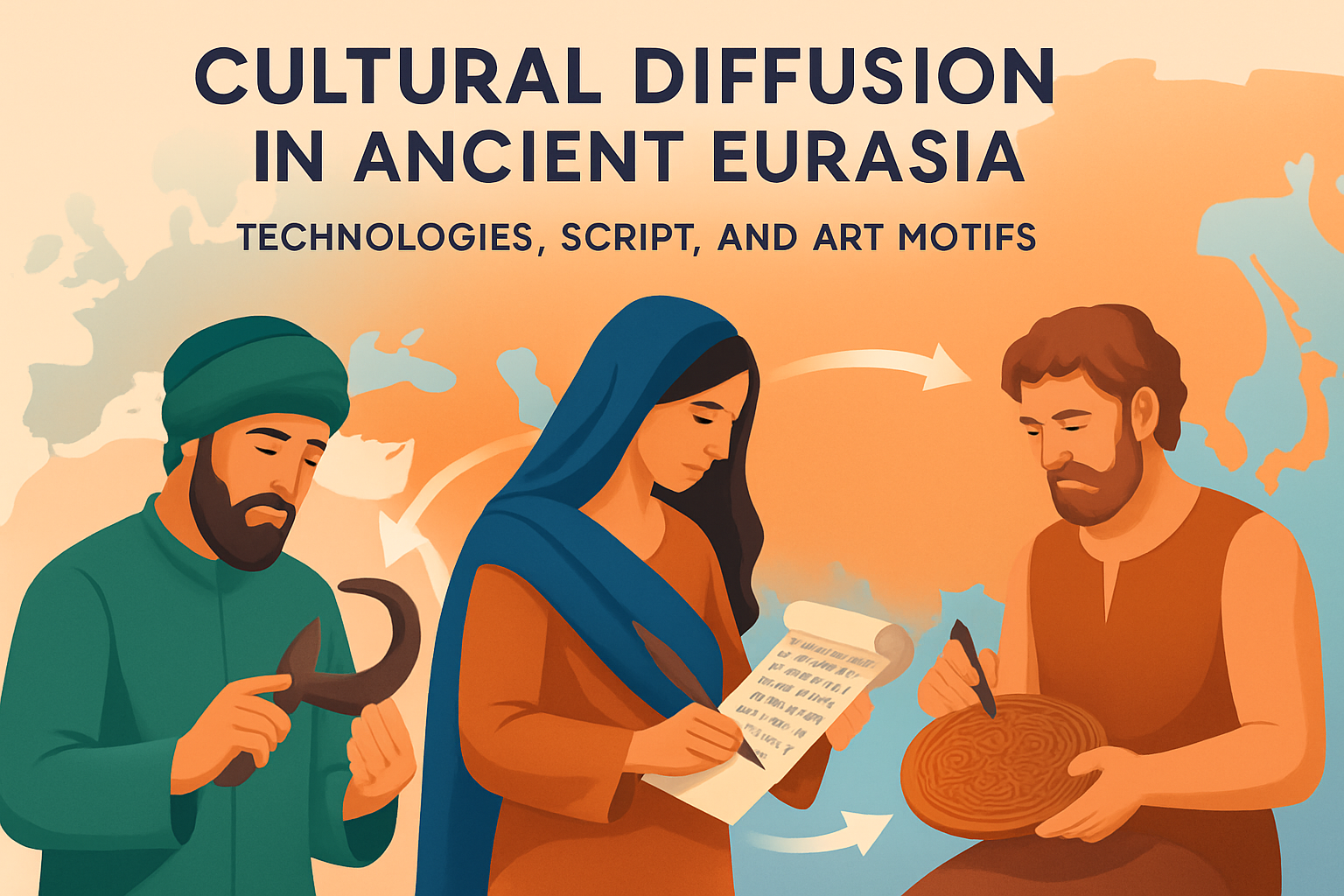
Introduction to Cultural Diffusion in Ancient Eurasia
Cultural diffusion refers to the spread of cultural beliefs, practices, technologies, and artifacts from one society to another. This process can occur through trade, warfare, migration, or even simple contact between neighboring cultures. In ancient Eurasia, cultural diffusion was a driving force behind significant historical developments, influencing technological advancements, writing systems, and artistic expressions across vast regions.
The ancient world of Eurasia was a dynamic and interconnected web of cultures, marked by the exchange of ideas and innovations that transcended borders. By understanding cultural diffusion, we gain insights into how civilizations shaped one another, fostering diplomatic relations, economic growth, and cultural enrichments. The study of cultural diffusion in ancient Eurasia enables us to appreciate how interconnected societies contributed to a collective human history. By tracing how technologies, scripts, and art motifs spread across this vast area, we can better comprehend the shared human heritage that binds modern civilizations.
The significance of cultural diffusion in ancient Eurasia lies in its ability to illustrate the transfer of knowledge and art among diverse populations. It highlights not only the importance of connectivity between cultures but also the innate human drive for curiosity, adaptability, and improvement. Ancient Eurasian societies were pivotal players in the dissemination of progressive ideas and tools that fundamentally shaped the trajectory of civilizations.
Technological Transfer Across Ancient Eurasia
One of the most profound examples of technological diffusion in ancient Eurasia is the spread of metallurgy. The knowledge of extracting and using metal transformed societies by enhancing military capabilities, improving agricultural tools, and refining craft production. The Bronze Age, which began around 3300 BCE, saw metallurgy’s rapid diffusion across the continent, marking a pivotal era characterized by increased social complexity and economic development.
The dissemination of iron smelting, originating from regions around present-day Turkey and the Middle East, provides a significant example of technological diffusion. This technological innovation reached Europe, India, and China, radically transforming each region’s ability to produce tools and weapons. The availability of such durable materials facilitated the rise of more complex societal structures, aiding in both warfare strategies and agricultural output.
Another notable technological diffusion example is the spread of the wheel and chariot across Eurasia. Initially developed in Mesopotamia around 3500 BCE, the concept of the wheel revolutionized transportation and farming techniques. The chariot, particularly, became a crucial military technology. By around 2000 BCE, chariots were used by societies from Egypt to the steppes of Central Asia and even reaching into China. This diffusion allowed for faster movement of armies and goods, thus enabling empires to expand and integrate distant territories.
The Spread of Scripts Across Eurasia
Scripts are one of the most critical elements of cultural diffusion, as they facilitate not only record-keeping but also the dissemination of ideas and governance. The invention and diffusion of writing systems across ancient Eurasia illustrate how interconnected and interdependent ancient civilizations were.
Cuneiform, originating in Mesopotamia circa 3200 BCE, is one of the earliest known writing systems. As empires expanded, this script style reached the distant Hittite and Ugarit cultures, influencing local administrative languages and practices. Similarly, the Phoenician alphabet, dating back to around 1050 BCE, spread through extensive maritime trade and contact, influencing the Greek alphabet, which in turn became the basis for the Latin and Cyrillic scripts used today.

The Silk Road played a significant role in the diffusion of script. Along with goods and spices, the Silk Road facilitated the movement of the Indian Brahmi script into Central Asia, which later contributed to the development of scripts used throughout Asia, including Tibetan and several Southeast Asian scripts. This script diffusion highlights the role of trade routes not just in economic exchanges, but in cultural and linguistic disseminations.
Art Motifs and Their Migration Across Eurasia
The spread of art motifs is a vivid testament to the interconnectedness of ancient Eurasian cultures. Artistic motifs, whether religious, decorative, or storytelling, carried deeper symbolism and cultural narratives that captivated different civilizations.
The Scythian art style, with its ornate animal motifs, demonstrates how these artistic influences migrated across Eurasia through the nomadic movements and trade exchanges of the Scythian peoples. These motifs significantly influenced art in regions as diverse as the Caucasus to Eastern Europe, finding resonance even in Chinese artefacts where similar motifs appear on ancient bronze vessels.
- Greek Influence: The spread of Greek artistic elements during and after the conquests of Alexander the Great provided another significant instance of diffusion. Greek motifs and styles, known as Hellenistic art, profoundly influenced the art styles of Central Asia and India. The iconic Gandhara art, for instance, is an amalgam of Greek and Buddhist artistic traditions, demonstrating a synthesis that would shape the region’s artistic heritage for centuries.
- Persian Motifs: Persian artistic themes, particularly those featuring intricate floral designs and hunting scenes, circulated via trade and conquests. This style influenced the development of Islamic art that later emerged, resonating through tiles, ceramics, and textiles in regions across Northwest India to the Iberian Peninsula.
The exchange of art motifs not only enriched the aesthetic preferences of societies but also facilitated a shared symbolic language that would establish common cultural touchstones across disparate regions. This exchange was often a two-way street, with local interpretations contributing to a broader, multifaceted artistic evolution.
Key Takeaways and Conclusion
Cultural diffusion in ancient Eurasia underscored the deep interconnectedness of human civilizations through the transmission of technologies, scripts, and art motifs. These exchanges facilitated developmental strides, particularly in the spheres of technology and literacy, crucial for the administration and expansion of complex societies. The journey of art motifs enriched cultural and spiritual lives, establishing a shared artistic legacy that transcended regional boundaries.
For the modern reader, understanding cultural diffusion provides a window into how interconnected our histories truly are. It underscores a history of cooperation, adaptation, and exchange that challenges notions of isolated cultural evolution. Such insights can be instrumental in fostering appreciation for diverse cultural heritages and can help guide mutual respect and collaboration in our increasingly globalized world.
As we gaze upon the remnants of ancient writings and artistic marvels, we are reminded that knowledge and creativity are universal traits that bind humanity. Embracing and studying cultural diffusion not only enriches our historical perspective but also inspires continued innovation and exchange. We encourage readers to engage with this history, perhaps by exploring materials available at your local library or museum, fostering a deeper understanding and appreciation of humanity’s shared cultural legacy.
Frequently Asked Questions
1. What is cultural diffusion, and how did it impact ancient Eurasia?
Cultural diffusion is the process through which cultural beliefs, practices, technologies, and artifacts spread from one society to another. In ancient Eurasia, this phenomenon occurred through various means, including trade routes, military conquests, and migratory movements. The impact was profound, leading to the exchange and transformation of technological innovations, written languages, and artistic motifs across the region. For instance, the introduction of ironworking from the Hittites to the rest of Eurasia revolutionized tools and weaponry. Similarly, script systems like the Phoenician alphabet found their way to different parts of Eurasia, evolving into the scripts we recognize today. Art motifs, such as those seen in Scythian nomadic cultures, influenced artistic expressions from eastern Europe to western China, indicating a shared cultural heritage cultivated through diffusion.
2. How did trade routes facilitate cultural diffusion in ancient Eurasia?
Trade routes in ancient Eurasia were akin to the lifelines of cultural exchange, serving as conduits through which various societies shared their goods, ideas, and technologies. Notable trade routes such as the Silk Road played a pivotal role in this process. The Silk Road connected China with the Mediterranean, passing through Central Asia, South Asia, and the Middle East. Along these routes, traders, travelers, and merchants not only exchanged goods like silk, spices, and precious metals but also shared knowledge, religious beliefs, and artistic techniques. This led to interconnected developments across civilizations, such as the spread of paper-making technology from China or the diffusion of Buddhist iconography into Central Asian and Far Eastern art.
3. In what ways did migration influence the spread of technologies in ancient Eurasia?
Migration was a crucial driver of technological diffusion in ancient Eurasia, as groups moving across regions carried with them their indigenous knowledge and practices. For instance, the Indo-European migrations brought the domestication of the horse and chariot technology to new territories. Nomadic groups like the Scythians and Huns, often on the move due to their reliance on pastoralism, introduced other cultures to innovations like advanced archery techniques and composite bows. The spread of agricultural practices also owes much to migration; as farming peoples moved, they adapted and introduced new crops and cultivation methods, thereby transforming the agricultural landscapes of regions they settled in.
4. Can you provide examples of writing systems influenced by cultural diffusion in ancient Eurasia?
Writing systems in ancient Eurasia offer some of the most compelling examples of cultural diffusion. The Phoenician alphabet is often cited as a progenitor to various scripts used across Eurasia. As Phoenician merchants traded across the Mediterranean, their alphabet spread and morphed into numerous derivatives. One of its most notable descendants is the Greek alphabet, which then influenced the Latin and Cyrillic scripts. Similarly, trade and conquest also facilitated the dissemination and evolution of South Asian scripts, like Brahmi, into scripts throughout Southeast Asia as well as into Tibetan and Mongolian writing systems. These scripts not only facilitated communication but also became instruments for cultural and administrative exchange across regions.
5. How did artistic motifs travel and evolve through cultural diffusion in ancient Eurasia?
Artistic motifs traveled across ancient Eurasia through the intricate web of trade, warfare, diplomacy, and migration, creating a rich tapestry of shared and adapted designs. For example, the distinctive floral and geometric designs in Islamic art can trace their roots to earlier Iranian and Central Asian influences, which were further enriched by the exchange of concepts along trade routes such as the Silk Road. The exchange of artistic styles is also evident in the influence of Hellenistic art on Indian sculpture during the Indo-Greek Kingdom era. The “Greco-Buddhist” art of the Gandhara region is a testament to this blend, characterized by a blend of Greek sculpture techniques with Indian religious iconography. These art motifs didn’t just mark aesthetic shifts but also mirrored the rich cultural interactions and syncretism across civilizations.