
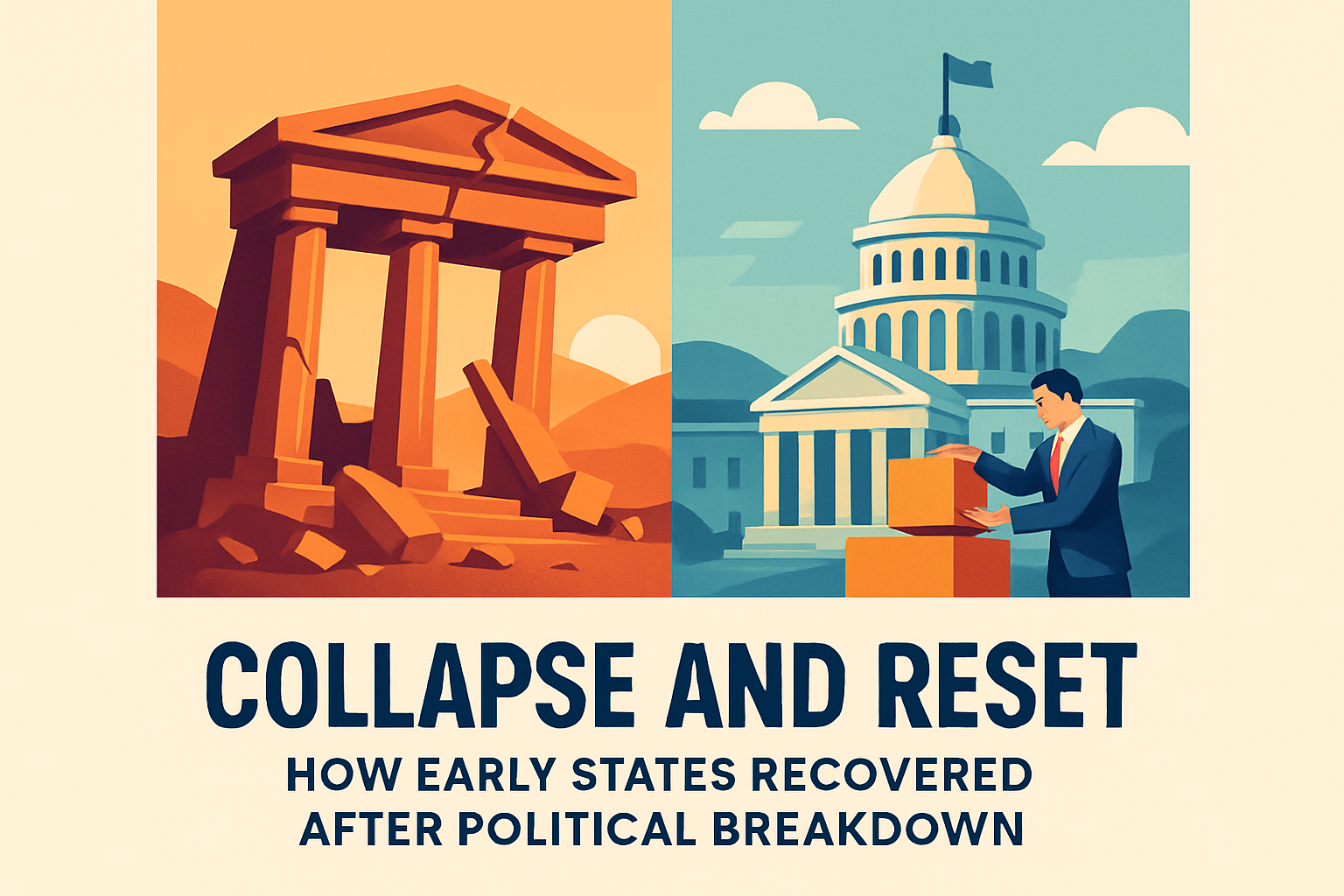
Political collapse is not a new phenomenon. Throughout history, early states have faced and endured the challenges of political breakdown. Understanding these instances of collapse and eventual recovery provides invaluable insights into the resilience of early civilizations and offers lessons that remain pertinent today. Political collapse can be defined as the breakdown of governmental structures and social order, often leading to economic decline and social unrest. For early states, the collapse of political systems meant the disintegration of centralized control, anarchy, or even eventual foreign rule. These occurrences were catastrophic yet not insurmountable, as many of these societies found ways to reset and rebuild. In today’s interconnected global landscape, learning from these historical narratives helps us comprehend how societal resilience, adaptation, and leadership can forge a pathway to recovery.
The Cycle of Collapse and Recovery in Early States
A cyclical pattern of rise, fall, and recovery has characterized many early states. The Maya civilization, for instance, experienced a noticeable collapse around the 9th century AD. It was characterized by the abandonment of cities and the cessation of monumental inscriptions and architecture. The fall of the Classic Maya civilization has been attributed to several factors: prolonged drought, overpopulation, warfare, and internal strife. Despite these setbacks, the Maya demonstrated remarkable resilience. Post-collapse, new cultural leaders emerged, and smaller, more localized societal structures were formed, eventually paving the way for recovery and adaptation to new environmental and social conditions.
- Fall: Abandonment of major urban centers
- Challenges: Drought, overpopulation, warfare
- Recovery: Emergence of new societal leaders and structures
This cycle illustrates how collapses are often multifaceted processes, driven by an interplay of environmental, economic, and social factors. Yet, recovery becomes possible through adaptation, leadership, and innovation, which allows societies to restructure and thrive anew.
Leadership and Governance during Recovery
One key aspect of recovery from political breakdown is the establishment of effective leadership and governance. The example of Egypt illustrates the significance of strategic leadership during recovery periods. Following the First Intermediate Period (circa 2181-2055 BC), which saw political fragmentation and decline, Egypt entered a phase known as the Middle Kingdom. This era marked a renaissance in Egyptian society, characterized by the reunification of lower and upper Egypt under rulers like Mentuhotep II. Strong leadership focused on rebuilding state structures, improving agriculture, and fostering creative arts and literature.
The Middle Kingdom reignited the economy and stabilized society through centralized control and infrastructural development. The reinstitution of these fundamental aspects of governance underscored the pivotal role leadership plays in the reconstitution of political stability and prosperity after a collapse.
Innovation and Adaptation: A Catalyst for Recovery
In many cases, political collapse incentivized innovation and adaptation, propelling societies forward over time. The collapse of the Western Roman Empire in the late 5th century led to a period commonly known as the Dark Ages. However, this era was far from static. It catalyzed significant technological and social innovations, as localized economies developed and new social structures formed.
In parts of Western Europe, technological advances in agriculture, such as the heavy plow and the three-field system, increased productivity and laid the groundwork for economic recovery and population growth. This era saw the rise of monasticism and the eventual establishment of feudal systems, effectively reorganizing societal structures to adapt to a post-Roman world.
Social Structures and Cultural Continuity
Despite the disruption caused by political breakdowns, cultural continuity and societal structures often persisted, forming the base for eventual recovery. In the case of the Indus Valley Civilization, which saw a decline around 1900 BC, subsequent societies in the region retained significant elements of urban planning and cultural practices. Cities like Harappa and Mohenjo-Daro had well-planned streets and standardized measures, indicative of a strong tradition of urban planning.
The endurance of cultural practices and social organization facilitated the resurgence of new forms of governance and trade that continued to honor and adapt existing cultural norms. This cultural continuity helped create a sense of identity and stability, which was essential for recovery.
| Element | Example/Role in Recovery |
|---|---|
| Urban Planning | Indus Valley retained planning techniques, aiding in recovery |
| Technological Innovation | Agricultural advancements post-Roman Empire |
| Leadership | Mentuhotep II’s reunification of Egypt |
| Adaptation | Rise of localized economies post-Roman Empire |
Lessons Learned and Modern Implications
Understanding the factors that led to early state recoveries after political collapse provides learning opportunities for contemporary societies. Take the cultural resilience and societal innovations initiated in post-collapse settings; they accentuate the importance of flexibility and adaptation. In a world facing environmental, economic, and social challenges, these historical narratives reveal the capabilities of human societies to find pathways forward through determined leadership and the willingness to innovate.
Furthermore, reviewing these historical collapses and recoveries highlights the importance of sustainable practices and governance structures that accommodate both environmental realities and social needs. As present-day societies grapple with modern challenges, including climate change, economic inequality, and political instability, the lessons of the past offer blueprints for fostering resilience and initiating meaningful resets.
Conclusion: Embrace Resilience and Innovation
The recoveries of early states after political breakdown demonstrate the process of embracing resilience and harnessing innovation to overcome adversity. From the adaptive strategies of the Maya to the leadership-driven recovery of ancient Egypt, history reveals how societies can realign and build anew even after significant disruptions. As we confront current global challenges, these lessons underscore the transformative potential inherent in periods of turmoil. Understanding the historical cycle of collapse and recovery not only deepens our appreciation of human capability but also encourages us to embrace this same resilience in the face of contemporary political turbulence. Thus, learning from our past allows us to better prepare for our future. Let us take these insights to heart and actively work towards more robust, adaptable, and sustainable societal frameworks.
In conclusion, the narrative of collapse and recovery in early states calls us to participate actively in shaping our world—encouraging innovation, championing effective leadership, and fostering cultural continuity. By acknowledging and applying these historical insights, we can help ensure that today’s political breakdowns become tomorrow’s pathways to rejuvenation and progress.
Frequently Asked Questions
1. What typically leads to the collapse of early states?
Early state collapse can usually be traced back to a combination of internal and external factors. Internally, issues such as ineffective governance, corruption, or social inequality can weaken state structures, making it difficult to maintain order and support the economy. Public dissatisfaction due to high taxes, poor leadership, or resource mismanagement can fuel unrest. Externally, threats such as invasions, natural disasters, or trade disruptions can exacerbate these issues, stressing the society beyond its capacity to deal with such pressures. These factors work synergistically, leading to the disintegration of political control and organization.
2. How did early states typically recover after a political collapse?
The recovery process for early states following a collapse often involved a combination of restoration, adaptation, and innovation. Initially, strong leaders would emerge to restore order and re-establish centralized control, often through a mix of military strength and political reform. Economically, states might adapt by diversifying their resources or by reconnecting with trade networks to stimulate recovery. Socially, fostering unity through shared cultural or religious beliefs was a common strategy to reduce divisions and encourage collaboration among the population. Importantly, adjustments in governance structures—such as decentralization or inclusion of previously marginalized groups—also helped in stabilizing and fostering recovery.
3. What role did geography play in the collapse and recovery of early states?
Geography played a significant role both in the downfall and revival of early states. States situated in fertile areas often faced competition and invasions from neighboring regions, which could lead to conflict and potential collapse. Harsh environmental changes such as droughts or floods could undermine agricultural productivity, crucial for those economies, accelerating political decline. In terms of recovery, geographical advantages like access to trade routes or natural resources were pivotal. Regions with diverse ecosystems could exploit alternative resources or agricultural products, fostering economic revival faster. Furthermore, isolation by mountains or deserts could protect recovering states from external invasion, allowing them the peace needed to restore strength and order.
4. Can you give examples of early states that successfully recovered from collapse, and how they did it?
Several notable examples illustrate successful recovery from political collapse. For instance, the Egyptians, after the collapse of the Old Kingdom, managed to recover during the Middle Kingdom by re-establishing centralized power and implementing agrarian reforms that ensured food security. Another example is the Chinese states, notably during the Warring States period, where the development of bureaucratic governance and technological advancements in irrigation and metalwork allowed regions like Qin to consolidate power, leading to the formation of the first unified Chinese empire. Similarly, the Roman Empire, after a significant downturn, saw rejuvenation during the Dominate era, partly due to Diocletian’s administrative reforms and reorganization of military structures, which re-stabilized and strengthened the state apparatus.
5. What lessons can modern states learn from the recovery processes of early states after a collapse?
Modern states can draw several valuable lessons from the recovery processes of early civilizations. A key takeaway is the importance of adaptable governance; states that successfully bounce back often leverage flexible political frameworks capable of evolving with social needs and external pressures. Another lesson is the role of strong institutions in ensuring stability and continuity, as these offer platforms for coherent policy enactment even amidst crises. Furthermore, social unity and inclusive policies that engage all community layers help mitigate conflict and promote collective recovery efforts. Importantly, fostering innovation, particularly in technology and trade, can create economic opportunities that stimulate growth. Lastly, sustainable resource management is crucial, underscoring the delicate balance between economic exploitation and environmental stewardship, which is just as relevant today as it was for early civilizations.