
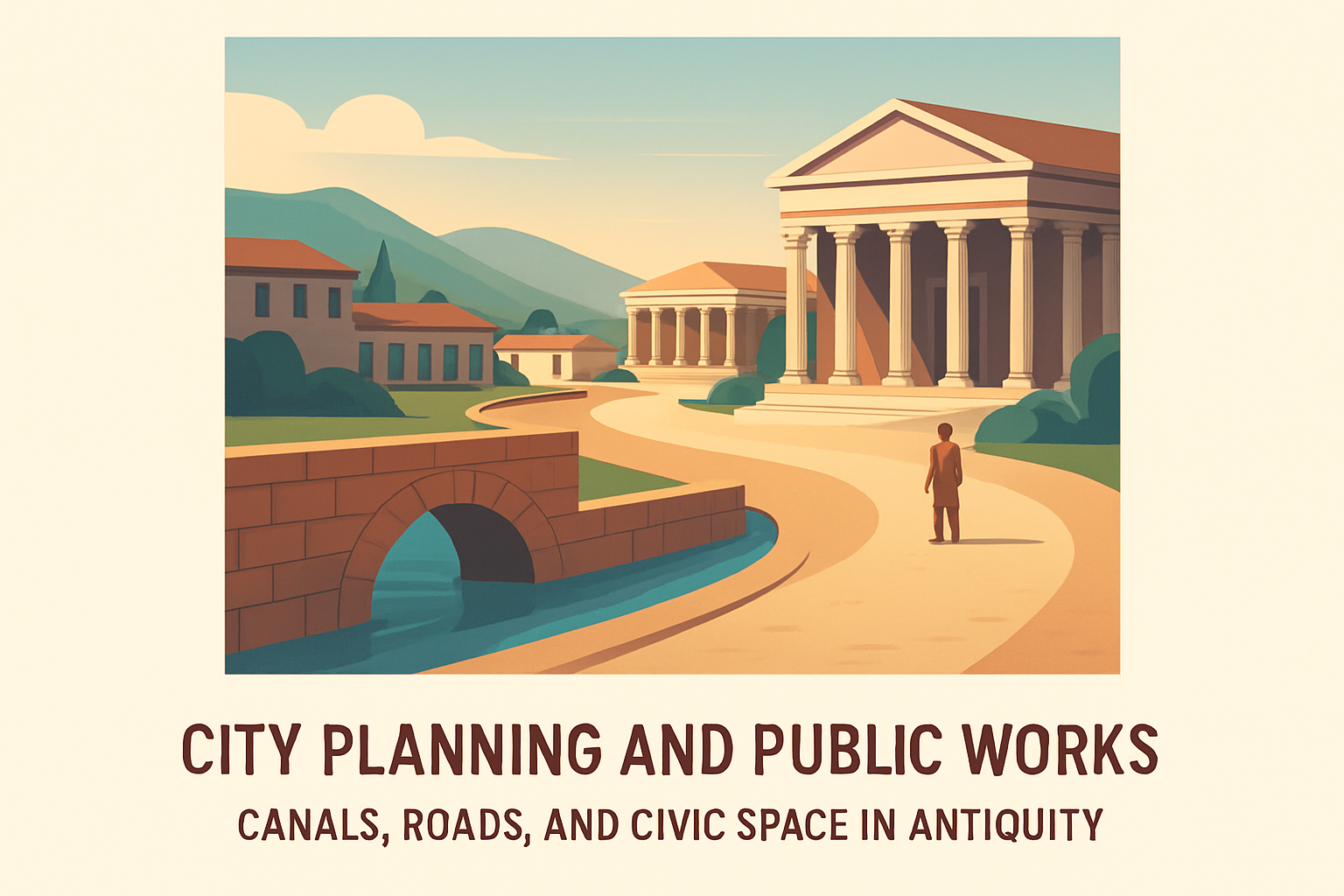
Human civilization has always been fascinated by the development of urban areas, fostering a legacy of ingenuity in city planning and public infrastructure that echoes through time. City planning and public works in antiquity offer a profound glimpse into the strategic and artistic minds of ancient engineers and architects who overcame staggering challenges to develop complex urban solutions. This historical overview delves into the creation and impact of canals, roads, and civic spaces in ancient cultures and offers insight into how these elements shaped societal growth. Understanding the evolution of these crucial infrastructures not only highlights our ancestors’ resourcefulness but also underscores the longstanding importance of effective city planning in enhancing the quality of life, fostering trade and communication, and promoting societal stability.
The Marvel of Ancient Canals
Canals were a vital part of ancient city planning, serving as lifelines that brought water to large populations, facilitated trade, and enabled efficient irrigation strategies. The Indus Valley Civilization, flourishing from 3300 to 1300 BCE, pioneered extraordinary advancements in canal systems that integrated comprehensive urban plans with meticulous attention to hydraulic engineering. These systems managed water distribution for agriculture in a manner that sustained large populations over extended periods, showcasing a sophisticated understanding of environmental management.
Moreover, the Canal of the Pharaohs in Egypt, connecting the Nile River to the Red Sea, stands as an outstanding example of ancient canal technology. Initiated by Pharaoh Necho II around 600 BCE, this project illustrated the strategic importance of maritime trade routes. Although the canal was eventually restored by Darius I of Persia, its continuous renovations illustrate the complexities and the value placed on maintaining these critical passageways that linked cultures and economies, significantly influencing trade in the region.
The Evolution of Roads in Ancient Societies
Roads are the arteries of civilization, providing pathways that connect cities, cultures, and countries. In antiquity, roads represented the tangible manifestation of an empire’s reach, facilitating communication, military expeditions, and economic exchange. The Roman road network, known for its durability and engineering excellence, remains one of the most impressive achievements in ancient urban planning.
Constructed during the height of the Roman Empire, roads such as the famous Via Appia Antica revealed Rome’s commitment to connectivity and expansion. Roman roads were meticulously designed with layers of stone and gravel to ensure durability and water drainage, underscoring the sophisticated engineering practices of the time. This network spanned over 400,000 kilometers, significantly contributing to the empire’s administrative efficiency and cultural cohesion. Their legacy continues to influence modern engineering principles and the development of national infrastructure.
In the context of the Inca Empire, the Qhapaq Ñan, or the Great Inca Road, is another fascinating example of road engineering. This intricate system traversed the challenging Andes Mountains, demonstrating exceptional adaptability to demanding terrains. The routes facilitated efficient administration and military movements across the empire, serving as a testament to the strategic foresight of the ancient planners.
Civic Space Design: Centers of Social and Political Life
Civic spaces have long served as the heart of public life, offering sites for political discourse, cultural exchange, and social gatherings. The design and structure of these spaces not only reflected the political and cultural values of their time but also played a central role in the daily lives of ancient populations.
One of the most iconic civic spaces is the Agora in ancient Athens, which served as a focal point of commercial, political, and social activity. The open-air market and meeting place were essential to the democratic processes of Athens, hosting assemblies and courts. This demonstrates how civic spaces were not just physical entities but also central to the philosophies and ideologies guiding a civilization.
Similarly, the Roman Forum exemplified the multipurpose nature of civic spaces, serving simultaneously as a marketplace, a venue for public speeches and ceremonies, and a hub of religious and legal activities. The architectural layout of the Forum mirrored Roman societal structures, fostering economic, political, and social interactions essential to the functioning of the city-state. The continued excavation and restoration of such sites offer contemporary planners and historians valuable lessons in designing multifunctional public spaces.
Interconnected Infrastructure: A Legacy of Adaptation and Innovation
Ancient city planning illustrates an enduring legacy of adaptation and innovation. While modern engineers have benefitted from advanced technology and materials, many principles stem from the lessons learned by their ancient ancestors. The remarkable ability to conceptualize and implement extensive public works projects using limited resources and rudimentary tools is a testament to human ingenuity.
| Infrastructure Element | Example | Function | Impact on Society |
|---|---|---|---|
| Canals | Canal of the Pharaohs | Transport and Irrigation | Boosted trade and agriculture |
| Roads | Via Appia Antica | Connectivity and Defense | Strengthened control and communication |
| Civic Spaces | Athenian Agora | Political and Social Activities | Promoted democracy and civic life |
Conclusion and Future Reflections in City Planning
The history of city planning and public works in antiquity is, indeed, an intricate tapestry of human creativity, perseverance, and grandeur. By analyzing these achievements, modern society gains valuable insights into sustainable development, resource management, and community-oriented design concepts that are as relevant today as they were thousands of years ago.
As we reflect on the significance of these ancient infrastructures, it becomes apparent that the legacy they have left is not just one of stones and structures but of ideas and innovations that continue to influence our approach to urban development. The ability to strategize, accommodate growing populations, and seamlessly adapt to changing environments and technological capabilities is a testament to the ingenuity of our predecessors.
With today’s challenges in global urbanization, environmental sustainability, and climate change, the call to modern city planners and engineers is to embrace the principles of foresight, resilience, and integration demonstrated by ancient societies. By investing in robust and sustainable infrastructure, ensuring efficient resource distribution, and promoting vibrant civic engagement spaces, we mirror the strategic mentality that shaped ancient constructions and lay a foundation for long-term prosperity.
As we move forward, let us carry forward the torch of innovation, learning from the past to create cities that meet the needs of the future generations. From scheduling a visit to archaeological sites to participating in workshops on sustainable development, there are numerous ways to delve deeper into the fascinating intersection of ancient engineering and modern urban planning.
Frequently Asked Questions
What roles did canals play in ancient city planning and public works?
Canals were absolutely essential in ancient city planning. They were the lifeblood of many ancient cities, delivering much-needed water for agriculture, drinking, and sanitation. Beyond their utility for irrigation, canals also served as transportation routes, facilitating trade and communication between regions. Ancient civilizations, like the Mesopotamians and the Egyptians, leveraged their engineering prowess to construct canal networks that could regulate water supply in regions where irregular flood patterns could devastate crops and communities. These hydraulic systems allowed insights into water management that were astounding for their time, enabling expansive urban growth and the flourishing of civilization in regions that might have otherwise been barren.
How did roads influence city planning and connectivity in the ancient world?
In ancient times, roads were the arteries of empire and culture, connecting vast territories and fostering economic exchange, cultural diffusion, and military expeditions. The Roman road network, for instance, is legendary for its sophistication and durability. Carefully engineered roads facilitated quick troop movements, efficient communication across the Roman Empire, and eased commerce, thereby significantly enhancing economic stability and expansion. In other civilizations, such as the Incan Empire, roads traversed challenging geographical terrains such as mountains and valleys, linking urban centers to one another and to strategic outposts. The construction of these roads required monumental effort and expertise, with road surfaces often optimized for longevity and evenness. Through these infrastructural marvels, ancient planners achieved a degree of connectivity that enabled prosperity and facilitated control over large swathes of territory.
What was the significance of civic spaces in ancient cities?
Civic spaces, such as forums, agoras, and public baths, were fundamental to the social, political, and cultural life of ancient urban centers. These gathering spaces were not merely functional areas for trade but also served as central hubs of civic life, where citizens could engage in dialogue, participate in democratic processes, and partake in communal activities. In ancient Rome, for example, forums were the epicenters of public life where political discourse, legal proceedings, and commercial transactions occurred. Similarly, in Greek cities, the agora was both a marketplace and a space for public assembly, reflecting the civic-minded spirit of the Greeks. Civic spaces were designed to accommodate large numbers of people, with attention to aesthetics and functionality, embodying the civic values and architectural achievements of ancient societies.
What challenges did ancient engineers face when constructing these public works?
Building public infrastructures like canals, roads, and civic spaces in ancient times was fraught with challenges that required incredible ingenuity and perseverance. Engineers had to contend with natural obstacles, such as dense forests, arid deserts, mountains, and unyielding bodies of water. Additionally, limited technology meant that many of these projects relied heavily on manual labor and simple machines, coupled with a deep understanding of materials and landscape. For instance, constructing a canal system involved precise calculations to ensure a consistent water flow without overflow or stagnation. Building roads required a solid grasp of geometry and materials, often necessitating pavement techniques that would withstand the wear and tear of heavy use over time. The coordination of labor, materials, and architectural knowledge was indispensable, showcasing the strategic minds and collaborative spirit of these ancient societies.
In what ways did ancient public works reflect the culture and values of their societies?
Public works in antiquity were more than just functional constructions; they were deeply reflective of the cultural identity, technological skill, and organizational capabilities of the societies that built them. Structures like roads and canals were an expression of an empire’s power and its commitment to connectivity and control. The grandeur and scale of civic spaces revealed a society’s prioritization of community life and public engagement. The architectural styles and decorations commonly found in these spaces often celebrated the achievements of the state’s deities or rulers, offering insight into the prevailing social narratives and spiritual beliefs. For example, the intricate frescos and sculptures in public baths and forums of Rome depicted victories and mythological stories, deeply engrained within the public psyche. These public works were thus not only practical but also highly symbolic, leaving behind a legacy of cultural pride and architectural brilliance that continues to captivate historians and architects today.