
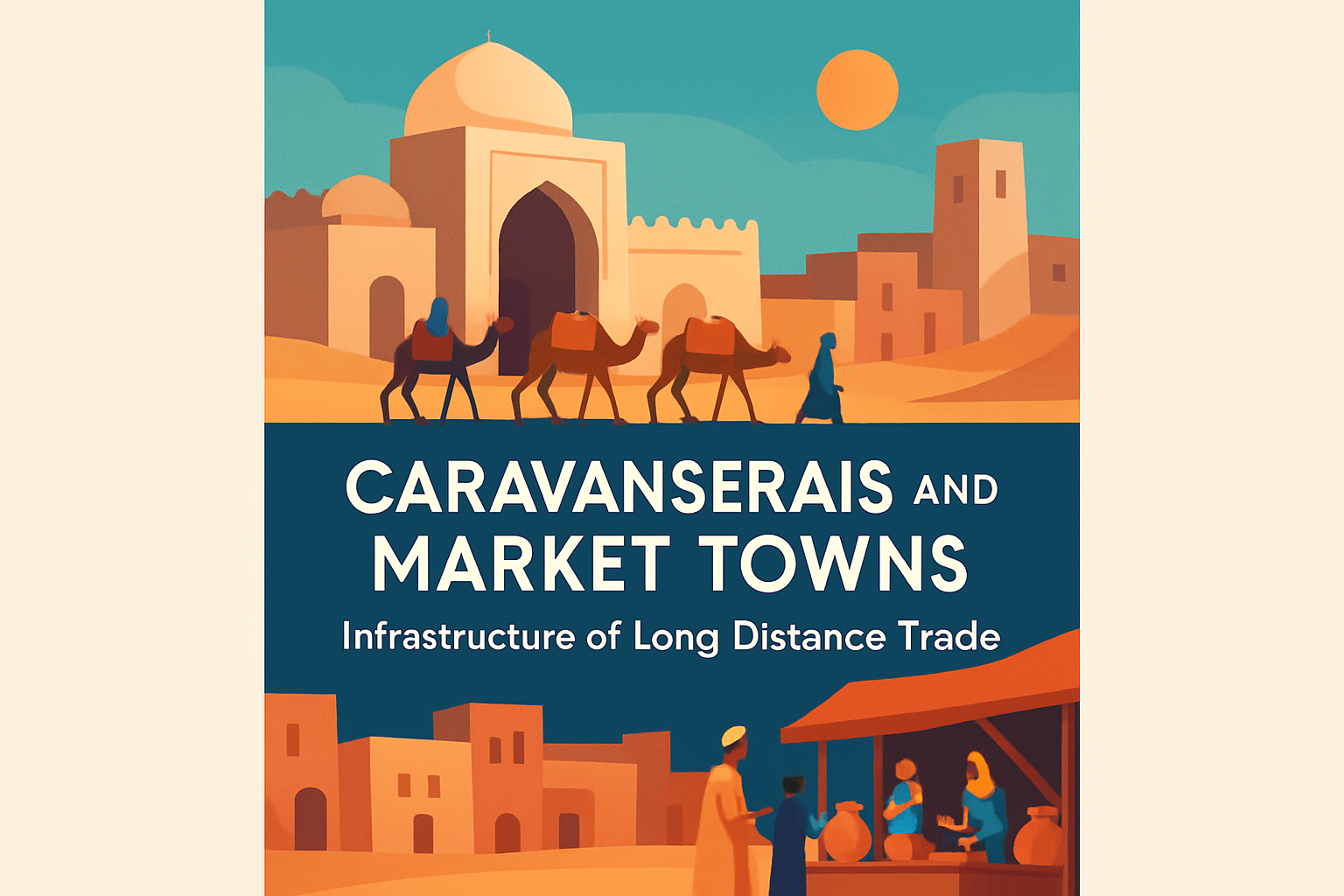
Caravanserais and market towns formed the operating system of premodern long-distance trade, linking deserts, steppes, mountain passes, and river valleys into commercial corridors that moved goods, people, credit, and information across continents. A caravanserai was a fortified roadside inn built to house merchants, animals, guards, and cargo, usually around a central courtyard with storerooms, stables, wells, workshops, and sleeping chambers. A market town was a settlement whose economic life centered on periodic exchange, warehousing, taxation, brokerage, and redistribution. Together they created the dependable infrastructure that made overland commerce possible from Anatolia and Iran to Central Asia, India, North Africa, and beyond. When historians explain why silk, spices, horses, metalware, paper, dyes, and ideas traveled so far before railroads or steamships, they usually return to these institutions because trade at scale required more than roads. It required protected stopping points, transparent rules, trusted intermediaries, and predictable places where supply met demand.
I have worked through travel accounts, archaeological site plans, and urban tax records from the Islamic world and Eurasia, and one pattern appears constantly: merchants rarely feared distance as much as uncertainty. A two-hundred-kilometer stretch without water, secure lodging, money changers, or legal witnesses could break a trading venture faster than high transport costs alone. Caravanserais reduced that uncertainty by standardizing rest, security, and service intervals, often a day’s journey apart. Market towns did the complementary work. They concentrated buyers, labor, repair specialists, animal feed, customs officials, and information about prices further down the route. In modern terms, caravanserais lowered transaction risk between nodes, while market towns increased market depth at nodes. That distinction matters because trade networks are not just lines on a map; they are systems sustained by institutions that convert movement into exchange.
The importance of this subject goes beyond economic history. Caravanserais and market towns reveal how states projected power, how religious endowments financed public goods, how merchants managed trust across languages, and how urban life expanded along trade routes. They also show that infrastructure is never only physical. A stone inn without guards, contracts, credit, and dispute resolution was far less useful than a modest compound embedded in a reliable legal and fiscal environment. For anyone studying the Silk Roads, the Indian Ocean hinterland, Ottoman commerce, Safavid Iran, Mughal India, or trans-Saharan exchange, understanding these institutions is essential because they explain how long-distance trade became routine rather than exceptional.
What caravanserais actually did for merchants and caravans
The basic answer is straightforward: caravanserais provided secure accommodation and logistical support for merchants, pack animals, and goods moving over long distances. In practice, they did much more. A typical caravanserai enclosed a single large courtyard behind thick outer walls with one defended entrance. Rooms opened onto arcades for travelers, while stables and storage areas occupied the ground level or rear ranges. Better-equipped examples included cisterns, baths, prayer space, fodder depots, kitchens, and blacksmithing or veterinary services nearby. Seljuk caravanserais in Anatolia, such as Sultan Han on the Konya-Aksaray route, were monumental examples, combining fortress-like security with carefully organized service areas. Their architecture embodied a commercial promise: arrive here, and your people, animals, and wares can recover safely for the next stage.
For merchants, the value was measurable. Animals needed water, feed, and rest at regular intervals, especially camels carrying textiles, ceramics, sugar, metal ingots, or paper over arid terrain. Guards needed controlled entrances and watch positions. Account keepers needed dry rooms, writing materials, witnesses, and a place to sort consignments. Caravan leaders needed to regroup after storms, raids, or route changes. I have seen route reconstructions where the placement of caravanserais aligns closely with ecological constraints: access to springs, manageable daily marching distances, and defensible approaches. This is why they were often spaced roughly thirty to forty kilometers apart, though terrain could compress or stretch that rhythm. Their position was logistical, not random.
Caravanserais also reduced information asymmetry. Travelers exchanged news about banditry, river levels, tax demands, animal disease, and prices in the next market center. That flow of intelligence was as valuable as shelter. If silk prices had dipped in Tabriz but risen in Aleppo, or if a mountain pass had become impassable, merchants could alter destinations, combine caravans, or hold stock. In that sense, the caravanserai functioned as an information market and risk-management hub. It gave traders the ability to make decisions with fresher knowledge than isolated travel would allow. Long-distance commerce depends on exactly that advantage.
How market towns converted movement into profitable exchange
If caravanserais kept caravans moving, market towns made movement economically worthwhile. A market town was not simply a place where people bought and sold goods. It was a settlement designed, formally or informally, to aggregate regional production and connect it to wider circuits. Grain from surrounding villages, wool from pastoral zones, copper from mining districts, indigo from cultivation belts, and imported luxuries from distant routes could all be priced, taxed, stored, repackaged, and resold there. Towns such as Bukhara, Kashgar, Tabriz, Isfahan, Multan, and Aleppo served as exchange points where local and transregional commerce overlapped. Their merchants did not merely pass goods onward; they financed trade, provided brokerage, translated contracts, and assessed quality.
The best market towns offered layered services. Warehouses protected bulk commodities from weather loss. Money changers handled multiple coinages, a constant necessity in regions where dinars, dirhams, copper fulus, Venetian ducats, Mughal rupees, and local issues might circulate together. Notaries and judges validated agreements and resolved disputes. Artisans repaired saddles, wagon parts, leather containers, and metal fittings. Weighing houses standardized measures, which mattered because profit could disappear quickly when units varied by district. In my reading of Ottoman and Safavid trade documentation, the persistence of commercial life in certain towns correlates strongly with these support functions. Merchants returned where transactions were legible and enforceable.
Market towns were also social filters. They translated frontier movement into urban order. Nomads, peasants, foreign merchants, imperial tax agents, and religious endowment managers all met there under relatively stable expectations. Weekly markets and annual fairs intensified that role by synchronizing supply and demand. A horse dealer from the steppe could arrive when textile brokers and grain merchants were present, while tax collectors and caravan organizers timed their activities around the same cycle. This periodic concentration lowered search costs and increased liquidity. Premodern towns did not use the language of logistics optimization, but they practiced it constantly through calendars, market rights, and routinized exchange.
States, endowments, and the financing of trade infrastructure
Caravanserais and market towns survived because someone paid for construction, maintenance, policing, and administration. In many regions, rulers sponsored caravanserais directly to encourage commerce, secure strategic roads, and advertise dynastic legitimacy. The Seljuks built extensively in Anatolia during the thirteenth century, positioning caravanserais along major inland routes to strengthen both revenue collection and territorial integration. The Safavids invested in road stations and urban commercial buildings to reinforce Iran’s role in silk exports and regional transit. Mughal authorities supported sarais and market centers across North India, where imperial roads and relay networks improved mobility for merchants, soldiers, and officials alike.
Religious endowments were equally important. Across the Islamic world, waqf institutions financed inns, fountains, bridges, mosques, and bazaars through income-bearing property dedicated to public or charitable purposes. This mattered because trade infrastructure required continuous upkeep. Wells silted up, roofs failed, walls cracked, and guards expected wages. Endowment structures created revenue streams that could outlast individual rulers. They also embedded commercial facilities in moral and legal frameworks familiar to merchants. A caravanserai supported by a recognized waqf could inspire more confidence than an improvised private stop because obligations were formally defined and overseen.
| Infrastructure element | Primary function | Who typically funded it | Direct trade benefit |
|---|---|---|---|
| Caravanserai | Lodging, security, animal care, storage | Rulers, waqf endowments, wealthy patrons | Reduced travel risk and delay |
| Bazaar or covered market | Retail, wholesale, brokerage, craft sales | Urban authorities, endowments, merchant investors | Higher market depth and easier price discovery |
| Bridge or road segment | Route continuity and safer crossings | State treasuries, local patrons, endowments | Lower transport costs and seasonal disruption |
| Warehouse or khan | Bulk storage and consignment handling | Merchants, urban elites, rulers | Protected inventory and smoother redistribution |
Taxation was the tradeoff. Merchants expected to pay customs, transit dues, stall fees, and levies on sales or storage, but they tolerated these when authorities delivered predictable security and adjudication. Excessive or arbitrary taxation pushed traffic onto alternate routes. This pattern appears repeatedly in Eurasian history. Trade did not simply follow geography; it followed incentive structures. Where states kept roads passable, punished predation, and regularized dues, caravan traffic thickened. Where officials multiplied tolls without improving conditions, commerce fragmented. Infrastructure therefore included governance quality as much as masonry.
Regional examples from the Silk Roads to the Indian subcontinent
Across the Silk Roads, caravanserais varied by climate, political setting, and trade composition, but their logic stayed remarkably consistent. In Anatolia, Seljuk sultans constructed large stone hans that looked almost military, with vaulted halls for winter use and courtyards for warmer seasons. These served merchants moving textiles, slaves, metal goods, and spices between Iran, Syria, the Black Sea, and Mediterranean ports. In Iran, Safavid caravanserais often linked Isfahan with provincial and frontier zones, supporting the state’s strong interest in silk circulation. Shah Abbas I is closely associated with extensive road and commercial building programs, and while older claims about exact numbers should be treated carefully, the broader pattern of state-backed infrastructure is not in doubt.
Central Asia provides another clear example. Cities such as Samarkand and Bukhara prospered not because caravans magically crossed deserts, but because urban institutions anchored routes running through oasis ecologies. Caravanserais on approach roads handled the final staging of goods, while city bazaars sorted imports and exports into wholesale circuits. Merchants dealing in horses, cotton textiles, manuscripts, dyes, and precious goods relied on these nodes to convert transit into contracts. The same urban centers also fostered scholarship and religious life, a reminder that commerce and culture were intertwined rather than separate historical stories.
In the Indian subcontinent, sarais along major imperial roads were indispensable to the movement of merchants, pilgrims, messengers, and administrators. Sher Shah Suri’s sixteenth-century road reforms, often associated with the route later called the Grand Trunk Road, illustrate the principle well. Roadside sarais, wells, and planted shade trees improved regularity of movement across long distances. Under the Mughals, commercial towns such as Lahore, Agra, Delhi, and Multan connected inland production zones with Central Asian, Persian, and maritime networks. A merchant carrying indigo or cotton piece goods did not depend on one giant market. He depended on a chain of intermediate towns where goods could be sampled, taxed, financed, and redirected according to demand.
Even in North Africa and trans-Saharan systems, where conditions differed sharply, the infrastructure logic remained familiar. Oasis settlements and market towns such as Sijilmasa acted as gateways between Mediterranean and West African trade, handling gold, salt, textiles, and enslaved people. Water points, fortifications, and storage capacity determined survival and profit. The geography changed; the institutional requirements did not.
Trust, credit, and information in premodern trade networks
Long-distance trade was never sustained by buildings alone. It depended on trust mechanisms that caravanserais and market towns made easier to operate. Merchants used family firms, ethnic and religious diasporas, partnerships, letters of introduction, and credit instruments to move value without carrying all wealth as coin. In Islamic commercial practice, contract forms such as qirad or mudaraba supported investment partnerships in which one party supplied capital and another conducted trade. Similar risk-sharing arrangements appeared in other legal traditions. What mattered was enforceability. Market towns supplied judges, witnesses, and reputational visibility, while caravanserais concentrated merchants who could verify identities and recent dealings.
Credit was especially important because bulky coin transport increased loss risk and tied up capital. A trader might sell goods in one town, settle part of a debt through a broker, take advances against expected arrivals, and only later convert profits into portable valuables. Money changers and sarrafs were indispensable here. They evaluated coin quality, handled exchange between monetary zones, and sometimes extended short-term finance. In practical terms, this made a market town an early financial service center. Without it, caravans would have been slower, more vulnerable, and less flexible.
Information worked the same way. Price knowledge, demand forecasts, and political intelligence circulated through merchant communities with surprising speed. Caravanserais acted as relay points for that information, while market towns stored it in durable form through account books and broker networks. I have often found that when a route declined, the first visible symptom was not architectural decay but thinning information density. Fewer reliable merchants meant weaker intelligence, and weaker intelligence raised risk for everyone else. Infrastructure, in other words, was partly cognitive. It lived in the expectations and records that made strangers willing to trade.
Decline, adaptation, and the legacy for modern logistics
Caravanserais and market towns did not disappear because they were primitive. They declined or changed function when transport technology, political geography, and trade priorities shifted. Maritime expansion redirected many high-value flows toward seaborne routes, which moved bulky goods more cheaply when ports and naval protection improved. Later, railways and steamships compressed distance further and reduced the need for tightly spaced overland lodging networks. Some caravanserais were abandoned; others became urban warehouses, workshops, barracks, or heritage monuments. Market towns adapted unevenly. Those able to connect to railheads, ports, or modern highways survived as regional distribution centers. Others lost traffic and stagnated.
Their legacy remains highly relevant. Modern logistics still depends on the same core principles: secure nodes, reliable intervals, standardized services, price transparency, and trusted intermediaries. Today’s truck stops, bonded warehouses, dry ports, freight forwarders, and wholesale mandis perform functions that would be recognizable to a medieval caravan merchant. The scale and technology differ, but the institutional logic is continuous. When policymakers discuss economic corridors now, they are still solving the old problem of how to make long-distance exchange predictable enough for private actors to invest. Caravanserais and market towns were among the earliest successful answers.
The central lesson is clear. Long-distance trade flourishes when infrastructure supports both movement and exchange. Caravanserais protected caravans between destinations; market towns organized the commercial life within destinations. States, endowments, and merchant communities all had roles in maintaining that system, and where they coordinated effectively, trade networks deepened for centuries. These places were not peripheral conveniences. They were the backbone of Eurasian commerce, shaping urban growth, state finance, and cultural contact across vast distances. If you want to understand how premodern trade actually worked, start with the caravanserai courtyard and the market town bazaar. They reveal the mechanics behind the map, and they show why infrastructure has always been the hidden architecture of prosperity.
Frequently Asked Questions
What was a caravanserai, and why was it so important to long-distance trade?
A caravanserai was far more than a place to sleep for the night. It was a purpose-built roadside institution designed to support overland trade across difficult environments such as deserts, mountain passes, steppes, and arid plains. Typically enclosed by sturdy walls and organized around a large central courtyard, a caravanserai could accommodate merchants, pack animals, guards, pilgrims, messengers, and valuable cargo in one protected space. Many included storerooms, wells or cisterns, stables, workshops, kitchens, prayer areas, and private chambers, making them highly practical hubs for people moving goods over great distances.
Its importance lay in reducing the risks and costs of travel. Long-distance trade was dangerous, slow, and logistically complex. Merchants needed secure places to rest, feed animals, repair equipment, replenish water, and safeguard merchandise such as textiles, spices, metals, ceramics, manuscripts, and luxury goods. Caravanserais provided that infrastructure at regular intervals along major routes, helping caravans plan journeys with greater confidence. In effect, they made trade routes usable on a sustained basis rather than only seasonally or under exceptional circumstances.
Just as important, caravanserais served as points of exchange for information, credit, and trust. Travelers shared news about road conditions, political unrest, taxation, banditry, prices, and demand in distant markets. Deals were initiated, partnerships formed, and reputations built in these spaces. That made the caravanserai a key part of the wider commercial system: not simply a building, but a mechanism that connected merchants to networks of security, communication, and commerce across regions and even continents.
How did market towns support caravan routes and regional commerce?
Market towns were the settlement-based counterparts to caravanserais. If caravanserais kept merchants moving, market towns gave trade routes their economic anchor points. A market town was a community whose daily rhythm and prosperity were shaped by exchange. Farmers, herders, artisans, transporters, money changers, warehouse keepers, brokers, and visiting merchants all interacted there, turning the town into a node where local production met long-distance circulation.
These towns provided essential services that caravans could not supply on the road. Merchants could buy fodder, food, rope, leather tack, tools, replacement pack animals, and wagon parts. They could hire guides, interpreters, guards, scribes, and porters. Artisans repaired saddles, harnesses, wheels, metal fittings, weapons, and containers. Officials might inspect goods, assess taxes, issue permits, or enforce market rules. In larger towns, merchants could also access lodging houses, baths, mosques, temples, churches, courts, and financial services. This made market towns indispensable staging grounds where caravans reorganized before crossing difficult terrain or entering a new political jurisdiction.
Market towns also linked long-distance trade to surrounding rural economies. Agricultural hinterlands supplied grain, livestock, wool, oil, fruit, timber, and other bulk goods, while local workshops produced textiles, pottery, metalware, and craft items for wider distribution. Imported goods arriving through the town then filtered outward to nearby villages and estates. In that sense, market towns were not isolated trading spots; they were regional distribution centers that translated transcontinental commerce into everyday economic life.
What kinds of goods, people, and information moved through caravanserais and market towns?
The traffic through caravanserais and market towns was remarkably diverse. Goods ranged from everyday necessities to rare luxuries. Bulk commodities could include grain, salt, timber, wool, leather, and horses, while higher-value goods often included silk, cotton textiles, spices, incense, precious metals, gems, dyes, glassware, paper, ceramics, and medicinal substances. Some items traveled enormous distances because their value justified the expense and risk of transport. Others moved in shorter regional circuits, connecting local production zones to broader commercial networks.
The people moving through these places were equally varied. Merchants are the most obvious group, but they were only part of the story. Caravans might include caravan leaders, drovers, animal handlers, guards, translators, accountants, brokers, pilgrims, diplomats, scholars, craftsmen, and laborers. Religious travelers, military personnel, and migrants often used the same infrastructure. Because these routes were shared by many kinds of travelers, caravanserais and market towns became socially mixed environments where languages, customs, and business practices met and interacted.
Information was arguably as valuable as cargo. News about safe passes, flooded rivers, disease outbreaks, military campaigns, currency quality, tax changes, and shifts in consumer demand could determine whether a trading venture succeeded or failed. Prices in one market affected decisions in another, and merchants depended on timely intelligence to manage risk. In many cases, the circulation of information through these nodes helped integrate far-flung regions into a more connected commercial world. That is one reason historians often see caravanserais and market towns as communication infrastructure as much as trade infrastructure.
How did caravanserais and market towns improve safety, trust, and financial exchange?
One of their greatest contributions was creating predictable environments in an otherwise uncertain world. Overland trade exposed merchants to theft, fraud, animal loss, weather shocks, border tolls, and political instability. A fortified caravanserai offered physical protection through walls, gates, and supervised entry, while a market town provided institutional protection through officials, courts, guilds, community norms, and established commercial routines. These features did not eliminate risk, but they made it more manageable.
Trust was especially important in premodern commerce because merchants often dealt with strangers, traveled far from home, and handled goods whose value depended on quality, weight, purity, or authenticity. Repeated interaction in known stopping places helped build reputations. Brokers and money changers who operated regularly in market towns became trusted intermediaries. Witnessed transactions, written contracts, sealed storage, and locally recognized measures and weights all helped reduce disputes. The more reliable a town or caravanserai was, the more attractive it became to merchants, which in turn increased traffic and commercial vitality.
Financial exchange also flourished in these settings. Merchants did not always travel with large amounts of coin; they often relied on credit arrangements, partnerships, delayed payment, currency exchange, and instruments that allowed value to be transferred more safely across distance. Market towns, in particular, could support lenders, investors, and accountants who enabled larger and more complex ventures. Caravanserais served as meeting points where these arrangements could be negotiated and confirmed. Together, these institutions lowered transaction costs and made long-distance trade more scalable, regular, and resilient.
Why do historians describe caravanserais and market towns as the infrastructure of premodern trade?
Historians use the term “infrastructure” because these institutions performed the same foundational role that roads, ports, warehouses, finance systems, and communication networks perform in later economies. Premodern long-distance trade did not depend on merchants alone. It required dependable places where movement could pause, resources could be replenished, goods could be protected, and exchanges could be organized. Caravanserais and market towns supplied exactly that support structure, allowing trade to function across vast and environmentally challenging territories.
They also created continuity across fragmented political and ecological landscapes. A merchant might cross multiple languages, currencies, legal systems, and climates on a single journey. What made such travel feasible was the presence of recurring, recognizable nodes where travelers could find shelter, supplies, labor, market access, and information. Those nodes stitched separate regions into commercial corridors. In practical terms, they linked deserts to oases, mountain passes to valleys, steppe routes to urban markets, and river transport to inland overland exchange.
Most importantly, caravanserais and market towns supported more than commerce in a narrow sense. They enabled the movement of ideas, technologies, artistic forms, religious practices, and social connections alongside goods. They shaped urban growth, regional specialization, state revenue, and diplomatic contact. That broader impact is why they are best understood not as isolated buildings or towns, but as parts of an operating system for long-distance exchange—one that made sustained interregional and intercontinental trade possible long before modern transportation networks emerged.