
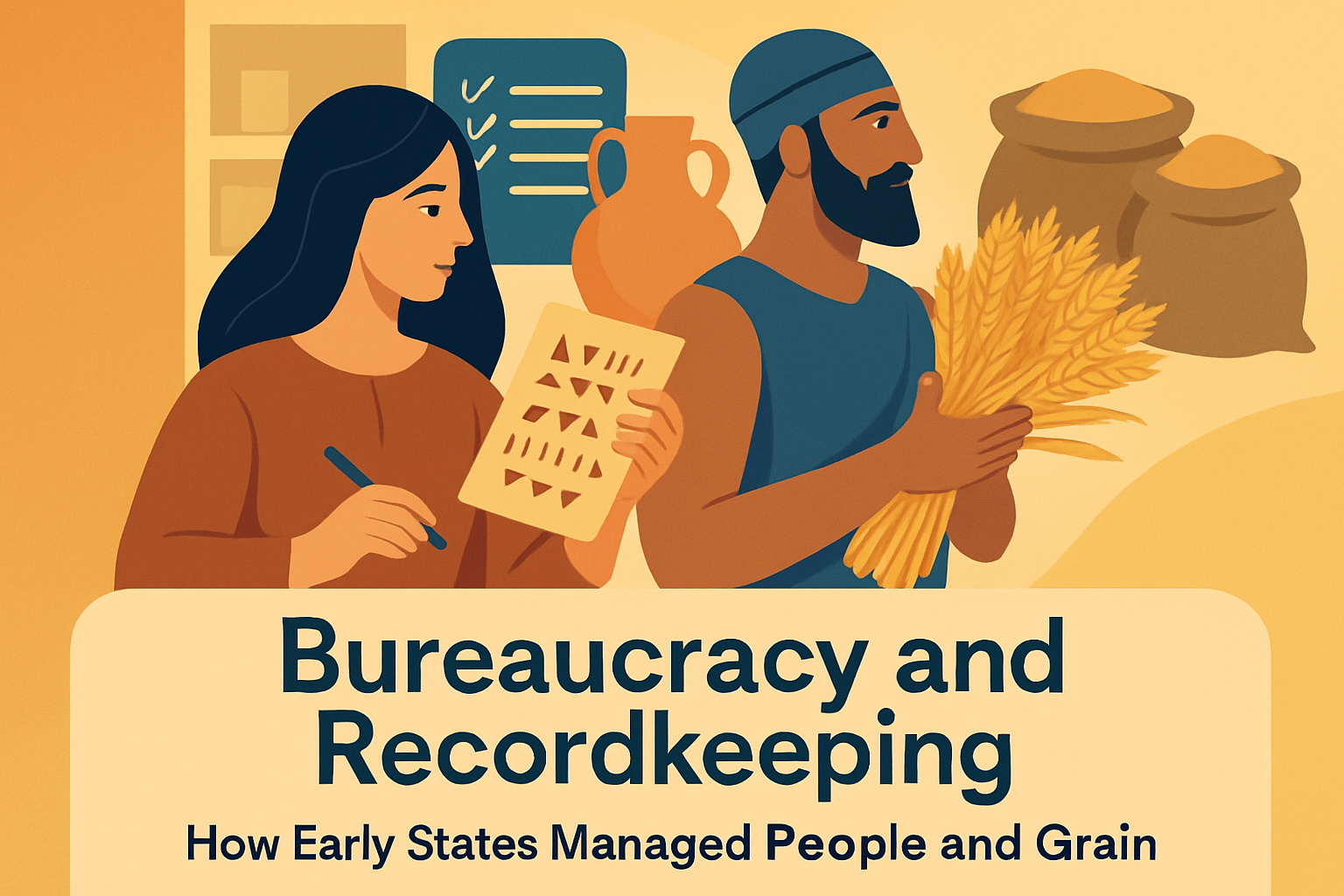
Bureaucracy and recordkeeping have been fundamental to the development and maintenance of early states and civilizations throughout history. They are intricate systems of administration and documentation that were utilized by these early societies to manage people, resources, and, most crucially, food supplies such as grain. Understanding these mechanisms is key to comprehending how these once-nascent states organized their societies, ensured stability, and prospered over time. Bureaucracy refers to a structured hierarchy of appointed officials with defined roles and responsibilities, designed to implement rules, regulations, and objectives efficiently. Recordkeeping, on the other hand, refers to the systematic documentation and maintenance of records, detailing various transactions, assets, and administrative proceedings. Together, these two elements formed the backbone of early governmental systems, particularly in the agricultural and administrative realms. As people transitioned from nomadic to settled lifestyles, driven by advances in agriculture, they faced new challenges in managing surplus grain and ensuring equitable distribution among their populations. The success of these early states depended heavily on their ability to administer resources and maintain order amidst growing complexity. This intersection of bureaucracy and recordkeeping, therefore, remains a topic of immense significance to historians and archeologists interested in the evolution of human civilization. By unraveling the intricacies of ancient administrative systems, we can better appreciate how early state societies laid the foundations for modern governance.
The Role of Bureaucracy in Early States
Bureaucracy was instrumental in the development of early states, managing everything from political decisions to daily administrative tasks. One prominent example is the ancient Egyptian civilization, which had a highly structured bureaucratic system. The Pharaoh, at the apex of the hierarchy, delegated power to various officials who oversaw different geographical regions and sectors like agriculture and construction. Below them were scribes, a crucial tier of bureaucrats, responsible for documenting transactions and orders. This bureaucracy ensured the smooth functioning of society, enabled massive projects like pyramid constructions, and maintained control over vast stretches of land and people. Without such an administrative framework, managing extensive agricultural activities and the harvests they yielded would have been chaotic and inefficient. The levels of bureaucracy helped streamline communication and implement the decisions of central authority throughout the country. This level of organization and specialization within the bureaucratic ranks was vital for managing resources efficiently and defending against external threats. By examining how these ancient bureaucracies operated, we gain insight into the systems that remain the basis of governmental operations today.
Recordkeeping: The Backbone of Resource Management
The practice of recordkeeping in early states was integral to resource management, particularly regarding grain, which was the staple food and primary resource. In the ancient Mesopotamian civilization, the development of cuneiform script was largely driven by the need to keep detailed records. These records included documents such as inventories, harvest yields, and redistribution details, meticulously inscribed on clay tablets. Through such records, officials could track distribution patterns, identify shortfalls or surpluses, and make informed decisions about rationing and trade. Early forms of bookkeeping provided the state with a written history that could be referenced and analyzed, facilitating the long-term planning of agricultural activities. Not only did this safeguard against famine and shortages, but it also maximized productivity and thus the wealth of the civilization. This facilitated a robust trade network and allowed states to engage in diplomacy using agricultural surplus as leverage. Recordkeeping was not only an administrative necessity but also a means of economic management and precursor to modern accounting practices.
Managing Grain: The Challenges and Solutions
The management of grain in early states was fraught with challenges such as storage, distribution, and allocation in the face of varying annual yields. In the Indus Valley Civilization, sophisticated granaries were constructed to store grain efficiently. These granaries were strategically placed in major urban centers and designed to protect the grain from pests and environmental damage. The allocation of grain was carefully planned; it was distributed based on productivity and special needs, like preparing for inevitable drought periods. This organization required a complex understanding of seasonal cycles and anticipated population needs, which was only possible through detailed recordkeeping. To address the challenge of distribution, early states often developed transportation networks to ferry grain from storage locations to areas of consumption. This was exemplified by the Roman Empire’s use of an extensive network of roads and shipping routes to transport grain from its provinces to urban centers such as Rome. The logistical demands of feeding large populations necessitated innovative solutions and underscored the indispensability of a well-maintained bureaucratic system.
Coordination Under Central Authority
A centralized authority system was essential for coordinating the complex tasks of taxation, grain storage, and resource distribution. The Inca Empire serves as an illustrative example, where a high level of centralization was achieved through a network of officials known as the Ayllu. These officials were responsible for collecting taxes in the form of labor and agricultural produce, which were then redistributed by the state. The Inca used quipus, a unique recording device consisting of colored threads and knots to keep accounts of resources through an intricate system without the need for written language. This allowed them to manage an extensive amount of data across different provinces. The ability of the central authority to exercise control and coordination over vast expanses and diverse populations was pivotal for the Inca’s infrastructure projects and redistribution of resources. This centralized governance structure ensured that resources like grain could be efficiently allocated according to necessity and strategic priorities. It illustrates how efficient leadership, supported by an effective bureaucratic and recordkeeping system, enabled states to thrive even against natural adversities.
- Facilitated the management of large territories
- Ensured equitable distribution of resources
- Supported expansive state projects like infrastructure development
- Enabled states to respond effectively to external threats
Legacy and Influence on Modern Systems
The legacy of early state systems of bureaucracy and recordkeeping continues to influence modern government structures and administrative practices. Today’s systems of governance often reflect ancient principles of centralized recordkeeping and structured bureaucracies, where a hierarchy of officials oversees various aspects of public and economic life. In democratic countries, for example, bureaucracy ensures that governmental decisions are implemented according to law and policy and that resources, including financial, are allocated and monitored efficiently. The advances in technology, such as computerized systems for data management, can trace their origins back to these early methodologies. The ancient practices of recordkeeping still echo in today’s extensive use of databases and archival systems. Modern states also grapple with resource management, though on a vastly larger scale. They continue to prioritize maintaining order, ensuring sustainability, and maximizing efficiency. Learning from history’s lessons, modern administrators can better appreciate the value of effective communication, careful planning, and records’ meticulous maintenance as cornerstones of successful statecraft.
Conclusion
In conclusion, the intricate relationship between bureaucracy, recordkeeping, and the management of people and grain in early states was no small feat. The successful administration of state affairs, driven by these elements, was pivotal for burgeoning civilizations as they navigated the complexities of governance and resource management. These systems ensured stability, facilitated trade, and enabled ambitious state projects, all the while laying the essential groundwork from which our modern institutions have evolved. As readers and scholars reflect upon the profound impact of these ancient practices, they are provided with a valuable perspective on how deeply rooted mechanisms of governance continue to shape society today. Recognizing this connection can aid contemporary policymakers and administrators as they craft solutions to modern-day challenges. By drawing inspiration from the past, we are better equipped to make informed decisions that foster growth and sustainability in our own societies. To connect further with the rich history of civilization, delve into specialized literature on ancient state management or consider visiting museums with exhibits featuring ancient recordkeeping artifacts. These routes can illuminate the enduring legacy of bureaucracy and recordkeeping on the evolution of human governance and society at large.
Frequently Asked Questions
1. What role did bureaucracy play in early states in managing people and resources?
Bureaucracy played a crucial role as the backbone of administration in early states, acting as an organized system that ensured the smooth functioning of their societies. It was an institutional mechanism that allowed for systematic control over the population and efficient allocation of resources. Bureaucracies established categories and procedures to govern different aspects of life and resource management, particularly focusing on taxation, law enforcement, and social services. By implementing hierarchical structures, early states were able to delegate authority and responsibilities, which facilitated localized governance under the overarching control of a central power. This, in turn, allowed states to maintain order and stability among large populations, manage land ownership, labor services, and conscription, and keep detailed economic records to track agricultural yields and manpower availability. Bureaucracies were not merely administrative bodies; they acted as channels through which early states communicated their authority and interests, forging connections between rulers and the ruled.
2. How did recordkeeping contribute to the governance of early civilizations with regard to grain management?
Recordkeeping was indispensable in early states for numerous reasons, especially concerning the management of grain, a critical resource. Storing and distributing grain effectively required meticulous documentation to ensure food security, prevent shortages, and maintain fair distribution among the populace. Written records, often inscribed on clay tablets or stone, encapsulated data on grain production, storage locations, expected yields, and lists of beneficiaries. This not only helped in planning agricultural activities but also optimized distribution practices by providing clarity on surplus or deficits and enabled states to regulate and stabilize their economies.
Moreover, literate scribes played an essential role as custodians of information; their expertise allowed them to categorize, analyze, and transmit vital data to administrative authorities, ensuring that decisions were well-informed. Such records also served as legal documents that established precedents and safeguarded the rights of subjects, thus fostering a sense of security and trust in the governance system.
3. In what ways did early states ensure the efficiency of their bureaucratic systems?
Early states developed several methods to ensure their bureaucracies were efficient and effective, addressing the complexities of managing extensive territories and diverse populations. First, they established hierarchical structures that delineated power from top leaders down to local administrators, which streamlined command and control processes. By having clearly defined roles and responsibilities, states prevented overlap and ambiguity in duties, ensuring accountability among officials.
Selection processes for bureaucrats often involved identifying individuals with particular skills or loyalties. Non-hereditary appointments in some cases allowed for merit-based advancement, ensuring a talented pool of administrators. Furthermore, frequent audits and assessments of bureaucratic functions helped in detecting inefficiencies or corrupt practices. By combining traditional systems with innovative administrative strategies, early states could maintain social harmony and economic prosperity through tightly controlled and disciplined bureaucracies.
4. What challenges did early states face in maintaining effective recordkeeping systems?
Despite the advantages they provided, early states faced numerous challenges in maintaining effective recordkeeping systems. Firstly, the physical durability and preservation of records were significant concerns. Materials like clay tablets or papyrus were susceptible to damage from the environment, requiring conditions that ensured their longevity. This made archiving a critical and resource-intensive task.
Another challenge was the need to train skilled scribes who were fluent in the writing systems of their cultures. As literacy was not widespread, the pool of individuals capable of producing accurate and comprehensive records was small and therefore valuable and sometimes scarce.
Additionally, the complexity and volume of information that needed to be maintained could occasionally overwhelm the administrative capacities of early states, leading to erratic record updates or loss of crucial data, which could impact resource allocation and decision-making. To combat these issues, many states innovated by developing more efficient recordkeeping methods and training programs to equip scribes with the necessary skills to meet the demands of their roles.
5. How have archaeological findings contributed to our understanding of bureaucracy and recordkeeping in early states?
Archaeological findings have been instrumental in shedding light on the bureaucracy and recordkeeping of early states. Excavations of ancient sites have unearthed countless artifacts, including tablets, inscriptions, and documents that offer direct insight into how these societies organized and managed their resources and populations. For instance, the discovery of administrative archives, such as the clay tablets found in the ancient city of Ebla, provide detailed accounts of trade, taxation, and agricultural production, revealing the sophistication and breadth of bureaucratic networks.
Such findings have allowed historians to reconstruct the economic, social, and political contexts of early states, offering a deeper understanding of the dynamics that governed their functionality. By analyzing the content, language, and format of these records, researchers can infer the priorities, challenges, and innovations of ancient societies, thereby enriching our knowledge of how foundational concepts of bureaucracy and recordkeeping shaped the course of civilization.