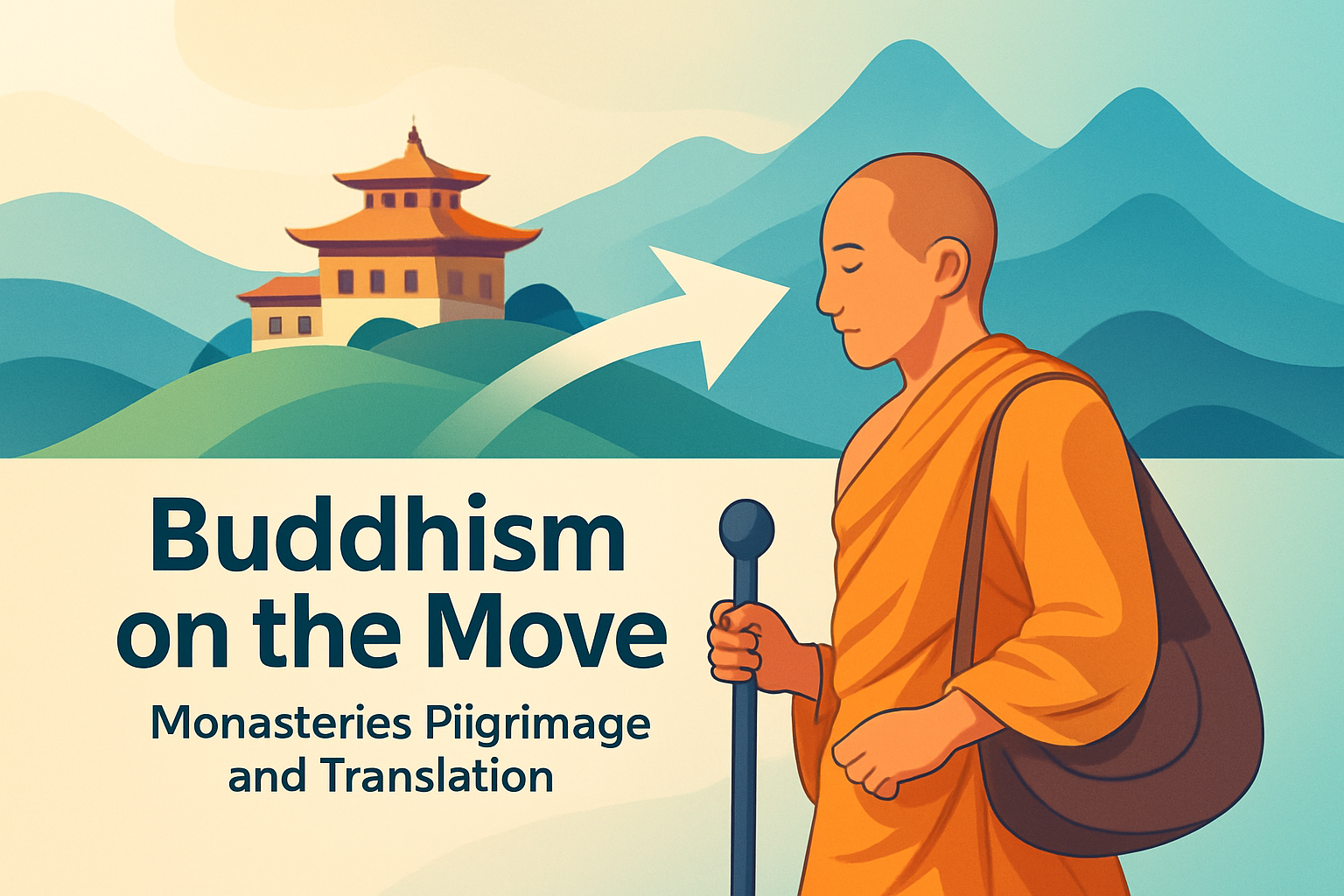
Buddhism spread across Asia not by accident but through movement: monks walking trade roads, pilgrims crossing deserts and seas, and translators turning oral teachings into durable texts. “Buddhism on the Move: Monasteries Pilgrimage and Translation” captures the three engines that carried the tradition from northeastern India into Sri Lanka, Central Asia, China, Korea, Japan, Tibet, and Southeast Asia. In my work with religious history sources and monastery archives, I have seen the same pattern repeatedly: institutions anchored communities, pilgrimage connected sacred geographies, and translation made doctrine portable. Without those three forces working together, Buddhism would likely have remained a regional śramaṇa movement rather than one of the world’s major religions.
To understand this history clearly, three key terms need definition. A monastery is not simply a secluded temple. In Buddhist contexts, monasteries were organized residential institutions where monks or nuns studied vinaya rules, memorized scriptures, performed rituals, copied manuscripts, and taught lay supporters. Pilgrimage refers to intentional travel to sites associated with the Buddha, eminent teachers, relics, mountains, caves, or miraculous images. Translation means more than substituting one word for another; it includes interpretation, commentary, adaptation, and the creation of equivalent religious vocabularies across languages such as Pali, Sanskrit, Gandhari, Chinese, Tibetan, and later Mongolian. These processes mattered because Buddhism depended on memory, patronage, and transmission. Mobility gave it all three.
The topic matters today for both historical and practical reasons. Historically, Buddhism offers one of the clearest examples of how ideas move through networks rather than through conquest alone. Long before modern globalization, monks traveled with caravans along Silk Road routes, merchants endowed shrines near ports, and rulers sponsored translation bureaus to legitimize their reigns. Practically, understanding monasteries, pilgrimage, and translation helps explain why Buddhist traditions differ while still sharing recognizable core teachings such as karma, rebirth, the Four Noble Truths, dependent origination, and the path to liberation. Theravada, Mahayana, and Vajrayana did not emerge in isolation. They took shape through institutions, sacred travel, and multilingual scholarship. If a reader wants the shortest answer to how Buddhism spread, it is this: monasteries preserved practice, pilgrimage built devotion, and translation made the Dharma intelligible in new worlds.
Monasteries as the infrastructure of Buddhist expansion
Monasteries were the fixed points that made Buddhist mobility sustainable. A wandering teacher can inspire, but a monastery can preserve teachings across generations. From early sites in the Gangetic plain to major centers such as Nālandā, Vikramaśīla, Anuradhapura, Dunhuang, and Samye, monasteries functioned as educational hubs, manuscript libraries, ritual centers, guesthouses, and economic institutions. Archaeology confirms their range. Excavated monasteries at Taxila and along Silk Road oasis towns reveal cells, assembly halls, stupas, and storage areas, showing that these were complex establishments designed to support study and travel. When I compare Buddhist monastic systems with other premodern institutions, their durability stands out: they combined disciplined internal rules with flexible relationships to merchants, rulers, and local communities.
The vinaya, or monastic code, was essential to this durability. Different early Buddhist schools preserved different vinaya lineages, but all treated discipline as the framework that made communal life reliable. Rules governed ordination, property, confession, food, robes, teaching authority, and relations with lay donors. That structure encouraged trust. A caravan merchant making a donation in Khotan or a king endowing a monastery in Sri Lanka needed confidence that the institution would endure beyond a single charismatic monk. Monasteries provided exactly that continuity. They also standardized training. Novices learned recitation, ethics, and ritual forms, enabling ideas to travel without dissolving into local improvisation. This is one reason Buddhist communities could remain recognizably linked even as they adapted to radically different regions.
Monasteries also became engines of regional integration. In Sri Lanka, the Mahāvihāra and Abhayagiri monasteries were not marginal religious compounds; they shaped political legitimacy, textual preservation, and artistic patronage. In northern India, Nālandā drew students from across Asia, including Chinese pilgrims who described its rigorous debates and vast libraries. In Tibet, the first monasteries translated Indian scholasticism into an institutional model suited to Himalayan society. In medieval China, state-supported monasteries provided ordination platforms, scripture storage, and administrative recognition, while mountain monasteries developed distinct contemplative traditions. These examples show a consistent pattern: wherever Buddhism took root deeply, monasteries connected local practice to transregional authority. They were the servers of the Buddhist world, storing knowledge and routing people, texts, and rituals through enduring networks.
Pilgrimage as sacred geography and social network
Pilgrimage turned Buddhist memory into a map. The Buddha himself identified four major places worthy of devotion: Lumbini, where he was born; Bodh Gaya, where he awakened; Sarnath, where he first taught; and Kushinagar, where he entered parinirvana. Over time, this sacred geography expanded to include stupas holding relics, miracle sites, footprints, caves, mountains, and monasteries linked to great masters. Pilgrimage mattered because it transformed abstract doctrine into embodied experience. A pilgrim did not merely learn that awakening happened under the Bodhi tree; the pilgrim stood before a living landscape, offered flowers or lamps, heard stories from resident monks, and brought those narratives home. That is how devotion scales across distance.
Famous pilgrims show how movement produced historical records as well as religious merit. Faxian traveled from China to India in the fifth century seeking vinaya texts and documenting Buddhist communities along the way. Xuanzang did the same in the seventh century with extraordinary precision, leaving accounts of monasteries, doctrinal debates, political conditions, and educational centers including Nālandā. Yijing later described monastic practice and maritime routes linking India and Southeast Asia. Their travelogues are indispensable because they reveal Buddhism not as a single block but as a network of regional traditions tied together by pilgrimage and scholarship. In practical terms, these travelers acted like auditors and messengers. They verified lineages, collected manuscripts, compared rituals, and carried back authoritative knowledge that reshaped East Asian Buddhism.
Pilgrimage also generated economic and artistic ecosystems. Roads to major shrines supported inns, markets, donation systems, image production, and relic veneration. At sites such as Sanchi, Amaravati, and later Bodh Gaya, patron inscriptions show gifts from monks, nuns, merchants, guilds, and rulers. The same pattern appeared across Central Asia and China, where cave complexes like Mogao at Dunhuang flourished through sustained patronage tied to devotional travel and frontier exchange. Pilgrimage was therefore not only a private act of piety. It was a mechanism for financing monuments, circulating stories, and creating visual culture that translated doctrine into accessible symbols. Stupas, murals, and processional rituals taught people who could not read and reinforced memory for those who could.
From direct study of pilgrimage records, one lesson is especially clear: pilgrims moved information as effectively as monks. They carried relics, copied inscriptions, commissioned art, reported miracles, and spread reputations of teachers and sites. In modern terms, pilgrimage created recurring high-trust traffic between distant Buddhist communities. That traffic helped align calendars, rituals, and doctrinal priorities. It also exposed differences. Travelers noticed which regions emphasized meditation, scholasticism, relic worship, tantric rites, or monastic discipline. Those comparisons often inspired reform. Pilgrimage, then, was not just movement toward the sacred; it was a feedback loop that continually reshaped Buddhism itself.
Translation as the turning point in Buddhist globalization
Translation was the decisive step that allowed Buddhism to become local without ceasing to be Buddhist. Early communities transmitted teachings orally in Middle Indic dialects before textual traditions developed in languages such as Pali, Sanskrit, and Gandhari. As Buddhism moved beyond India, translators faced a problem every religious movement eventually confronts: how do you carry technical concepts into a language that lacks direct equivalents? Terms like dharma, karma, nirvana, śūnyatā, bodhisattva, and pratītyasamutpāda are densely layered. Translate them too literally and you lose depth; leave them untranslated and the teaching remains foreign. Successful Buddhist translators used a mix of transcription, semantic translation, commentary, and standardization.
Chinese translation history shows this process with exceptional clarity. Early translators such as An Shigao and Lokakṣema worked in the second century, often under difficult conditions, introducing meditation texts and Mahayana scriptures. Kumarajiva, active in the late fourth and early fifth centuries, became famous for elegant and influential renderings that balanced readability with doctrinal precision. Xuanzang later pursued greater philological exactness, sometimes correcting terms that earlier translations had rendered too loosely through Daoist analogies. In Tibet, imperial translation teams developed systematic terminological standards, preserved in works such as the Mahāvyutpatti, a lexicon designed to ensure consistency across the canon. These were not casual literary efforts. They were large-scale intellectual projects involving bilingual masters, editors, scribes, reciters, and patrons.
| Region | Key translation language | Representative figures | Lasting impact |
|---|---|---|---|
| South Asia and Sri Lanka | Pali | Buddhaghosa | Systematized Theravada commentary and preserved a stable canon |
| China | Classical Chinese | An Shigao, Kumarajiva, Xuanzang | Created textual foundations for Chan, Tiantai, Pure Land, and Huayan |
| Tibet | Classical Tibetan | Śāntarakṣita, Vimalamitra, Rinchen Zangpo | Standardized Vajrayana and scholastic translation across the Kangyur and Tengyur |
| Central Asia | Gandhari, Khotanese, Tocharian | Multiple local teams | Linked Indian texts to Silk Road communities and manuscript circulation |
Translation changed doctrine, but not in the simplistic sense of corruption. It changed doctrine by making interpretation explicit. When Chinese Buddhists rendered concepts through terms familiar from Confucian and Daoist discourse, Buddhism gained intelligibility but also invited new philosophical readings. That process helped generate schools such as Tiantai and Huayan, which organized sprawling scriptural corpora into coherent systems. In Tibet, translation and commentary preserved a remarkable amount of late Indian Buddhist philosophy after Buddhism declined in much of India. In Southeast Asia, Pali scholarship and vernacular preaching created a layered environment where canonical language carried authority while local languages carried instruction. The wider lesson is important for any reader asking how religions spread: translation does not merely transmit a tradition; it builds the tradition’s future forms.
How monasteries, pilgrimage, and translation worked together
These three forces were powerful individually, but Buddhism expanded most effectively when they reinforced one another. A pilgrim visited a monastery, received texts or teachings, and returned home with new ritual practices. A translator worked inside or alongside monasteries, using manuscripts brought by travelers. A monastery gained prestige when it sat on a pilgrimage route or housed relics, images, and famous teachers. Consider Dunhuang: it was not only an oasis town but also a manuscript repository, devotional center, and cultural junction where Indian, Iranian, Tibetan, and Chinese influences met. Or consider Xuanzang’s return to Chang’an, where state support, monastic organization, and his pilgrimage-acquired manuscripts combined to create a major translation enterprise. Buddhism moved farthest where these systems overlapped.
This integrated model also explains variation within unity. Sri Lankan monastic preservation of Pali texts differed from Chinese scriptural translation bureaus, and both differed from Tibetan tantric and scholastic institutions. Yet each case shows the same architecture: stable institutions, sacred travel, and linguistic transfer. For modern readers, the takeaway is straightforward. Buddhism became a transregional religion because it mastered continuity without rigidity. Monasteries preserved discipline, pilgrimage energized devotion and exchange, and translation enabled cultural adaptation. If you want to understand why Buddhist traditions remain diverse yet connected, follow the roads, read the travelogues, and study the monasteries where texts were copied and lives were formed. That is where Buddhism on the move becomes Buddhism enduring. The same pattern still informs contemporary Buddhism, from international retreat centers to digital canon projects and revived pilgrimage circuits across Asia today.
Buddhism’s movement across Asia was neither random nor purely spiritual; it was organized through institutions, journeys, and language. Monasteries gave the tradition memory, discipline, education, and economic stability. Pilgrimage transformed sacred history into lived geography and connected distant communities through recurring travel and patronage. Translation converted teachings from local speech into transregional knowledge systems, allowing Buddhists in China, Tibet, Sri Lanka, Japan, and Southeast Asia to inherit the Dharma in forms they could actually use. When historians ask how Buddhism spread so widely without a single central authority, this three-part answer is the most accurate one.
The main benefit of understanding monasteries, pilgrimage, and translation together is that it replaces vague stories of diffusion with a concrete model of religious transmission. You can see how a monastery trained teachers, how a pilgrim carried stories and manuscripts, and how a translation team turned those materials into durable scripture. That model remains useful beyond Buddhist studies because it explains how ideas survive contact with new cultures. If you want to go deeper, read primary travel accounts such as Faxian and Xuanzang, study sites like Nālandā and Dunhuang, and compare Pali, Chinese, and Tibetan textual traditions. Follow those paths, and Buddhism on the move becomes a history you can truly understand.
Frequently Asked Questions
How did Buddhism spread so widely across Asia?
Buddhism spread across Asia through a combination of human movement, institutional support, and careful preservation of teachings. It did not expand as a single wave or through one centralized mission. Instead, monks, merchants, pilgrims, rulers, and translators all played important roles. From its origins in northeastern India, Buddhism moved outward along overland trade corridors and maritime routes that connected South Asia with Sri Lanka, Central Asia, Southeast Asia, and eventually East Asia. Monks traveled with caravans, lodged in urban centers and oasis towns, and established monasteries in places where trade and political power created stable conditions for religious life.
Monasteries were especially important because they turned movement into continuity. A traveling monk could carry teachings, but a monastery could preserve them, teach them, copy manuscripts, train new generations, and create ties with local communities. As Buddhism entered new cultural regions, it adapted to local languages, artistic styles, and social structures without losing its core concern with suffering, ethics, meditation, and liberation. Royal patronage also mattered. Kings and regional elites often supported monasteries because they saw Buddhism as a source of moral prestige, political legitimacy, and cultural sophistication.
Translation was another decisive factor. Buddhist teachings were first transmitted orally and then written down in various Indic languages, but they could only take root in new regions when scholars translated them into local literary languages such as Chinese and Tibetan. These translations were not simple word-for-word conversions. They were major intellectual projects that required interpretation, comparison, and debate. That is why Buddhism’s spread is best understood not as accidental diffusion, but as a sustained process driven by monasteries, pilgrimage networks, and translation communities working across centuries.
Why were monasteries so central to the movement of Buddhism?
Monasteries were the backbone of Buddhist expansion because they served as religious centers, educational institutions, manuscript libraries, ritual sites, and rest stops for travelers all at once. In practical terms, a monastery gave Buddhism a permanent base in a new region. It allowed monks and nuns to live according to the discipline, teach lay followers, receive donations, and organize communal life. In cultural terms, monasteries became places where local populations encountered Buddhism not merely as an abstract philosophy, but as a lived tradition expressed through sermons, festivals, art, architecture, and ethical practice.
They also formed networks. A monastery in one region was rarely isolated. It might be linked through ordination lineages, shared texts, pilgrimage circuits, and patronage ties to institutions hundreds or even thousands of miles away. This made monasteries powerful engines of transmission. A monk trained in one center could travel to another, carrying commentaries, ritual methods, and interpretive traditions. In this way, monasteries helped standardize practice while still allowing local variation. Some became major intellectual capitals, producing influential scholars and preserving texts that might otherwise have disappeared.
Just as importantly, monasteries interacted with the economies around them. Many were located near trade routes, ports, or political capitals, where resources and travelers flowed regularly. Merchants might fund monastic construction, rulers might sponsor translation or temple building, and local communities might support monks through food and land grants. This material support enabled Buddhist institutions to endure over long periods. When we look at how Buddhism moved, monasteries are central because they transformed mobility into memory, scholarship, and stable community life.
What role did pilgrimage play in Buddhist history?
Pilgrimage played a profound role in Buddhist history because it connected devotion, geography, scholarship, and cultural exchange. For many Buddhists, traveling to places associated with the Buddha’s life or to famous monasteries and sacred images was an act of religious merit and personal transformation. Pilgrims journeyed to sites of birth, awakening, first teaching, and death, but pilgrimage also expanded beyond India as Buddhism spread. Sacred mountains, relic shrines, cave temples, and renowned monasteries across Asia became destinations in their own right.
These journeys did more than express piety. Pilgrims served as transmitters of knowledge. Some recorded what they saw in extraordinary detail, leaving behind travel accounts that are now invaluable historical sources. Chinese pilgrims who traveled to India, for example, documented monasteries, rituals, political conditions, routes, and textual traditions. They did not simply observe Buddhism; they collected manuscripts, sought instruction from respected teachers, and returned home with materials that shaped the development of Buddhist schools in East Asia. Their travel narratives also reveal just how interconnected the Buddhist world had become.
Pilgrimage strengthened a sense of belonging to a larger sacred landscape. A monk or layperson in China, Sri Lanka, Tibet, or Japan could understand themselves as participating in a transregional tradition rooted in shared stories and revered places. At the same time, pilgrimage encouraged local reinterpretation. As new sacred destinations emerged outside India, Buddhist communities mapped holiness onto their own terrains. That process helped Buddhism become both international and locally grounded. In short, pilgrimage was not only about reaching holy places; it was one of the main ways Buddhist ideas, texts, rituals, and communities stayed in motion.
Why was translation so important to the survival and growth of Buddhism?
Translation was essential because Buddhism could not have become a major pan-Asian tradition without crossing linguistic boundaries. The teachings originated in the linguistic environment of ancient India, and for a time they circulated orally before being written in languages such as Pali, Sanskrit, and related forms. As Buddhism moved into regions with very different literary cultures, translators faced the challenge of rendering complex ideas about karma, meditation, monastic discipline, emptiness, consciousness, and liberation into languages that did not always have exact equivalents. This made translation a creative and disciplined act of interpretation, not merely a technical exercise.
In places such as China and Tibet, translation projects became large-scale collaborative undertakings. Monks from India, Central Asia, and local communities often worked together, comparing manuscripts, explaining terminology, and refining style and doctrine. Over time, these efforts produced massive scriptural collections and commentarial traditions. Translation allowed Buddhist teachings to be taught, memorized, debated, copied, and institutionalized in entirely new settings. It also helped create new religious vocabularies that shaped philosophy, literature, and political thought far beyond monastery walls.
Translation was equally important for preservation. In some cases, texts lost in India survived because they had been translated elsewhere. Chinese and Tibetan canons preserve works that are no longer extant in their original Indic forms, making translation a key part of Buddhist intellectual history. At the same time, translation inevitably influenced interpretation. Different word choices and conceptual frameworks could guide how communities understood doctrine and practice. That is why translation was not secondary to Buddhism’s movement across Asia; it was one of the main forces that made enduring transmission possible.
How did monasteries, pilgrimage, and translation work together to shape regional Buddhist traditions?
These three forces worked together in ways that explain both Buddhism’s unity and its diversity. Monasteries provided institutional stability, pilgrimage created movement and exchange, and translation made teachings intelligible across cultures. When a pilgrim visited a famous monastery, studied with teachers, and brought manuscripts home, all three processes overlapped. When a ruler sponsored translators at a monastery and invited foreign monks to his court, the same pattern appeared again. Buddhism spread most effectively where these elements reinforced one another over time.
This interaction helps explain the emergence of distinct regional traditions. In Sri Lanka, monastic lineages and textual preservation were crucial to the consolidation of Theravada Buddhism. In Central Asia, oasis monasteries linked trade routes with manuscript culture and artistic patronage. In China, translation centers and pilgrimage reports helped shape a richly varied Buddhist landscape that included meditation traditions, devotional movements, and scholastic schools. In Tibet, imperial sponsorship, translation enterprises, and monastery building created a deeply textual and institutional form of Buddhism. In Korea, Japan, and Southeast Asia, local courts, monks, and sacred geographies adapted inherited teachings to their own historical circumstances.
What ties these regional stories together is the repeated pattern of movement becoming tradition. A teaching had to be carried, housed, interpreted, and practiced. Monasteries gave it a home, pilgrims gave it routes, and translators gave it durable form. That is why the history of Buddhism in Asia is not just the story of ideas traveling outward from India. It is the story of communities actively receiving, reshaping, preserving, and transmitting those ideas through institutions, journeys, and texts.